NFPA 70E Training
Our customized live online or in‑person group training can be delivered to your staff at your location.

- Live Online
- 6 hours Instructor-led
- Group Training Available
Regular Price:
$199
Coupon Price:
$149
President Barack Obama and Energy Secretary Steven Chu announced new energy efficiency standards for lighting, as well as DOE's investment of $346 million in American Recovery and Reinvestment Act funds to develop and deploy energy-efficient technologies in buildings.
The new standards apply to general service fluorescent lamps, used in most offices and commercial buildings, and incandescent reflector lamps, which are used for recessed lighting and track lighting. It will result in a 15% lower electricity use for general service fluorescent lamps, while decreasing the electricity use of incandescent reflector lamps by 25%.
The rule will apply to lamps manufactured for sale in the United States or imported into the United States starting in mid-2012, and in the 30 years following that, they will save consumers up to $4 billion per year, avoid the emission of up to 594 million tons of carbon dioxide, and eliminate the need for as many as 14 500-megawatt power plants.
The new fluorescent lamp standards are extended to include two types of four-foot-long lamps, while the standards for four other types of lamps require an increase of 10%-31.2% in the light output per watt. For incandescent reflector lamps, the new standard is essentially the same as the old one for the smallest 40-watt bulb, but it requires higher efficiencies for brighter bulbs.
For the brightest bulb, at 205 watts, the new standard requires nearly one-third more light per watt than the old standard. It also sets slightly lower requirements for new "modified-spectrum" bulbs, which use a coating to achieve specific effects, such as a better approximation of natural daylight.
Related News

A resilient Germany is weathering the energy crunch
German Energy Price Brakes harness price signals in a market-based policy, cutting gas consumption, preserving…
View more
The German economy used to be the envy of the world. What happened?
Germany's Economic Downturn reflects an energy crisis, deindustrialization risks, export weakness, and manufacturing stress, amid…
View more

Electrifying: New cement makes concrete generate electricity
Cement-Based Conductive Composite transforms concrete into power by energy harvesting via triboelectric nanogenerator action, carbon…
View more
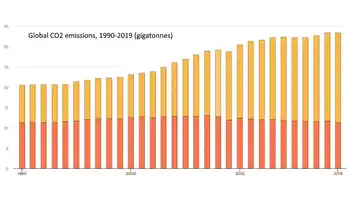
Global CO2 emissions 'flatlined' in 2019, says IEA
2019 Global CO2 Emissions stayed flat, IEA reports, as renewable energy growth, wind and solar…
View more
UK National Grid Commissions 2GW Substation
UK 2-GW Substation strengthens National Grid power transmission in Kent, enabling offshore wind integration, voltage…
View more
Reliability of power winter supply puts Newfoundland 'at mercy of weather': report
Labrador Island Link Reliability faces scrutiny as Nalcor Energy and General Electric address software issues;…
View more
Sign Up for Electricity Forum’s Newsletter
Stay informed with our FREE Newsletter — get the latest news, breakthrough technologies, and expert insights, delivered straight to your inbox.
Electricity Today T&D Magazine Subscribe for FREE

Stay informed with the latest T&D policies and technologies.
- Timely insights from industry experts
- Practical solutions T&D engineers
- Free access to every issue

