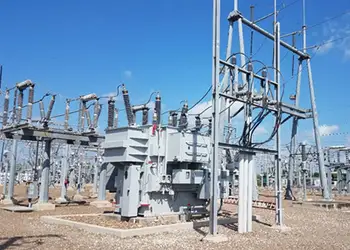
Substation Relay Protection Training
Our customized live online or in‑person group training can be delivered to your staff at your location.
- Live Online
- 12 hours Instructor-led
- Group Training Available
Regular Price:
$699
Coupon Price:
$599
Turning up the heat on publicly traded power companies that are contributing to global warming, the National Environmental Trust recently compiled a list of the industry's top 50 greenhouse gas producers.
Duluth, Minn.-based Allete Inc. came in at No. 50, but a troubling fact was revealed about the parent company of Minnesota Power, said Carin Skoog, a St. Paul representative for the National Environmental Trust. It ranked seventh nationally in terms of the amount of carbon dioxide produced for every megawatt hour of power generated.
Carbon dioxide emissions are not regulated. Nevertheless, Skoog hopes Allete stockholders will push for reduced greenhouse gas emissions.
In 2003, Allete discharged about 9.5 million tons of carbon dioxide, compared with Xcel Energy's 106.9 million tons and American Electric Power's 219.6 million tons.
But Skoog noted that Allete's heavy reliance on coal is revealed by the fact that it produced 1.14 tons of carbon dioxide for every megawatt hour of power it generated in 2003. Xcel ranked 23rd and Wisconsin Energy ranked 32nd in terms of emissions per megawatt hour with 0.96 tons and 0.87 tons, respectively.
Three of the nation's largest power companies - American Electric Power, Cinergy and TXU - recently responded to shareholder concerns by issuing reports on the business implications of global warming.
"All these companies believe, without a shadow of a doubt, that there will be some restraints placed on carbon dioxide emissions in the future," Skoog said. "They don't know exactly when or how it will happen, but they know it will happen."
There's currently no commercially available technology that will remove carbon dioxide from power plant stacks, said Mike Cashin, a Minnesota Power corporate environmental engineer. Reducing carbon dioxide emissions would require a shift away from burning coal, which would likely drive up the cost of power, he said.
Plants that burn natural gas produce less carbon dioxide than coal-burning units, but as a fuel, natural gas currently costs about four to five times more than coal.
"It's important to the economy of northern Minnesota that we keep our electric rates inexpensive," Cashin said.
He also questioned the wisdom of changing course in an attempt to anticipate how the regulatory scene may evolve.
"It doesn't make sense to second guess our national policy on this," Cashin said.
Allete should continue to diversify its power generation portfolio, said Dave Parker, a utility industry analyst for the Robert W. Baird investment firm. But he believes the company is well positioned to deliver inexpensive power to its customers at present.
"Coal seems to be the game today," Parker said.
Many power companies that invested in natural gas facilities versus coal plants a few years ago are today paying the financial price, he said.
But coal's free ride in terms of carbon dioxide emissions won't last, predicted J. Drake Hamilton, science policy director for a private nonprofit called Minnesotans for an Energy Efficient Economy.
"Some companies with 'low-cost' power are not paying the true cost for the carbon dioxide they produce," she said.
Hamilton foresees a day when companies may be forced to trade for carbon dioxide emission credits.
"Investors are seeing the writing on the wall," she said. "What appears to be low-cost power now will be more expensive in the future."
Hamilton believes power companies would be wise to invest more in renewable forms of energy, such as wind power and biomass. Her group has pushed for the passage of the Minnesota Renewable Energy Standard bill now before the state Legislature. It would require generators to produce 20 percent of their power from renewable energy sources by 2020.
Cashin said Minnesota Power continues to explore expanded roles for wind and biomass power, but he doubts such energy sources will significantly supplant coal any time soon.
Related News
California Blackouts reveal lapses in power supply
California Electricity Reliability covers grid resilience amid heat waves, rolling blackouts, renewable energy integration, resource…
View more

Power industry may ask staff to live on site as Coronavirus outbreak worsens
Power plant staff sequestration isolates essential operators on-site at plants and control centers, safeguarding critical…
View more

Nuclear alert investigation won't be long and drawn out, minister says
Pickering Nuclear False Alert Investigation probes Ontario's emergency alert system after a provincewide cellphone, radio,…
View more

Wind power making gains as competitive source of electricity
Canada Wind Energy Costs are plunging as renewable energy auctions, CfD contracts, and efficient turbines…
View more
EU draft shows plan for more fixed-price electricity contracts
EU Electricity Market Reform advances two-way CfDs, PPAs, and fixed-price tariffs to cut volatility, support…
View more
India is now the world’s third-largest electricity producer
India Electricity Production 2017 surged to 1,160 BU, ranking third globally; rising TWh output with…
View more
Sign Up for Electricity Forum’s Newsletter
Stay informed with our FREE Newsletter — get the latest news, breakthrough technologies, and expert insights, delivered straight to your inbox.
Electricity Today T&D Magazine Subscribe for FREE

Stay informed with the latest T&D policies and technologies.
- Timely insights from industry experts
- Practical solutions T&D engineers
- Free access to every issue

