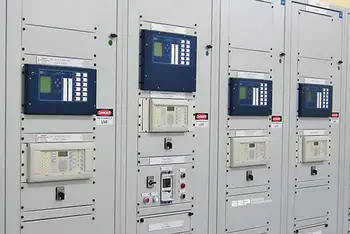
Protective Relay Training - Basic
Our customized live online or in‑person group training can be delivered to your staff at your location.
- Live Online
- 12 hours Instructor-led
- Group Training Available
Regular Price:
$699
Coupon Price:
$599
FirstEnergy plant deactivations reflect EPA MATS compliance, retiring Hatfield's Ferry and Mitchell coal plants, 2,080 MW capacity. PJM review pending; fleet shifts to nuclear, renewables, gas; severance offered; emissions cuts target NOx, SO2, mercury, CO2.
Context and Background
FirstEnergy will retire two PA coal plants to meet EPA MATS, shifting output to cleaner, low-emitting resources.
- Retires Hatfield's Ferry and Mitchell coal stations in PA.
- Removes 2,080 MW; 10% of capacity, 30% of projected MATS costs.
- About 380 roles affected; severance via plan or union agreements.
FirstEnergy Corp. recently announced that it expects to deactivate two coal-fired power plants located in Pennsylvania by October 9, 2013. The decision is based on the cost of compliance with current and future environmental regulations in conjunction with the continued low market price for electricity.
The plants scheduled to be deactivated are Hatfield's Ferry Power Station in Masontown, Pa., and Mitchell Power Station in Courtney, Pennsylvania. The total capacity of these plants is 2,080 megawatts, representing approximately 10 percent of the company's total generating capacity, but about 30 percent of the estimated $925 million cost to comply with the Environmental Protection Agency's Mercury and Air Toxics Standards MATS, and related shifts such as biomass conversions at select units.
In total, about 380 plant employees and generation related positions are expected to be affected. Eligible employees will receive severance benefits through the FirstEnergy plan or as provided by their collective bargaining agreement.
Following the deactivation of the Hatfield's Ferry and Mitchell power stations, FirstEnergy will continue to operate one of the nation's largest, cleanest and most diversified electric generating fleets. The company's fleet after the deactivations will be comprised of 56 percent coal, 22 percent nuclear, 13 percent renewables and 9 percent gas/oil, even as Ohio gas plant competition increases in the region, and will have a generating capacity of more than 18,000 megawatts.
With the deactivation of these two plants, in addition to the nine plants the company announced for deactivation last year, nearly 100 percent of the power generated by FirstEnergy will come from resources that are either non- or low-emitting, including nuclear facilities such as the Davis-Besse plant continuing operations, hydro, pumped-storage hydro, natural gas and scrubbed coal units. The company expects to invest approximately $650 million in MATS-related control technology to enhance or modify existing air quality equipment or install new equipment on its remaining facilities. Following these upgrades, FirstEnergy expects to reduce emissions of nitrogen oxides by 84 percent, sulfur dioxide by 95 percent and mercury by 91 percent below 1990 levels. In addition, the company expects to reduce carbon dioxide emissions 20 to 30 percent below 1990 levels by 2020.
The plant deactivations are subject to review for reliability impacts, if any, by PJM Interconnection, the regional transmission operator that controls the area where they are located, and follow milestones like a recent nuclear license renewal at another FirstEnergy plant.
FirstEnergy is a diversified energy company dedicated to safety, reliability and operational excellence, and to demand-side initiatives like saving power in Ohio where appropriate. Its 10 electric distribution companies form one of the nation's largest investor-owned electric systems, serving customers in Ohio, Pennsylvania, New Jersey, West Virginia, Maryland and New York. Its diverse generating fleet features non-emitting nuclear, scrubbed baseload coal, natural gas, hydro and pumped-storage hydro and other renewables, and currently has a total generating capacity of more than 20,000 megawatts.
Related News
Related News
Doug Ford's New Stance on Wind Power in Ontario
Ontario Wind Power Policy Shift signals renewed investment in renewable energy, wind farms, and grid…
View more
Saudis set to 'boost wind by over 6GW'
Saudi Arabia Wind Power Market set to lead the Middle East, driven by Vision 2030…
View more
Ontario's Clean Electricity Regulations: Paving the Way for a Greener Future
Ontario Clean Electricity Regulations accelerate renewable energy adoption, drive emissions reduction, and modernize the smart…
View more
Hungary's Quiet Alliance with Russia in Europe's Energy Landscape
Hungary's Russian Energy Dependence underscores EU tensions, as TurkStream gas flows, discounted imports, and pipeline…
View more

Potent greenhouse gas declines in the US, confirming success of control efforts
US SF6 Emissions Decline as NOAA analysis and EPA mitigation show progress, with atmospheric measurements…
View more

Let’s make post-COVID Canada a manufacturing hub again
Canada Manufacturing Policy prioritizes affordable energy, trims carbon taxes, aligns with Buy America, and supports…
View more
Sign Up for Electricity Forum’s Newsletter
Stay informed with our FREE Newsletter — get the latest news, breakthrough technologies, and expert insights, delivered straight to your inbox.
Electricity Today T&D Magazine Subscribe for FREE

Stay informed with the latest T&D policies and technologies.
- Timely insights from industry experts
- Practical solutions T&D engineers
- Free access to every issue
