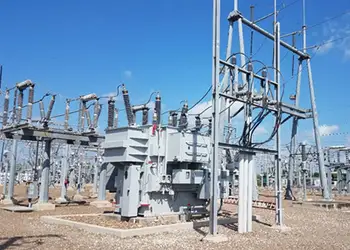
Substation Relay Protection Training
Our customized live online or in‑person group training can be delivered to your staff at your location.
- Live Online
- 12 hours Instructor-led
- Group Training Available
Regular Price:
$699
Coupon Price:
$599
Nazi Germany tested a crude nuclear device in March 1945, killing hundreds of people in a massive explosion south of Berlin, a German researcher claims in a recently published book.
That the Nazis conducted nuclear experiments has been known for decades, but Hitler's Bomb, by Berlin academic Rainer Karlsch, suggests they may have been closer to building an atomic weapon for military use than previously believed.
No independent corroboration of the claims was immediately available.
"German physicians did not lag behind their colleagues in the United States and Britain in their understanding of theory," Karlsch told a news conference. "They knew what a plutonium bomb was and what a uranium-235 bomb was."
What Nazi Germany lacked was enough fissile material — such as enriched uranium — to make a full-size, functioning nuclear bomb, he said.
Other researchers already have theorized that the Nazis conducted crude nuclear experiments, but Karlsch said he has discovered additional evidence, notably in the archives of the former Soviet Union.
The book cites postwar witness accounts and Soviet military intelligence reports to back up its theory of a March 3, 1945, experimental nuclear test blast at the Nazis' Ohrdruf military testing area, but it offers no direct documentary proof.
Karlsch acknowledged he had no positive proof the Nazis conducted a nuclear test blast, but he hoped his book would provoke more research. Soil samples that Karlsch had analysed for his book found the presence of radioactive isotopes, he said.
Witnesses reported a bright flash of light and a column of smoke over the area that day, and residents said they had nausea and nosebleeds for days afterward, Karlsch says.
One witness said he helped burn heaps of corpses inside the military area the next day. They were hairless and some had blisters and "raw, red flesh."
Karlsch concludes that the blast killed several hundred prisoners of war and others forced to work at the site. Two months later, on May 8, 1945, Nazi Germany surrendered after the Soviets captured Berlin.
Ohrdruf, located in the southeastern state of Thuringia, was a Soviet military base after the Second World War.
Related News
Is tidal energy the surge remote coastal communities need?
BC Tidal Energy Micro-Grids harness predictable tidal currents to replace diesel in remote Indigenous coastal…
View more

Germany considers U-turn on nuclear phaseout
Germany Nuclear Power Extension debated as Olaf Scholz weighs energy crisis, gas shortages from Russia,…
View more

Hydro One bends to government demands, caps CEO pay at $1.5M
Hydro One CEO Pay Cap sets executive compensation at $1.5 million under Ontario's provincial directive,…
View more

Washington Australia announces $600 electricity bill bonus for every household
WA $600 Electricity Credit supports households with power bills as a budget stimulus, delivering an…
View more

Energy freedom and solar’s strategy for the South
South Carolina Energy Freedom Act lifts net metering caps, reforms PURPA, and overhauls utility planning…
View more

Tunisia moves ahead with smart electricity grid
Tunisia Smart Grid Project advances with an AFD loan as STEG deploys smart meters in…
View more
Sign Up for Electricity Forum’s Newsletter
Stay informed with our FREE Newsletter — get the latest news, breakthrough technologies, and expert insights, delivered straight to your inbox.
Electricity Today T&D Magazine Subscribe for FREE

Stay informed with the latest T&D policies and technologies.
- Timely insights from industry experts
- Practical solutions T&D engineers
- Free access to every issue

