Electric Motor Control Training - Starters, Circuits, Protection

Electric Motor Control Training is a practical course that teaches electricians, maintenance technicians and engineers how motor control systems are designed, wired, protected and repaired. Participants learn to read ladder diagrams, understand every component between the disconnect and the motor, select starters and overload protection to code, and find control circuit faults quickly and safely.

Our 12-Hour live online instructor-led Motor Control Training course is designed to provide you with a comprehensive understanding of motor control systems, including their operation, maintenance, and troubleshooting. 

Why Electric Motor Control Training Matters

Motor control circuits run pumps, fans, conveyors, compressors and production lines in every plant, building and utility facility. When a starter fails to pull in, an overload trips without explanation or a reversing circuit misbehaves, production stops and the pressure to fix it fast is high. Technicians who cannot read the ladder diagram replace parts by guesswork, and engineers who misapply overload, short-circuit and coordination requirements create nuisance trips, damaged equipment and code violations. Understanding how control circuits are built, and why they are built that way, is the foundation for safe work, correct design and fast troubleshooting.

This Electric Motor Control Training course covers the complete motor control system: pilot and sensing devices, control relays, contactors, magnetic starters and timers; ladder and wiring diagrams; two-wire, three-wire, jogging, reversing, sequence and timing circuits; full-voltage, reduced-voltage and soft starter starting methods; overload relays and electronic motor protection; NEC Article 430 and CEC Section 28 requirements; motor control centers; the move from relay logic to PLCs; and a structured method for troubleshooting motor control circuits. The course concentrates on the controller, the control circuit and the protection that keep motors running. Drive technology and motor winding diagnostics are covered in depth in our companion VFD Training and Electric Motor Testing Training courses.


Course Highlights

  • Control devices, relays, contactors, magnetic starters, timers and control transformers
  • Reading and interpreting ladder, wiring and connection diagrams using NEMA and IEC symbols
  • Two-wire, three-wire, jogging, reversing, sequence, timing, plugging and braking circuits
  • Across-the-line, reduced-voltage and soft starter starting methods
  • Overload relays, trip classes, electronic motor protection relays and motor management
  • NEC Article 430, CEC Section 28, SCCR and Type 1 and Type 2 coordination
  • Motor control center construction, safety and NFPA 70B maintenance
  • Relay logic to PLC control, and structured troubleshooting of motor control circuits


Course Approach

The Electric Motor Control Training course is vendor-neutral and built around real control circuits. The instructor walks through ladder diagrams step by step, traces circuit operation sequence by sequence, and works through fault-finding scenarios, code sizing examples and live polls. Codes and standards are explained in terms of what they require in the field and on the drawing. Participants are encouraged to bring questions and diagrams from their own facilities.


Learning Outcomes

By the end of the Electric Motor Control Training course, participants will be able to:
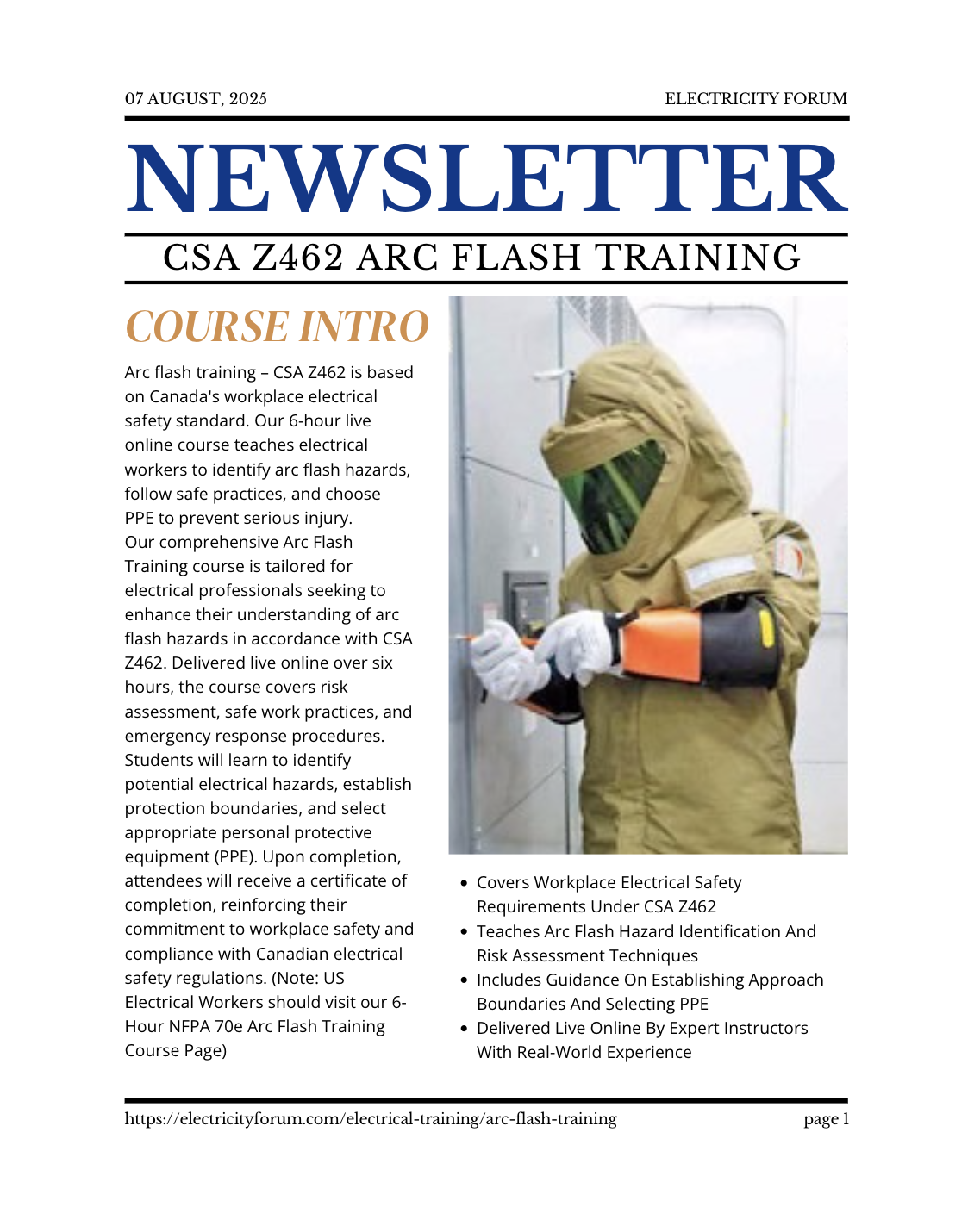
  • Explain the functions of a motor controller and apply NFPA 70E and CSA Z462 safe work practices to motor control work.
  • Identify pilot devices, sensors, control relays, contactors, magnetic starters, timers and control transformers, and describe how each operates in a control circuit.
  • Read and interpret ladder, wiring and connection diagrams, including NEMA and IEC symbols, wire numbering and contact cross-referencing.
  • Describe the operation of two-wire, three-wire, jogging, reversing, sequence, timing, plugging and braking circuits.
  • Compare across-the-line, primary resistor, autotransformer, wye-delta, part-winding and soft starter starting methods, and select the right method for an application.
  • Select overload relays and electronic motor protection, and size conductors, short-circuit protection, overloads and disconnects to NEC Article 430 and CEC Section 28.
  • Describe motor control center construction, ratings, safety features and maintenance requirements under NFPA 70B.
  • Convert relay logic to PLC ladder logic concepts, and troubleshoot motor control circuits using a structured, safe method.


Live online course schedule

No schedules available
Please contact us for availability

Sign Up For Our Electrical Training Newsletter – Stay Informed!

Newsletter
What you'll receive:
New course launches and schedules
Exclusive discounts and free resources
Practical tools, quizzes, and Free downloads

Who should attend

  • Engineering and design personnel
  • Maintenance and technical services personnel
  • Process and operations personnel
  • Technical and process managers
  • Engineering and design personnel
  • Electrical consulting engineers
  • Electrical contractors


Course Benefits

  • Electric Motor Control Training Certificate
  • 1.2 Continuing Education Unit (CEU) Credits (12 Professional Development Hours)
  • This Course Includes Our Latest Electric Motor And VFD Handbook Volume!! (Value $20)
  • $100 Coupon Toward Any Future Electricity Forum Event (Restrictions Apply)
  • FREE Magazine Subscription (Value $50.00)
  • Course Materials In PDF Format


Electric Motor Control Training Course Outline


DAY ONE

Control Devices and Control Circuits


Module 1: Motor Control Fundamentals and Safety

  • Functions of a motor controller: start, stop, protect, reverse, jog and sequence
  • Manual, semi-automatic and automatic control
  • Power circuit, control circuit and pilot devices
  • NEMA and IEC control equipment compared
  • NFPA 70E and CSA Z462 safe work practices for motor control work
  • Lockout and tagout, and justified energized troubleshooting


Module 2: Pilot and Sensing Devices

  • Pushbuttons, selector switches, emergency stops and pilot lights
  • Normally open and normally closed, maintained and momentary contacts
  • Limit, float, pressure, flow and temperature switches
  • Proximity, photoelectric and zero-speed switches
  • Sinking and sourcing sensor connections


Module 3: Relays, Contactors, Starters and Timers

  • Control relays and contactors compared
  • Magnetic starter construction: coil, shading ring, main and auxiliary contacts
  • NEMA sizes and IEC utilization categories (AC-3, AC-4)
  • Manual motor starters and motor protective circuit breakers
  • On-delay, off-delay and multifunction timing relays
  • Control transformers, control voltage and control circuit fusing


Module 4: Reading Motor Control Diagrams

  • Ladder, wiring and connection diagrams
  • NEMA and IEC symbols
  • Rung rules, wire numbering, line numbering and contact cross-referencing
  • Transferring a ladder diagram to a wiring diagram
  • Dual-voltage and wye-delta motor lead connections


Module 5: Basic Control Circuits

  • Two-wire control and low-voltage release
  • Three-wire control, seal-in contacts and low-voltage protection
  • Multiple start/stop stations and pilot light circuits
  • Hand-off-auto control
  • Jogging and inching circuits
  • Automatic float and pressure control circuits


Module 6: Reversing, Sequence, Timing and Braking Circuits

  • Forward/reverse starters with mechanical and electrical interlocks
  • Pushbutton interlocking and limit switch reversing
  • Sequence starting and conveyor control
  • Timed sequence circuits with on-delay and off-delay timers
  • Plugging and anti-plugging with zero-speed switches
  • DC injection braking and electromechanical brakes


DAY TWO

Starting, Protection, Codes and Troubleshooting


Module 7: Full-Voltage and Reduced-Voltage Starting

  • Inrush current, locked-rotor code letters and voltage dip
  • Across-the-line starting
  • Primary resistor and reactor starting
  • Autotransformer starting
  • Wye-delta starting, open and closed transition
  • Part-winding and two-speed starters
  • Soft starters: ramp, current limit, pump control and bypass contactors
  • Choosing a starting method


Module 8: Motor Overload and Protection Devices

  • Bimetallic, eutectic alloy and electronic overload relays
  • Trip classes 10, 20 and 30, ambient compensation and reset modes
  • Phase loss, phase unbalance and single-phasing protection
  • Electronic motor protection relays: ground fault, jam, underload and thermistor or RTD inputs
  • ANSI protective device functions for larger motors
  • Networked motor management and diagnostics


Module 9: Code Requirements: NEC Article 430 and CEC Section 28

  • Using motor full-load current tables and nameplate data
  • Branch-circuit conductor sizing
  • Branch-circuit short-circuit and ground-fault protection
  • Overload protection sizing
  • Controller ratings, disconnecting means and in-sight requirements
  • Control circuit protection
  • Short-circuit current ratings (SCCR) and Type 1 and Type 2 coordination
  • Worked sizing example


Module 10: Motor Control Centers

  • MCC construction: vertical sections, bus and plug-in units
  • NEMA wiring classes and types
  • Combination starter units and MCC ratings
  • Arc-resistant MCCs, remote racking and remote operation
  • Intelligent MCCs
  • MCC inspection and maintenance under NFPA 70B: thermography, torque checks, cleaning and contact inspection


Module 11: From Relay Logic to PLC Control

  • Why PLCs replaced hardwired relay logic
  • PLC inputs, outputs and processor
  • Converting a ladder diagram to PLC ladder logic
  • Interfacing starters and soft starters with PLCs
  • Hardwired emergency stop and safety relay circuits
  • Using PLC I/O status for troubleshooting


Module 12: Troubleshooting Motor Control Circuits

  • A structured troubleshooting method
  • Safe meter selection and use: CAT ratings and test-before-touch
  • Voltage tracing and continuity testing
  • Power circuit faults versus control circuit faults
  • Common failures: coils, contacts, overloads, control transformer fuses and loose connections
  • Motor or controller: quick checks before calling for motor testing
  • Fault-finding scenarios, course review and Q&A


COURSE SCHEDULE

Both days:


Start: 10:00 a.m. Eastern Time
Finish: 4:30 p.m. Eastern Time

 

EFTI Logo

Live online course registration fees & CEU credits

Request Quotation

Download free discount coupon

1

Enter Your Information

Fill out the form below with your name and email address.

2

Receive Your Coupon

Check your email for a message with a link to your $50 discount coupon.

3

Register for the Course

Use the coupon code when you sign up for the Advanced Electrical Safety Training course to save $50 off the regular price.

Discount Coupon

Group Offer
Register 3, Get 1 Free

Register 3 delegates at the full price of $249 each and get the 4th registration free! Perfect for companies, safety departments, and teams looking to train multiple employees at once.

1st $249
2nd $249
3rd $249
4th FREE

Earn Continuing Education Unit (CEU) Credits

  • Successful completion of this course qualifies delegates to receive a certificate of course completion with indicated CEUs.
  • One CEU is equivalent to 10 professional development hours of instruction.
  • This course earns 1.2 CEUs.

Request a free training quote – Live Online & In-Person Group Training

Whether you choose live online or in-person instruction, our electrical training can be customized to your needs and delivered to your team at one or multiple locations.

Interactive – Real-Time Q&A
Tailored – Built To Your Needs
Flexible – Join From Any Location
Cost-Saving – No Travel Expenses
Certified – Earn CEU Credits
Discounted – Multi-Course Savings

Our instructors will work with you to assess your team's skills and tailor the training to match your requirements.


Complete this handy form and I will send you a FREE written Quotation on any electrical training you need! Or send me an email and I will contact you to discuss your electrical training requirements Today!

R.W. HURST
PRESIDENT, THE ELECTRICITY FORUM TRAINING INSTITUTE
randy@electricityforum.com

Get the 2026 Live Online Training Catalog

Explore 50+ live, expert-led electrical training courses – interactive, flexible, CEU-certified.

Download Catalog
Training Catalog Preview

Download Course Brochure

Get detailed information about this course in our comprehensive brochure.

Download Brochure (PDF)

Download free discount coupon

1

Enter Your Information

Fill out the form below with your name and email address.

2

Receive Your Coupon

Check your email for a message with a link to your $50 discount coupon.

3

Register for the Course

Use the coupon code when you sign up for the Advanced Electrical Safety Training course to save $50 off the regular price.

Discount Coupon

Group Offer
Register 3, Get 1 Free

Register 3 delegates at the full price of $249 each and get the 4th registration free! Perfect for companies, safety departments, and teams looking to train multiple employees at once.

1st $249
2nd $249
3rd $249
4th FREE

Download our FREE Electrical Training Catalog

Explore our comprehensive training programs and find the perfect course for your professional development.

Training Catalog