Electrical Safety Hazards
By Howard WIlliams, Associate Editor
By Howard WIlliams, Associate Editor
Our customized live online or in‑person group training can be delivered to your staff at your location.
Request for Quotation Service
Buyers Submit Free RFQs to top suppliers, no obligation.
Suppliers Browse real project RFQs directly from buyers.
Trust Electricity Forum 40 years connection buyers and suppliers.
Electrical safety programs cover arc flash, shock, PPE, and lockout tagout under NFPA 70E and OSHA. Learn hazard assessment, boundaries, and training.
Electrical hazards injure and kill workers in facilities where equipment is well maintained, procedures are documented, and workers are experienced. That is the part that gets overlooked in safety training. The hazard is not confined to unfamiliar equipment or unusual tasks. It is present in the routine, the repeated, and the familiar, precisely because familiarity erodes the caution that keeps exposure from becoming injury.
Voltage, current, and stored energy behave predictably. The arc flash resulting from a fault in a 480V switchgear lineup follows physical laws that can be calculated, labeled, and planned around. What cannot be fully controlled is the human judgment that precedes every energized task: whether the hazard was assessed, whether the PPE was selected for the actual exposure rather than a general assumption, and whether the isolation was verified or assumed.
The two primary electrical hazards in industrial and commercial environments are electric shock and arc flash. They require different controls, PPE, and engineering analyses, though they often occur in the same work context.
Electric shock results from current passing through the body. At levels as low as 10 milliamps, muscle control is compromised. Above 100 milliamps, ventricular fibrillation becomes likely. The severity depends on the current level, the path through the body, and the duration of contact. Shock hazards are controlled through insulation, guarding, grounding, rubber insulating gloves rated for the system voltage, and maintaining safe approach distances.
Download our FREE Electrical Training Catalog and explore a full range of expert-led electrical training courses.

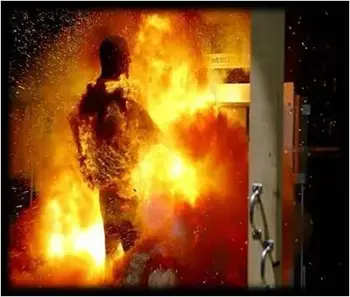
Arc flash results from an uncontrolled electrical fault that produces a plasma arc between conductors. Temperatures at the arc can exceed 35,000 degrees Fahrenheit. The resulting incident energy, measured in cal/cm2, is what drives PPE selection and approach boundary decisions. An arc flash event also produces a pressure wave, molten metal, and intense light, each of which can cause injury independently of the thermal exposure. For a full explanation of how arc flash develops and what it produces, see What Is Arc Flash? Electrical Explosion Hazard Guide.
Three frameworks govern electrical safety in North America, and understanding how they relate to each other matters for compliance decisions.
NFPA 70E, the Standard for Electrical Safety in the Workplace, is the primary consensus standard for electrical hazard control in the United States. It governs arc flash risk assessment, arc flash boundary determination, PPE selection, energized work justification, and safe work practices. NFPA 70E is updated on a three-year cycle. The 2024 edition is the current governing document. OSHA references NFPA 70E as the applicable consensus standard for electrical safety in general industry, making compliance with NFPA 70E the practical basis for OSHA compliance in electrical work. For a complete breakdown of what NFPA 70E requires of employers and workers, see NFPA 70E Arc Flash Requirements For OSHA Electrical Safety.
CSA Z462, Workplace Electrical Safety, is the Canadian equivalent. It parallels NFPA 70E in structure and requirements. Most jurisdictions in Canada reference CSA Z462 through provincial occupational health and safety legislation. Employers operating in both countries must address the requirements of both standards. The differences are minor at the technical level, but regulatory language and documentation requirements vary by province.
OSHA governs electrical safety through multiple standards: 29 CFR 1910 Subpart S for general industry, 29 CFR 1926 Subpart K for construction, and 29 CFR 1910.147 for the control of hazardous energy. OSHA enforcement examines whether work practices reflect known risks and accepted controls. An employer whose workers perform energized electrical tasks without a documented arc flash risk assessment or without PPE rated for the calculated incident energy is exposed to citation under multiple standards simultaneously. For how OSHA applies these requirements in practice, see OSHA Electrical Safety – Arc Flash, NFPA 70E, PPE Standards.
Before any energized electrical work begins, NFPA 70E requires an arc flash risk assessment for the specific task and equipment. This assessment determines whether an arc flash hazard exists, the likelihood of an arc flash event given the task being performed, and the consequences if an arc flash occurs.
Where an engineering-based arc flash study has been completed for the facility, equipment labels show the required PPE category or the calculated incident energy at the working distance. Workers read the label and select PPE accordingly. Where no study exists, NFPA 70E Table 130.5(C) provides a task-based PPE category method as a conservative alternative. That method does not account for site-specific fault-current levels or protective-device characteristics, and it does not replace an engineering study for high-energy systems.
The arc flash study is the engineering foundation of a compliant electrical safety program. It applies IEEE 1584 to calculate incident energy at each equipment location, defines arc flash boundaries, recommends protective device settings, and produces the labels workers rely on for every energized task.

NFPA 70E defines arc flash boundaries based on the calculated incident energy at a given working distance. The arc flash boundary is the distance from an energized conductor at which a worker without arc-rated PPE would receive a second-degree burn from an arc flash event. Inside that boundary, arc-rated PPE is required. The boundary distance varies by equipment and system characteristics. It is not a fixed number that applies across facilities.
Workers who approach closer than the labeled working distance are exposed to higher incident energy than the label or PPE rating reflects. This is one of the most common field-level compliance failures. For how boundary distances are calculated and applied, including reference distances by incident energy level, see Arc Flash Boundary Chart: Calculated Distances By Incident Energy.
Arc-rated PPE is selected based on the calculated incident energy for the task, not on a general risk estimate. NFPA 70E defines four PPE categories with minimum arc ratings of 4, 8, 25, and 40 cal/cm2. The category whose minimum rating is at least as high as the calculated exposure governs PPE selection for that task.
A common selection error is treating the PPE category table as interchangeable with an incident energy calculation. Where an arc flash study has been completed and equipment is labeled, the label drives selection. The table is a conservative shortcut for facilities without a current study. For PPE requirements by category and task type, see Arc Flash PPE Requirements | NFPA 70E Compliance Guide.
NFPA 70E requires that an electrically safe work condition be established before any electrical work begins, unless energized work is justified by infeasibility or increased hazard. Establishing an electrically safe work condition means applying lockout tagout to de-energize the equipment, verify the absence of voltage at the point of work, and control stored energy before any worker approaches within the arc flash boundary.
Lockout tagout is the practical mechanism for achieving an electrically safe work condition. It is governed by OSHA 29 CFR 1910.147 across all industries and requires equipment-specific written procedures, annual inspections, and training for all authorized and affected employees. For a complete explanation of LOTO requirements, procedures, and common violations, see What Is Lockout Tagout – OSHA Safety & Hazard Control.
NFPA 70E Article 110 requires that qualified persons be trained to understand electrical hazards, recognize arc flash and shock risk, select appropriate PPE, and apply safe work practices. Training must be task-specific and equipment-relevant. A worker who understands the general concept of arc flash but cannot read an arc flash label, determine the required PPE category, or apply a LOTO procedure correctly does not meet the qualified person standard.
Training must be repeated when job assignments change, when equipment or procedures change, or when an audit reveals deficiencies in knowledge or application. NFPA 70E does not specify a fixed retraining interval beyond these triggers, but most programs set a maximum interval of three years as a baseline.
Electrical Safety Training – NFPA 70E and CSA Z462 Courses cover arc flash hazard assessment, PPE selection, arc flash boundaries, lockout tagout, and NFPA 70E work practices in a 6-hour live online or in-person course. Group booking is available for facilities qualifying their full maintenance and operations workforce.
A compliant electrical safety program under NFPA 70E includes a written electrical safety program, arc flash risk assessment procedures, equipment-specific lockout tagout procedures, PPE selection criteria tied to incident energy, equipment labeling, annual inspection of energy control procedures, and documented worker training.
A program that exists on paper but is not applied in daily work planning does not control exposure. The test is not whether the binder exists. It is whether supervisors use study data when planning tasks, whether workers check labels before selecting PPE, and whether lockout tagout is verified rather than assumed at every job.
Electrical safety in practice is the accumulation of those daily decisions. When they are consistent and correct, incidents are rare. When they are routine and assumed, the risk accumulates silently until a fault occurs under conditions that were never actually controlled.
Explore 50+ live, expert-led electrical training courses –