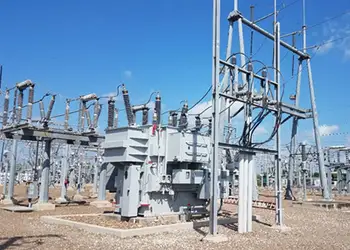
Substation Protection Training - Protect Transformers, Buses and Lines
Our customized live online or in‑person group training can be delivered to your staff at your location.
- Live Online
- 12 hours Instructor-led
- Group Training Available
Regular Price:
$799
Coupon Price:
$699
American politics still runs fast in the veins of Raymond Chrétien, the former Canadian ambassador to the United States who became strategic counsel and globe-trotting partner for Fasken Martineau LLP four years ago.
The Montreal- and Ottawa-based Chrétien had former U.S. vice-president and Nobel Prize-winner Al Gore stop into a Fasken reception for clients when he was in town some weeks back and is personally acquainted with Democrat presidential hopeful Hillary Clinton and John McCain, the Republican Party frontrunner.
Chrétien, the nephew of former prime minister Jean Chrétien, is no stranger to major trade irritants between the U.S. and Canada.
During his seven years as Canada's 18th representative in Washington from 1994 to 2000, he had to deal with two disputes between the countries over Canadian lumber and British Columbia salmon.
Both disputes were settled - at least temporarily in the case of lumber - during his watch.
Chrétien sees more potential conflict on the horizon as the numbers and dynamics of the race between Clinton and Barack Obama to become the Democratic nominee for presidential elections Nov. 4 change on a daily - even hourly - basis.
Clinton and Obama have threatened to reopen and renegotiate the North American Free Trade Agreement signed by Canada, the United States and Mexico.
And even if that does not happen, if neither wins the U.S. presidency, Chrétien suggests an expected, stronger Democrat majority than exists in Senate and Congress now could mean a bumpier road ahead as troubled economic times dictate fiercer protection of U.S. interests.
"At the time of a recession in the U.S., a Congress controlled by the Democrats is bound to be more protectionist and more protectionism is bad news for Canada," Chrétien said in an interview.
"Why? Because a protectionist Congress will frown upon trade agreements and will look at existing trade agreements," said Chrétien, speaking hours before he shared his behind-the-scenes insights with several hundred lawyers and judges gathered for a fundraising event on behalf of the Quebec Bar Foundation.
He pointed out that the level of Canadian exports to the U.S. has already dropped almost 10 points to 75 per cent in the last few years in part because of tighter security controls and significantly increased wait times and new requirements for small- and medium-size Canadian businesses at the border, he pointed out.
And that is separate from new passport requirements for Canadians entering the U.S. overland.
"The big challenge for Canada in the years to come is to try to convince the Americans to find a better equilibrium between ensuring the security of the border and an easier border. This balance has now gone too far, in my view, on the side of security."
Still, Chrétien figures Canada does have weaponry in its arsenal if push comes to shove - leverage Prime Minister Stephen Harper has already hinted at could be brought to the fore.
Canada provides 100 per cent of U.S. electricity imports, about 35 per cent of its natural gas, 17 per cent of oil foreign electricity power purchased by the U.S. and that is not counting uranium and other metals, Chrétien said.
"So far we have not used (those numbers) as a bargaining chip," Chrétien said. "I think just the fact that Canada has now overtaken Saudi Arabia as the main supplier of oil to the U.S. should give pause for thought."
Besides avidly watching events south of the border, Chrétien has not had much time to pause.
A few months ago, he wrapped up a four-year mandate with a team at Fasken as chief federal negotiator for the Canadian Department of Indian and Northern Affairs's signing of a historic agreement with the Grand Council of the Crees of Quebec for the implementation of the James Bay and Northern Quebec Agreement.
He travels to Europe, Asia, the Middle East and, more recently, Africa - he was once Canadian ambassador to the Congo - talking with governments and clients for mining deals.
Related News

Egypt Plans Power Link to Saudis in $1.6 Billion Project
Egypt-Saudi Electricity Interconnection enables cross-border power trading, 3,000 MW capacity, and peak-demand balancing across the…
View more

Ireland goes 25 days without using coal to generate electricity
Ireland Coal-Free Electricity Record: EirGrid reports 25 days without coal on the all-island grid, as…
View more

Investor: Hydro One has too many unknowns to be a good investment
Hydro One investment risk reflects Ontario government influence, board shakeup, Avista acquisition uncertainty, regulatory hearings,…
View more

UK breaks coal free energy record again but renewables still need more support
UK Coal-Free Grid Streak highlights record hours without coal, as renewable energy, wind and solar…
View more

Melting Glass Experiment Surprises Scientists by Defying a Law of Electricity
Electric Field-Induced Glass Softening reveals a Joule heating anomaly in silicate glass, where anode-side nanoscale…
View more
Trump unveils landmark rewrite of NEPA rules
Trump NEPA Overhaul streamlines environmental reviews, tightening 'reasonably foreseeable' effects, curbing cumulative impacts, codifying CEQ…
View more
Sign Up for Electricity Forum’s Newsletter
Stay informed with our FREE Newsletter — get the latest news, breakthrough technologies, and expert insights, delivered straight to your inbox.
Electricity Today T&D Magazine Subscribe for FREE

Stay informed with the latest T&D policies and technologies.
- Timely insights from industry experts
- Practical solutions T&D engineers
- Free access to every issue

