Hydro One shares jump 5.7 per cent after U.S. regulators reject $6.7B takeover


hydro one building

Substation Relay Protection Training

Our customized live online or in‑person group training can be delivered to your staff at your location.

  • Live Online
  • 12 hours Instructor-led
  • Group Training Available
Regular Price:
$699
Coupon Price:
$599
Reserve Your Seat Today

Hydro One Avista takeover rejection signals Washington regulators blocking a utility acquisition over governance risk, EPS dilution, and balance sheet impact, as investors applaud share price gains and a potential US$103M break fee.


Key Points

A regulator-led block of Hydro One's Avista bid, citing EPS dilution, balance sheet risk, and governance concerns.

✅ Washington denies approval; Idaho, Oregon decisions pending.

✅ EPS dilution avoided; balance sheet strength preserved.

✅ Shares rise 5.7%; US$103M break fee if deal collapses.


Opposition politicians may not like it but investors are applauding the rejection of Hydro One Ltd.'s $6.7-billion Avista takeover of U.S.-based utility Avista Corp.

Shares in the power company controlled by the Ontario government, which has also proposed a bill redesign to simplify statements, closed at $21.53, up $1.16 or 5.7 per cent, on the Toronto Stock Exchange on Thursday.

On Wednesday, Washington State regulators said they would not allow Ontario's largest utility to buy Avista over concerns about political risk that the provincial government, which owns 47 per cent of Hydro One's shares, might meddle in Avista's operations.

Financial analysts had predicted investors would welcome the news because the deal, announced in July 2017, would have eroded earnings per share and weakened Hydro One's balance sheet.

"The Washington regulator's denial of Avista is a positive development for the shares, in our opinion," said analyst Ben Pham of BMO Capital Markets in a report on Wednesday.

"While this may sound odd, we note that the Avista deal is expected to be EPS dilutive and result in a weaker balance sheet for (Hydro One). Not acquiring Avista and refocusing its attention on its core Ontario franchise ... along with related interprovincial arrangements such as the Ontario-Quebec electricity deal under discussion would likely be viewed positively if the deal ultimately breaks."

Decisions are yet to come from Idaho and Oregon state regulators, but Washington was probably the most important as the state contains customers making up about 60 per cent of Avista's rate base, Pham said.

He pointed out that a US$103-million break fee is to be paid to Avista if the deal collapses due to a failure to obtain regulatory approval.

CIBC analyst Robert Catellier raised his 12-month Hydro One target price by 25 cents and said many shareholders will feel "relieved" that the deal had failed.

He warned that the company's earnings power could deteriorate as the province seeks to reduce power bills by 12 per cent, despite an Ontario-Quebec hydro deal that may not lower costs.


Related News

Related News
Wind and solar make more electricity than nuclear for first time in UK

UK Renewables Surpass Nuclear Milestone as wind farms and solar panels outpace atomic output, cutting greenhouse gas emissions. BEIS data show low-carbon power generation rising while onshore wind subsidies and auction timelines face policy debate.


Key Points

It is the quarter when UK wind and solar generated more electricity than nuclear, signaling cleaner, low-carbon growth.

✅ BEIS reports wind and solar at 18.33 TWh vs nuclear 16.69 TWh

✅ Energy sector emissions fell 8% as coal use dropped

✅ Calls grow to reopen onshore wind support via CFD auctions


Wind farms and solar panels, with wind leading the power mix during key periods, produced more electricity than the UK’s eight nuclear power stations for the first time at the end of last year, official figures show.

Britain’s greenhouse gas emissions also continued to fall, dropping 3% in 2017, as coal use fell and the use of renewables climbed, though low-carbon generation stalled in 2019 according to later data.

Energy experienced the biggest drop in emissions of any UK sector, of 8%, while pollution from transport and businesses stayed flat.

Energy industry chiefs said the figures showed that the government should rethink its ban on onshore wind subsidies, a move that ministers have hinted could happen soon.

Lawrence Slade, chief executive of the big six lobby group Energy UK, said: “We need to keep up the pace ... by ensuring that the lowest cost renewables are no longer excluded from the market.”

Across the whole year, low-carbon sources of power – wind, solar, biomass and nuclear – provided a record 50.4% of electricity, up from 45.7% in 2016, when wind beat coal for the first time.

But in the fourth quarter of 2017, high wind speeds, new renewables installations and lower nuclear output saw wind and solar becoming the second biggest source of power for the first time.

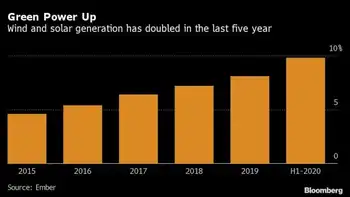
Wind and solar generated 18.33 terawatt hours (TWh), with nuclear on 16.69TWh, and the UK later set a new record for wind power during 2019, the figures published by the Department for Business, Energy and Industrial Strategy show.

But renewables still have a long way to go to catch up with gas, the UK’s top source of electricity at 36.12TWh, which saw its share of generation fall slightly, though at times wind became the main source as capacity expanded.

Greenpeace said the figures showed the government should capitalise on its lead in renewables and “stop wasting time and money propping up nuclear power”.

Horizon Nuclear Power, a subsidiary of the Japanese conglomerate Hitachi, is in talks with Whitehall officials for a financial support package from the government, which it says it needs by midsummer.

By contrast, large-scale solar and onshore wind projects are not eligible for support, after the Conservative government cut subsidies in 2015.

However the energy minister, Claire Perry, recently told House Magazine that “we will have another auction that brings forward wind and solar, we just haven’t yet said when”.


Related News

View more

"Energy war": Ukraine tries to protect electricity supply before winter

Ukraine Power Grid Resilience details preparations for winter blackouts, airstrike defense, decentralized generation, backup generators, battery storage, DTEK restorations, EU grid synchronization, and upgraded air defenses to safeguard electricity, heating, water, and essential services.


Key Points

Ukraine Power Grid Resilience is a strategy to harden energy systems against winter attacks and outages.

✅ DTEK repairs, backup equipment, and fortified plants across Ukraine

✅ Expanded air defenses targeting missiles and attack drones

✅ EU grid sync enables emergency imports and power trading


Oleksandr Gindyuk is determined not to be caught off guard if electricity supplies fail again this winter. When Russia pounded Ukraine’s power grid with widespread and repeated waves of airstrikes last year, causing massive rolling blackouts, his wife had just given birth to their second daughter.

“It was quite difficult,”  Gindyuk, who lives with his family in the suburbs of the capital, Kyiv, told CNN. “There is no life in our house if there is no electricity. Without electricity, we have no water, light or heating.”

He has spent the summer preparing for Russia to repeat its strategy, which was designed to sow terror and make life unsustainable, robbing Ukrainians of heat, water and health services. “We are totally ready — we have a diesel generator and a powerful 9 kWh battery. We are not scared, we are ready,” Gindyuk told CNN.

As families like Gindyuk’s gird themselves for the possibility of another dark winter, Ukraine has been rushing to rebuild and, drawing on protecting the grid lessons, protect its fragile energy infrastructure.

The summer provided a respite for Ukraine’s power grid. Russia focused its attacks on military targets and on ports on the Black Sea and the Danube River, to hinder Ukraine’s efforts to move grain and choke off an important income stream.

As the days grow shorter and the temperatures drop, Russia has another opportunity to try to break Ukrainian resilience with punishing blackouts. But this winter, defense and energy officials say Ukraine is better prepared.

With limited Ukrainian air defenses in operation last year, Russia was able to target and hit the energy grid easily, including during missile and drone assaults on Kyiv’s grid that strained responders.

“The Russians may use a combination of missile weapons and attack UAVs (unmanned aerial vehicles, or drones). These will definitely not be such primitive attacks as last year. It will be difficult for the Russians to achieve a result - we are also preparing and understanding how they act.”

DTEK, the country’s largest private energy company, has spent the past seven months restoring infrastructure, trying to boost output and bolstering defenses at its facilities across Ukraine, mindful of Russian utility hacks reported elsewhere.

“We restored what could be restored, bought back-up equipment and installed defenses around power plants, as Russian-linked breaches at US plants have underscored risks,” DTEK chief executive Maxim Timchenko told CNN.

The company generates around a quarter of Ukraine’s electricity and runs 40% of its grid network, making it a prime target for Russian attacks. Four DTEK employees have been killed while on duty and its power stations have been attacked nearly 300 times since the start of the full-scale invasion, according to the company. “Last winter, determination carried us through. This winter we are stronger, and our people are more experienced,” Timchenko said.

Russia launched 1,200 attacks on Ukraine’s energy system between October 2022 and April 2023, with every thermal power and hydro-electric plant in the country sustaining some damage, according to DTEK.

In a damage assessment report released in June, the United Nations Development Programme said that Ukraine’s power generation capacity had been reduced to about half of what it was before Russia’s full-scale invasion. “Ukraine’s power system continues to operate in an emergency mode, which affects both power grids and generation, amid rising concerns about state-backed grid hacking worldwide,” a news release accompanying the report said.

The report also laid out a roadmap to rebuilding the energy sector, prioritizing decentralization, renewable energy sources and greater integration with the European Union. Ukraine has been hooked into the EU’s power grid since the full-scale invasion, allowing it to synchronize and trade power with the bloc. But the massive wave of attacks on energy infrastructure last winter threw that balance off kilter.


Related News

View more

No time to be silent on NZ's electricity future

New Zealand Renewable Energy Strategy examines decarbonisation, GHG emissions, and net energy as electrification accelerates, expanding hydro, geothermal, wind, and solar PV while weighing intermittency, storage, materials, and energy security for a resilient power system.


Key Points

A plan to expand electricity generation, balancing decarbonisation, net energy limits, and energy security.

✅ Distinguishes decarbonisation targets from renewable capacity growth

✅ Highlights net energy limits, intermittency, and storage needs

✅ Addresses materials, GHG build-out costs, and energy security


The Electricity Authority has released a document outlining a plan to achieve the Government’s goal of more than doubling the amount of electricity generated in New Zealand over the next few decades.

This goal is seen as a way of both reducing our greenhouse gas (GHG) emissions overall, as everything becomes electrified, and ensuring we have a 100 percent renewable energy system at our disposal. Often these two goals are seen as being the same – to decarbonise we must transition to more renewable energy to power our society.

But they are quite different goals and should be clearly differentiated. GHG emissions could be controlled very effectively by rationing the use of a fossil fuel lockdown approach, with declining rations being available over a few years. Such a direct method of controlling emissions would ensure we do our bit to remain within a safe carbon budget.

If we took this dramatic step we could stop fretting about how to reduce emissions (that would be guaranteed by the rationing), and instead focus on how to adapt our lives to the absence of fossil fuels.

Again, these may seem like the same task, but they are not. Decarbonising is generally thought of in terms of replacing fossil fuels with some other energy source, signalling that a green recovery must address more than just wind capacity. Adapting our lives to the absence of fossil fuels pushes us to ask more fundamental questions about how much energy we actually need, what we need energy for, and the impact of that energy on our environment.

MBIE data indicate that between 1990 and 2020, New Zealand almost doubled the total amount of energy it produced from renewable energy sources - hydro, geothermal and some solar PV and wind turbines.

Over this same time period our GHG emissions increased by about 25 percent. The increase in renewables didn’t result in less GHG emissions because we increased our total energy use by almost 50 percent, mostly by using fossil fuels. The largest fossil fuel increases were used in transport, agriculture, forestry and fisheries (approximately 60 percent increases for each).

These data clearly demonstrate that increasing renewable energy sources do not necessarily result in reduced GHG emissions.

The same MBIE data indicate that over this same time period, the amount of Losses and Own Use category for energy use more than doubled. As of 2020 almost 30 percent of all energy consumed in New Zealand fell into this category.

These data indicate that more renewable energy sources are historically associated with less energy actually being available to do work in society.

While the category Losses and Own Use is not a net energy analysis, the large increase in this category makes the call for a system-wide net energy analysis all the more urgent.

Net energy is the amount of energy available after the energy inputs to produce and deliver the energy is subtracted. There is considerable data available indicating that solar PV and wind turbines have a much lower net energy surplus than fossil fuels.

And there is further evidence that when the intermittency and storage requirements are engineered into a total renewable energy system, the net energy of the entire system declines sharply. Could the Losses and Other Uses increase over this 30-year period be an indication of things to come?

Despite the importance of net energy analysis in designing a national energy system which is intended to provide energy security and resilience, there is not a single mention of net energy surplus in the EA reference document.

So over the last 30 years, New Zealand has doubled its renewable energy capacity, and at the same time increased its GHG emissions and reduced the overall efficiency of the national energy system.

And we are now planning to more than double our renewable energy system yet again over the next 30 years, even as zero-emissions electricity by 2035 is being debated elsewhere. We need to ask if this is a good idea.

How can we expand New Zealand’s solar PV and wind turbines without using fossil fuels? We can’t.

How could we expand our solar PV and wind turbines without mining rare minerals and the hidden costs of clean energy they entail, further contributing to ecological destruction and often increasing social injustices? We can't.

Even if we could construct, deliver, install and maintain solar PV and wind turbines without generating more GHG emissions and destroying ecosystems and poor communities, this “renewable” infrastructure would have to be replaced in a few decades. But there are at least two major problems with this assumed scenario.

The rare earth minerals required for this replacement will already be exhausted by the initial build out. Recycling will only provide a limited amount of replacements.

The other challenge is that a mostly “renewable” energy system will likely have a considerably lower net energy surplus. So where, in 2060, will the energy come from to either mine or recycle the raw materials, and to rebuild, reinstall and maintain the next iteration of a renewable energy system?

There is currently no plan for this replacement. It is a serious misnomer to call these energy technologies “renewable”. They are not as they rely on considerable raw material inputs and fossil energy for their production and never ending replacement.

New Zealand is, of course, blessed with an unusually high level of hydro electric and geothermal power. New Zealand currently uses over 170 GJ of total energy per capita, 40 percent of which is “renewable”. This provides approximately 70 GJ of “renewable” energy per capita with our current population.

This is the average global per capita energy level from all sources across all nations, as calls for 100% renewable energy globally emphasize. Several nations operate with roughly this amount of total energy per capita that New Zealand can generate just from “renewables”.

It is worth reflecting on the 170 GJ of total energy use we currently consume. Different studies give very different results regarding what levels are necessary for a good life.

For a complex industrial society such as ours, 100 GJ pc is said to be necessary for a high levels of wellbeing, determined both subjectively (life satisfaction/ happiness measures), and objectively (e.g. infant mortality levels, female morbidity as an index of population health, access to nutritious food and educational and health resources, etc). These studies do not take into account the large amount of energy that is wasted either through inefficient technologies, or frivolous use, which effective decarbonization strategies seek to reduce.

Other studies that consider the minimal energy needed for wellbeing suggest a much lower level of per capita energy consumption is required. These studies take a different approach and focus on ensuring basic wellbeing is maintained, but not necessarily with all the trappings of a complex industrial society. Their results indicate a level of approximately 20 GJ per capita is adequate.

In either case, we in New Zealand are wasting a lot of energy, both in terms of the efficiency of our technologies (see the Losses and Own Use info above), and also in our uses which do not contribute to wellbeing (think of the private vehicle travel that could be done by active or public transport – if we had good infrastructure in place).

We in New Zealand need a national dialogue about our future. And energy availability is only one aspect. We need to discuss what our carrying capacity is, what level of consumption is sustainable for our population, and whether we wish to make adjustments in either our per capita consumption or our population. Both together determine whether we are on the sustainable side of carrying capacity. Currently we are on the unsustainable side, meaning our way of life cannot endure. Not a good look for being a good ancestor.

The current trajectory of the Government and Electricity Authority appears to be grossly unsustainable. At the very least they should be able to answer the questions posed here about the GHG emissions from implementing a totally renewable energy system, the net energy of such a system, and the related environmental and social consequences.

Public dialogue is critical to collectively working out our future. Allowing the current profit-driven trajectory to unfold is a recipe for disasters for our children and grandchildren.

Being silent on these issues amounts to complicity in allowing short-term financial interests and an addiction to convenience jeopardise a genuinely secure and resilient future. Let’s get some answers from the Government and Electricity Authority to critical questions about energy security.


Related News

View more

Africa must quadruple power investment to supply electricity for all, IEA says

Africa Energy Investment must quadruple, says IEA, to deliver electricity access via grids, mini-grids, and stand-alone solar PV, wind, hydropower, natural gas, and geothermal, targeting $120 billion annually and 2.5% of GDP.


Key Points

Africa Energy Investment funds reliable, low-carbon electricity via grids, mini-grids, and renewables.

✅ Requires about $120B per year, or 2.5% of GDP

✅ Mix: grids, mini-grids, stand-alone solar PV and wind

✅ Targets reliability, economic growth, and electricity access


African countries will need to quadruple their rate of investment in their power sectors for the next two decades to bring reliable electricity to all Africans, as outlined in the IEA’s path to universal access analysis, an International Energy Agency (IEA) study published on Friday said.

If African countries continue on their policy trajectories, 530 million Africans will still lack electricity in 2030, the IEA report said. It said bringing reliable electricity to all Africans would require annual investment of around $120 billion and a global push for clean, affordable power to mobilize solutions.

“We’re talking about 2.5% of GDP that should go into the power sector,” Laura Cozzi, the IEA’s Chief Energy Modeller, told journalists ahead of the report’s launch. “India’s done it over the past 20 years. China has done it, with solar PV growth outpacing any other fuel, too. So it’s something that is doable.”

Taking advantage of technological advances and optimizing natural resources, as highlighted in a renewables roadmap, could help Africa’s economy grow four-fold by 2040 while requiring just 50% more energy, the agency said.

Africa’s population is currently growing at more than twice the global average rate. By 2040, it will be home to more than 2 billion people. Its cities are forecast to expand by 580 million people, a historically unprecedented pace of urbanization.

While that growth will lead to economic expansion, it will pile pressure on power sectors that have already failed to keep up with demand, with the sub-Saharan electricity challenge intensifying across the region. Nearly half of Africans - around 600 million people - do not have access to electricity. Last year, Africa accounted for nearly 70% of the global population lacking power, a proportion that has almost doubled since 2000, the IEA found.

Some 80% of companies in sub-Saharan Africa suffered frequent power disruptions in 2018, leading to financial losses that curbed economic growth.

The IEA recommended changing how power is distributed, with mini-grids and stand-alone systems like household solar playing a larger role in complementing traditional grids as targeted efforts to accelerate access funding gain momentum.

According to IEA Executive Director Fatih Birol, with the right government policies and energy strategies, Africa has an opportunity to pursue a less carbon-intensive development path than other regions.

“To achieve this, it has to take advantage of the huge potential that solar, wind, hydropower, natural gas and energy efficiency offer,” he said.

Despite possessing the world’s greatest solar potential, Africa boasts just 5 gigawatts of solar photovoltaics (PV), or less than 1% of global installed capacity, a slow green transition that underscores the scale of the challenge, the report stated.

To meet demand, African nations should add nearly 15 gigawatts of PV each year through 2040. Wind power should also expand rapidly, particularly in Ethiopia, Kenya, Senegal and South Africa. And Kenya should develop its geothermal resources.


Related News

View more

France hopes to keep Brussels sweet with new electricity pricing scheme

France Electricity Pricing Mechanism aligns with EU rules, leveraging nuclear energy and EDF profits, avoiding Contracts for Difference, redistributing windfalls to industry and households, targeting €70/MWh amid electricity market reform and Brussels oversight.


Key Points

A framework to keep power near €70/MWh by reclaiming EDF windfalls and redistributing them under EU market rules.

✅ Targets average price near €70/MWh from 2026

✅ Skims EDF profits above €78-80 and €110/MWh thresholds

✅ Aligns with EU rules; avoids nuclear CfDs and state aid clashes


France has unveiled a new electricity pricing mechanism, hoping to defuse months of tension over energy subsidies with Brussels and its neighbors.

The strain has included a Franco-German fight over EU electricity reform with Germany accusing France of wanting to subsidize its industry via artificially low energy prices, while Paris maintained it should have the right to make the most of its relatively cheap nuclear energy. That fight has now been settled.

On Tuesday, the French government presented a new mechanism — complex, and still-to-be-detailed — to bring the average price of electricity closer to €70 per megawatt hour (MWh) as of 2026, amid Europe's electricity market revamp efforts.

"The agreement has been defined to comply with European rules and avoid difficulties with the European Commission," said France's Economy and Finance Minister Bruno Le Maire, noting that France had ruled out other "simpler" options that would have caused tension with Brussels.

For example, France has not yet envisaged the use of state-backed investment schemes called Contracts for Difference (CfD), which were the main source of discord in talks with Germany on the electricity market reform and the EU push for more fixed-price contracts in generation. The compromise agreed by EU ministers last month gives the Commission the power to monitor CfDs in the nuclear sector.

"France wanted to limit as much as possible the European Commission's nuisance power," said Phuc-Vinh Nguyen, an energy expert at the Jacques Delors Institute think tank in Paris.

The announcement came weeks after French President Emmanuel Macron promised that France would "take back control" of its electricity prices to allow its industry to make the most of the country's relatively cheap nuclear energy.

Germany, by contrast, has moved to support energy-intensive industries with an industrial electricity subsidy, underscoring the policy divergence.

“The price of electricity has always been a major competitive advantage for the French nation, and it must remain so,” Le Maire said.

Under the new mechanism, part of a broader deal on electricity prices between the state and EDF, the government will seize EDF profits above certain thresholds and redistribute them directly to industry and households to bring prices closer to the desired level. Specifically, the government will redistribute 50 percent of EDF’s additional profits if prices rise above €78-€80 per MWh, and 90 percent of extra profits if prices rise above €110 per MWh.

The move also marks a new step in the government's power grab at EDF, after the company was fully nationalized earlier this year.

For years, France has been discussing an EDF reform with the Commission in order to address concerns by Brussels regarding disguised state aid to the company. In particular, the Commission wanted assurances that any state aid given to nuclear would be kept separate from those parts of the business subject to competition, such as renewable energy development.

An economy ministry official close to Le Maire argued that the new pricing mechanism would settle matters with Brussels on that front. A Commission spokesperson said Brussels was in contact with France on the file, but declined further comment.

The mechanism will replace the existing EU-mandated energy pricing mechanism, dubbed ARENH, which was set to expire at the end of 2025, and which has forced EDF to sell some of its electricity to competitors at a fixed low price since 2010, and comes amid contested electricity market reforms at EU level.

The new system could benefit EDF because it won't be bound to sell energy at a lower price, but instead will be allowed to auction off its energy to competitors. On the other hand, the redistribution system would deprive the company of some profits when electricity prices are higher. No wonder, then, that negotiations between the government and EDF have been "difficult," as Le Maire put it.


Related News

View more

Funding Approved for Bruce C Project Exploration

Bruce C Project advances Ontario clean energy with NRCan funding for nuclear reactors, impact assessment, licensing, and Indigenous engagement, delivering reliable baseload power and low-carbon electricity through pre-development studies at Bruce Power.


Key Points

A proposed nuclear build at Bruce Power, backed by NRCan funding for studies, licensing, and impact assessment to expand clean power.

✅ Up to $50M NRCan support for pre-development

✅ Focus: feasibility, impact assessment, licensing

✅ Early Indigenous and community engagement


Canada's clean energy landscape received a significant boost recently with the announcement of federal funding for the Bruce Power's Bruce C Project. Natural Resources Canada (NRCan) pledged up to $50 million to support pre-development work for this potential new nuclear build on the Bruce Power site. This collaboration between federal and provincial governments signifies a shared commitment to a cleaner energy future for Ontario and Canada.

The Bruce C Project, if it comes to fruition, has the potential to be a significant addition to Ontario's clean energy grid. The project envisions constructing new nuclear reactors at the existing Bruce Power facility, located on the shores of Lake Huron. Nuclear energy is a reliable source of clean electricity generation, as evidenced by Bruce Power's operating record during the pandemic, producing minimal greenhouse gas emissions during operation.

The funding announced by NRCan will be used to conduct crucial pre-development studies. These studies will assess the feasibility of the project from various angles, including technical considerations, environmental impact assessments, and Indigenous and community engagement, informed by lessons from a major refurbishment that required a Bruce reactor to be taken offline, to ensure thorough planning. Obtaining a license to prepare the site and completing an impact assessment are also key objectives for this pre-development phase.

This financial support from the federal government aligns with both national and provincial clean energy goals. The "Powering Canada Forward" plan, spearheaded by NRCan, emphasizes building a clean, reliable, and affordable electricity system across the country. Ontario's "Powering Ontario's Growth" plan echoes these objectives, focusing on investment options, such as the province's first SMR project, to electrify the province's economy and meet its growing clean energy demand.

"Ontario has one of the cleanest electricity grids in the world and the nuclear industry is leading the way," stated Mike Rencheck, President and CEO of Bruce Power. He views this project as a prime example of collaboration between federal and provincial entities, along with the private sector, where recent manufacturing contracts underscore industry capacity.

Nuclear energy, however, remains a topic of debate. While proponents highlight its role in reducing greenhouse gas emissions and providing reliable baseload power, opponents raise concerns about nuclear waste disposal and potential safety risks. The pre-development studies funded by NRCan will need to thoroughly address these concerns as part of the project's evaluation.

Transparency and open communication with local communities and Indigenous groups will also be crucial for the project's success. Early engagement activities facilitated by the funding will allow for open dialogue and address any potential concerns these stakeholders might have.

The Bruce C Project is still in its early stages. The pre-development work funded by NRCan will provide valuable data to determine the project's viability. If the project moves forward, it has the potential to significantly contribute to Ontario's clean energy future, while also creating jobs and economic benefits for local communities and suppliers.

However, the project faces challenges. Public perception of nuclear energy and the lengthy regulatory process are hurdles that will need to be addressed, as debates around the Pickering B refurbishment have highlighted in Ontario. Additionally, ensuring cost-effectiveness and demonstrating the project's long-term economic viability will be critical for securing broader support.

The next few years will be crucial for the Bruce C Project. The pre-development work funded by NRCan will be instrumental in determining its feasibility. If successful, this project could be a game-changer for Ontario's clean energy future, building on the province's Pickering life extensions to strengthen system adequacy, offering a reliable, low-carbon source of electricity for the province and beyond.


Related News

View more

Sign Up for Electricity Forum’s Newsletter

Stay informed with our FREE Newsletter — get the latest news, breakthrough technologies, and expert insights, delivered straight to your inbox.

Electricity Today T&D Magazine Subscribe for FREE

Stay informed with the latest T&D policies and technologies.
  • Timely insights from industry experts
  • Practical solutions T&D engineers
  • Free access to every issue

Download the 2025 Electrical Training Catalog

Explore 50+ live, expert-led electrical training courses –

  • Interactive
  • Flexible
  • CEU-cerified