Nova ScotiaÂ’s first wind farm developer is a fan of the ToriesÂ’ proposed legislation on wind turbine taxation.
"Wind energy has a lot of potential in Nova Scotia," Charles Demond, president of Pubnico Point Wind Farm Inc., said at Province House recently.
"The bill provides certainty for wind developers and, in our view, a very healthy,... very attractive stream of revenue in the municipalities where they are developing... wind power."
He said his 30.6-megawatt operation was facing a $450,000 tax bill before this legislation. It had launched an appeal and, if successful, the bill would have been reduced to around $75,000.
Mr. Demond said the rate set in the proposed legislation is fair to wind farm operators and the municipalities where they are located. He said his new bill would be about $200,000.
Service Nova Scotia Minister Jamie Muir, who tabled the bill recently, said it was a compromise reached by the province, the Union of Nova Scotia Municipalities and wind-power producers.
"Everybody recognizes that alternative sources of energy are a necessity in our province," he said. "Quite frankly, we all gave a little bit."
Under the proposed legislation, all wind farms will pay a standard rate. It will be based on the assessment of land and buildings, multiplied by the tax rate.
Those who are already operating will pay an additional $4,500 per megawatt a year. The province will pay municipalities another $1,000 per megawatt, a subsidy estimated at $100,000 annually.
New wind farms will have to pay $5,500 per megawatt.
The bill would not cover wind turbines under 100 kilowatts.
Union of Nova Scotia Municipalities president Russell Walker said municipalities are forgoing about 40 per cent of the taxes they might have gotten from the wind farms.
"ItÂ’s a plus because itÂ’s a step forward in getting green energy in this province," he said. "ItÂ’s less pollution in the air and itÂ’s better for everybody in Nova Scotia."
A 2005 study by the Canadian Wind Energy Association showed the average property taxes for a 20-megawatt wind project in Nova Scotia were $679,810, compared with $42,785 in Ontario.
Staff for Service Nova Scotia said the current taxation of a 20-megawatt facility would be $680,000 a year, while the proposed legislation would mean a 30-megawatt facility would pay $200,000 a year.
Related News
Tunisia invests in major wind farm as part of longterm renewable energy plan
Sidi Mansour Wind Farm Tunisia will deliver 30 MW as an IPP, backed by UPC…
View more
Ontario, Quebec to swap energy in new deal to help with electricity demands
Ontario-Quebec Energy Swap streamlines electricity exchange, balancing peak demand across clean grids with hydroelectric and…
View more
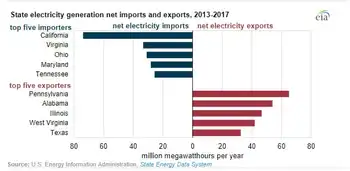
EIA: Pennsylvania exports the most electricity, California imports the most from other states
U.S. Electricity Trade by State, 2013-2017 highlights EIA grid patterns, interstate imports and exports, cross-border…
View more

Shopping for electricity is getting cheaper in Texas
Texas Electricity Prices are shifting as deregulation matures, with competitive market shopping lowering residential rates,…
View more
Canada expected to miss its 2035 clean electricity goals
Canada 2035 Clean Electricity Target faces a 48.4GW shortfall as renewable capacity lags; accelerating wind,…
View more
NorthX and BC Hydro open $5 million grid-flexibility funding program
BC Grid Flexibility Funding supports Canadian clean-technology companies developing demand response, energy storage and distributed…
View more
Sign Up for Electricity Forum’s Newsletter
Stay informed with our FREE Newsletter — get the latest news, breakthrough technologies, and expert insights, delivered straight to your inbox.
Electricity Today T&D Magazine Subscribe for FREE

Stay informed with the latest T&D policies and technologies.
- Timely insights from industry experts
- Practical solutions T&D engineers
- Free access to every issue

