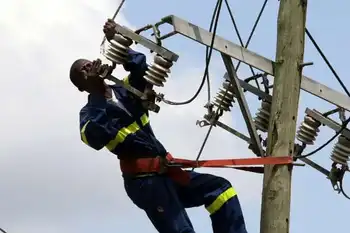
FirstEnergy asks Ohio to save power

By Reuters


CSA Z463 Electrical Maintenance -

Our customized live online or in‑person group training can be delivered to your staff at your location.

  • Live Online
  • 6 hours Instructor-led
  • Group Training Available
Regular Price:
$249
Coupon Price:
$199
Reserve Your Seat Today
Utility FirstEnergy Corp., who have been under fire as a result of the blackout, have appealed to its Ohio customers to cut their electricity use to offset high demand in a heat wave and reduced power supplies.

The Akron, Ohio-based utility warned it might order rolling blackouts in the Cleveland area, lasting up to two hours, if the generation shortage worsens.

FirstEnergy resorted to rolling outages a day after the blackout as it struggled to restore normal operations on its part of the power grid after Thursday's massive U.S.-Canada blackout.

An initial assessment of the cause of the blackout by an industry group focused on three power lines near Cleveland operated by FirstEnergy. But industry officials say multiple failures were likely involved in the blackout, the biggest in North American history.

Temperatures in the Cleveland area were expected to reach into the high 80s degrees Fahrenheit Wednesday, according to the AccuWeather forecast service, pushing up demand for power to run air conditioners.

FirstEnergy's 1,320 megawatt Perry nuclear power plant in Ohio was knocked off the grid in last week's blackout and is not expected to be back in service until early Thursday, according to the company.

The Perry plant can supply power for more than 1 million homes.

The utility's 925-megawatt Davis-Besse nuclear station in Ohio has been closed since early 2002 to replace a badly corroded cap on top of the reactor vessel.

Related News
Senate Committee Advised by WIRES Counsel That Electric Transmission Still Faces Barriers to Development

U.S. Transmission Grid Modernization underscores FERC policy certainty, high-voltage infrastructure upgrades, renewables integration, electrification, and grid resilience to cut congestion and enable distributed energy resources, safeguarding against extreme weather, cyber threats, and market volatility.


Key Points

A plan to expand, upgrade, and secure high-voltage networks for renewables integration, electrification, reliability.

✅ Replace aging lines to cut congestion and customer costs

✅ Integrate renewables and distributed energy resources at scale

✅ Enhance resilience to weather, cyber, and physical threats


Today, in a high-visibility hearing on U.S. energy delivery infrastructure before the United States Senate Committee on Energy and Natural Resources, WIRES Executive Director and Former FERC Chairman Jim Hoecker addressed the challenges and opportunities that confront the modern high-voltage grid as the industry strives to upgrade and expand it to meet the demands of consumers and the economy.

In prepared testimony and responses to Senators' questions, Hoecker urged the Committee to support industry efforts to expand and upgrade the transmission network and to help regulators, especially the Federal Energy Regulatory Commission (FERC action on aggregated DERs), promote certainty and predictability in energy policy and regulation. 


His testimony stressed these points:

Significant transmission investment is needed now to replace aging infrastructure like the aging grid risks to clean energy, reduce congestion costs, and deliver widespread benefits to customers.

Increasingly, the role of the transmission grid is to integrate new distributed resources and renewable energy into the electric system and make them available to the market.

The changing electric generation mix, including needed nuclear innovation, and the coming electrification of transportation, heating, and other segments of the American economy in the next quarter century will depend on a strong and adaptable electric system. A robust transmission grid will be the linchpin that will enable us to meet those demands.

"Transmission is the common element that will support all future electricity needs and provide a hedge against uncertainties and potential costly outcomes. The time is now to be proactive in encouraging additional investments in our nation's most crucial infrastructure: the electric transmission system," Hoecker said. 

Hoecker's testimony also emphasized that transmission investment will contribute to the overall resilience of the electric system by bringing multiple resources and technologies to bear on threats to the power system, including extreme weather and proposals like a wildfire-resilient grid bill, cyber or physical attacks, or other events. Visit WIRES website for recently filed comments on the subject (supported by a Brattle Group study). 

"Transmission gives us the optionality to adapt to whatever the future holds, and a modern and resilient transmission system, informed by Texas reliability improvements, will be the most valuable energy asset we have," says Nina Plaushin, president of WIRES and vice president of federal affairs, regulatory and communications for ITC Holdings Corp. 

Hoecker closed his testimony by emphasizing that the "electrification" scenario that is being discussed across multiple industries demands action now in order to ensure policy and regulatory certainty that will support needed transmission investment. More studies need to be conducted to better understand and define how this delivery network must be configured and planned in anticipation of this potential transformation in how we use electrical energy. A full copy of the WIRES testimony can be found here.


Related News

View more

Ireland and France will connect their electricity grids - here's how

Celtic Interconnector, a subsea electricity link between Ireland and France, connects EU grids via a high-voltage submarine cable, boosting security of supply, renewable integration, and cross-border trade with 700 MW capacity by 2026.


Key Points

A 700 MW subsea link between Ireland and France, boosting security, enabling trade, and supporting renewables.

✅ Approx. 600 km subsea cable from East Cork to Brittany

✅ 700 MW capacity; powers about 450,000 homes

✅ Financed by EIB, banks, CEF; Siemens Energy and Nexans


France and Ireland signed contracts on Friday to advance the Celtic Interconnector, a subsea electricity link to allow the exchange of electricity between the two EU countries. It will be the first interconnector between continental Europe and Ireland, as similar UK interconnector plans move forward in parallel. 

Representatives for Ireland’s electricity grid operator EirGrid and France’s grid operator RTE signed financial and technical agreements for the high-voltage submarine cable, mirroring developments like Maine’s approved transmission line in North America for cross-border power. The countries’ respective energy ministers witnessed the signing.

European commissioner for energy Kadri Simson said:

In the current energy market situation, marked by electricity price volatility, and the need to move away from imports of Russian fossil fuels, European energy infrastructure has become more important than ever.

The Celtic Interconnector is of paramount importance as it will end Ireland’s isolation from the Union’s power system, with parallels to Cyprus joining the electricity highway in the region, and ensure a reliable high-capacity link improving the security of electricity supply and supporting the development of renewables in both Ireland and France.

EirGrid and RTE signed €800 million ($827 million) worth of financing agreements with Barclays, BNP Paribas, Danske Bank, and the European Investment Bank, similar to the Lake Erie Connector investment that blends public and private capital.

In 2019, the project was awarded a Connecting Europe Facility (CEF) grant worth €530.7 million to support construction works and align with a broader push for electrification in Europe under climate strategies. The CEF program also provided €8.3 million for the Celtic Interconnector’s feasibility study and initial design and pre-consultation.

Siemens Energy will build converter stations in both countries, and Paris-based global cable company Nexans will design and install a 575-km-long cable for the project.

The cable will run between East Cork, on Ireland’s southern coast, and northwestern France’s Brittany coast and will connect into substations at Knockraha in Ireland and La Martyre in France.

The Celtic Interconnector, which is expected to be operational by 2026, will be approximately 600 km (373 miles) long and have a capacity of 700 MW, similar to cross-border initiatives such as Quebec-to-New York power exports expected in 2025, which is enough to power 450,000 households.


Related News

View more

Nova Scotia regulator approves 14% electricity rate hike, defying premier

Nova Scotia Power Rate Increase 2023-2024 approved by the UARB lifts electricity rates 14 percent, citing fuel costs and investments, despite Bill 212; includes ROE 9 percent, decarbonization deferral, and a storm cost recovery rider.


Key Points

An approved UARB rate case raising electricity bills about 14% over 2023-2024, with ROE 9% and cost recovery tools.

✅ UARB approves average 6.9% annual increases for 2023 and 2024.

✅ Maintains 9% ROE; sets storm cost rider trial and decarbonization deferral.

✅ Government opposed via Bill 212, but settlement mostly upheld.


Nova Scotia regulators approved a 14 per cent electricity rate hike on Thursday, defying calls by Premier Tim Houston to reject the increase.

Rates will rise on average by 6.9 per cent each year in 2023 and 2024.

In Newfoundland and Labrador, the NL Consumer Advocate called an 18 per cent electricity rate hike unacceptable amid affordability concerns.

The Nova Scotia Utility and Review Board (UARB) issued a 203-page decision ratifying most of the elements in a settlement agreement reached between Nova Scotia Power and customer groups after Houston's government legislated a rate, spending and profit cap on the utility in November.

The board said approval was in the public interest and the increase is "reasonable and appropriate."

"The board cannot simply disallow N.S. Power's reasonable costs to make rates more affordable. These principles ensure fair rates and the financial health of a utility so it can continue to invest in the system providing services to its customers," the three-member panel wrote.

"While the board can (and has) disallowed costs found to be imprudent or unreasonable, absent such a finding, N.S. Power's costs must be reflected in the rates."

In addition to the 14 per cent hike, the board maintained Nova Scotia Power's current return on equity of 9 per cent, with an earnings band of 8.75 to 9.25 per cent. It agreed in principle to establish a decarbonization deferral account to pay for the retirement of coal plants and related decommissioning costs, and implemented a storm cost recovery rider for a three-year trial period.

The board rejected several items in the agreement, including rolling some Maritime Link transmission capital projects into consumers' rates.

Nova Scotia Power welcomed the ruling in a statement, describing it as "the culmination of an extensive and transparent regulatory process over the past year."

Natural Resources and Renewables Minister Tory Rushton, who has said the government cannot order lower power rates in Nova Scotia, stated the UARB decision was not what the government wanted, but he did not indicate the government has any plans to bring forward legislation to overturn it. 

"We're disappointed by the decision today. We've always been very clear that we were standing by ratepayers right from the get-go but we also respect the independent body of the UARB and their decision today."


Pressure from the province
Houston claimed the settlement breached his government's legislation, known as Bill 212 in Nova Scotia, which he said was intended to protect ratepayers. It capped rates to cover non-fuel costs by 1.8 per cent. It did not cap rates to cover fuel costs or energy efficiency programs.

Bill 212 was passed after the board concluded weeks of public hearings into Nova Scotia Power's request for an electricity rate increase, its first general rate application in 10 years. Nova Scotia Power is a subsidiary of Halifax-based Emera, which is a publicly traded company.

The legislation triggered credit downgrades from two credit rating agencies who said it compromised the independence of the Nova Scotia Utility and Review Board.

In Newfoundland and Labrador, electricity users have begun paying for Muskrat Falls as project costs flow through rates, highlighting broader pressures on Atlantic Canada utilities.

In its decision, the board accepted that legislation was intended to protect ratepayers but did not preclude increases in rates.

"Given the exclusion of fuel and purchased power costs when these were expected to cause significant upward pressure on rates, it also did not preclude large increases in rates. Instead, the protection afforded by the Public Utilities Act amendments appears to be focused on N.S. Power's non-fuel costs, with several amendments targeting N.S. Power's cost of capital and earnings."

The board noted the province was the only intervenor in the rate case to object to the settlement.


Opposition reaction
Rushton said despite the outcome, Bill 212 achieved its goal, which was to protect ratepayers.

"Without Bill 212 the rates would have actually been higher," he said. "It would have double-digit rates for this year and next year and now it's single digits."

NDP Leader Claudia Chender said the end result is that Nova Scotians are still facing "incredibly unaffordable power."

Similar criticism emerged in Saskatchewan after an 8 per cent SaskPower increase, which the NDP opposed during provincial debates.

"It's really unfortunate for a lot of Nova Scotians who are heading into a freezing weekend where heat is not optional."

Chender said a different legislative approach is needed to change the regulatory system, and more needs to be done to help people pay their electricity bills.

Liberal MLA Kelly Regan echoed that sentiment.

"There are lots of people who can absorb this. There are a lot of people who cannot, and those are the people that we should be worried about right now. This is why we've been saying all along the government needs to actually give money directly to Nova Scotians who need help with power rates."

Rushton said the government has introduced programs to help Nova Scotians pay for heat, including raising the income threshold to access the Heating Assistance Rebate Program and creating incentives to install heat pumps.

Elsewhere, some governments have provided a lump-sum credit on electricity bills to ease short-term costs for households.


Related News

View more

Ontario Breaks Ground on First Small Modular Nuclear Reactor

Ontario SMR BWRX-300 leads Canada in next-gen nuclear energy at Darlington, with GE Vernova and Hitachi, delivering clean, reliable power via modular design, passive safety, scalability, and lower costs for grid integration.


Key Points

Ontario SMR BWRX-300 is a 300 MW modular boiling water reactor at Darlington with passive safety and clean power.

✅ 300 MW BWR supplies power for about 300,000 homes

✅ Passive safety enables safe shutdown without external power

✅ Modular design reduces costs and speeds grid integration


Ontario has initiated the construction of Canada's first small modular nuclear reactor (SMR), supported by OPG's SMR commitment to deployment, marking a significant milestone in the province's energy strategy. This development positions Ontario at the forefront of next-generation nuclear technology within the G7 nations.

The project, known as the Darlington New Nuclear Project, is being led by Ontario Power Generation (OPG) in collaboration with GE Vernova and Hitachi Nuclear Energy, and through its OPG-TVA partnership on new nuclear technology development. The chosen design is the BWRX-300, a 300-megawatt boiling water reactor that is approximately one-tenth the size and complexity of traditional nuclear reactors. The first unit is expected to be operational by 2029, with plans for additional units to follow.

Each BWRX-300 reactor is projected to supply electricity to about 300,000 homes, contributing to Ontario's efforts, which include the decision to refurbish Pickering B for additional baseload capacity, to meet the anticipated 75% increase in electricity demand by 2050. The compact design of the SMR allows for easier integration into existing infrastructure, reducing the need for extensive new transmission lines.

The economic impact of the project is substantial. The construction of four such reactors is expected to create up to 18,000 jobs and contribute approximately $38.5 billion CAD to the Canadian economy, reflecting the economic benefits of nuclear projects over 65 years. The modular nature of SMRs also allows for scalability, with each additional unit potentially reducing costs through economies of scale.

Safety is a paramount consideration in the design of the BWRX-300. The reactor employs passive safety features, meaning it can safely shut down without the need for external power or operator intervention. This design enhances the reactor's resilience to potential emergencies, aligning with stringent regulatory standards.

Ontario's commitment to nuclear energy is further demonstrated by its plans for four SMRs at the Darlington site. This initiative reflects a broader strategy to diversify the province's energy mix, incorporating clean and reliable power sources to complement renewable energy efforts.

While the development of SMRs in Ontario is a significant step forward, it also aligns with the Canadian nuclear initiative positioning Canada as a leader in the global nuclear energy landscape. The successful implementation of the BWRX-300 could serve as a model for other nations exploring advanced nuclear technologies.

Ontario's groundbreaking work on small modular nuclear reactors represents a forward-thinking approach to energy generation. By embracing innovative technologies, the province is not only addressing future energy demands but also, through the Pickering NGS life extension, contributing to the global transition towards sustainable and secure energy solutions.


Related News

View more

Trump declares end to 'war on coal,' but utilities aren't listening

US Utilities Shift From Coal as natural gas stays cheap, renewables like wind and solar scale, Clean Power Plan uncertainty lingers, and investors, state policies, and emissions targets drive generation choices and accelerate retirements.


Key Points

A long-term shift by utilities from coal to cheap natural gas, expanding renewables, and lower-emission generation.

✅ Cheap natural gas undercuts coal on price and flexibility.

✅ Renewables costs falling; wind and solar add competitive capacity.

✅ State policies and investors sustain emissions reductions.


When President Donald Trump signed an executive order last week to sweep away Obama-era climate change regulations, he said it would end America's "war on coal", usher in a new era of energy production and put miners back to work.

But the biggest consumers of U.S. coal - power generating companies - remain unconvinced about efforts to replace Obama's power plant overhaul with a lighter-touch approach.

Reuters surveyed 32 utilities with operations in the 26 states that sued former President Barack Obama's administration to block its Clean Power Plan, the main target of Trump's executive order. The bulk of them have no plans to alter their multi-billion dollar, years-long shift away from coal, suggesting demand for the fuel will keep falling despite Trump's efforts.

The utilities gave many reasons, mainly economic: Natural gas - coal’s top competitor - is cheap and abundant; solar and wind power costs are falling; state environmental laws remain in place; and Trump's regulatory rollback may not survive legal challenges, as rushed pricing changes draw warnings from energy groups.

Meanwhile, big investors aligned with the global push to fight climate change – such as the Norwegian Sovereign Wealth Fund – have been pressuring U.S. utilities in which they own stakes to cut coal use.

"I’m not going to build new coal plants in today’s environment," said Ben Fowke, CEO of Xcel Energy, which operates in eight states and uses coal for about 36 percent of its electricity production. "And if I’m not going to build new ones, eventually there won’t be any."

Of the 32 utilities contacted by Reuters, 20 said Trump's order would have no impact on their investment plans; five said they were reviewing the implications of the order; six gave no response. Just one said it would prolong the life of some of its older coal-fired power units.

North Dakota's Basin Electric Power Cooperative was the sole utility to identify an immediate positive impact of Trump's order on the outlook for coal.

"We're in the situation where the executive order takes a lot of pressure off the decisions we had to make in the near term, such as whether to retrofit and retire older coal plants," said Dale Niezwaag, a spokesman for Basin Electric. "But Trump can be a one-termer, so the reprieve out there is short."

Trump's executive order triggered a review aimed at killing the Clean Power Plan and paving the way for the EPA's Affordable Clean Energy rule to replace it, though litigation is ongoing. The Obama-era law would have required states, by 2030, to collectively cut carbon emissions from existing power plants by 30 percent from 2005 levels. It was designed as a primary strategy in U.S. efforts to fight global climate change.

The U.S. coal industry, without increases in domestic demand, would need to rely on export markets for growth. Shipments of U.S. metallurgical coal, used in the production of steel, have recently shown up in China following a two-year hiatus - in part to offset banned shipments from North Korea and temporary delays from cyclone-hit Australian producers.


RETIRING AND RETROFITTING

Coal had been the primary fuel source for U.S. power plants for the last century, but its use has fallen more than a third since 2008 after advancements in drilling technology unlocked new reserves of natural gas.

Hundreds of aging coal-fired power plants have been retired or retrofitted. Huge coal mining companies like Peabody Energy Corp and Arch Coal fell into bankruptcy, and production last year hit its lowest point since 1978.

The slide appears likely to continue: U.S. power companies now expect to retire or convert more than 8,000 megawatts of coal-fired plants in 2017 after shutting almost 13,000 MW last year, according to U.S. Energy Information Administration and Thomson Reuters data.

Luke Popovich, a spokesman for the National Mining Association, acknowledged Trump's efforts would not return the coal industry to its "glory days," but offered some hope.

"There may not be immediate plans for utilities to bring on more coal, but the future is always uncertain in this market," he said.

Many of the companies in the Reuters survey said they had been focused on reducing carbon emissions for a decade or more while tracking 2017 utility trends that reinforce long-term planning, and were hesitant to change direction based on shifting political winds in Washington D.C.

"Utility planning typically takes place over much longer periods than presidential terms of office," Berkshire Hathaway Inc-owned Pacificorp spokesman Tom Gauntt said.

Several utilities also cited falling costs for wind and solar power, which are now often as cheap as coal or natural gas, thanks in part to government subsidies for renewable energy and recent FERC decisions affecting the grid.

In the meantime, activist investors have increased pressure on U.S. utilities to shun coal.

In the last year, Norway's sovereign wealth fund, the world's largest, has excluded more than a dozen U.S. power companies - including Xcel, American Electric Power Co Inc and NRG Energy Inc - from its investments because of their reliance on coal-fired power.

Another eight companies, including Southern Co and NorthWestern Corp, are "under observation" by the fund.

Wyoming-based coal miner Cloud Peak Energy said it doesn't blame utilities for being lukewarm to Trump's order.

"For eight years, if you were a utility running coal, you got the hell kicked out of you," said Richard Reavey, a spokesman for the company. "Are you going to turn around tomorrow and say, 'Let's buy lots of coal plants'? Pretty unlikely."


Related News

View more

Charting a path to net zero electricity emissions by the middle of the century

Clean Energy Standard charts a federal path to decarbonize the power sector, scaling renewables, wind, solar, nuclear, and carbon capture to slash emissions, create green jobs, and reach net-zero targets amid the climate crisis.


Key Points

A federal policy to expand clean power and cut emissions with renewables, nuclear, and carbon capture toward net-zero.

✅ Mandates annual increases in clean electricity supply

✅ Includes renewables, nuclear, hydro, and carbon capture

✅ Targets rapid emissions cuts and net-zero by mid-century


The world has been put on notice. Last year, both the UN Intergovernmental Panel on Climate Change and the U.S. National Climate Assessment warned that we need to slash greenhouse gas emissions to avoid disastrous impacts of global warming. Their direct language forecasting devastating effects on our health, economics, environment, and ways of life has made even more urgent the responsibility we all have to act boldly to combat the climate crisis.

This week, we’re adding one important tool for addressing the climate crisis to the national conversation.

Together, we’re taking that bold action. The Climate reports made clear that to limit the global temperature rise and stave off devastating impacts to our climate—human-caused CO2 emissions must fall rapidly by 2030 and that we, as a global community, underscored at the Katowice climate talks, must reach net-zero emissions by the middle of the century. The Clean Energy Standard is federal legislation that offers a pathway toward decarbonizing our power sector and helping our nation accomplish a goal of net-zero emissions by the 2050s.

Under this plan, any company selling retail electricity will have a mandate to increase the amount of clean energy provided to its customers. It will incentivize clean electricity investment to put the U.S. on a sustainable path.

To deal most effectively with a crisis, all tools must be on the table. Our plan focuses solely on emissions, and there is a place for all technologies that can put us on the path to net zero. That will mean drastic increases in wind and solar energy for sure, as states like California pursue a 100% carbon-free electricity mandate to accelerate deployment, but nuclear power, hydro power, and fossil fuels with carbon capture and storage all have important roles to play.

We’re doing this because the science is clear – tackling our climate crisis requires serious and rapid action to control greenhouse gas emissions, and the push for decarbonization is irreversible according to many. Inaction on the climate crisis puts our families at risk, and we’re not wasting any time. This is also an opportunity to create good-paying green jobs that can last generations and uplift the middle class.

We are doing this for the environment, but also for jobs and economic competitiveness. The green economy is the future and we’re ready to see it grow, with states like New York advancing a Green New Deal that drives innovation. The United States can lead, or we can follow, and we want our nation to lead.

And, because as a New Mexican and a Minnesotan, we know that the impacts of climate change go far beyond the headlines and political discourse. It means devastation within tamarack forests and an increase in deadly fires. It means hotter summers and shorter winters with extreme temperature swings throughout the year. It means devastating flash floods with increasingly intense rain. It’s impacting our pocketbooks when farmers and small businesses who work the land in rural communities are unable to make ends meet.

States across the country are already acting to combat the climate crisis – including Minnesota's 2050 carbon-free electricity plan and New Mexico. But in order to truly address climate change, we have to be in this together as Americans. If the problem is far-reaching, our solutions must be equally as holistic.

It's why we've worked with green groups and activists, unions, and communities across the country - from urban to rural - to create a solution that understands the different starting points communities face in reaching net zero emissions, but doesn't shrink from the absolute need to reach that standard.

There is not one solution to climate change – it will take a collective group of individuals prepared to boldly act. And we are ready to take on that fight.

In Congress, we have formed the House Select Committee on the Climate Crisis and the Senate Democrats’ Special Committee on the Climate Crisis to hear from everyday Americans how climate change is affecting them – and how we can come together to find solutions that build on the historic climate deal passed this year. We have heard the stories of young people worried about their futures. And we realize there is a sense of urgency to act.

Over the coming weeks and months, we will be building support from communities across the country to make this plan a reality. We will continue working with stakeholders to ensure every voice is heard. Most importantly, we will continue listening to you and your communities.


Related News

View more

Sign Up for Electricity Forum’s Newsletter

Stay informed with our FREE Newsletter — get the latest news, breakthrough technologies, and expert insights, delivered straight to your inbox.

Electricity Today T&D Magazine Subscribe for FREE

Stay informed with the latest T&D policies and technologies.
  • Timely insights from industry experts
  • Practical solutions T&D engineers
  • Free access to every issue

Download the 2025 Electrical Training Catalog

Explore 50+ live, expert-led electrical training courses –

  • Interactive
  • Flexible
  • CEU-cerified