Texas lawmakers propose electricity market bailout after winter storm


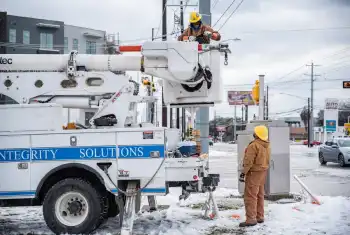
texas line crew performs repairs

NFPA 70b Training - Electrical Maintenance

Our customized live online or in‑person group training can be delivered to your staff at your location.

  • Live Online
  • 12 hours Instructor-led
  • Group Training Available
Regular Price:
$599
Coupon Price:
$499
Reserve Your Seat Today

Texas Electricity Market Bailout proposes securitization bonds and ERCOT-backed fees after Winter Storm Uri, spreading costs via ratepayer charges on power bills to stabilize generators, co-ops, and retailers and avert bankruptcies and investor flight.


Key Points

State plan to securitize storm debts via ERCOT fees, adding bill charges to stabilize Texas power firms.

✅ Securitization bonds finance unpaid ancillary services and energy costs

✅ ERCOT fee spreads Winter Storm Uri debts across ratepayers statewide

✅ Aims to prevent bankruptcies, preserve grid reliability, reassure investors


An approximately $2.5 billion plan to bail out Texas’ distressed electricity market from the financial crisis caused by Winter Storm Uri in February has been approved by the Texas House.

The legislation would impose a fee — likely for the next decade or longer — on electricity companies, which would then get passed on to residential and business customers in their power bills, even as some utilities waived certain fees earlier in the crisis.

House lawmakers sent House Bill 4492 to the Senate on Thursday after a 129-15 vote. A similar bill is advancing in the Senate.

Some of the state’s electricity providers and generators are financially underwater in the aftermath of the February power outages, which left millions without power and killed more than 100 people. Electricity companies had to buy whatever power was available at the maximum rate allowed by Texas regulations — $9,000 per megawatt hour — during the week of the storm (the average price for power in 2020 was $22 per megawatt hour). Natural gas fuel prices also spiked more than 700% during the storm.

Several companies are nearing default on their bills to the Electric Reliability Council of Texas, which manages the Texas power grid that covers most of the state and facilitates financial transactions in it.

Rural electric cooperatives were especially hard hit; Brazos Electric Power Cooperative, which supplies electricity to 1.5 million customers, filed for bankruptcy citing a $1.8 billion debt to ERCOT.

State Rep. Chris Paddie, R-Marshall, the bill’s author, said a second bailout bill will be necessary during the current legislative session for severely distressed electric cooperatives.

“This is a financial crisis, and it’s a big one,” James Schaefer, a senior managing director at Guggenheim Partners, an investment bank, told lawmakers at a House State Affairs Committee hearing in early April. He warned that more bankruptcies would cause higher costs to customers and hurt the state’s image in the eyes of investors.

“You’ve got to free the system,” Schaefer said. “It’s horrible that a bunch of folks have to pay, but it’s a system-wide failure. If you let a bunch of folks crash, it’s not a good look for your state.”

If approved by the Senate and Gov. Greg Abbott, a newly-created Texas Electric Securitization Corp. would use the money raised from the fees for bonds to help pay the companies’ debts, including costs for ancillary services, a financial product that helps ensure power is continuously generated and improve electricity reliability across the grid.

Paddie told his colleagues Wednesday that he could not yet estimate how long the new fee would be imposed, but during committee hearings lawmakers estimated it’s likely to be at least a decade. Several other bills to spread out the costs of the winter storm and consider market reforms are also moving through the Legislature.

ERCOT’s independent market monitor recommended in March that energy sold during that period be repriced at a lower rate, which would have allowed ERCOT to claw back about $4.2 billion in payments to power generators, but the Public Utility Commission declined to do so, even as a court ruling on plant obligations in emergencies drew scrutiny among market participants.

Instead, lawmakers are pushing for bailouts that several energy experts have said is needed, both to ensure distressed companies don’t pass enormous costs on to their customers and to prevent electricity investors and companies from leaving the state if it’s viewed as too risky to continue doing business.

Becky Klein, an energy consultant in Austin and former chair of the Public Utility Commission who played a key role in de-regulating Texas’ electricity market two decades ago, said during a retail electricity panel hosted by Integrate that legislation is necessary to provide “some kind of backstop during a crazy market crisis like this to show the financial market that we’re willing to provide some relief.”

Still, some lawmakers are concerned with how they will win public support, including potential voter-approved funding measures, for bills to bail out the state’s electricity market.

“I have to go back to Laredo and say, ‘I know you didn’t have electricity for several days, but now I’m going to make you pay a little more for the next 20 years,’” state Rep. Richard Peña Raymond, D-Laredo, said during an early April discussion on the plan in the House State Affairs Committee. He said he voted for the bill because it’s in the best interest of the state.


Paddie, during the same committee hearing, acknowledged that “none of us want to increase fees or taxes.” However, he said, “We have to deal with the reality set before us.”


Related News

Related News
Hydroelectricity Under Pumped Storage Capacity

Pumped Storage Hydroelectricity balances renewable energy, stabilizes the grid, and provides large-scale energy storage using reservoirs and reversible turbines, delivering flexible peak power, frequency control, and rapid response to variable wind and solar generation.


Key Points

A reversible hydro system that stores energy by pumping water uphill, then generates flexible peak power.

✅ Balances variable wind and solar with rapid ramping

✅ Stores off-peak electricity in upper reservoirs

✅ Enhances grid stability, frequency control, and reserves


The expense of hydroelectricity is moderately low, making it a serious wellspring of sustainable power. The hydro station burns-through no water, dissimilar to coal or gas plants. The commonplace expense of power from a hydro station bigger than 10 megawatts is 3 to 5 US pennies for every kilowatt hour, and Niagara Falls powerhouse upgrade projects show how modernization can further improve efficiency and reliability. With a dam and supply it is likewise an adaptable wellspring of power, since the sum delivered by the station can be shifted up or down quickly (as meager as a couple of moments) to adjust to changing energy requests.

When a hydroelectric complex is developed, the task creates no immediate waste, and it for the most part has an extensively lower yield level of ozone harming substances than photovoltaic force plants and positively petroleum product fueled energy plants, with calls to invest in hydropower highlighting these benefits. In open-circle frameworks, unadulterated pumped storage plants store water in an upper repository with no normal inflows, while pump back plants use a blend of pumped storage and regular hydroelectric plants with an upper supply that is renewed to a limited extent by common inflows from a stream or waterway.

Plants that don't utilize pumped capacity are alluded to as ordinary hydroelectric plants, and initiatives focused on repowering existing dams continue to expand clean generation; regular hydroelectric plants that have critical capacity limit might have the option to assume a comparable function in the electrical lattice as pumped capacity by conceding yield until required.

The main use for pumped capacity has customarily been to adjust baseload powerplants, however may likewise be utilized to decrease the fluctuating yield of discontinuous fuel sources, while emerging gravity energy storage concepts broaden long-duration options. Pumped capacity gives a heap now and again of high power yield and low power interest, empowering extra framework top limit.

In specific wards, power costs might be near zero or once in a while negative on events that there is more electrical age accessible than there is load accessible to retain it; despite the fact that at present this is infrequently because of wind or sunlight based force alone, expanded breeze and sun oriented age will improve the probability of such events.

All things considered, pumped capacity will turn out to be particularly significant as an equilibrium for exceptionally huge scope photovoltaic age. Increased long-distance bandwidth, including hydropower imports from Canada, joined with huge measures of energy stockpiling will be a critical piece of directing any enormous scope sending of irregular inexhaustible force sources. The high non-firm inexhaustible power entrance in certain districts supplies 40% of yearly yield, however 60% might be reached before extra capaciy is fundamental.

Pumped capacity plants can work with seawater, despite the fact that there are extra difficulties contrasted with utilizing new water. Initiated in 1966, the 240 MW Rance flowing force station in France can incompletely function as a pumped storage station. At the point when elevated tides happen at off-top hours, the turbines can be utilized to pump more seawater into the repository than the elevated tide would have normally gotten. It is the main enormous scope power plant of its sort.

Alongside energy mechanism, pumped capacity frameworks help control electrical organization recurrence and give save age. Warm plants are substantially less ready to react to abrupt changes in electrical interest, and can see higher thermal PLF during periods of reduced hydro generation, conceivably causing recurrence and voltage precariousness.

Pumped storage plants, as other hydroelectric plants, including new BC generating stations, can react to stack changes in practically no time. Pumped capacity hydroelectricity permits energy from discontinuous sources, (for example, sunlight based, wind) and different renewables, or abundance power from consistent base-load sources, (for example, coal or atomic) to be put something aside for times of more popularity.

The repositories utilized with siphoned capacity are tiny when contrasted with ordinary hydroelectric dams of comparable force limit, and creating periods are regularly not exactly a large portion of a day. This technique produces power to gracefully high top requests by moving water between repositories at various heights.

Now and again of low electrical interest, the abundance age limit is utilized to pump water into the higher store. At the point when the interest gets more noteworthy, water is delivered once more into the lower repository through a turbine. Pumped capacity plans at present give the most monetarily significant methods for enormous scope matrix energy stockpiling and improve the every day limit factor of the age framework. Pumped capacity isn't a fuel source, and shows up as a negative number in postings.


Related News

View more

Former B.C. Hydro CEO earns half a million without working a single day

B.C. Hydro Salary Continuance Payout spotlights executive compensation, severance, and governance at a Crown corporation after a firing, citing financial disclosure reports, Site C dam ties, and a leadership change under a new government.


Key Points

Severance-style pay for B.C. Hydro's fired CEO, via salary continuance and disclosed in public filings.

✅ $541,615 total compensation without working days

✅ Salary continuance after NDP firing; financial disclosures

✅ Later named Canada Post interim CEO amid strike


Former B.C. Hydro president and chief executive officer Jessica McDonald received a total of $541,615 in compensation during the 2017-2018 fiscal year, a figure that sits amid wider debates over executive pay at utilities such as Hydro One CEO pay at the provincial utility, without having worked a single day for the Crown corporation.

She earned this money under a compensation package after the in-coming New Democratic government of John Horgan fired her, a move comparable to Ontario's decision when the Hydro One CEO and board exit amid share declines. The previous B.C. Liberal government named her president and CEO of B.C. Hydro in 2014, and McDonald was a strong supporter of the controversial Site C dam project now going ahead following a review.

The current New Democratic government placed her on what financial disclosure documents call “salary continuance” effective July 21, 2017 — the day the government announced her departure — at a utility scrutinized in a misled regulator report that raised oversight concerns.

According to financial disclosure statements, McDonald remained on “salary continuance” until Sept. 21 of this year, and the utility has also been assessed in a deferred operating costs report released by the auditor general. During this period, she earned $272,659, a figure that includes benefits, pension and other compensation.

McDonald — who used to be the deputy minister to former premier Gordon Campbell — is now working for Canada Post, which appointed her as interim president and chief executive officer in March, while developments at Manitoba Hydro highlight broader political pressures on Crown utilities.

She started in her new role on April 2, 2018, and now finds herself in the middle of managing a postal carrier strike.


Related News

View more

The Need for Electricity During the COVID-19 Pandemic

US utilities COVID-19 resilience shows electric utilities maintaining demand stability, reaffirming earnings guidance, and accessing the bond market for low-cost financing, as Dominion, NextEra, and Con Edison manage recession risks.


Key Points

It is the sector's capacity to sustain demand, financing access, and guidance despite pandemic recession pressures.

✅ Bond market access locks in low-cost, long-term debt

✅ Stable residential load offsets industrial weakness

✅ Guidance largely reaffirmed by major utilities


Dominion Energy (D) expects "incremental residential load" gains, consistent with COVID-19 electricity demand patterns, as a result of COVID-19 fallout. Southern Company CEO Tom Fanning says his company is "nowhere near" a need to review earnings guidance because of a potential recession, in a region where efficiency and demand response can help level electricity demand for years.

Sempra Energy (SRE) has reaffirmed earnings per share guidance for 2020 and 2021, as well timing for the sale of assets in Chile and Peru, and peers such as Duke Energy's renewables plan have reaffirmed capital investments to deliver cleaner energy and economic growth. And Xcel Energy (XEL) says it still "hasn’t seen material impact on its business."

Several electric utilities have demonstrated ability to tap the bond market, in line with utility sector trends in recent years, to lock in low-cost financing, as America moves toward broader electrification, despite ongoing turmoil. Their ranks include Dominion Energy, renewable energy leader NextEra Energy (NEE) and Consolidated Edison (ED), which last week sold $1 billion of 30-year bonds at a coupon rate of just 3.95 percent.

It’s still early days for US COVID-19 fallout. And most electric companies have yet to issue guidance. That’s understandable, since so much is still unknown about the virus and the damage it will ultimately do to human health and the global economy. But so far, the US power industry is showing typical resilience in tough times, as it coordinates closely with federal partners to maintain reliability.

Will it last? We won’t know for certain until there’s a lot more data. NextEra is usually first to report its Q1 earnings reports and detailed guidance. But that’s not expected until April 23. And companies may delay financials further, should the virus and efforts to control it impede collection and analysis of data, and as they address electricity shut-off risks affecting customers.


Related News

View more

How ‘Virtual Power Plants’ Will Change The Future Of Electricity

Virtual Power Plants orchestrate distributed energy resources like rooftop solar, home batteries, and EVs to deliver grid services, demand response, peak shaving, and resilience, lowering costs while enhancing reliability across wholesale markets and local networks.


Key Points

Virtual Power Plants aggregate solar and batteries to provide grid services, cut peak costs, and boost reliability.

✅ Aggregates DERs via cloud to bid into wholesale markets

✅ Reduces peak demand, defers costly grid upgrades

✅ Enhances resilience vs outages, cyber risks, and wildfires


If “virtual” meetings can allow companies to gather without anyone being in the office, then remotely distributed solar panels and batteries can harness energy and act as “virtual power plants.” It is simply the orchestration of millions of dispersed assets within a smarter electricity infrastructure to manage the supply of electricity — power that can be redirected back to the grid and distributed to homes and businesses. 

The ultimate goal is to revamp the energy landscape, making it cleaner and more reliable. By using onsite generation such as rooftop solar and smart solar inverters in combination with battery storage, those services can reduce the network’s overall cost by deferring expensive infrastructure upgrades and by reducing the need to purchase cost-prohibitive peak power. 

“We expect virtual power plants, including aggregated home solar and batteries, to become more common and more impactful for energy consumers throughout the country in the coming years,” says Michael Sachdev, chief product officer for Sunrun Inc., a rooftop solar company, in an interview. “The growth of home solar and batteries will be most apparent in places where households have an immediate need for backup power, as they do in California, where grid reliability pressures have led utilities to turn off the electricity to reduce wildfire risk.”

Most Popular In: Energy

How Extremophile Bacteria Living In Nuclear Reactors Might Help Us Make Vaccines
Apple, Ford, McDonald’s, Microsoft Among This Summer’s Climate Leaders
What’s Next For Oil And Gas?
Home battery adoption, such as Tesla Powerwall systems, is becoming commonplace in Hawaii and in New England, he adds, because those distributed assets are improving the efficiency of the electrical network. It is a trend that is reshaping the country’s energy generation and delivery system by relying more on clean onsite generation and less on fossil fuels.

Sunrun has recently formed a business partnership with AutoGrid, which will manage Sunrun’s fleet of rechargeable batteries. It is a cloud-based system that allows Sunrun to work with utilities to dispatch its “storage fleet” to optimize the economic results. AutoGrid compiles the data and makes AI-driven forecasts that enable it to pinpoint potential trouble spots. 

But a distributed energy system, or a virtual power plant, would have 200,000 subsystems. Or, 200,000 5 kilowatt batteries would be the equivalent of one power plant that has a capacity of 1,000 megawatts. 

“A virtual power plant acts as a generator,” says Amit Narayan, chief executive officer of AutoGrid, in an interview. “It is one of the top five innovations of the decade. If you look at Sunrun, 60% of every solar system it sells in the Bay Area is getting attached to a battery. The value proposition comes when you can aggregate these batteries and market them as a generation unit. The pool of individual assets may improve over time. But when you add these up, it is better than a large-scale plant. It is like going from mainframe computers to laptops.”

The AutoGrid executive goes on to say that centralized systems are less reliable than distributed resources. While one battery could falter, 200,000 of them that operate from remote locations will prove to be more durable — able to withstand cyber attacks and wildfires. Sunrun’s Sachdev adds that the ability to store energy in batteries, as seen in California’s expanding grid-scale battery use supporting reliability, and to move it to the grid on demand creates value not just for homes and businesses but also for the network as a whole.

The good news is that the trend worldwide is to make it easier for smaller distributed assets, including energy storage for microgrids that support local resilience, to get the same regulatory treatment as power plants. System operators have been obligated to call up those power supplies that are the most cost-effective and that can be easily dispatched. But now regulators are giving virtual power plants comprised of solar and batteries the same treatment. 

In the United States, for example, the Federal Energy Regulatory Commission issued an order in 2018 that allows storage resources to participate in wholesale markets — where electricity is bought directly from generators before selling that power to homes and businesses. Under the ruling, virtual power plants are paid the same as traditional power suppliers. A federal appeals court this month upheld the commission’s order, saying that it had the right to ensure “technological advances in energy storage are fully realized in the marketplace.” 

“In the past, we have used back-up generators,” notes AutoGrid’s Narayan. “As we move toward more automation, we are opening up the market to small assets such as battery storage and electric vehicles. As we deploy more of these assets, there will be increasing opportunities for virtual power plants.” 

Virtual power plants have the potential to change the energy horizon by harnessing locally-produced solar power and redistributing that to where it is most needed — all facilitated by cloud-based software that has a full panoramic view. At the same time, those smaller distributed assets can add more reliability and give consumers greater peace-of-mind — a dynamic that does, indeed, beef-up America’s generation and delivery network.


Related News

View more

Energy Vault Secures $28M for California Green Hydrogen Microgrid

Calistoga Resiliency Centre Microgrid delivers grid resilience via green hydrogen and BESS, providing island-mode backup during PSPS events, wildfire risk, and outages, with black-start and grid-forming capabilities for reliable community power.


Key Points

A hybrid green hydrogen and BESS facility ensuring resilient, islanded power for Calistoga during PSPS and outages.

✅ 293 MWh capacity with 8.5 MW peak for critical backup

✅ Hybrid lithium-ion BESS plus green hydrogen fuel cells

✅ Island mode with black-start and grid-forming support


Energy Vault, a prominent energy storage and technology company known for its gravity storage, recently secured US$28 million in project financing for its innovative Calistoga Resiliency Centre (CRC) in California. This funding will enable the development of a microgrid powered by a unique combination of green hydrogen and battery energy storage systems (BESS), marking a significant step forward in enhancing grid resilience in the face of natural disasters such as wildfires.

Located in California's fire-prone regions, the CRC is designed to provide critical backup power during Public Safety Power Shutoff (PSPS) events—periods when utility companies proactively cut power to prevent wildfires. These events can leave communities without electricity for extended periods, making the need for reliable, independent power sources more urgent as many utilities see benefits in energy storage today. The CRC, with a capacity of 293 MWh and a peak output of 8.5 MW, will ensure that the Calistoga community maintains power even when the grid is disconnected.

The CRC features an integrated hybrid system that combines lithium-ion batteries and green hydrogen fuel cells, even as some grid-scale projects adopt vanadium flow batteries for long-duration needs. During a PSPS event or other grid outages, the system will operate in "island mode," using hydrogen to generate electricity. This setup not only guarantees power supply but also contributes to grid stability by supporting black-start and grid-forming functions. Energy Vault's proprietary B-VAULT DC battery technology complements the hydrogen fuel cells, enhancing the overall performance and resilience of the microgrid.

One of the key aspects of the CRC project is the utilization of green hydrogen. Unlike traditional hydrogen, which is often produced using fossil fuels, green hydrogen is generated through renewable energy sources like solar or wind power, with large-scale initiatives such as British Columbia hydrogen project accelerating supply, making it a cleaner and more sustainable alternative. This aligns with California’s ambitious clean energy goals and is expected to reduce the carbon footprint of the region’s energy infrastructure.

The CRC project also sets a precedent for future hybrid microgrid deployments across California and other wildfire-prone areas, with utilities like SDG&E Emerald Storage highlighting growing adoption. Energy Vault has positioned the CRC as a model for scalable, utility-scale microgrids that can be adapted to various locations facing similar challenges. Following the success of this project, Energy Vault is expanding its portfolio with additional projects in Texas, where it anticipates securing up to US$25 million in financing.

The funding for the CRC also includes the sale of an investment tax credit (ITC), a key component of the financing structure that helps make such ambitious projects financially viable. This structure is crucial as it allows companies to leverage government incentives to offset development costs, including CEC long-duration storage funding, thus encouraging further investment in green energy infrastructure.

Despite some skepticism regarding the transportation of hydrogen rather than producing it onsite, the project has garnered strong support. California’s Public Utilities Commission (CPUC) acknowledged the potential risks of transporting green hydrogen but emphasized that it is still preferable to using more harmful fuel sources. This recognition is important as it validates Energy Vault’s approach to using hydrogen as part of a broader strategy to transition to clean, reliable energy solutions.

Energy Vault's shift from its traditional gravity-based energy storage systems to battery energy storage systems, such as BESS in New York, reflects the company's adaptation to the growing demand for versatile, efficient energy solutions. The hybrid approach of combining BESS with green hydrogen represents an innovative way to address the challenges of energy storage, especially in regions vulnerable to natural disasters and power outages.

As the CRC nears mechanical completion and aims for full commercial operations by Q2 2025, it is poised to become a critical part of California’s grid resilience strategy. The microgrid's ability to function autonomously during emergencies will provide invaluable benefits not only to Calistoga but also to other communities that may face similar grid disruptions in the future.

Energy Vault’s US$28 million financing for the Calistoga Resiliency Centre marks a significant milestone in the development of hybrid microgrids that combine the power of green hydrogen and battery energy storage. This project exemplifies the future of energy resilience, showcasing a forward-thinking approach to mitigating the impact of natural disasters and ensuring a reliable, sustainable energy future for communities at risk. With its innovative use of renewable energy sources and cutting-edge technology, the CRC sets a strong example for future energy storage projects worldwide.


Related News

View more

Scotland’s Wind Farms Generate Enough Electricity to Power Nearly 4.5 Million Homes

Scotland Wind Energy delivered record renewable power as wind turbines and farms generated 9,831,320 MWh in H1 2019, supplying clean electricity for every home twice and supporting northern England, according to WWF data.


Key Points

Term for Scotland's wind power output, highlighting 2019 records, clean electricity, and progress on decarbonization.

✅ 9,831,320 MWh generated Jan-Jun 2019 by wind farms

✅ Enough to power 4.47 million homes twice in that period

✅ Advances decarbonization and 2030 renewables, 2050 net-zero goals


Wind turbines in Scotland produced enough electricity in the first half of 2019, reflecting periods when wind led the power mix across the UK, to power every home in the country twice over, according to new data by the analytics group WeatherEnergy. The wind farms generated 9,831,320 megawatt-hours between January and June, as the UK set a wind generation record in comparable periods, equal to the total electricity consumption of 4.47 million homes during that same period.

The electricity generated by wind in early 2019 is enough to power all of Scotland’s homes, as well as a large portion of northern England’s, highlighting how wind and solar exceeded nuclear in the UK in recent milestones as well, and events such as record UK output during Storm Malik underscore this capacity.

“These are amazing figures,” Robin Parker, climate and energy policy manager at WWF, which highlighted the new data, said in a statement. “Scotland’s wind energy revolution is clearly continuing to power ahead, as wind became the UK’s main electricity source in a recent first. Up and down the country, we are all benefitting from cleaner energy and so is the climate.”

Scotland currently has a target of generating half its electricity from renewables by 2030, a goal buoyed by milestones like more UK electricity from wind than coal in 2016, and decarbonizing its energy system almost entirely by 2050. Experts say the latest wind energy data shows the country could reach its goal far sooner than originally anticipated, especially with complementary technologies such as tidal power in Scottish waters gaining traction.


Related News

View more

Sign Up for Electricity Forum’s Newsletter

Stay informed with our FREE Newsletter — get the latest news, breakthrough technologies, and expert insights, delivered straight to your inbox.

Electricity Today T&D Magazine Subscribe for FREE

Stay informed with the latest T&D policies and technologies.
  • Timely insights from industry experts
  • Practical solutions T&D engineers
  • Free access to every issue

Live Online & In-person Group Training

Advantages To Instructor-Led Training – Instructor-Led Course, Customized Training, Multiple Locations, Economical, CEU Credits, Course Discounts.

Request For Quotation

Whether you would prefer Live Online or In-Person instruction, our electrical training courses can be tailored to meet your company's specific requirements and delivered to your employees in one location or at various locations.