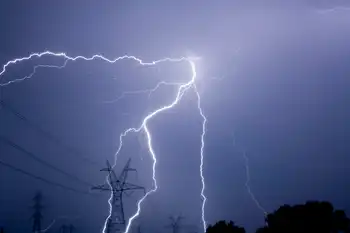
CDA to Present Grounding Guidelines for Electrical Disaster Prevention


NFPA 70e Training - Arc Flash

Our customized live online or in‑person group training can be delivered to your staff at your location.
  • Live Online
  • 6 hours Instructor-led
  • Group Training Available
Regular Price:
$199
Coupon Price:
$149
Reserve Your Seat Today

Electrical Grounding and Bonding are critical for safety, power quality, surge suppression, and low ground resistance, reinforcing NEC-compliant wiring practices and preventing outages in facilities and emergency systems through reliable bonding design.


Key Points

Electrical grounding and bonding link systems to earth to stabilize voltage, clear faults, and improve safety.

✅ Reduces ground loops, noise, and power quality issues

✅ Ensures NEC-compliant fault clearing and surge suppression

✅ Lowers ground resistance for reliable emergency systems


Session to Highlight Electrical Fundamentals Often Overlooked by Building and Design Professionals

New York, NY (November 29, 2016) – There are a variety of electrical powering, grounding and bonding techniques that should be considered in new or renovated structures, yet they are often overlooked by contractors and designers.  David Brender, the national program manager for electrical applications at the Copper Development Association (CDA), will  discuss why proper electrical grounding fundamentals are imperative in order to prevent electrical disasters at the 2017 PowerTest Conference.

“When it comes to electrical outages and safety, the topic of wiring and grounding practices doesn’t receive the proper attention it deserves,” Bender said. “It’s crucial for building professionals to understand the proper grounding, powering and bonding practices and lightning protection systems when dealing with emergency situations so that they don’t turn into catastrophic ones down the road.”

In his 45-minute presentation scheduled for Feb. 27, Brender will examine several case studies that focus on topics such as: problems and cost-effective solutions of power quality, ground resistance, ground loops, surge suppression, general wiring practices and more. He will also highlight the limitations of National Electrical Code grounding and what is required by code, including NEC 250 grounding and bonding provisions.

The PowerTest Conference, hosted by the InterNational Electrical Testing Association (NETA), offers over 47 sessions from professionals in the electrical, power systems acceptance and maintenance industries, covering VFD drive training topics among others. The Expo features over 100 industry suppliers who showcase the latest in new electrical products, technology and substation maintenance training resources and testing procedures.

Attendees also look for electric motor testing training to strengthen reliability programs and predictive maintenance.

Brender is an expert on grounding and bonding and has been giving presentations for CDA on the topic for more than 14 years. Brender is also a principal member of Panel 5 of the National Electrical Code, a senior member of the Institute of Electrical and Electronics Engineers (IEEE) and a life member of the Association of Energy Engineers.

CDA offers seminars on grounding and other topics to electrical groups, many at no charge. Please visit copper.org/electricalseminars. For more information about copper grounding systems or to access a variety of CDA’s electrical case studies, please visit www.copper.org. 


Related News

Related News
With a Focus on Local Response, PG&E Prepares for Winter Storm Season

PG&E Storm Outage Response deploys localized forecasts, mobile generators, and microsite base camps to restore power fast, leveraging SmartMeters, self-healing grid automation, and regional control centers across Northern and Central California.


Key Points

PG&E Storm Outage Response uses localized forecasts, mobile generators, and grid automation to restore power quickly.

✅ Advanced forecasts pinpoint high-impact zones

✅ Mobile generators enable rapid neighborhood restoration

✅ Microsites and control centers coordinate local crews


Fall is here and winter is just around the corner, and PG&E has been busily planning to respond to storm season and possible electric outages, including wildfire-risk safety shutoffs across its 70,000-square-mile service area in Northern and Central California.

And even as new tools and technologies have improved the energy company’s customer restoration capabilities system-wide, the ability to localize outage response has sharpened, too. Those capabilities include weather forecasts that pinpoint where storm damage will be most severe; mobile generators that allow rapid restoration to individual neighborhoods, including after safety shutoffs in some areas; and small base camps, or microsites, to coordinate restoration response closer to storm damage.

“Over the last few years, we’ve been able to strengthen our ability to get in front of weather events, wherever they happen in our service area. We follow industry best practices to develop local restoration models and quickly assemble multiple base camps as they’re needed,” said Pat Hogan, PG&E senior vice president of Electric Transmission & Distribution

Storm season arrived early in parts of the service area, with two notable weather makers along the North Coast in October. Eureka saw its wettest October since 1950, and the second-wettest since recordkeeping began in 1896, said Mike Voss, PG&E principal meteorologist.

A rainy start to the season doesn’t necessarily herald above-average winter storm activity.

“Larger storms can happen anytime, independent of El Niño or La Niña. We always have to be prepared for winter storms. With multiple local forecasts each day, our storm outage prediction model helps us know in advance where we will need to deploy resources to restore power,” Voss said.

Nor is weather uniform across the area, and electricity inequities in California can shape local impacts as well. Last year, the northern part of PG&E’s service area saw higher-than-usual snowpack, while the Central Valley and the southern Sierras experienced average to below-average precipitation.

Those variations show the importance of localized storm preparation and response, as seen in BC Hydro storm response during atypical events. Measures include:

  • Advanced Weather Forecasting
  • Localized Resource Planning
  • Upgraded Telecommunications
  • Scalable Base Camp
  • Portable Power Generation

Those initiatives add to PG&E tools including SmartMeters that quickly pinpoint outage locations and cut response times; advanced technology that “self-heals” the grid by rerouting power and restoring service to customers in minutes; and state-of-the-art distribution control centers in Fresno, Concord and Rocklin to manage PG&E’s 140,000 circuit miles of distribution lines.


Related News

View more

Substation Automation Training

Substation Automation Training Course delivers live, instructor-led learning on SCADA, cybersecurity, IEC 61850, DNP3, integration, FAT/SAT testing, digital substation design, T&D automation, communication protocols, and system commissioning for new builds and retrofit projects.


Key Points

An online, instructor-led program on SCADA, cybersecurity, IEC 61850, integration, and FAT/SAT for substation projects.

✅ Live online, instructor-led sessions with practical case studies

✅ Covers SCADA, IEC 61850, DNP3, cybersecurity, and integration

✅ Includes FAT/SAT testing, system design, and commissioning


The Electricity Forum has organized a Substation Automation Training Course - This 12-Hour live online instructor-led course is an introduction to state-of-the-art substation automation technologies that advance a smarter electricity infrastructure agenda and their applications in new and retrofitting substations.

September 16-17 , 2020 - 10:00 am - 4:30 pm ET

In recent years, electric utilities have embraced substation automation, supported by integration service providers across the sector, as much as any T&D automation technology. A recent research report found that 84 per cent of utilties have active substation automation and integration programs under way that align with the emerging digital grid model for operations. Part of substation automation's popularity undoubtedly has to do with the fact that a number of recent utility projects have shown that substation automation is a technology that can benefit the utility as a whole. Virtually any department that needs information mined at the substation can obtain benefits from a substation automation implementation.

Supervisory control and data acquisition systems -- or SCADA systems -- have been in place at electric utilities for decades. SCADA systems, old and new alike, are receiving more attention in recent times as "cybersecurity" of SCADA systems becomes an issue and as the use of AI in utilities grows for monitoring and response. The findings of a recent utility industry survey indicate that SCADA cybersecurity is a very real concern, as 20 per cent of utilties believe that their SCADA systems have already been subjected to outside threats. Compounding the problem of shoring up electric utility SCADA systems is the fact that different technologies and techniques may be required depending on whether the utility is working to secure a newly installed SCADA system or a legacy SCADA system.

Our Substation Automation training course will provide attendees a brief history of automation development in substations, the communications profiles and architectures used within and beyond the substations, including applications around digital transformer stations now being widely deployed, and the related automation functions and associated FAT/SAT testing and system integration.

The course will be fuelled with practical projects applications internationally, such as the 2 GW UK substation commissioning effort, to demonstrate how a substation automation system is specified, designed, integrated and tested before substation energization.

Complete course Details Here:

https://electricityforum.com/electrical-training/substation-automation-training

For ongoing learning, see the EasyPower webinars schedule available throughout the year.


Related News

View more

Sign Up for Electricity Forum’s Newsletter

Stay informed with our FREE Newsletter — get the latest news, breakthrough technologies, and expert insights, delivered straight to your inbox.

Electricity Today T&D Magazine Subscribe for FREE

Stay informed with the latest T&D policies and technologies.
  • Timely insights from industry experts
  • Practical solutions T&D engineers
  • Free access to every issue

Download the 2025 Electrical Training Catalog

Explore 50+ live, expert-led electrical training courses –

  • Interactive
  • Flexible
  • CEU-cerified