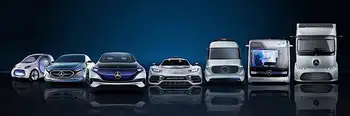
Daimler Details Gigantic Scope of Its Electrification Plan


new daimler electric vehicles

High Voltage Maintenance Training Online

Our customized live online or in‑person group training can be delivered to your staff at your location.

  • Live Online
  • 12 hours Instructor-led
  • Group Training Available
Regular Price:
$599
Coupon Price:
$499
Reserve Your Seat Today

Daimler Electric Strategy drives EV adoption with global battery factories, Mercedes-Benz electrified models, battery cells procurement, and major investments spanning vans, buses, trucks, and production capacity across Europe, Asia, and the USA.


Key Points

Daimler Electric Strategy is a multi-billion EV roadmap for batteries, factories, and 130 electrified Mercedes models.

✅ Eight battery factories across three continents

✅ EUR 10B for EV lineup; EUR 20B for battery cells

✅ 130 electrified variants plus vans, buses, trucks


Throughout 2018, we all witnessed the unprecedented volume of promises for a better future made by the giants of the auto industry. All say they've committed billions so that, within a decade, combustion engines will be on their way out.

The most active of all companies when talking about promises is Volkswagen, which, amid German plant closures, time and time again has said it will do this or that and completely change the meaning of car in the coming years. But there are other planning the same thing, possibly with even vaster resources.

Planning to end the year on a high note, Daimler detailed its plan for the electric future once again on Tuesday, this time making no secret of its gigantic size and scope.

As announced before, Daimler plans to build electric cars, but also manufacture electric batteries for its own and others’ use, and has launched a US energy storage company to support this strategy. These batteries will eventually be produced by Daimler in eight factories on three continents.

Batteries are already rolling off the lines in Kamenz, and a second facility will begin doing so next year. Two more factories will be built in Stuttgart-Untertürkheim, one at the company’s Sindelfingen site, and one each at the sites in Beijing (China), Bangkok (Thailand) and Tuscaloosa (USA).

In all, one billion EUR will be invested in the expansion of the global battery production network, but that is nothing compared to the 10 billion to be poured into the expansion of the Mercedes-Benz car fleet.

On top of that, 20 billion EUR will go towards the purchase of battery cells from producers all around the world, echoing other automakers' battery sourcing strategies worldwide over the next 12 years.

“After investing billions of euros in the development of the electric fleet and the expansion of our global battery network, we are now taking the next step,” said in a statement Dieter Zetsche, Daimler chairman of the board.

“With the purchase of battery cells for more than 20 billion euros, we are systematically pushing forward with the transformation into the electric future of our company.”

By 2022, the carmaker plans to launch 130 electrified variants of its cars, as cheaper, more powerful batteries become available, adding to them electric vans, buses and trucks. That pretty much means all the models and variants sold by Daimler globally will be at least partially powered by electricity.


Related News

Related News
Stellat'en and Innergex Sign Wind Deal with BC Hydro

Nithi Mountain Wind Project delivers 200 MW of renewable wind power in British Columbia under a BC Hydro electricity purchase deal, producing 600 GWh yearly, led by Stellat'en First Nation and Innergex.


Key Points

A 200 MW wind farm in British Columbia producing 600 GWh yearly, co-owned by Stellat'en First Nation and Innergex.

✅ 30-year BC Hydro take-or-pay PPA, CPI-indexed

✅ 200 MW capacity, ~600 GWh per year for ~60,000 homes

✅ 51% Stellat'en First Nation; operations targeted for 2030


In December 2024, a significant development unfolded in British Columbia's renewable energy sector, where the clean-energy regulatory process continues to evolve, as Stellat'en First Nation and Innergex Renewable Energy Inc. announced the signing of a 30-year electricity purchase agreement with BC Hydro. This agreement pertains to the Nithi Mountain Wind Project, a 200 MW initiative poised to enhance the province's clean energy capacity.

Project Overview

The Nithi Mountain Wind Project is a collaborative venture between Stellat'en First Nation, which holds a 51% stake, and Innergex Renewable Energy Inc., which holds a 49% stake. Located in the Bulkley-Nechako region of British Columbia, the project is expected to generate approximately 600 GWh of renewable electricity annually, comparable to other large-scale projects like the 280 MW wind farm in Alberta now online, sufficient to power around 60,000 homes. The wind farm is scheduled to commence commercial operations in 2030.

Economic and Community Impact

This partnership is anticipated to create approximately 150 job opportunities during the development, construction, and operational phases, thereby supporting local economic growth and workforce development, and aligns with recent federal green electricity procurement efforts that signal broader market support. The long-term electricity purchase agreement with BC Hydro is structured as a 30-year take-or-pay contract, indexed to a predefined percentage of the Consumer Price Index (CPI), ensuring financial stability and protection against inflation.

Environmental and Cultural Considerations

The Nithi Mountain Wind Project is being developed in close collaboration with First Nations in the area, guided by collaborative land-use planning. The project integrates cultural preservation, environmental stewardship, and economic empowerment for Indigenous communities in the Bulkley-Nechako region, while other solutions such as tidal energy for remote communities are also advancing across Canada. The project is committed to minimizing environmental impact by avoiding sensitive cultural and ecological resources and integrating sustainability at every stage, with remediation practices to restore the land, preserve cultural values, and enhance biodiversity and wildlife habitats if decommissioned.

Broader Implications

This agreement underscores a growing trend of collaboration between Indigenous communities, exemplified by the Ermineskin First Nation project emerging nationwide, and renewable energy developers in Canada. Such partnerships are instrumental in advancing sustainable energy projects that respect Indigenous rights and contribute to the nation's clean energy objectives, as renewable power developers find that diversified energy sources strengthen project outcomes. The Nithi Mountain Wind Project exemplifies how integrating traditional knowledge with modern renewable energy technologies can lead to mutually beneficial outcomes for both Indigenous communities and the broader society.

In summary, the Nithi Mountain Wind Project represents a significant step forward in British Columbia's renewable energy landscape, highlighting the importance of collaboration between Indigenous communities and renewable energy developers. The project promises substantial economic, environmental, and cultural benefits, setting a precedent for future partnerships in the clean energy sector, as large-scale storage acquisitions like Centrica's battery project illustrate complementary pathways to unlock wind potential.


Related News

View more

Electrifying: New cement makes concrete generate electricity

Cement-Based Conductive Composite transforms concrete into power by energy harvesting via triboelectric nanogenerator action, carbon fibers, and built-in capacitors, enabling net-zero buildings and self-sensing structural health monitoring from footsteps, wind, rain, and waves.


Key Points

A carbon fiber cement that harvests and stores energy as electricity, enabling net-zero, self-sensing concrete.

✅ Uses carbon fibers to create a conductive concrete matrix

✅ Acts as a triboelectric nanogenerator and capacitor

✅ Enables net-zero, self-sensing structural health monitoring


Engineers from South Korea have invented a cement-based composite that can be used in concrete to make structures that generate and store electricity through exposure to external mechanical energy sources like footsteps, wind, rain and waves, and even self-powering roads concepts.

By turning structures into power sources, the cement will crack the problem of the built environment consuming 40% of the world’s energy, complementing vehicle-to-building energy strategies across the sector, they believe.

Building users need not worry about getting electrocuted. Tests showed that a 1% volume of conductive carbon fibres in a cement mixture was enough to give the cement the desired electrical properties without compromising structural performance, complementing grid-scale vanadium flow batteries in the broader storage landscape, and the current generated was far lower than the maximum allowable level for the human body.

Researchers in mechanical and civil engineering from from Incheon National University, Kyung Hee University and Korea University developed a cement-based conductive composite (CBC) with carbon fibres that can also act as a triboelectric nanogenerator (TENG), a type of mechanical energy harvester.

They designed a lab-scale structure and a CBC-based capacitor using the developed material to test its energy harvesting and storage capabilities, similar in ambition to gravity storage approaches being scaled.

“We wanted to develop a structural energy material that could be used to build net-zero energy structures that use and produce their own electricity,” said Seung-Jung Lee, a professor in Incheon National University’s Department of Civil and Environmental Engineering, noting parallels with low-income housing microgrids in urban settings.

“Since cement is an indispensable construction material, we decided to use it with conductive fillers as the core conductive element for our CBC-TENG system,” he added.

The results of their research were published this month in the journal Nano Energy.

Apart from energy storage and harvesting, the material could also be used to design self-sensing systems that monitor the structural health and predict the remaining service life of concrete structures without any external power, which is valuable in industrial settings where hydrogen-powered port equipment is being deployed.

“Our ultimate goal was to develop materials that made the lives of people better and did not need any extra energy to save the planet. And we expect that the findings from this study can be used to expand the applicability of CBC as an all-in-one energy material for net-zero energy structures,” said Prof. Lee, pointing to emerging circular battery recycling pathways for net-zero supply chains.

Publicising the research, Incheon National University quipped: “Seems like a jolting start to a brighter and greener tomorrow!”


Related News

View more

Understanding the Risks of EV Fires in Helene Flooding

EV Flood Fire Risks highlight climate change impacts, lithium-ion battery hazards, water damage, post-submersion inspection, first responder precautions, manufacturer safeguards, and insurance considerations for extreme weather, flood-prone areas, and hurricane aftermaths.


Key Points

Water-exposed EV lithium-ion batteries may ignite later, requiring inspection, isolation, and trained responders.

✅ Avoid driving through floodwaters; park on high ground.

✅ After submersion, isolate vehicle; seek qualified inspection.

✅ Inform first responders and insurers about EV water damage.


As climate change intensifies the frequency and severity of extreme weather events, concerns about electric vehicle (EV) safety in flood-prone areas have come to the forefront. Recent warnings from officials regarding the risks of electric vehicles catching fire due to flooding from Hurricane Idalia underscore the need for heightened awareness and preparedness among consumers and emergency responders, as well as attention to grid reliability during disasters.

The alarming incidents of EVs igniting after being submerged in floodwaters have raised critical questions about the safety of these vehicles during severe weather conditions. While electric vehicles are often touted for their environmental benefits and lower emissions, it is crucial to understand the potential risks associated with their battery systems when exposed to water, even as many drivers weigh whether to buy an electric car for daily use.

The Risks of Submerging Electric Vehicles

Electric vehicles primarily rely on lithium-ion batteries, which can be sensitive to water exposure. When these batteries are submerged, they risk short-circuiting, which may lead to fires. Unlike traditional gasoline vehicles, where fuel may leak out, the sealed nature of an EV’s battery can create hazardous situations when compromised. Experts warn that even after water exposure, the risk of fire can persist, sometimes occurring days or weeks later.

Officials emphasize the importance of vigilance in flood-prone areas, including planning for contingencies like mobile charging and energy storage that support recovery. If an electric vehicle has been submerged, it is crucial to have it inspected by a qualified technician before attempting to drive it again. Ignoring this can lead to catastrophic consequences not only for the vehicle owner but also for surrounding individuals and properties.

Official Warnings and Recommendations

In light of these dangers, safety officials have issued guidelines for electric vehicle owners in flood-prone areas. Key recommendations include:

  1. Avoid Driving in Flooded Areas: The most straightforward advice is to refrain from driving through flooded streets, which can not only damage the vehicle but also pose risks to personal safety.

  2. Inspection After Flooding: If an EV has been submerged, owners should seek immediate professional inspection. Technicians can evaluate the battery and electrical systems for damage and determine if the vehicle is safe to operate.

  3. Inform Emergency Responders: In flood situations, informing emergency personnel about the presence of electric vehicles can help them mitigate risks during rescue operations, including firefighter health risks that may arise. First responders are trained to handle conventional vehicles but may need additional precautions when dealing with EVs.

Industry Response and Innovations

In response to rising concerns, electric vehicle manufacturers are working to enhance the safety features of their vehicles. This includes developing waterproof battery enclosures and improving drainage systems to prevent water intrusion, as well as exploring vehicle-to-home power for resilience during outages. Some manufacturers are also investing in research to improve battery chemistry, making them more resilient in extreme conditions.

The automotive industry recognizes that consumer education is equally important, particularly around utility impacts from mass-market EVs that affect planning. Manufacturers and safety organizations are encouraged to disseminate information about proper EV maintenance, the importance of inspections after flooding, and safety protocols for both owners and first responders.

The Role of Insurance Companies

As the risks associated with electric vehicle flooding become more apparent, insurance companies are also reassessing their policies. With increasing incidences of extreme weather, insurers are likely to adapt coverage options related to water damage and fire risks specific to electric vehicles. Policyholders should consult with their insurance providers to ensure they understand their coverage in the event of flooding.

Preparing for the Future

With the increasing adoption of electric vehicles, it is vital to prepare for the challenges posed by climate change and evolving state power grids capacity. Community awareness campaigns can play a significant role in educating residents about the risks and safety measures associated with electric vehicles during flooding events. By fostering a well-informed public, the likelihood of accidents and emergencies can be reduced.


Related News

View more

Ukraine has electricity reserves, no more outages planned if no new strikes

Ukraine Electricity Outages may pause as the grid stabilizes, with energy infrastructure repairs, generators, and reserves supporting supply; officials cite no rationing absent new Russian strikes, while Odesa networks recover and Ukrenergo completes restoration works.


Key Points

Planned power cuts in Ukraine paused as grid capacity, repairs, and reserves improve, barring new strikes.

✅ No rationing if Russia halts strikes on energy infrastructure

✅ Grid repairs and reserves meet demand for third straight week

✅ Odesa networks restored; Ukrenergo crews redeploy to repairs


Ukraine plans no more outages to ration electricity if there are no new strikes and has been able to amass some power reserves, the energy minister said on Saturday, as it continues to keep the lights on despite months of interruptions caused by Russian bombings.

"Electricity restrictions will not be introduced, provided there are no Russian strikes on infrastructure facilities," Energy Minister Herman Halushchenko said in remarks posted on the ministry's Telegram messaging platform.

"Outages will only be used for repairs."

After multiple battlefield setbacks and scaling down its troop operation to Ukraine's east and south, Russia in October began bombing the country's energy infrastructure, as winter loomed over the battlefront, leaving millions without power and heat for days on end.

The temperature in winter months often stays below freezing across most of Ukraine. Halushchenko said this heating season has been extremely difficult.

"But our power engineers managed to maintain the power system, and for the third week in a row, electricity generation has ensured consumption needs, we have reserves," Halushchenko said.

Ukraine, which does not produce power generators itself, has imported and received thousands of them over the past few years, with the U.S. pledging a further $10 billion on Friday to aid Kyiv's energy needs, despite ended grid restoration support reported earlier.

Separately, the chief executive of state grid operator Ukrenergo, Volodymyr Kudrytskyi, said that repair works on the damaged infrastructure in the city of Odesa suffered earlier this month, has been finished, highlighting how Ukraine has even helped Spain amid blackouts while managing its own network challenges.

"Starting this evening, there is more light in Odesa," Kudrytskyi wrote on his Facebook page. "The crews that worked on restoring networks are moving to other facilities."

A Feb. 4 fire that broke out at an overloaded power station left hundreds of thousands of residents without electricity, prompting many to adopt new energy solutions to cope with outages.


Related News

View more

Six key trends that shaped Europe's electricity markets in 2020

European Electricity Market Trends 2020 highlight decarbonisation, rising renewables, EV adoption, shifting energy mix, COVID-19 impacts, fuel switching, hydro, wind and solar growth, gas price dynamics, and wholesale electricity price increases.


Key Points

EU power in 2020 saw lower emissions, more renewables, EV growth, demand shifts, and higher wholesale prices.

✅ Power sector CO2 down 14% on higher renewables, lower coal

✅ Renewables 39% vs fossil 36%; hydro, wind, solar expanded

✅ EV share hit 17%; wholesale prices rose with gas, ETS costs


According to the Market Observatory for Energy DG Energy report, the COVID-19 pandemic and favorable weather conditions are the two key drivers of the trends experienced within the European electricity market in 2020. However, the two drivers were exceptional or seasonal.

The key trends within Europe’s electricity market include:


1. Decrease in power sector’s carbon emissions

As a result of the increase in renewables generation and decrease in fossil-fueled power generation in 2020, the power sector was able to reduce its carbon footprint by 14% in 2020. The decrease in the sector’s carbon footprint in 2020 is similar to trends witnessed in 2019 when fuel switching was the main factor behind the decarbonisation trend.

However, most of the drivers in 2020 were exceptional or seasonal (the pandemic, warm winter, high
hydro generation). However, the opposite is expected in 2021, with the first months of 2021 having relatively cold weather, lower wind speeds and higher gas prices, with stunted hydro and nuclear output also cited, developments which suggest that the carbon emissions and intensity of the power sector could rise.

The European Union is targeting to completely decarbonise its power sector by 2050 through the introduction of supporting policies such as the EU Emissions Trading Scheme, the Renewable Energy Directive and legislation addressing air pollutant emissions from industrial installations, with expectations that low-emissions sources will cover most demand growth in the coming years.

According to the European Environment Agency, Europe halved its power sector’s carbon emissions in 2019 from 1990 levels.


2. Changes in energy consumption

EU consumption of electricity fell by -4% as majority of industries did not operate at full level during the first half of 2020. Although majority of EU residents stayed at home, meaning an increase in residential energy use, rising demand by households could not reverse falls in other sectors of the economy.

However, as countries renewed COVID-19 restrictions, energy consumption during the 4th quarter was closer to the “normal levels” than in the first three quarters of 2020. 

The increase in energy consumption in the fourth quarter of 2020 was also partly due to colder temperatures compared to 2019 and signs of surging electricity demand in global markets.


3. Increase in demand for EVs

As the electrification of the transport system intensifies, the demand for electric vehicles increased in 2020 with almost half a million new registrations in the fourth quarter of 2020. This was the highest figure on record and translated into an unprecedented 17% market share, more than two times higher than in China and six times higher than in the United States.

However, the European Environment Agency (EEA)argues that the EV registrations were lower in 2020 compared to 2019. EEA states that in 2019, electric car registrations were close to 550 000 units, having reached 300 000 units in 2018.


4. Changes in the region’s energy mix and increase in renewable energy generation

The structure of the region’s energy mix changed in 2020, according to the report.

Owing to favorable weather conditions, hydro energy generation was very high and Europe was able to expand its portfolio of renewable energy generation such that renewables (39%) exceeded the share of fossil fuels (36%) for the first time ever in the EU energy mix.

Rising renewable generation was greatly assisted by 29 GW of wind and solar capacity additions in 2020, which is comparable to 2019 levels. Despite disrupting the supply chains of wind and solar resulting in project delays, the pandemic did not significantly slow down renewables’ expansion.

In fact, coal and lignite energy generation fell by 22% (-87 TWh) and nuclear output dropped by 11% (-79 TWh). On the other hand, gas energy generation was not significantly impacted owing to favorable prices which intensified coal-to-gas and lignite-to-gas switching, even as renewables crowd out gas in parts of the market.


5. Retirement of coal energy generation intensify

 As the outlook for emission-intensive technologies worsens and carbon prices rise, more and more early coal retirements have been announced. Utilities in Europe are expected to continue transitioning from coal energy generation under efforts to meet stringent carbon emissions reduction targets and as they try to prepare themselves for future business models that they anticipate to be entirely low-carbon reliant.

6. Increase in wholesale electricity prices

In recent months, more expensive emission allowances, along with rising gas prices, have driven up wholesale electricity prices on many European markets to levels last seen at the beginning of 2019. The effect was most pronounced in countries that are dependent on coal and lignite. The wholesale electricity prices dynamic is expected to filter through to retail prices.

The rapid sales growth in the EVs sector was accompanied by expanding charging infrastructure. The number of high-power charging points per 100 km of highways rose from 12 to 20 in 2020.


Related News

View more

Florida says no to $400M in federal solar energy incentives

Florida Solar for All Opt-Out highlights Gov. DeSantis rejecting EPA grant funds under the Inflation Reduction Act, limiting low-income households' access to solar panels, clean energy programs, and promised electricity savings across disadvantaged communities.


Key Points

Florida Solar for All Opt-Out is the state declining EPA grants, restricting low-income access to solar energy savings.

✅ EPA grant under IRA aimed at low-income solar

✅ Estimated 20% electricity bill savings missed

✅ Florida lacks PPAs and renewable standards


Florida has passed up on up to $400 million in federal money that would have helped low-income households install solar panels.

A $7 billion grant “competition” to promote clean energy in disadvantaged communities by providing low-income households with access to affordable solar energy was introduced by President Joe Biden earlier this year, and despite his climate law's mixed results in practice, none of that money will reach Florida households.

The Environmental Protection Agency announced the competition in June as part of Biden’s Inflation Reduction Act. However, Florida Gov. Ron DeSantis has decided to pass on the $400 million up for grabs by choosing to opt out of the opportunity.

Inflation Reduction Act:What is the Inflation Reduction Act? Everything to know about one of Biden's big laws

The program would have helped Florida households reduce their electricity costs by a minimum of 20% during a key time when Floridians are leaving in droves due to a rising cost of living associated with soaring insurance costs, inflation, and proposed FPL rate hikes statewide.

Florida was one of six other states that chose not to apply for the money.

President Joe Biden announced a $7 billion “competition” to promote clean energy in disadvantaged communities.

The opportunity, named “Solar for All,” was announced by the EPA in June and promised to provide up to $7 billion in grants to states, territories, tribal governments, municipalities, and nonprofits to expand the number of low-income and disadvantaged communities primed for residential solar investment — enabling millions of low-income households to access affordable, resilient and clean solar energy.

The grant is intended to help lower energy costs for families, create jobs and help reduce greenhouse effects that accelerate global climate change by providing financial support and incentives to communities that were previously locked out of investments.


How much money would Floridians save under the ‘Solar for All’ solar panel grant?

The program aims to reduce household electricity costs by at least 20%. Florida households paid an average of $154.51 per month for electricity in 2022, just over 14% of the national average of $135.25, and debates over hurricane rate surcharges continue to shape customer bills, according to the U.S. Energy Information Administration. A 20% savings would drop those bills down to around $123 per month.

On the campaign trail, DeSantis has pledged to unravel Biden’s green energy agenda if elected president, amid escalating solar policy battles nationwide, slamming the Inflation Reduction Act and what he called “a concerted effort to ramp up the fear when it comes to things like global warming and climate change.”

His energy agenda includes ending Biden’s subsidies for electric cars while pushing policies that he says would ramp up domestic oil production.

“The subsidies are going to drive inflation higher,” DeSantis said at an event in September. “It’s not going to help with interest rates, and it is certainly not going to help with our unsustainable debt levels.”

DeSantis heading to third debate:As he enters third debate, Ron DeSantis has a big Nikki Haley problem

DeSantis’ plan to curb clean energy usage in Florida seems to be at odds with the state as a whole, and the region's evolving strategy for the South underscores why it has been ranked among the top three states to go solar since 2019, according to the Solar Energy Industries Association (SEIA).

SEIA also shows, however, that Florida lags behind many other states when it comes to solar policies, as utilities tilt the solar market in ways that influence policy outcomes statewide. Florida, for instance, has no renewable energy standards, which are used to increase the use of renewable energy sources for electricity by requiring or encouraging suppliers to provide customers with a stated minimum share of electricity from eligible renewable resources, according to the EIA.

Power purchase agreements, which can help lower the cost of going solar through third-party financing, are also not allowed in Florida, with court rulings on monopolies reinforcing the existing market structure. And there have been other policies implemented that drove other potential solar investments to other states.


Related News

View more

Sign Up for Electricity Forum’s Newsletter

Stay informed with our FREE Newsletter — get the latest news, breakthrough technologies, and expert insights, delivered straight to your inbox.

Electricity Today T&D Magazine Subscribe for FREE

Stay informed with the latest T&D policies and technologies.
  • Timely insights from industry experts
  • Practical solutions T&D engineers
  • Free access to every issue

Live Online & In-person Group Training

Advantages To Instructor-Led Training – Instructor-Led Course, Customized Training, Multiple Locations, Economical, CEU Credits, Course Discounts.

Request For Quotation

Whether you would prefer Live Online or In-Person instruction, our electrical training courses can be tailored to meet your company's specific requirements and delivered to your employees in one location or at various locations.