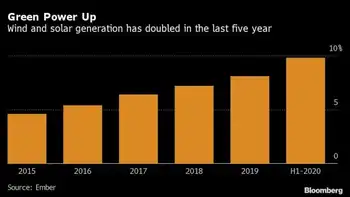
Wind and Solar Double Global Share of Electricity in Five Years


wind solar record

NFPA 70e Training - Arc Flash

Our customized live online or in‑person group training can be delivered to your staff at your location.
  • Live Online
  • 6 hours Instructor-led
  • Group Training Available
Regular Price:
$199
Coupon Price:
$149
Reserve Your Seat Today

Wind And Solar Energy Growth is reshaping the global power mix, accelerating grid decarbonization as coal declines; boosted by pandemic demand drops, renewables now supply near 10% of electricity, advancing climate targets toward net-zero trajectories.


Key Points

It is the rise in wind and solar's share of electricity, driving decarbonization and displacing coal globally.

✅ Share doubled in five years across 83% of global electricity

✅ Coal's share fell; renewables neared 10% in H1 2020

✅ Growth still insufficient for 1.5 C; needs ~13% coal cuts yearly


Wind and solar energy doubled its share of the global power mix over the last five years, with renewable power records underscoring the trend, moving the world closer to a path that would limit the worst effects of global warming.

The sources of renewable energy made up nearly 10% of power in most parts of the world in the first half of this year, according to analysis from U.K. environmental group Ember, while globally over 30% of electricity is renewable in broader assessments.

That decarbonization of the power grid was boosted this year as shutdowns to contain the coronavirus reduced demand overall, leaving renewables to pick up the slack.

Ember analyzed generation in 48 countries that represent 83% of global electricity. The data showed wind and solar power increased 14% in the first half of 2020 compared with the same period last year while global demand fell 3% because of the impact of the coronavirus.

At the same time that wind turbines and solar panels have proliferated, coal’s share of the mix has fallen around the world. In some, mainly western European countries, where renewables surpassed fossil fuels, coal has been all but eliminated from electricity generation.


China relied on the dirtiest fossil fuel for 68% of its power five years ago, and solar PV growth in China has accelerated since then. That share dipped to 62% this year and renewables made up 10% of all electricity generated.

Still, the growth of renewables may not be going fast enough for the world to hit its climate goals, even as the U.S. is projected to have one-fourth of electricity from renewables soon, and coal is still being burnt for power in many parts of the world.

Coal use needs to fall by about 79% by 2030 from last year’s levels - a fall of 13% every year throughout the decade to come, and in the U.S. renewable electricity surpassed coal in 2022, Ember said.

New installations of wind farms are set to hold more or less steady in the next five years, according to data from BloombergNEF on deployment trends. That will make it difficult to realize a sustained pace of doubling renewable power every five years.

“If your expectations are that we need to be on target for 1.5 degrees, clearly we’re not going fast enough,” said Dave Jones, an analyst at Ember. “We’re not on a trajectory where we’re reducing coal emissions fast enough.”


Related News

Related News
840 million people have no electricity – World Bank must fund more energy projects

World Bank Energy Policy debates financing for coal, oil, gas, and renewables to fight energy poverty, expand grid reliability, ensure baseload power, and balance climate goals with development finance for affordable, reliable electricity access.


Key Points

It outlines the bank's stance on financing fossil fuels and renewables to expand affordable, reliable electricity.

✅ Focus on energy access, baseload reliability, and poverty alleviation

✅ Debate over coal, gas, and renewables in development finance

✅ Geopolitics: China and Russia fill funding gaps, raising risks


Why isn’t the World Bank using all available energy resources in its global efforts to fight poverty? That’s the question I’ve asked World Bank President David Malpass. Nearly two years ago, the multilateral development bank decided to stop supporting critical coal, oil and gas projects that help people in developing countries escape poverty.

Along with 11 other senators, and as a member who votes on whether to give U.S. taxpayer dollars to the World Bank, I am pressing the bank to lift these restrictions. Developing countries desperately need access to a steady supply of affordable, reliable clean electricity to support economic growth.

The World Bank has pulled funding for critical electricity projects in poor countries, including high-efficiency power stations that are fueled by coal, even as efforts to revitalize coal communities with clean energy have grown.

Despite Kosovo having the world’s fifth-largest reserves of coal, the bank announced it would only support new energy projects from renewable sources going forward. Kosovo’s Minister of Economic Development Valdrin Lluka responded: “We don’t have the luxury to do such experiments in a poor country such as Kosovo. … It is in our national security interest to secure base energy inside our country.”

The World Bank’s misguided move comes as 840 million people worldwide are living without electricity, including 70 percent of sub-Saharan Africa, and as the fall in global energy investment may lead to shortages.

Even more troubling, nearly 3 billion people in developing countries rely on fuels like wood and other biomass for cooking and home heating, resulting in serious health problems and premature deaths, and the pandemic saw widespread electricity shut-offs that deepened energy insecurity. In 2016, household smoke killed an estimated 2.6 million people.

The World Bank’s mission is to lift people out of poverty. The bank is now compromising that mission in favor of a political agenda targeting certain energy sources.

With the World Bank blocking financing to affordable and reliable energy projects, Russia and China are stepping up their investments in order to gain geopolitical leverage.

President Vladimir Putin is pursuing Russian oil and gas projects in Mozambique, Gabon, and Angola. China’s Belt and Road Initiative is supporting traditional energy resources, with 36 percent of its power projects from 2014 to 2017 involving coal. South Africa had to turn to the China Development Bank to fund its $1.5 billion coal-fired power plant.

There are real risks for countries partnering with China and Russia on these projects. Developing countries are facing what some are calling China’s “debt trap” diplomacy. These nations have also raised concerns over safety compliance, unfair business practices, and labor standards.

As the bank’s largest contributor, the United States has a duty to make sure U.S. taxpayer dollars are used wisely and effectively. Every U.S. dollar at the World Bank should make a difference for people in the developing world.

My colleagues and I have asked the bank to pursue an all-of-the-above energy strategy as it strives to achieve its mission to end extreme poverty and promote shared prosperity. We will take the bank’s response into account during the congressional appropriations process.

The United States is a top global energy producer. And yet Democrats running for president are pursuing anti-energy policies that would hurt not only the United States but the entire world, with implications for U.S. national security as well.

Utilizing our abundant energy resources has fueled an American energy renaissance and a booming U.S. economy, even as disruptions in coal and nuclear have strained the grid, with millions of new jobs and higher wages.

People who are struggling to survive and thrive in developing countries deserve the same opportunity to access affordable and reliable sources of power.

As Microsoft founder and global philanthropist Bill Gates has noted of renewables: "Many people experiencing energy poverty live in areas without access to the kind of grids that are needed to make those technologies cheap and reliable enough to replace fossil fuels."

Ultimately, there is a role for all sources of energy to help countries alleviate poverty and improve the education, health and wellbeing of their people.

The solution to ending energy poverty does not lie in limiting options, but in using all available options. The World Bank must recommit to ending extreme poverty by helping countries use all of the world’s abundant energy resources. Let’s end energy poverty now.


Related News

View more

Europe Is Losing Nuclear Power Just When It Really Needs Energy

Europe's Nuclear Energy Policy shapes responses to the energy crisis, soaring gas prices, EU taxonomy rules, net-zero goals, renewables integration, baseload security, SMRs, and Russia-Ukraine geopolitics, exposing cultural, financial, and environmental divides.


Key Points

A policy guiding nuclear exits or expansion to balance energy security, net-zero goals, costs, and EU taxonomy.

✅ Divergent national stances: phase-outs vs. new builds

✅ Costs, delays, and waste challenge large reactors

✅ SMRs, renewables, and gas shape net-zero pathways


As the Fukushima disaster unfolded in Japan in 2011, then-German Chancellor Angela Merkel made a dramatic decision that delighted her country’s anti-nuclear movement: all reactors would be ditched.

What couldn’t have been predicted was that Europe would find itself mired in one of the worst energy crises in its history. A decade later, the continent’s biggest economy has shut down almost all its capacity already. The rest will be switched off at the end of 2022 — at the worst possible time.

Wholesale power prices are more than four times what they were at the start of the coronavirus pandemic. Governments are having to take emergency action to support domestic and industrial consumers faced with crippling bills, which could rise higher if the tension over Ukraine escalates. The crunch has not only exposed Europe’s supply vulnerabilities, but also the entrenched cultural and political divisions over the nuclear industry and a failure to forge a collective vision. 

Other regions meanwhile are cracking on, challenging the idea that nuclear power is in decline worldwide. China is moving fast on nuclear to try to clean up its air quality. Its suite of reactors is on track to surpass that of the U.S., the world’s largest, by as soon as the middle of this decade. Russia is moving forward with new stations at home and has more than 20 reactors confirmed or planned for export construction, according to the World Nuclear Association.

“I don’t think we’re ever going to see consensus across Europe with regards to the continued running of existing assets, let alone the construction of new ones,” said Peter Osbaldstone, research director for power and renewables at Wood Mackenzie Group Ltd. in the U.K. “It’s such a massive polarizer of opinions that national energy policy is required in strength over a sustained period to support new nuclear investment.” 

France, Europe’s most prolific nuclear energy producer, is promising an atomic renaissance as its output becomes less reliable. Britain plans to replace aging plants in the quest for cleaner, more reliable energy sources. The Netherlands wants to add more capacity, Poland also is seeking to join the nuclear club, and Finland is starting to produce electricity later this month from its first new plant in four decades. 

Belgium and Spain, meanwhile, are following Germany’s lead in abandoning nuclear, albeit on different timeframes. Austria rejected it in a referendum in 1978.

Nuclear power is seen by its proponents as vital to reaching net-zero targets worldwide. Once built, reactors supply low-carbon electricity all the time, unlike intermittent wind or solar.

Plants, though, take a decade or more to construct at best and the risk is high of running over time and over budget. Finland’s new Olkiluoto-3 unit is coming on line after a 12-year delay and billions of euros in financial overruns. 

Then there’s the waste, which stays hazardous for 100,000 years. For those reasons European Union members are still quarreling over whether nuclear even counts as sustainable.

Electorates are also split. Polling by YouGov Plc published in December found that Danes, Germans and Italians were far more nuclear-skeptic than the French, British or Spanish. 

“It comes down to politics,” said Vince Zabielski, partner at New York-based law firm Pillsbury Winthrop Shaw Pittman LLP, who was a nuclear engineer for 15 years. “Everything political ebbs and flows, but when the lights start going off people have a completely different perspective.”


What’s Behind Europe’s Skyrocketing Energy Prices

Indeed, there’s a risk of rolling blackouts this winter. Supply concerns plaguing Europe have sent gas and electricity prices to record levels and inflation has ballooned. There’s also mounting tension with Russia over a possible invasion of Ukraine, which could lead to disrupted supplies of gas. All this is strengthening the argument that Europe needs to reduce its dependence on international sources of gas.

Europe will need to invest 500 billion euros ($568 billion) in nuclear over the next 30 years to meet growing demand for electricity and achieve its carbon reduction targets, according to Thierry Breton, the EU’s internal market commissioner. His comments come after the bloc unveiled plans last month to allow certain natural gas and nuclear energy projects to be classified as sustainable investments. 

“Nuclear power is a very long-term investment and investors need some kind of guarantee that it will generate a payoff,” said Elina Brutschin at the International Institute for Applied Systems Analysis. In order to survive in liberalized economies like the EU, the technology needs policy support to help protect investors, she said.

That already looks like a tall order. The European Commission has been told by a key expert group that the labeling risks raising greenhouse gas emissions and undermining the bloc’s reputation as a bastion for environmentally friendly finance.

Austria has threatened to sue the European Commission over attempts to label atomic energy as green. The nation previously attempted a legal challenge, when the U.K. was still an EU member, to stop the construction of Electricite de France SA’s Hinkley Point C plant, in the west of England. It has also commenced litigation against new Russia-backed projects in neighboring Hungary.

Germany, which has missed its carbon emissions targets for the past two years, has been criticized by some environmentalists and climate scientists for shutting down a supply of clean power at the worst time, despite arguments for a nuclear option for climate policy. Its final three reactors will be halted this year. Yet that was never going to be reversed with the Greens part of the new coalition government. 

The contribution of renewables in Germany has almost tripled since the year before Fukushima, and was 42% of supply last year. That’s a drop from 46% from the year before and means the country’s new government will have to install some 3 gigawatts of renewables — equivalent to the generating capacity of three nuclear reactors — every year this decade to hit the country's 80% goal.

“Other countries don’t have this strong political background that goes back to three decades of anti-nuclear protests,” said Manuel Koehler, managing director of Aurora Energy Research Ltd., a company analyzing power markets and founded by Oxford University academics. 

At the heart of the issue is that countries with a history of nuclear weapons will be more likely to use the fuel for power generation. They will also have built an industry and jobs in civil engineering around that.

Germany’s Greens grew out of anti-nuclear protest movements against the stationing of U.S. nuclear missiles in West Germany. The 1986 Chernobyl meltdown, which sent plumes of radioactive fallout wafting over parts of western Europe, helped galvanize the broader population. Nuclear phase-out plans were originally laid out in 2002, but were put on hold by the country's conservative governments. The 2011 Fukushima meltdowns reinvigorated public debate, ultimately prompting Merkel to implement them.

It’s not easy to undo that commitment, said Mark Hibbs, a Bonn, Germany-based nuclear analyst at Carnegie Endowment for International Peace, or to envision any resurgence of nuclear in Germany soon: “These are strategic decisions, that have been taken long in advance.”

In France, President Emmanuel Macron is about to embark on a renewed embrace of nuclear power, even as a Franco-German nuclear dispute complicates the debate. The nation produces about two-thirds of its power from reactors and is the biggest exporter of electricity in Europe. Notably, that includes anti-nuclear Germany and Austria.

EDF, the world’s biggest nuclear plant operator, is urging the French government to support construction of six new large-scale reactors at an estimated cost of about 50 billion euros. The first of them would start generating in 2035.

But even France has faced setbacks. Development of new projects has been put on hold after years of technical issues at the Flamanville-3 project in Normandy. The plant is now scheduled to be completed next year. 

In the U.K., Business Secretary Kwasi Kwarteng said that the global gas price crisis underscores the need for more home-generated clean power. By 2024, five of Britain’s eight plants will be shuttered because they are too old. Hinkley Point C is due to be finished in 2026 and the government will make a final decision on another station before an election due in 2024. 

One solution is to build small modular reactors, or SMRs, which are quicker to construct and cheaper. The U.S. is at the forefront of efforts to design smaller nuclear systems with plans also underway in the U.K. and France. Yet they too have faced delays. SMR designs have existed for decades though face the same challenging economic metrics and safety and security regulations of big plants.

The trouble, as ever, is time. “Any investment decisions you make now aren’t going to come to fruition until the 2030s,” said Osbaldstone, the research director at Wood Mackenzie. “Nuclear isn’t an answer to the current energy crisis.”


Related News

View more

Why the promise of nuclear fusion is no longer a pipe dream

ITER Nuclear Fusion advances tokamak magnetic confinement, heating deuterium-tritium plasma with superconducting magnets, targeting net energy gain, tritium breeding, and steam-turbine power, while complementing laser inertial confinement milestones for grid-scale electricity and 2025 startup goals.


Key Points

ITER Nuclear Fusion is a tokamak project confining D-T plasma with magnets to achieve net energy gain and clean power.

✅ Tokamak magnetic confinement with high-temp superconducting coils

✅ Deuterium-tritium fuel cycle with on-site tritium breeding

✅ Targets net energy gain and grid-scale, low-carbon electricity


It sounds like the stuff of dreams: a virtually limitless source of energy that doesn’t produce greenhouse gases or radioactive waste. That’s the promise of nuclear fusion, often described as the holy grail of clean energy by proponents, which for decades has been nothing more than a fantasy due to insurmountable technical challenges. But things are heating up in what has turned into a race to create what amounts to an artificial sun here on Earth, one that can provide power for our kettles, cars and light bulbs.

Today’s nuclear power plants create electricity through nuclear fission, in which atoms are split, with next-gen nuclear power exploring smaller, cheaper, safer designs that remain distinct from fusion. Nuclear fusion however, involves combining atomic nuclei to release energy. It’s the same reaction that’s taking place at the Sun’s core. But overcoming the natural repulsion between atomic nuclei and maintaining the right conditions for fusion to occur isn’t straightforward. And doing so in a way that produces more energy than the reaction consumes has been beyond the grasp of the finest minds in physics for decades.

But perhaps not for much longer. Some major technical challenges have been overcome in the past few years and governments around the world have been pouring money into fusion power research as part of a broader green industrial revolution under way in several regions. There are also over 20 private ventures in the UK, US, Europe, China and Australia vying to be the first to make fusion energy production a reality.

“People are saying, ‘If it really is the ultimate solution, let’s find out whether it works or not,’” says Dr Tim Luce, head of science and operation at the International Thermonuclear Experimental Reactor (ITER), being built in southeast France. ITER is the biggest throw of the fusion dice yet.

Its $22bn (£15.9bn) build cost is being met by the governments of two-thirds of the world’s population, including the EU, the US, China and Russia, at a time when Europe is losing nuclear power and needs energy, and when it’s fired up in 2025 it’ll be the world’s largest fusion reactor. If it works, ITER will transform fusion power from being the stuff of dreams into a viable energy source.


Constructing a nuclear fusion reactor
ITER will be a tokamak reactor – thought to be the best hope for fusion power. Inside a tokamak, a gas, often a hydrogen isotope called deuterium, is subjected to intense heat and pressure, forcing electrons out of the atoms. This creates a plasma – a superheated, ionised gas – that has to be contained by intense magnetic fields.

The containment is vital, as no material on Earth could withstand the intense heat (100,000,000°C and above) that the plasma has to reach so that fusion can begin. It’s close to 10 times the heat at the Sun’s core, and temperatures like that are needed in a tokamak because the gravitational pressure within the Sun can’t be recreated.

When atomic nuclei do start to fuse, vast amounts of energy are released. While the experimental reactors currently in operation release that energy as heat, in a fusion reactor power plant, the heat would be used to produce steam that would drive turbines to generate electricity, even as some envision nuclear beyond electricity for industrial heat and fuels.

Tokamaks aren’t the only fusion reactors being tried. Another type of reactor uses lasers to heat and compress a hydrogen fuel to initiate fusion. In August 2021, one such device at the National Ignition Facility, at the Lawrence Livermore National Laboratory in California, generated 1.35 megajoules of energy. This record-breaking figure brings fusion power a step closer to net energy gain, but most hopes are still pinned on tokamak reactors rather than lasers.

In June 2021, China’s Experimental Advanced Superconducting Tokamak (EAST) reactor maintained a plasma for 101 seconds at 120,000,000°C. Before that, the record was 20 seconds. Ultimately, a fusion reactor would need to sustain the plasma indefinitely – or at least for eight-hour ‘pulses’ during periods of peak electricity demand.

A real game-changer for tokamaks has been the magnets used to produce the magnetic field. “We know how to make magnets that generate a very high magnetic field from copper or other kinds of metal, but you would pay a fortune for the electricity. It wouldn’t be a net energy gain from the plant,” says Luce.


One route for nuclear fusion is to use atoms of deuterium and tritium, both isotopes of hydrogen. They fuse under incredible heat and pressure, and the resulting products release energy as heat


The solution is to use high-temperature, superconducting magnets made from superconducting wire, or ‘tape’, that has no electrical resistance. These magnets can create intense magnetic fields and don’t lose energy as heat.

“High temperature superconductivity has been known about for 35 years. But the manufacturing capability to make tape in the lengths that would be required to make a reasonable fusion coil has just recently been developed,” says Luce. One of ITER’s magnets, the central solenoid, will produce a field of 13 tesla – 280,000 times Earth’s magnetic field.

The inner walls of ITER’s vacuum vessel, where the fusion will occur, will be lined with beryllium, a metal that won’t contaminate the plasma much if they touch. At the bottom is the divertor that will keep the temperature inside the reactor under control.

“The heat load on the divertor can be as large as in a rocket nozzle,” says Luce. “Rocket nozzles work because you can get into orbit within minutes and in space it’s really cold.” In a fusion reactor, a divertor would need to withstand this heat indefinitely and at ITER they’ll be testing one made out of tungsten.

Meanwhile, in the US, the National Spherical Torus Experiment – Upgrade (NSTX-U) fusion reactor will be fired up in the autumn of 2022, while efforts in advanced fission such as a mini-reactor design are also progressing. One of its priorities will be to see whether lining the reactor with lithium helps to keep the plasma stable.


Choosing a fuel
Instead of just using deuterium as the fusion fuel, ITER will use deuterium mixed with tritium, another hydrogen isotope. The deuterium-tritium blend offers the best chance of getting significantly more power out than is put in. Proponents of fusion power say one reason the technology is safe is that the fuel needs to be constantly fed into the reactor to keep fusion happening, making a runaway reaction impossible.

Deuterium can be extracted from seawater, so there’s a virtually limitless supply of it. But only 20kg of tritium are thought to exist worldwide, so fusion power plants will have to produce it (ITER will develop technology to ‘breed’ tritium). While some radioactive waste will be produced in a fusion plant, it’ll have a lifetime of around 100 years, rather than the thousands of years from fission.

At the time of writing in September, researchers at the Joint European Torus (JET) fusion reactor in Oxfordshire were due to start their deuterium-tritium fusion reactions. “JET will help ITER prepare a choice of machine parameters to optimise the fusion power,” says Dr Joelle Mailloux, one of the scientific programme leaders at JET. These parameters will include finding the best combination of deuterium and tritium, and establishing how the current is increased in the magnets before fusion starts.

The groundwork laid down at JET should accelerate ITER’s efforts to accomplish net energy gain. ITER will produce ‘first plasma’ in December 2025 and be cranked up to full power over the following decade. Its plasma temperature will reach 150,000,000°C and its target is to produce 500 megawatts of fusion power for every 50 megawatts of input heating power.

“If ITER is successful, it’ll eliminate most, if not all, doubts about the science and liberate money for technology development,” says Luce. That technology development will be demonstration fusion power plants that actually produce electricity, where advanced reactors can build on decades of expertise. “ITER is opening the door and saying, yeah, this works – the science is there.”


Related News

View more

Electric Cooperatives, The Lone Shining Utility Star Of The Texas 2021 Winter Storm

Texas Electric Cooperatives outperformed during Winter Storm Uri, with higher customer satisfaction, equitable rolling blackouts, and stronger grid reliability compared to deregulated markets, according to ERCOT-area survey data of regulated utilities and commercial providers.


Key Points

Member-owned utilities in Texas delivering power, noted for reliability and fair outages during Winter Storm Uri.

✅ Member-owned, regulated utilities serving local communities

✅ Rated higher for blackout management and communication

✅ Operate outside deregulated markets; align incentives with users


Winter Storm Uri began to hit parts of Texas on February 13, 2021 and its onslaught left close to 4.5 million Texas homes and businesses without power, and many faced power and water disruptions at its peak. By some accounts, the preliminary number of deaths attributed to the storm is nearly 200, and the economic toll for the Lone Star State is estimated to be as high as $295 billion. 

The more than two-thirds of Texans who lost power during this devastating storm were notably more negative than positive in their evaluation of the performance of their local electric utility, mirrored by a rise in electricity complaints statewide, with one exception. That exception are the members of the more than 60 electric cooperatives operating within the Texas Interconnection electrical grid, which, in sharp contrast to the customers of the commercial utilities that provide power to the majority of Texans, gave their local utility a positive evaluation related to its performance during the storm.

In order to study Winter Storm Uri’s impact on Texas, the Hobby School of Public Affairs at the University of Houston conducted an online survey during the first half of March of residents 18 and older who live in the 213 counties (91.5% of the state population) served by the Texas power grid, which is managed by the Electric Reliability Council of Texas (ERCOT). 

Three-quarters of the survey population (75%) live in areas with a deregulated utility market, where a specified transmission and delivery utility by region is responsible for delivering the electricity (purchased from one of a myriad of private companies by the consumer) to homes and businesses. The four main utility providers are Oncor, CenterPoint CNP -2.2%, American Electric Power (AEP) North, and American Electric Power (AEP) Central. 

The other 25% of the survey population live in areas with regulated markets, where a single company is responsible for both delivering the electricity to homes and businesses and serves as the only source from which electricity is purchased. Municipal-owned and operated utilities (e.g., Austin Energy, Bryan Texas Utilities, Burnet Electric Department, Denton Municipal Electric, New Braunfels Utilities, San Antonio’s CPS Energy CMS -2.1%) serve 73% of the regulated market. Electric cooperatives (e.g., Bluebonnet Electric Cooperative, Central Texas Electric Cooperative, Guadalupe Valley Cooperative, Lamb County Electric Cooperative, Pedernales Electricity Cooperative, Wood County Electric Cooperative) serve one-fifth of this market (21%), with private companies accounting for 6% of the regulated market.

The overall distribution of the survey population by electric utility providers is: Oncor (38%), CenterPoint (21%), municipal-owned utilities (18%), AEP Central & AEP North combined (12%), electric cooperatives (6%), other providers in the deregulated market (4%) and other providers in the regulated market (1%). 

There were no noteworthy differences among the 31% of Texans who did not lose power during the winter storm in regard to their evaluations of their local electricity provider or their belief that the power cuts in their locale were carried out in an equitable manner.  

However, among the 69% of Texans who lost power, those served by electric cooperatives in the regulated market and those served by private electric utilities in the deregulated market differed notably regarding their evaluation of the performance of their local electric utility, both in regard to their management of the rolling blackouts, amid debates over market reforms to avoid blackouts, and to their overall performance during the winter storm. Those Texans who lost power and are served by electric cooperatives in a regulated market had a significantly more positive evaluation of the performance of their local electric utility than did those Texans who lost power and are served by a private company in a deregulated electricity market. 

For example, only 24% of Texans served by electric cooperatives had a negative evaluation of their local electric utility’s overall performance during the winter storm, compared to 55%, 56% and 61% of those served by AEP, Oncor and CenterPoint respectively. A slightly smaller proportion of Texans served by electric cooperatives (22%) had a negative evaluation of their local electric utility’s performance managing the rolling blackouts during the winter storm, compared to 58%, 61% and 71% of Texans served by Oncor, AEP and CenterPoint, respectively.

Texans served by electric cooperatives in regulated markets were more likely to agree that the power cuts in their local area were carried out in an equitable manner compared to Texans served by commercial electricity utilities in deregulated markets. More than half (52%) of those served by an electric cooperative agreed that power cuts during the winter storm in their area were carried out in an equitable manner, compared to only 26%, 23% and 23% of those served by Oncor, AEP and CenterPoint respectively

The survey data did not allow us to provide a conclusive explanation as to why the performance during the winter storm by electric cooperatives (and to a much lesser extent municipal utilities) in the regulated markets was viewed more favorably by their customers than was the performance of the private companies in the deregulated markets viewed by their customers. Yet here are three, far from exhaustive, possible explanations.

First, electric cooperatives might have performed better (based on objective empirical metrics) during the winter storm, perhaps because they are more committed to their customers, who are effectively their bosses. .  

Second, members of electric cooperatives may believe their electric utility prioritizes their interests more than do customers of commercial electric utilities and therefore, even if equal empirical performance were the case, are more likely to rate their electric utility in a positive manner than are customers of commercial utilities.  

Third, regulated electric utilities where a single entity is responsible for the commercialization, transmission and distribution of electricity might be better able to respond to the type of challenges presented by the February 2021 winter storm than are deregulated electric utilities where one entity is responsible for commercialization and another is responsible for transmission and distribution, aligning with calls to improve electricity reliability across Texas.

Other explanations for these findings may exist, which in addition to the three posited above, await future empirical verification via new and more comprehensive studies designed specifically to study electric cooperatives, large commercial utilities, and the incentives that these entities face under the regulatory system governing production, commercialization and distribution of electricity, including rulings that some plants are exempt from providing electricity in emergencies under state law. 

Still, opinion about electricity providers during Winter Storm Uri is clear: Texans served by regulated electricity markets, especially by electric cooperatives, were much more satisfied with their providers’ performance than were those in deregulated markets. Throughout its history, Texas has staunchly supported the free market. Could Winter Storm Uri change this propensity, or will attempts to regulate electricity lessen as the memories of the storm’s havoc fades? With a hotter summer predicted to be on the horizon in 2021 and growing awareness of severe heat blackout risks, we may soon get an answer.   


Related News

View more

Saudis set to 'boost wind by over 6GW'

Saudi Arabia Wind Power Market set to lead the Middle East, driven by Vision 2030 renewables goals, REPDO tenders, and PIF backing, adding 6.2GW wind capacity by 2028 alongside solar PV diversification.


Key Points

It is the emerging national segment leading Middle East wind growth, targeting 6.2GW by 2028 under Vision 2030 policies.

✅ Adds 6.2GW, 46% of regional wind capacity by 2028

✅ REPDO tenders and PIF funding underpin pipeline

✅ Targets: 16GW wind, 40GW solar under Vision 2030


Saudi Arabia will become a regional heavyweight in the Middle East's wind power market adding over 6GW in the next 10 years, according to new research by Wood Mackenzie Power & Renewables.

The report – 'Middle East Wind Power Market Outlook, 2019-2028’ – said developers will build 6.2GW of wind capacity in the country or 46% of the region’s total wind capacity additions between 2019 and 2028.

Wood Mackenzie Power & Renewables senior analyst Sohaib Malik said: “The integration of renewables in Vision 2030’s objectives underlines strong political commitment within Saudi Arabia.

“The level of Saudi ambition for wind and solar PV varies significantly, despite the cost parity between both technologies during the first round of tenders in 2018.”

Saudi Arabia has set a 16GW target for wind by 2030 and 40GW for solar, plans to solicit 60 GW of clean energy over the next decade, Wood Mackenzie added.

“Moving forward, the Renewable Energy Project Development Office will award 850MW of wind capacity in 2019, which is expected to be commissioned in 2021-2022, and increase the local content requirement in future tendering rounds,” Malik said.

However, Saudi Arabia will fall short of its current 2030 renewables target, despite growth projections and regional leadership, the report said.

Some 70% of the renewables capacity target is to be supported by the Public Investment Fund (PIF), the Saudi sovereign wealth fund, while the remaining capacity is to be awarded through REPDO.

“A central concern is the PIF’s lack of track record in the renewables sector and its limited in-house sectoral expertise,” said Malik

“REPDO, on the other hand, completed two renewables request for proposals after pre-developing the sites,” he said.

PIF is estimated to have $230bn of assets – targeted to reach $2 trillion under Vision 2030 – driven by investments in a variety of sectors ranging from electric vehicles to public infrastructure, Wood Mackenzie said.

“There is little doubt about the fund’s financial muscle, however, its past investment strategy focused on established firms in traditional industries,” Malik added.

“Aspirations to develop a value chain for wind and PV technologies locally is a different ball game and requires the PIF to acquire new capabilities for effective oversight of these ventures,” he said.

The report noted that regional volatility is expected to remain, with strong positive growth, driven by Jordan and Iran in 2018 expected to reverse in 2019, and policy shifts, as in Canada’s scaled-back projections, can influence outcomes.

Post-2020 Wood Mackenzie Power & Renewables sees regional demand returning to steady growth as global renewables set more records elsewhere.

“In 2018, developers added 185MW and 63MW of wind capacity in Jordan and Iran, respectively, compared to 53MW of capacity across the entire region in 2017, following a record year for renewables in 2016,” said Malik.

“The completion of the 89MW Al Fujeij and the 86MW Al Rajef projects in 2018 indicates that Jordan has 375MW of the region’s operational 675MW wind capacity.

“Iran followed with 278MW of installed capacity at the end of 2018. A slowdown in 2019 is expected, as project development activity softens in Iran.

“Additionally, delays in awarding the 400MW Dumat Al Jandal project in Saudi Arabia will limit annual capacity additions to 184MW.”

He added that a maturing project pipeline in the region supports the 2020-2021 outlook, even as wind power grew despite Covid-19 globally.

“Saudi Arabian demand serves as the foundation for regional demand. Regional demand diversification is also occurring, with Lebanon set to add 200-400MW to its existing permitted capacity pipeline of 202MW in 2019,” he said

“These developments pave the way for the addition of 2GW of wind capacity between 2019 and 2021.”

Wood Mackenzie Power & Renewables added that the outlook for solar in the region is “much more positive” than wind.

“Compared to only 6GW of wind power capacity, developers will add 53GW of PV capacity through 2024,” said Malik.

He added: “Solar PV, supported by trends such as China’s rapid PV growth in 2016, has become a natural choice for many countries in the region, which is endowed with world class solar energy resources.

“The increased focus on solar energy is demonstrated by ambitious PV targets across the region.”


Related News

View more

EU outlines $300 billion plan to dump Russian energy

REPowerEU Plan accelerates the EU's shift from Russian fossil fuels with renewable energy, energy efficiency, solar, wind, heat pumps, faster permits, and energy security measures by 2027, backed by grants, loans, and grid investments.


Key Points

EU plan to quit Russian fossil fuels via renewables and efficiency, with faster permits, by 2027.

✅ €300bn in grants and loans for efficiency and renewables

✅ Streamlined permits; solar mandate on new buildings

✅ Targets 2027 independence; cuts Russian gas, oil, coal


The European Union’s executive arm moved Wednesday to jump-start plans for the 27-nation bloc to abandon Russian energy amid the Kremlin’s war in Ukraine, proposing a nearly 300 billion-euro ($315 billion) package that includes more efficient use of fuels and faster rollout of renewable power, even as rolling back electricity prices remains challenging.

The European Commission’s investment initiative is meant to help the 27 EU countries start weaning themselves off Russian fossil fuels this year, a move many see as a wake-up call to ditch fossil fuels across Europe. The goal is to deprive Russia, the EU’s main supplier of oil, natural gas and coal, of tens of billions in revenue and strengthen EU climate policies.

“We are taking our ambition to yet another level to make sure that we become independent from Russian fossil fuels as quickly as possible,” European Commission President Ursula von der Leyen said in Brussels when announcing the package, dubbed REPowerEU.

With no end in sight to Russia’s war in Ukraine and European energy security shaken, amid what some describe as an energy nightmare for the region, the EU is rushing to align its geopolitical and climate interests for the coming decades. It comes amid troubling signs that have raised concerns about energy supplies that the EU relies on and have no quick replacements for, including Russia cutting off member nations Poland and Bulgaria after they refused a demand to pay for natural gas in rubles.

The bloc’s dash to ditch Russian energy stems from a combination of voluntary and mandatory actions. Both reflect the political discomfort of helping fund Russia’s military campaign in a country that neighbors the EU and wants to join the bloc.

An EU ban on coal from Russia is due to start in August, and the bloc has pledged to try to reduce demand for Russian gas by two-thirds by year's end, while debating gas price cap strategies to curb volatility. Meanwhile, a proposed EU oil embargo has hit a roadblock from Hungary and other landlocked countries that worry about the cost of switching to alternative sources.

In a bid to swing Hungary behind the oil phaseout, the REPowerEU package expects oil investment funding of around 2 billion euros for member nations highly dependent on Russian oil.

Energy savings and renewables form the cornerstones of the package, which would be funded mainly by an economic stimulus program put in place to help member countries overcome the slump triggered by the coronavirus pandemic.

The European Commission said the price tag for abandoning Russian fossil fuels completely by a 2027 target date is 210 billion euros. Its package includes 56 billion euros for energy efficiency and 86 billion euros for renewables.

Von der Leyen cited a total funding pot of 72 billion euros in grants and 225 billion euros for loans.

The European Commission also proposed ways to streamline the approval processes in EU countries for renewable projects, which can take up to a decade to get through red tape, as part of a broader effort to revamp the electricity market across Europe. The commission said approval times need to fall to as little as a year or less.

It put forward a specific plan on solar energy, seeking to double photovoltaic capacity by 2025 and pushing for a phased-in obligation to install solar panels on new buildings.

Simone Tagliapietra, an energy expert at the Bruegel think tank in Brussels, called REPowerEU a “jumbo package” whose success will ultimately depend on political will in the bloc’s national capitals, with examples such as Germany’s 200 billion euro energy price shield illustrating the scale of national responses.

“Most of the actions entailed in the plan require either national implementation or strong coordination among member states,” Tagliapietra said. “The extent to which countries really engage is going to be defining.”

The German energy think tank Agora Energiewende said the EU’s plan “gives too little attention to concrete initiatives that reduce fossil fuel demand in the short term and thereby misses the opportunity to simultaneously enhance Europe’s energy security and meet Europe’s climate objectives.”

The group's research shows rapidly expanding solar, wind parks and use of heat pumps for low-temperature heat in industry and buildings could be done faster than constructing new liquefied natural gas terminals or gas infrastructure, said Matthias Buck, its director for Europe.

The European Commission’s recommendations on short-term national actions to cut demand for Russian energy, which include potential emergency measures to limit electricity prices as well, coincide with deliberations underway in the bloc since last year on setting more ambitious EU energy-efficiency and renewable targets for 2030.

Those targets, being negotiated by the European Parliament and national governments, are part of the bloc’s commitments to a 55% cut in greenhouse gases by decade's end, compared with 1990 emissions, and to climate neutrality by 2050.

Von der Leyen urged the European Parliament and national governments to deepen the commission’s July proposal for an energy efficiency target of 9% and renewable energy goal of 40% by 2030. She said those objectives should be 13% and 45%, respectively.

Belgium, the Netherlands, Germany and Denmark plan to build North Sea wind farms to help cut carbon emissions.


Related News

View more

Sign Up for Electricity Forum’s Newsletter

Stay informed with our FREE Newsletter — get the latest news, breakthrough technologies, and expert insights, delivered straight to your inbox.

Electricity Today T&D Magazine Subscribe for FREE

Stay informed with the latest T&D policies and technologies.
  • Timely insights from industry experts
  • Practical solutions T&D engineers
  • Free access to every issue

Live Online & In-person Group Training

Advantages To Instructor-Led Training – Instructor-Led Course, Customized Training, Multiple Locations, Economical, CEU Credits, Course Discounts.

Request For Quotation

Whether you would prefer Live Online or In-Person instruction, our electrical training courses can be tailored to meet your company's specific requirements and delivered to your employees in one location or at various locations.