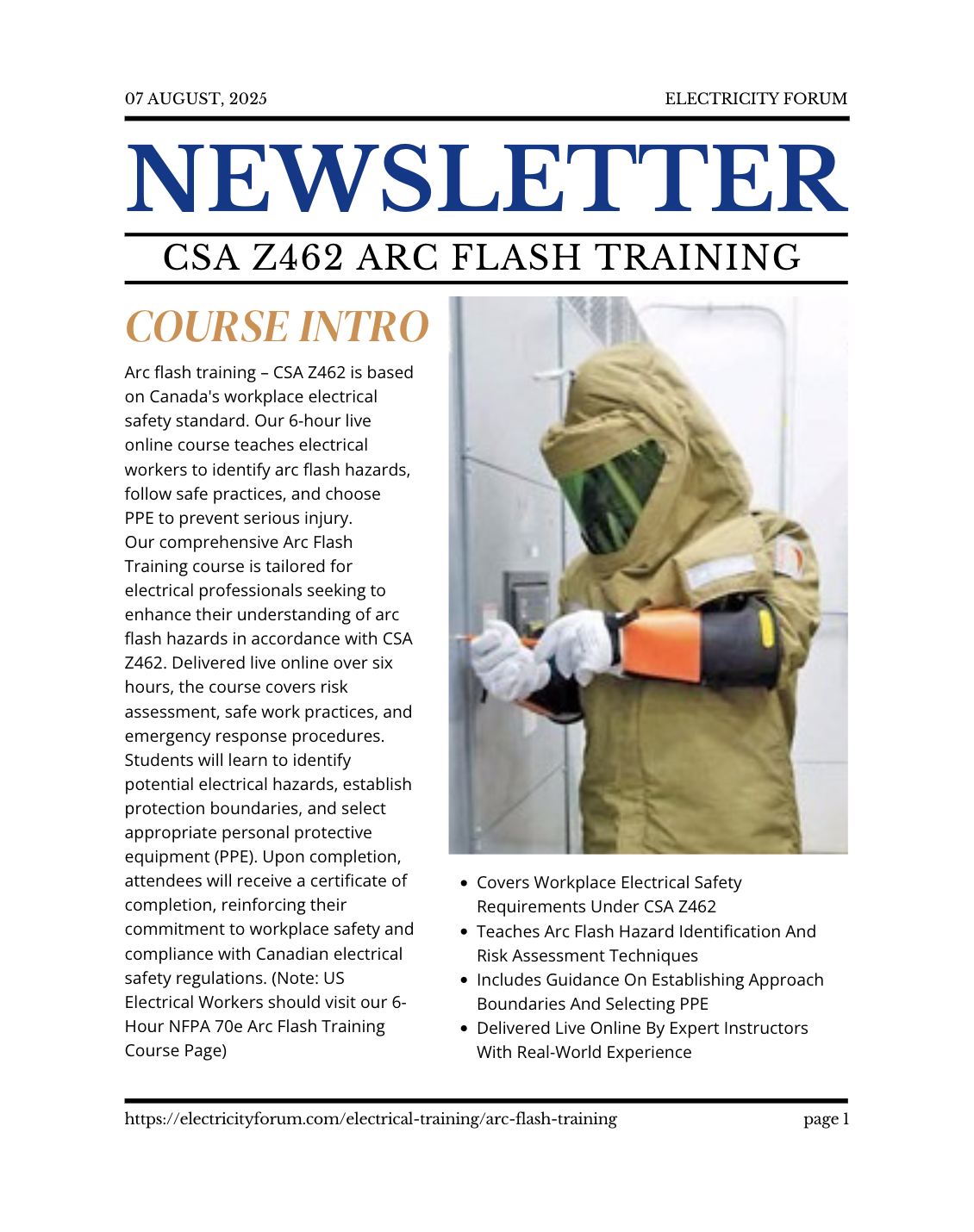
NFPA 70E Training Overview
NFPA 70E training exists to bridge the gap between written electrical safety standards and real field conditions. The standard itself defines expectations. This course teaches how those expectations are applied during maintenance, troubleshooting, commissioning, and operational work.
Students learn how to evaluate energized tasks, determine when energized work is justified, select appropriate controls, and apply PPE based on incident energy and task exposure. Instruction emphasizes hazard recognition, job planning discipline, and consistent application of boundaries and protective methods.
Rather than focusing on theory, the course uses real maintenance scenarios to help workers learn to recognize risk early, plan correctly, and execute work with confidence.
Why NFPA 70E Electrical Safety Matters
Electrical safety failures rarely occur because standards are unavailable. They occur because hazards are misjudged, controls are applied inconsistently, or energized work is normalized.
NFPA 70E establishes a disciplined framework for controlling shock and arc flash hazards. When applied correctly, it reduces injuries, improves reliability, and creates accountability across maintenance operations.
NFPA 70E training strengthens this framework by teaching workers how to interpret the standard in real situations, not just how to reference it.
NFPA 70E Requirements and OSHA Alignment
This NFPA 70E training course supports OSHA-aligned electrical safety programs by reinforcing requirements for energized work control, job planning, boundaries, and PPE selection.
Participants learn how NFPA 70E supports OSHA expectations through:
-
Energized work justification and permit processes
-
Shock protection boundaries and access control
-
Arc flash risk management and labeling
-
Safe work practices and documentation discipline
This course helps organizations apply NFPA 70E in support of formal electrical safety programs rather than treating compliance as a paperwork exercise.
If your organization is developing a documented program to address these requirements, pair this course with Electrical Safety Program Development.
NFPA 70E Training Benefits
NFPA 70E training improves electrical safety performance by strengthening the recognition, evaluation, and control of hazards.
Key outcomes include:
-
Improved shock and arc flash risk control
-
Stronger job planning and energized work discipline
-
Greater PPE accuracy and consistency
-
Reduced incident probability
-
Improved maintenance reliability
-
Lower downtime and liability exposure
What You Will Learn
You will learn how to:
-
Recognize shock and arc flash hazards before work begins
-
Apply boundaries and energized work restrictions correctly
-
Select PPE based on task exposure and voltage conditions
-
Perform job briefings that reduce error and confusion
-
Support OSHA-aligned electrical safety programs using NFPA 70E principles
Related Courses