



By "We need to go with the company which makes the most business sense."


NFPA 70e Training - Arc Flash

Our customized live online or in‑person group training can be delivered to your staff at your location.

  • Live Online
  • 6 hours Instructor-led
  • Group Training Available
Regular Price:
$199
Coupon Price:
$149
Reserve Your Seat Today
-- The company taking over key B.C. Hydro services is at the centre of a storm of criticism in the United States over organizations using offshore havens to evade taxes.

Controversy over Accenture, a management consulting company with its head office in Bermuda, is also fuelling a fight by B.C. groups vehemently opposed to B.C. Hydro handing its business and technology services to the private sector.

Accenture and B.C. Hydro have signed a memorandum of understanding to create a new company, which could be a B.C. subsidiary of Accenture or a partnership between Hydro and Accenture.

The new company will take over customer service, computing services, human resources, financial systems, purchasing, property services and office services.

Accenture spokesmen say the company should never have been included on the tax dodging list because it is a genuine multinational, rather than an organization which created a Bermuda mail drop to evade taxes.

B.C. Hydro spokeswoman Elisha Odowichuk said Hydro has received assurances that Accenture will pay all B.C. taxes.

The fiercest attack on companies with bogus offshore relocations has come from California state treasurer Phil Angelides, who has prohibited state government dealings with 19 companies, including Accenture.

Angelides is also asking two of the largest public pension funds in the U.S., the California Public Employees Retirement System and California State Teachers Retirement System, to sell all stock in the 19 companies.

Any company which would do a sham relocation to escape taxes would also look at bending environmental rules, shortchanging workers or sticking it to their shareholders, he said.

"These sham transactions, like the accounting scandals at Enron and WorldCom, are the kinds of deceptive corporate practices that have shaken the financial marketplace and cost families, pensioners and taxpayers billions," Angelides said.

The U.S. Congress is also debating curbs on corporate expatriation.

B.C. Citizens for Public Power says the condemnations from the U.S. prove their point. The group has been raising the alarm over links between Accenture and disgraced accounting company Arthur Andersen; it has also pointed out the Ontario auditor general's criticism of Accenture's program to streamline welfare.

"It is outrageous that we would invite Accenture to run key B.C. Hydro services when other jurisdictions are condemning them for their questionable business practices," said Rudy Lawrence, Citizens for Public Power spokesman and president of the Council of Senior Citizens Organizations.

"The Accenture deal should be stopped immediately."

Mark Veerkamp, Citizens for Public Power coordinator, said privatization will be irreversible under NAFTA rules, but there has been absolutely no public consultation.

The offshore headquarters not only affect taxes, but also mean shareholders do not have the same rights as in the U.S. or Canada, he said.

"People are in a high state of anxiety. They don't know why this is happening," Veerkamp said.

"We have an amazing system and customer satisfaction rates are through the roof, so why would we monkey with it?"

Accenture spokesman Jim McAvoy said the company should never have been included on the California list because it did not relocate to Bermuda.

"Accenture has never been a U.S. company," he said.

Initially, Accenture was based in Switzerland with partnerships all over the world and, when the company went public, Bermuda was chosen as the corporate headquarters because it was "culturally neutral," he said.

"In Canada, we pay Canadian taxes on everything we do in Canada and it's the same in the U.S.," he said.

The much-publicized Arthur Andersen connection existed only as a contractual agreement and in 1997 Accenture moved to sever all contractual ties between the two companies, McAvoy said.

Those ties were finally severed in 2000.

"There has never been any involvement in the Arthur Andersen business or auditing services," he said.

Arthur Andersen in the U.S. has virtually shut down after it lost many of its customers in the wake of the Enron accounting scandal.

In Ontario, despite criticism from the auditor general, Accenture delivered on time and on budget, McAvoy said.

The company brought in overseas experts at high salaries and put them up in hotels because they were the best people for the job -- and the final price remained the same, he said.

Odowichuk said B.C. Hydro is confident about Accenture's business practices.

"It's going to be a B.C. based company and it will pay B.C. taxes," she said.

Accenture was chosen from a list of 19 companies because it has a proven track record and there was the opportunity to create jobs in B.C., Odowichuk said.

No local companies met all the criteria, she said.
Related News

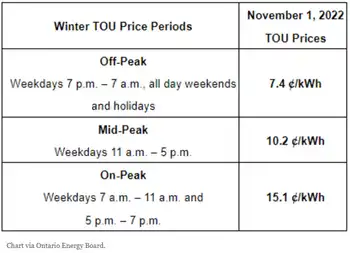
Electricity rates are about to change across Ontario

Ontario Electricity Rate Changes lower OEB Regulated Price Plan costs, adjust Time-of-Use winter hours and tiered thresholds, and modify the Ontario Electricity Rebate, affecting off-peak, mid-peak, and on-peak pricing for households and small businesses.


Key Points

OEB updates lowering RPP prices, shifting TOU hours, adjusting tiers, and modifying the Ontario Electricity Rebate.

✅ Winter TOU: Off-peak 7 p.m.-7 a.m.; weekends, holidays all day.

✅ Tiered pricing adds 400 kWh at lower rate for residential users.

✅ Ontario Electricity Rebate falls to 11.7% from 17% on Nov 1.


Electricity rates are about to change for consumers across Ontario.

On November 1, households and small businesses will see their electricity rates go down under the Ontario Energy Board's (OEB) Regulated Price Plan framework.

Customer's on the OEB's tiered pricing plan will also see their bills lowered on November 1, a shift from the 2021 increase when fixed pricing ended, as winter time-of-use hours and the seasonal change in the killowatt-hour threshold take effect.

Off-peak time-of-use hours will run from 7 p.m. to 7 a.m. during weekdays, including the ultra-low overnight rates option for some customers, and all day on weekends and holidays. On-peak hours will be from 7 a.m. to 11 a.m. and 5 p.m. to 7 p.m. on weekdays, and mid-peak hours from 11 a.m. to 5 p.m. on weekdays.

The winter-tier threshold provides residential customers with an extra 400 kilowatt-hours per month at a lower price during the colder weather, alongside the off-peak price freeze in effect.

The Ontario Electricity Rebate - a pre-tax credit that shows up at the bottom of electricity bills - will also see changes as a hydro rate change takes effect on November 1. Starting next month, the rebate will drop from 17 per cent to 11.7 per cent.

For a typical residential customer, the credit will decrease electricity bills by about $13.91 per month, according to the OEB.

Under the board's winter disconnection ban, electricity providers can't turn off a residential customer's power between November 15, 2022 and April 30, 2023 for failing to pay, and earlier pandemic relief included a fixed COVID-19 hydro rate for customers.


Related News

View more

Paris Finalises Energy Roadmap for 2025–2035 with Imminent Decree

France 2025–2035 Energy Roadmap accelerates carbon neutrality via renewables expansion, energy efficiency, EV adoption, heat pumps, hydrogen, CCS, nuclear buildout, and wind and solar targets, cutting fossil fuels and emissions across transport, housing, industry.


Key Points

A national plan to cut fossil use and emissions, boost renewables, and scale efficiency and clean technologies.

✅ Cuts fossil share to 30% by 2035 with efficiency gains

✅ Scales solar PV and wind; revives nuclear with EPR 2

✅ Electrifies transport and industry with EVs, hydrogen, CCS


Paris is on the verge of finalising its energy roadmap for the period 2025–2035, with an imminent decree expected to be published by the end of the first quarter of 2025. This roadmap is part of France's broader strategy to achieve carbon neutrality by 2050, aligning with wider moves toward clean electricity regulations in other jurisdictions.

Key Objectives of the Roadmap

The energy roadmap outlines ambitious targets for reducing greenhouse gas emissions across various sectors, including transport, housing, food, and energy. The primary goals are:

  • Reducing Fossil Fuel Dependency: Building on the EU's plan to dump Russian energy, the share of fossil fuels in final energy consumption is to fall from 60% in 2022 to 42% in 2030 and 30% in 2035.

  • Enhancing Energy Efficiency: A target of a 28.6% reduction in energy consumption between 2012 and 2030 is set, focusing on conservation and energy efficiency measures.

  • Expanding Decarbonised Energy Production: The roadmap aims to accelerate the development of renewable energies and the revival.

Sector-Specific Targets

  • Transport: The government aims to cut emissions by 31, focusing on the growth of electric vehicles, increasing public transport, and expanding charging infrastructure.

  • Housing: Emissions from buildings are to be reduced by 44%, with plans to replace 75% of oil-fired and install 1 million heat pumps.

  • Agriculture and Food: The roadmap includes measures to reduce emissions from agriculture by 9%, promoting organic farming and reducing the use of nitrogen fertilizers.

  • Industry: A 37% reduction in emissions is targeted through the use of electricity, biomass, hydrogen, and CO₂ capture and storage technologies informed by energy technology pathways outlined in ETP 2017.

Renewable Energy Targets

The roadmap sets ambitious targets for renewable energy production that align with Europe's ongoing electricity market reform efforts:

  • Photovoltaic Power: A sixfold increase in photovoltaic power between 2022

  • Offshore Wind Power: Reaching 18 gigawatts up from 0.6 GW

  • Onshore Wind Power: Doubling capacity from 21 GW to 45 GW over the same period.

  • Nuclear Power: The commissioning of the evolutionary power and the construction of six EPR 2 reactors, underpinned by France's deal on electricity prices with EDF to support long-term investment, with the potential for eight more.
     

Implementation and Governance

The final version of the roadmap will be adopted by decree, alongside a proposed electricity pricing scheme to address EU concerns, rather than being enshrined in law as required by the Energy Code. The government had previously abandoned the energy-climate planning. The decree is expected to be published at the end of the Multiannual Energy Program (PPE) and in the second half of the third National Low-Carbon Strategy (SNBC).

Paris's finalisation of its energy roadmap for 2025–2035 marks a significant step towards achieving carbon neutrality by 2050. The ambitious targets set across various sectors reflect a comprehensive approach to reducing greenhouse gas emissions and transitioning to a more sustainable energy system amid the ongoing EU electricity reform debate shaping market rules. The imminent decree will provide the legal framework necessary to implement these plans and drive the necessary changes across the country.


Related News

View more

External investigators looking into alleged assaults by Manitoba Hydro workers

Manitoba Hydro Allegations Investigation reveals RCMP and OPP probes into 1960s abuses in northern Manitoba, affecting Fox Lake Cree Nation, citing racism, discrimination, sexual assault, and oversight by the IIU and Clean Environment Commission.


Key Points

A coordinated probe into historic abuses tied to Manitoba Hydro projects, led by OPP and IIU after RCMP referral.

✅ OPP to investigate historical cases involving Hydro staff and contractors.

✅ IIU to examine any allegations implicating Manitoba RCMP officers.

✅ Findings follow CEC report on racism and abuse near Fox Lake.


Manitoba RCMP have called in outside investigators to probe alleged assaults linked to hydro projects in the province’s north during the 1960s.

RCMP say any historical criminal investigations involving Manitoba Hydro employees or contractors will be handled by the Ontario Provincial Police.

The Independent Investigation Unit of Manitoba, the province’s police watchdog, will investigate any allegations involving RCMP officers.

A report released last month by an arm’s-length review agency outlined racism, discrimination and sexual abuse at the Crown-owned utility’s work sites dating back decades, while projects like Site C COVID-19 updates provide contemporary examples of reporting.

Much of the development at that time was centered around the community of Gillam and the nearby Fox Lake Cree Nation.

The report said the presence of a largely male construction workforce led to the sexual abuse of Indigenous women, some of whom said their complaints were ignored by the RCMP, and in a different context, Hydro One worker injury highlights safety risks in the sector.

Premier Brian Pallister says his government is taking the right approach to addressing alleged sexual assaults and racism by Manitoba Hydro workers against members of a remote northern First Nation, while pandemic cost-cutting at Manitoba Hydro has shaped recent operations.

Pallister made his first public comments about the allegations after a private meeting with Prime Minister Justin Trudeau on Tuesday evening, as COVID-19 reshaped Saskatchewan and other Prairie priorities were in focus.

The allegations, made by members of Fox Lake Cree Nation, were revealed in a report produced by the Clean Environment Commission. The report was released by the provincial government in August, although it was completed in May.

Allegations against Manitoba Hydro workers: What you need to know

"My reaction would be that's deplorable behaviour, and I have to admit, my puzzlement is why this wasn't investigated sooner or didn't come to light sooner," Pallister said, adding that he believes his government has taken the right approach by referring the information to the RCMP.

Some members of Fox Lake Cree Nation say the government didn't give them any advance notice of the release of the report, so the community was traumatized when it hit the news.

Pallister said his government didn't want to delay the release of the report.

'Pure trauma': Fox Lake members stricken after hasty release of troubling report

"I think the right thing to do is release the report. A lot of this information was in the public domain over the last number of weeks and months anyway. It wasn't the case of it being new in that respect," he said.

However, he accepted criticism of the timeline of the report's release.

"I would rather accept those criticisms, than accept the argument that we were in any way covering up information that is important to be released," he said.

Fox Lake Chief Walter Spence has said he expects Pallister to visit the community.

The premier said Tuesday he was not sure of the effectiveness of such a trip.

"I think most of the communities would prefer that there be electricity jobs for young Canadians created in their communities, that there be better water, many other tangible things rather than symbolism," he said.

"That's what I'm hearing and I've been in dozens of First Nations communities in the last two years."


Related News

View more

EU Plans To Double Electricity Use By 2050

European Green Deal Electrification accelerates decarbonization via renewables, electric vehicles, heat pumps, and clean industry, backed by sustainable finance, EIB green lending, just transition funds, and energy taxation reform to phase out fossil fuels.


Key Points

An EU plan to replace fossil fuels with renewable electricity in transport, buildings, and industry, supported by green finance.

✅ Doubles electricity's share to cut CO2 and phase out fossil fuels.

✅ Drives EVs, heat pumps, and electrified industry via renewables.

✅ Funded by EIB lending, EU budget, and just transition support.


The European Union is preparing an ambitious plan to completely decarbonize by 2050. Increasing the share of electricity in Europe’s energy system – electricity that will increasingly come from renewable sources - will be at the center of this strategy, aligning with the broader global energy transition under way, the new head of the European Commission’s energy department said yesterday.

This will mean more electric cars, electric heating and electric industry. The idea is that fossil fuels should no longer be a primary energy source, heating homes, warming food or powering cars. In the medium term they should only be used to generate electricity, a shift mirrored by New Zealand's electricity shift efforts, which then powers these things, resulting in less CO2 emissions.

“First assessments show we need to double the share of electricity in energy consumption by 2050,” Ditte Juul-Jørgensen said at an event in Brussels this week, a goal echoed by recent calls to double investment in power systems from world leaders. “We’ve already seen an increase in the last decade, but we need to go further”.

Juul-Jørgensen, who started in her job as director-general of the commission’s energy department in August, has come to the role at a pivotal time for energy. The 2050 decarbonization proposal from the Commission, the EU’s executive branch, is expected to be approved next month by EU national leaders. A veto from Poland that has blocked adoption until now is likely to be overcome if Poland and other Eastern European countries are offered financial assistance from a “just transition fund”, according to EU sources.

Ursula von der Leyen, the incoming President of the Commission, has promised to unveil a “European Green Deal” in her first 100 days in office designed to get the EU to its 2050 goal. Juul-Jørgensen will be working with the incoming EU Energy Commissioner, Kadri Simson, on designing this complex strategy. The overall aim will be to phase out fossil fuels, and increase the use of electricity from green sources, amid trends like oil majors pivoting to electric across Europe today.

“This will be about how do we best make use of electricity to feed into other sectors,” Juul-Jørgensen said. “We need to think about transforming it into other sources, and how to best transport it.”

“But the biggest challenge from what I see today is that of investment and finance - the changes we have to make are very significant.”


Financing problems

The Commission is going to try to tackle the challenges of financing the energy transition with two tools: dedicated climate funding in the EU budget, and dedicated climate lending from the European Investment Bank.

“The EIB will play an increasing role in future. We hope to see agreement [with the EIB board] on that in the coming months so there’s a clear operator in the EIB to support the green transition. We’re looking at something around €400 billion a year.”

The Commission’s proposed dedicated climate spending in the next seven-year budget must still be approved by the 28 EU national governments. Juul-Jørgensen said there is unanimous agreement on the amount: 25% of the budget. But there is disagreement about how to determine what is green spending.

“A lot of work has been ongoing to ensure that when it comes to counting it reflects the reality of the investments,” she said. “We’re working on the taxonomy on sustainable finance - internally identifying sectors contributing to overall climate objectives.”


Electricity pact

Juul-Jørgensen was speaking at an event organized by the the Electrification Alliance, a pact between nine industry organizations to lobby for electricity to be put at the heart of the European green deal. They signed a declaration at the event calling for a variety of measures to be included in the green deal, reflecting debates over a fully renewable grid by 2030 in other jurisdictions, including a change to the EU’s energy taxation regime which incentivizes a switch from fossil fuel to electricity consumption.

“Electrification is the most important solution to turn the vision of a fossil-free Europe into reality,” said Laurence Tubiana, CEO of the European Climate Foundation, one of the signatories, and co-architect of the Paris Agreement.

“We are determined to deliver, but we must be mindful of the different starting points and secure sufficient financing to ensure a fair transition”, said Magnus Hall, President of electricity industry association Eurelectric, another signatory.

The energy taxation issue has been particularly tricky for the EU, since any change in taxation rules requires the unanimous consent of all 28 EU countries. But experts say that current taxation structures are subsidizing fossil fuels and punishing electricity, as recent UK net zero policy changes illustrate, and unless this is changed the European Green Deal can have little effect.

“Yes this issue will be addressed in the incoming commission once it takes up its function,” Juul-Jørgensen said in response to an audience question. “We all know the challenge - the unanimity requirement in the Council - and so I hope that member states will agree to the direction of work and the need to address energy taxation systems to make sure they’re consistent with the targets we’ve set ourselves.”

But some are concerned that the transformation envisioned by the green deal will have negative impacts on some of the most vulnerable members of society, including those who work in the fossil fuel sector.

This week the Centre on Regulation in Europe sent an open letter to Frans Timmermans, the Commission Vice President in charge of climate, warning that they need to be mindful of distributional effects. These worries have been heightened by the yellow vest protests in France, which were sparked by French President Emmanuel Macron’s attempt to increase fuel taxes for non-electric cars.

“The effectiveness of climate action and sustainability policies will be challenged by increasing social and political pressures,” wrote Máximo Miccinilli, the center’s director for energy. “If not properly addressed, those will enhance further populist movements that undermine trust in governance and in the public institutions.”

Miccinilli suggests that more research be done into identifying, quantifying and addressing distributional effects before new policies are put in place to phase out fossil fuels. He proposes launching a new European Observatory for Distributional Effects of the Energy Transition to deal with this.

EU national leaders are expected to vote on the 2050 decarbonization target, building on member-state plans such as Spain's 100% renewable electricity goal by mid-century, at a summit in Brussels on December 12, and Von der Leyen will likely unveil her European Green Deal in March.


Related News

View more

Octopus Energy and Ukraine's DTEK enter Energy Talks

Octopus Energy and DTEK Partnership explores licensing the Kraken platform to rebuild Ukraine's power grid, enabling real-time analytics, smart-home integration, renewable energy orchestration, and distributed resilience amid ongoing attacks on critical energy infrastructure.


Key Points

Collaboration to deploy Kraken and renewables to modernize Ukraine's grid with analytics, smart control, and resilience.

✅ Kraken licensing for grid operations and customer analytics

✅ Shift to distributed solar, wind, and smart-home devices

✅ Real-time monitoring to mitigate outages and cyber risks


Octopus Energy, a prominent UK energy firm, has begun preliminary conversations with Ukraine's DTEK regarding potential collaboration to refurbish Ukraine's heavily damaged electric infrastructure as ongoing strikes threaten the power grid across the country.

Persistent assaults by Russia on Ukraine's power network, including a five-hour attack on Kyiv's grid, have led to significant electricity shortages in numerous regions.

Octopus Energy, the largest electricity and second-largest gas supplier in the UK, collaborates with energy firms in 17 countries using its Kraken software platform, and Ukraine joined Europe's power grid with unprecedented speed to bolster resilience. This platform is currently being trialled by the Abu Dhabi National Energy Company (Taqa) for power and water customers in the UAE.

A spokesperson from Octopus revealed to The National that the company is "in the early stages of discussions with DTEK to explore potential collaborative opportunities.”

One of the possibilities being considered is licensing Octopus's Kraken technology platform to DTEK, a platform that presently serves 54 million customer accounts globally.

Russian drone and missile attacks, which initially targeted Ukrainian ports and export channels last summer, shifted focus to energy infrastructure by October, ahead of the winter season as authorities worked to protect electricity supply before winter across the country.

These initial talks between Octopus CEO Greg Jackson and DTEK CEO Maxim Timchenko took place at the World Economic Forum in Davos, set against the backdrop of these ongoing challenges.

DTEK, Ukraine's leading private energy provider, might integrate Octopus's advanced Kraken software to manage and optimize data systems ranging from large power plants to smart-home devices, with a growing focus on protecting the grid against emerging threats.

Kraken is described by Octopus as a comprehensive technology platform that supports the entire energy supply chain, from generation to billing. It enables detailed analytics, real-time monitoring, and control of energy devices like heat pumps and electric vehicles, underscoring the need to counter cyber weapons that can disrupt power grids as systems become more connected.

Octopus Energy, with its focus on renewable sources, can also assist Ukraine in transitioning its power infrastructure from centralized coal-fired power stations, which are vulnerable targets, to a more distributed network of smaller solar and wind projects.

DTEK, serving approximately 3.5 million customers in the Kyiv, Donetsk, and Dnipro regions, is already engaged in renewable initiatives. The company constructed a wind farm in southern Ukraine within nine months last year and has plans for additional projects in Italy and Croatia.

Emphasizing the importance of rebuilding Ukraine's economy, Timchenko recently expressed at Davos the need for Ukrainian and international companies to work together to create a sustainable future for Ukraine, noting that incidents such as Russian hackers accessed U.S. control rooms highlight the urgency.


Related News

View more

Investor: Hydro One has too many unknowns to be a good investment

Hydro One investment risk reflects Ontario government influence, board shakeup, Avista acquisition uncertainty, regulatory hearings, dividend growth prospects, and utility M&A moves in Peterborough, with stock volatility since the 2015 IPO.


Key Points

Hydro One investment risk stems from political control, governance turnover, regulatory outcomes, and uncertain M&A.

✅ Ontario retains near-50% stake, affecting autonomy and policy risk

✅ Board overhaul and CEO exit create governance uncertainty

✅ Avista deal, OEB hearings, local utility M&A drive outcomes


Hydro One may be only half-owned by the province on Ontario but that’s enough to cause uncertainty about the company’s future, thus making for an investment risk, says Douglas Kee of Leon Frazer & Associates.

Since its IPO in November of 2015, Hydro One has seen its share of ups and downs, including a Q2 profit decline earlier this year, mostly downs at this point. Currently trading at $19.87, the stock has lost 11 per cent of its value in 2018 and 12 per cent over the last 12 months, despite a one-time gain boosting Q2 profit that followed a court ruling.

This year has been a turbulent one, to say the least, as newly elected Ontario premier Doug Ford made good this summer on his campaign promise re Hydro One by forcing the resignation of the company’s 14-person board of directors along with the retirement of its chief executive, an event that saw Hydro One shares fall amid the turmoil. An interim CEO has been found and a new 10-person board and chairman put in place, but Kee says it’s unclear what impact the shakeup will ultimately have, other than delaying a promising-looking deal to purchase US utility Avista Corp, with the companies moving to ask the U.S. regulator to reconsider the order.


Douglas Kee’s take on Hydro One stock

“We looked at Hydro One a couple of times two years ago and just decided that with the Ontario government’s still owning a big chunk of the company … there are other public companies where you get the same kind of yield, the same kind of dividend growth, so we just avoided it,” says Kee, managing director and chief investment officer with Leon Frazer & Associates, to BNN Bloomberg.

“The old board versus the new board, I’m not sure that there’s much of an improvement. It was politics more than anything,” he says. “The unfortunate part is that the acquisition they were making in the United States is kind of on hold for now. The regulatory procedures have gone ahead but they are worried, and I guess the new board has to make a decision whether to go ahead with it or not.”

“Their transmissions side is coming up for regulatory hearings next year, which could be difficult in Ontario,” says Kee. “The offset to that is that there are a lot of municipal distributions systems in Ontario that may be sold — they bought one in Peterborough recently, which was a good deal for them. There may be more of that coming too.”

Last month, Hydro One reached an agreement with the City of Peterborough to buy its Peterborough Distribution utility which serves about 37,000 customers for $105 million. Another deal to purchase Orillia Power Distribution Corp for $41 million has been cancelled after an appeal to the Ontario Energy Board was denied in late August. Hydro One’s sought-after Avista Corp acquisition is reported to be worth $7 billion.


Related News

View more

Sign Up for Electricity Forum’s Newsletter

Stay informed with our FREE Newsletter — get the latest news, breakthrough technologies, and expert insights, delivered straight to your inbox.

Electricity Today T&D Magazine Subscribe for FREE

Stay informed with the latest T&D policies and technologies.
  • Timely insights from industry experts
  • Practical solutions T&D engineers
  • Free access to every issue

Live Online & In-person Group Training

Advantages To Instructor-Led Training – Instructor-Led Course, Customized Training, Multiple Locations, Economical, CEU Credits, Course Discounts.

Request For Quotation

Whether you would prefer Live Online or In-Person instruction, our electrical training courses can be tailored to meet your company's specific requirements and delivered to your employees in one location or at various locations.