Arc Flash Labels and Electrical Safety Decisions
By Frank Baker, Associate Editor
By Frank Baker, Associate Editor
Our customized live online or in‑person group training can be delivered to your staff at your location.
Request for Quotation Service
Buyers Submit Free RFQs to top suppliers, no obligation.
Suppliers Browse real project RFQs directly from buyers.
Trust Electricity Forum 40 years connection buyers and suppliers.
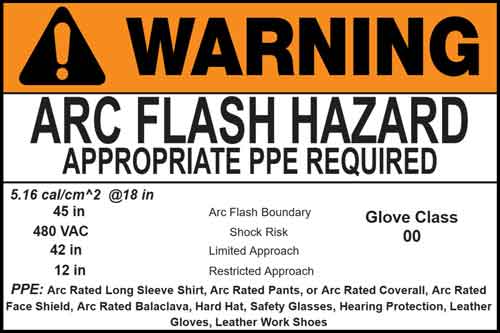
Arc flash labels are required markings under NFPA 70E that display incident energy in cal/cm2, arc flash boundary, PPE requirements, nominal voltage, and shock hazard limits for energized electrical equipment.
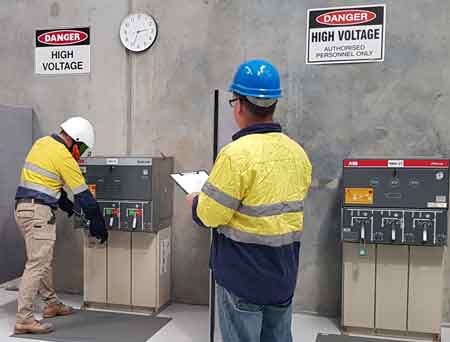
A worker approaching a switchgear lineup reads the arc flash label before opening the panel. In the time it takes to read the label, they determine whether the work can proceed, what PPE is required, and whether their planned working distance is inside or outside the arc flash boundary. If the label is wrong, outdated, or missing, that decision is made on an assumption. The label is the last engineering control between the arc flash study and the worker performing the task.
That is the function of arc flash labels: they convert the outputs of an arc flash study into field-usable information at the exact location where exposure decisions are made. An accurate, up-to-date label supports sound decisions. A label that reflects system conditions that no longer exist creates the appearance of control while the actual hazard goes unaccounted for.
NFPA 70E Article 130.5(H) requires that electrical equipment likely to be examined, adjusted, serviced, or maintained while energized be marked with arc flash hazard information. The standard specifies that labels must include nominal system voltage and arc flash boundary, and at least one of the following: incident energy and working distance, minimum arc rating of clothing, or PPE category. Shock hazard information is typically included alongside arc flash data because both hazards are present at the same equipment.

The label does not need to show all possible data fields. It must show enough that a qualified worker can determine the required PPE and understand the approach boundaries before interaction begins.
Incident energy is the thermal exposure a worker would experience at a defined working distance if an arc flash occurred. It is expressed in cal/cm2 and calculated per IEEE 1584 as part of the arc flash study. This value directly determines PPE selection. The selected garment must be rated at or above the incident energy shown on the label.
The working distance is the distance from the potential arc point at which the incident energy was calculated. If a worker's actual working distance is shorter than the distance on the label, their exposure exceeds what the label indicates. This is one of the most common field-level compliance failures: the label is current and correct, but the task is performed closer to the equipment than the analysis assumed.
The arc flash boundary is the distance from the potential arc source at which incident energy equals 1.2 cal/cm2, the threshold for onset of a second-degree burn on unprotected skin. Inside this boundary, arc-rated PPE is required. Outside it, the thermal exposure drops below the injury threshold for unprotected workers.
In confined spaces, maintaining the arc flash boundary may be physically impossible. That condition requires a different approach: equipment de-energization, increased PPE rated for the actual exposure at the reduced working distance, or a change to the task plan. A label that shows the arc flash boundary cannot resolve a space constraint. It reveals it. For how boundary distances are calculated and applied by incident energy level, see Arc Flash Boundary Chart: Calculated Distances By Incident Energy.
When a label shows a PPE category rather than a specific incident energy value, it is communicating a minimum protection level. Category 1 requires a 4 cal/cm2 minimum arc rating. Category 2 requires 8 cal/cm2. Category 3 requires 25 cal/cm2. Category 4 requires 40 cal/cm2. The worker selects clothing and equipment that meets or exceeds the minimum arc rating for the stated category.
A label showing a PPE category derived from NFPA 70E Table 130.5(C) is based on a task-based method that does not account for site-specific fault-current levels or protective-device characteristics. A label derived from an incident energy analysis is based on the actual calculated exposure for that equipment under current system conditions. Both are compliant under NFPA 70E, but they carry different levels of precision. For a full explanation of category selection and what each level requires, see Arc Flash PPE Category Risk And Compliance Guide.
Nominal voltage identifies the class of system being approached. It anchors every other decision on the label. A worker who does not know the system voltage cannot correctly select rubber insulating gloves for shock protection, cannot determine whether test equipment is rated for the circuit, and cannot apply the correct approach boundaries for shock hazard control.
Shock hazard approach distances (limited approach boundary and restricted approach boundary) are typically shown alongside arc flash data because both hazards exist simultaneously at energized equipment. Inside the restricted approach boundary, accidental contact with energized conductors becomes possible. Within the limited-approach boundary, unqualified persons cannot be present without an escort. These distances are fixed in NFPA 70E Table 130.4(E) based on nominal voltage and are not site-specific.
Stay informed with our FREE Arc Flash Newsletter — get the latest news, breakthrough technologies, and expert insights, delivered straight to your inbox.
NFPA 70E does not require a label date, but many programs include one because it allows workers to assess whether the label was generated before or after known system changes. Equipment identification ties the label to the specific panel or equipment it covers, which matters in facilities where multiple panels of similar appearance are in proximity.
For the complete specification of what labels must include, placement requirements, size guidance, and the exception for supervised industrial installations, see NFPA 70E Arc Flash Label Requirements And PPE Guidance.
The label is encountered in sequence, not all at once. A worker approaching the equipment reads the warning signal word first. Then the incident energy or PPE category. Then the arc flash boundary. Then the nominal voltage and shock limits. Each value narrows the decision about how to proceed.
If the PPE available does not meet the label's stated requirement, work stops. If the working distance cannot be maintained, work stops. If the label is missing, the worker cannot proceed with energized work under NFPA 70E without first establishing hazard data through another compliant method.
This is where label quality becomes operational. A label that is hard to read under field lighting, faded from exposure, or physically obscured by equipment does not function as a decision control. It exists as a document that cannot be used. ANSI Z535 standards provide guidance on signal words, colors, and layout that improve label legibility under real working conditions, though NFPA 70E does not prescribe a specific format.
For a detailed explanation of how each field on the label is interpreted and used in real work conditions, including the distinction between what labels show and what workers must supply through judgment, see Arc Flash Warning Label Guide To Incident Energy.
An arc flash label is only as accurate as the arc flash study it came from, and only as current as the system it describes. Changes to protective device types or settings, transformer impedance, available fault current, or equipment configuration directly affect incident energy and boundary distances. When those changes occur, a label that has not been updated no longer reflects actual hazard conditions.
NFPA 70E requires that arc flash studies be reviewed when system changes occur. It also recommends review at intervals not exceeding five years regardless of whether changes have been identified. In facilities with active capital programs, that interval is often too long. Equipment modifications, protective device replacements, and upstream utility changes can all alter calculated incident energy at equipment that has not been physically touched.
The most operationally dangerous scenario is a label that looks valid but is not. A worker who trusts a label generated before a system modification that increased available fault current may select PPE rated for an exposure level that no longer applies. The label was accurate when it was generated. The system is now different. The arc flash study is the only way to know whether the label still reflects reality. For the engineering process behind label generation and when studies must be updated, see Arc Flash Study – NFPA 70E Compliance, Hazard Analysis, PPE.
Knowing that a label shows 18 cal/cm2 at 18 inches is not the same as knowing what to do with that information. Workers must be trained to read a label, identify the required PPE category or minimum arc rating, determine whether available PPE is sufficient, apply the arc flash boundary to the physical work environment, and recognize when conditions require stopping the task or re-evaluating the approach.
Electrical Safety Training – NFPA 70E and CSA Z462 Courses cover arc flash label interpretation, PPE selection, boundary application, and NFPA 70E work practices in
a 6-hour live online or in-person course. Group booking is available for facilities qualifying their full workforce.
Explore 50+ live, expert-led electrical training courses –