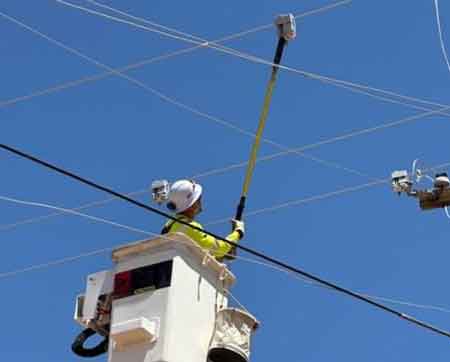
Asset Intelligence & Predictive Maintenance
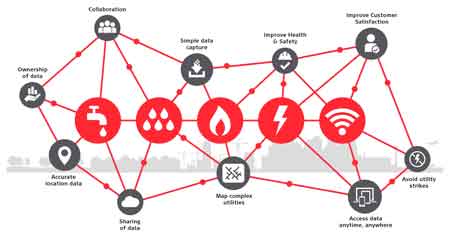
Utility Network Device Management for Distribution Control
Utility Network Device Management integrates AMI, GIS, and SCADA into a validated digital twin that governs device state, topology accuracy, load flow integrity, outage localization, and predictive maintenance across distribution systems.
Utility Network Device Management governs the operational state of transformers, reclosers, regulators, switches, meters, and protection assets across modern distribution systems. It integrates AMI, GIS, and SCADA into a continuously verified digital twin that functions as a structural control boundary for operational decisions.
In high-density distribution environments where millions of endpoints stream interval data, device-level topology accuracy determines whether switching sequences, overload assessments, and outage localization actions are based…
View more
Latest Asset Intelligence & Predictive Maintenance Articles
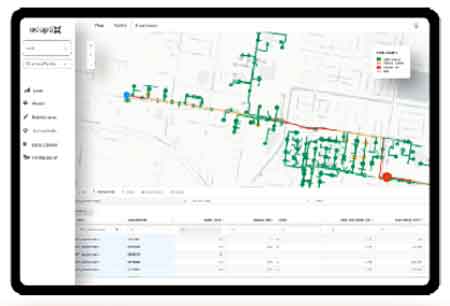
Predictive Grid Intelligence Gives Utilities Advance Warning
Predictive grid intelligence transforms AMI, GIS, and SCADA telemetry into a continuously validated digital grid model that forecasts asset overloads, topology errors, outage risk, and voltage instability. This operational intelligence enables utilities to anticipate failures, optimize restoration sequencing, and improve reliability before physical infrastructure reaches failure thresholds.
Distribution utilities operate vast electrical networks in which most assets function without direct telemetry. Transformers, switches, and feeder segments often operate for years without revealing their internal stress or connectivity condition. Predictive grid intelligence changes this reality by converting meter data, topology models, and operational telemetry into a continuously evolving electrical model that…
View more
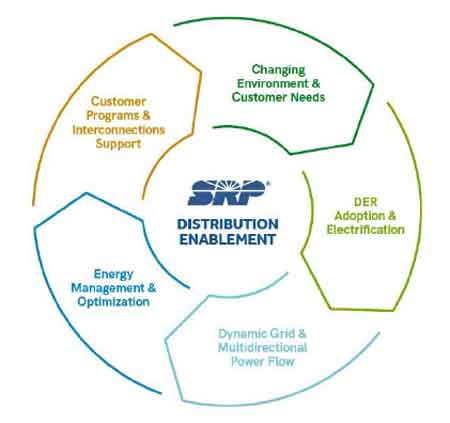
Line Sensors for Utilities in Distribution Fault Detection
Line sensors for utilities provide near real-time fault detection, waveform capture, and feeder visibility, reducing patrol time, improving outage isolation, and strengthening ADMS model accuracy across overhead and underground distribution networks.
Line sensors for utilities shift distribution control from post-event troubleshooting to near real-time situational awareness. When deployed on critical feeders, high-fire-risk circuits, and hard-to-access underground sections, they alter how operators interpret breaker trips, patrol decisions, and sectionalizing sequences.
In systems spanning tens of thousands of distribution miles with large underground penetration, the absence of intermediate sensing creates blind segments between substations and field devices. A breaker trip confirms interruption…
View more
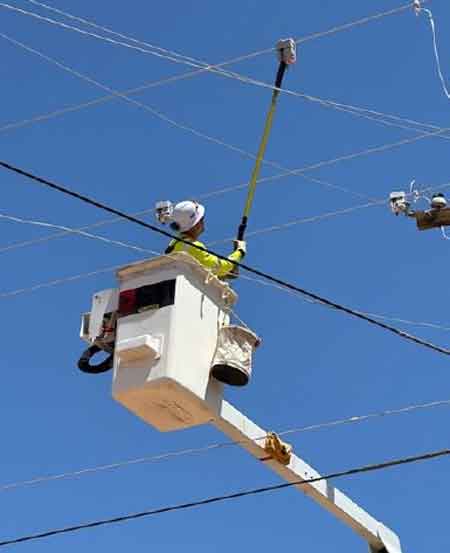
Real-Time Line Monitoring for Distribution Fault Visibility
Real-time line monitoring provides continuous visibility into fault current, waveforms, and power flow across distribution feeders, enabling faster restoration, ADMS model validation, and predictive analytics while reducing customer minutes of interruption in high-risk circuits.
Distribution systems are increasingly difficult to observe at the feeder level. Underground expansion, distributed energy resource backfeed, aging electromechanical protection, and wildfire exposure have widened the gap between breaker-level visibility and actual fault location. When operators cannot see beyond the substation, restoration becomes probabilistic rather than deterministic.
Breaker status alone does not explain where a fault occurred, how it propagated, or whether reverse power flow altered…
View more
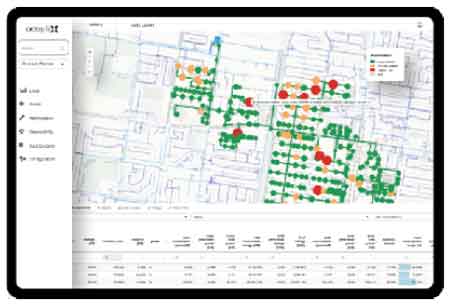
AI Grid Monitoring System Architecture
AI grid monitoring system platforms turn AMI, GIS, and SCADA data into a continuously verified digital twin, exposing overloads, connectivity errors, and outage risk before they escalate into restoration delays, switching misoperations, or avoidable asset failure.
Utilities do not lack data. They lack confidence in the model interpreting it. When AMI readings, GIS topology, and SCADA status disagree, restoration slows and switching decisions become defensive. In extreme weather or rapid DER ramping, small topology errors distort load transfer assumptions and amplify operational risk. The issue is not visibility. It is whether the digital twin can be trusted when a control…
View more

Grid Digitalization in Transmission Interface Modeling
Grid digitalization transforms transmission planning, interconnection modeling, and real time validation so utilities can manage cluster volatility, cost allocation shifts, and dynamic reliability risk before regulatory timelines force high exposure commitments.
Grid digitalization restructures transmission planning and interconnection governance under compressed decision windows, where restudy exposure driven by cluster withdrawal volatility can rapidly distort upgrade commitments. It converts transmission modeling from a periodic analytical exercise into a continuous control architecture, enabling utilities to assess cost allocation shifts and dynamic uncertainty before operational margin erodes.
At the transmission interface, digitalization is not a reporting enhancement. It is a structural discipline inside…
View more
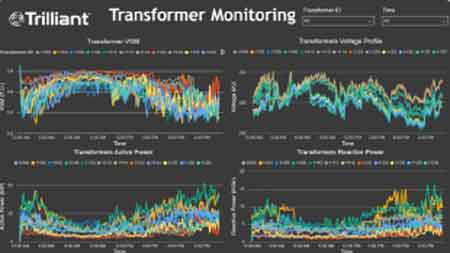
Condition Based Asset Strategy in Utility OT Risk Planning
Condition Based Asset Strategy determines whether utilities allocate capital before failure or after disruption. When AMI data and DA asset health signals drive enforceable asset risk scoring, predictive asset prioritization becomes a reliability containment decision.
Condition Based Asset Strategy reframes asset management from age driven replacement toward telemetry informed risk governance. In regulated utility environments, capital deployment is no longer justified by calendar cycles alone. It is justified by measured degradation, probabilistic exposure to failure, and operational consequences under load.
Utilities now possess interval voltage, outage event, and switching telemetry that historically remained siloed. AMI data for asset management and…
View more