Grid Data Foundations & AI Infrastructure
Enterprise AI Governance for Utilities
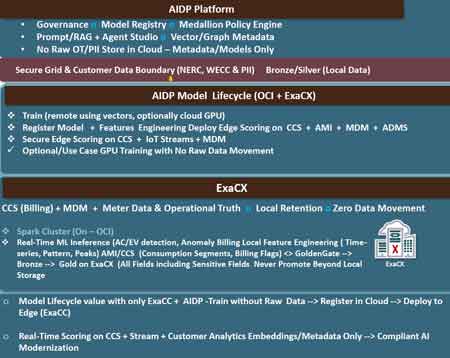
Enterprise AI Governance for Utilities establishes model lifecycle controls, OT boundary enforcement, and data governance to prevent model drift, uncontrolled inference, and telemetry distortion that degrade grid reliability and regulatory compliance.
Enterprise AI Governance for Utilities determines whether predictive models strengthen grid control or quietly degrade it. In modern distribution environments, inference engines now influence load forecasting, DER detection, anomaly billing, and dispatch optimization. When model lifecycle discipline is weak, drift becomes invisible until switching errors, voltage instability, or misclassified demand signals surface in operations.
Integrated AI platforms can process hundreds of millions of interval records monthly. In the referenced…
View more
Latest Grid Data Foundations & AI Infrastructure Articles
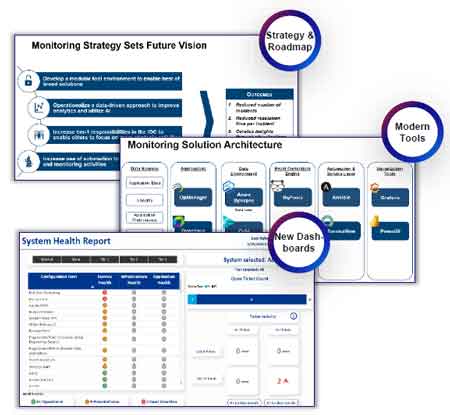
Buy vs Build Event Correlation Platform for Utility OT Observability
Buy vs Build Event Correlation Platform decisions define how utilities govern OT telemetry, alarm noise reduction, root cause analysis, and automated remediation under regulatory constraints. Procurement errors can cascade into misoperation risk and false incident escalation.
The procurement decision is not about software preference. It is about where operational accountability resides when correlation logic determines incident priority inside a regulated control environment. In a utility network operations center, event correlation defines whether telemetry becomes actionable intelligence or unmanaged noise.
Modern grid operations generate high volume alarms across SCADA, WAN infrastructure, DER telemetry, cybersecurity systems, and automation platforms. Without structured correlation,…
View more
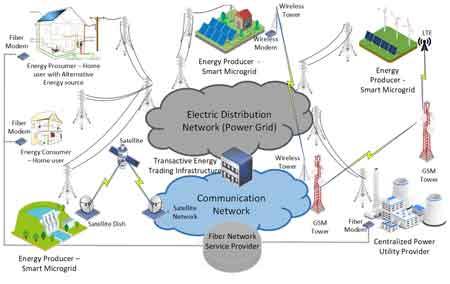
Utility Network Automation Architecture For Deterministic AI Ops
Utility network automation architecture governs deterministic provisioning, config drift control, AI orchestration, and ITSM integrated remediation to prevent unstable switching, audit gaps, and cascading network failures across substations and telecom domains.
Utility network automation architecture is not an IT efficiency initiative. It is an operational control boundary that determines whether telecom and substation networks can be trusted to execute switching, protection coordination, and remote remediation under AI assisted conditions.
Utility network automation architecture as an operational control boundary
In large service territories exceeding 50,000 square miles, with more than 100,000 infrastructure assets and hundreds of substations, manual provisioning and…
View more
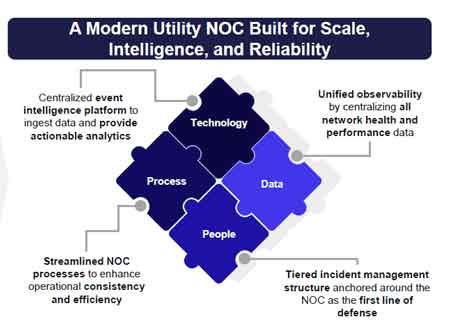
Utility NOC Maturity Model for Grid Observability
Utility NOC Maturity Model defines the staged evolution from reactive monitoring to predictive grid observability and centralized grid intelligence governance in regulated OT environments, where threshold discipline determines operational risk exposure.
A modern utility Network Operations Center (NOC) is no longer a device alarm clearing function. It is an operational control layer that determines whether telemetry, topology awareness, and remediation authority are aligned to grid risk. The maturity path of the Utility Network Operations Center Maturity Model defines how that control layer evolves under regulatory, cyber, and reliability constraints.
In regulated OT environments, monitoring gaps do not remain informational weaknesses.…
View more
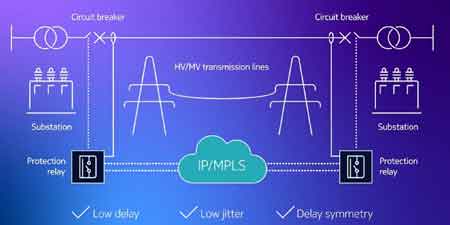
Utility WAN Architecture for AI Workloads
Utility WAN architecture determines whether AI inference, edge compute, and substation control traffic maintain deterministic latency under exponential bandwidth growth, optical transport scaling, and secure OT segmentation constraints.
AI is not simply increasing bandwidth demand across utility networks. It is redefining the tolerance envelope within which grid control remains trustworthy. When inference engines, distributed analytics, and high resolution telemetry converge on substations and regional cores, the WAN becomes a control dependency rather than a communications utility.
Operators do not experience WAN saturation as an inconvenience. They experience it as distorted situational awareness. If congestion arises during feeder switching or when…
View more

SCADA Cybersecurity: Protecting Utility Grid Control Systems
SCADA cybersecurity protects grid control systems from unauthorized commands, data manipulation, and operational disruption. Without proper authentication, encryption, and network segmentation, attackers can interfere with switching, protection, and real-time grid control.
Grid reliability depends on trust. Every breaker operation, relay command, and switching instruction issued through supervisory control and data acquisition SCADA systems carries immediate physical consequences. When that trust is compromised, attackers do not merely access data. They gain the ability to influence equipment behavior, disrupt protection coordination, and interfere with operational decisions that maintain system stability.
These systems operate as part of critical infrastructure operational control systems, where…
View more
AIOps for Electric Utilities in Deterministic Grid Remediation
AIOps for Electric Utilities applies alarm correlation, deterministic orchestration, and governed automated remediation to reduce false positives, preserve OT control authority, and prevent cascading instability across substations and grid networks.
Control room instability rarely begins with equipment failure. It begins when alarm density exceeds human discrimination capacity and automated responses trigger without sufficient context. At scale, false positives are not nuisance events. They are latent instability vectors.
AIOps for Electric Utilities exists to compress noise before execution authority is exercised. It binds telemetry ingestion, alarm correlation, deterministic workflow sequencing, and governed remediation into a constrained control loop. The objective is…
View more