Intelligent Asset Management in Power Systems
By Florian Klughammer, Portfolio Manager, Reinhausen
By Florian Klughammer, Portfolio Manager, Reinhausen
Request for Quotation Service
Buyers Submit Free RFQs to top suppliers, no obligation.
Suppliers Browse real project RFQs directly from buyers.
Trust Electricity Forum 40 years connection buyers and suppliers.
Intelligent asset management converts transformer condition data into prioritized maintenance decisions using asset analytics, automated diagnostics, and fleet risk evaluation, allowing utilities to identify emerging failure risk early, optimize maintenance timing, and manage asset lifecycle reliability based on actual operating condition rather than fixed schedules.
For decades, utilities relied on inspection schedules and historical failure rates to guide maintenance planning. While effective in stable operating environments, this approach cannot account for the highly variable stresses modern transformers experience. Load growth, fluctuating demand patterns, and aging infrastructure create conditions where identical transformers can age at dramatically different rates.
Transformers generate large volumes of condition data, including temperature trends, gas formation, electrical behavior, and operational history. On their own, these measurements provide limited guidance. Equipment intelligence platforms integrate these data streams, identifying patterns that indicate degradation and predicting future failure risk.
Instead of presenting engineers with isolated measurements, intelligent systems evaluate relationships between multiple indicators. For example, a moderate increase in operating temperature may not require intervention if the insulation condition remains stable. However, when temperature changes coincide with indicators of insulation degradation, the risk profile changes significantly.
This contextual interpretation transforms raw data into engineering insight.
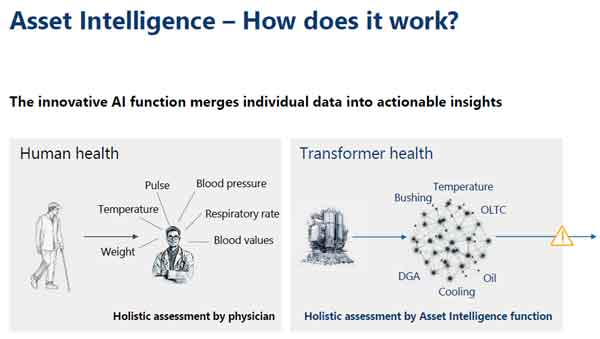
One of the most valuable functions of intelligent asset management systems is automated fault detection. Advanced analytics continuously evaluate transformer behavior by comparing current operating conditions with expected performance models.
When abnormal patterns emerge, automated diagnostics identify the likely cause and estimate the severity of degradation. This capability allows engineers to identify emerging insulation deterioration, thermal stress accumulation, or internal electrical weakness long before protective devices detect a fault.
Stay informed with our FREE Asset Intelligence & Predictive Maintenance Newsletter — get the latest news, breakthrough technologies, and expert insights, delivered straight to your inbox.
Instead of waiting for failure symptoms to become obvious, utilities can intervene while the transformer remains fully operational.
Managing individual transformers effectively is important, but intelligent asset management provides even greater value when applied across entire fleets. Utilities often operate hundreds or thousands of transformers, each with unique operating conditions and degradation profiles.
Asset intelligence systems continuously evaluate the condition of every unit, assigning relative risk scores based on degradation indicators and operating stress. These rankings allow maintenance teams to prioritize attention on the most vulnerable equipment.
This fleet-level perspective ensures maintenance resources are directed toward transformers with the highest probability of failure, rather than those that simply reach a scheduled maintenance interval.
Traditional maintenance strategies often result in unnecessary inspections or premature equipment replacement. Intelligent asset management eliminates this inefficiency by aligning maintenance activities with the actual equipment condition.
Transformers operating under favorable conditions can remain in service longer without increased risk, while heavily stressed units receive earlier intervention. This condition-based approach improves equipment utilization while reducing maintenance costs.
Utilities gain the confidence to extend maintenance intervals safely for low-risk transformers while focusing attention where it is needed most.
Intelligent asset management extends beyond condition awareness by integrating transformer asset data into enterprise-level asset management processes. Every transformer progresses through a defined asset lifecycle, from commissioning and peak operational use to aging and eventual replacement. Transformer lifecycle management systems use condition intelligence to determine each transformer's lifecycle stage, enabling utilities to make maintenance and replacement decisions based on actual degradation rather than assumed service life. An enterprise asset management system provides the operational foundation for intelligent asset management by organizing asset lifecycle data, maintenance history, and asset performance indicators into a unified decision framework.
Enterprise asset management (EAM) platforms play a central role in this process. These systems collect and organize data from across the transformer fleet, including thermal exposure, insulation condition, operational stress history, and maintenance records. Intelligent asset management solutions combine this information into unit performance management models that provide engineering teams with a clear understanding of equipment condition and reliability risk.
Artificial intelligence and machine learning enhance these capabilities by identifying degradation patterns that would be difficult to detect through manual analysis. By evaluating historical and real-time data, machine learning algorithms improve failure prediction accuracy and support intelligent asset management strategies that align maintenance timing with actual equipment condition. This allows utilities to shift from reactive maintenance to predictive lifecycle management.
These intelligent asset management solutions also strengthen risk management by allowing utilities to quantify operational risk across the transformer fleet. Instead of treating asset maintenance as a fixed operational process, utilities can prioritize maintenance based on equipment performance, failure probability, and operational importance. This improves operational processes by ensuring maintenance resources are applied where they deliver the greatest reliability benefit.
By integrating equipment lifecycle management, enterprise asset management, and transformer performance management into a unified, intelligent asset management framework, utilities can manage transformer fleets with greater precision. Maintenance decisions become based on engineering evidence rather than assumptions, improving reliability while optimizing lifecycle cost and operational performance.
An intelligent asset management solution enables utilities to integrate data, predictive analytics, and equipment performance management into a unified operational framework that supports long-term reliability and lifecycle optimization.
Think you know Asset Intelligence & Predictive Maintenance? Take our quick, interactive quiz and test your knowledge in minutes.
Modern asset intelligence platforms integrate directly with transformer monitoring infrastructure and automatically perform continuous condition evaluation. These embedded systems analyze operating data in real time, providing an ongoing assessment of equipment health.
Automated analysis eliminates the delay between condition changes and engineering evaluation. Instead of waiting for periodic inspection or manual data review, intelligent systems provide continuous awareness of transformer condition.
This continuous evaluation improves response time and prevents degradation from progressing unnoticed.
The greatest advantage of intelligent asset management lies in its ability to shift maintenance strategy from reactive to predictive. Instead of responding to failures after they occur, utilities can anticipate degradation and intervene proactively.
This predictive capability reduces unexpected outages, improves grid reliability, and extends transformer lifespan. Maintenance decisions become based on engineering evidence rather than assumptions.
As transformer fleets age and system demands increase, intelligent asset management provides the operational visibility required to maintain reliability and control risk.
By converting transformer condition intelligence into engineering decision guidance, intelligent asset management enables utilities to proactively manage equipment lifecycle risk rather than reactively. This transition from schedule-based maintenance to condition-driven asset management improves reliability, extends transformer lifespan, and enables utilities to maintain system stability under increasing operational stress.
Advantages To Instructor-Led Training – Instructor-Led Course, Customized Training, Multiple Locations, Economical, CEU Credits, Course Discounts.
Request For QuotationWhether you would prefer Live Online or In-Person instruction, our electrical training courses can be tailored to meet your company's specific requirements and delivered to your employees in one location or at various locations.