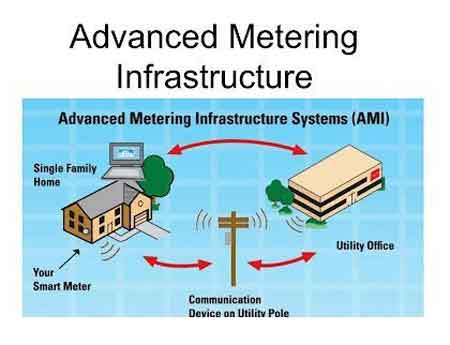
AMI Metering Network Interoperability
By Joe Vale, Director of AMI Operations & Meter Engineering, Duke Energy
By Joe Vale, Director of AMI Operations & Meter Engineering, Duke Energy


AMI metering establishes interoperable smart meter networks and standards-based field area communications that reduce vendor lock-in, enforce consistent cybersecurity controls, and preserve grid visibility as distributed energy penetration and endpoint scale accelerate.
AMI deployments are no longer defined by interval data collection. They now operate as a structural control layer that influences outage restoration sequencing, DER coordination, voltage management, and procurement strategy. When metering architecture limits interoperability, it narrows operational flexibility across the distribution system.
Duke Energy and National Grid have demonstrated that AMI 2.0 interoperability is not a procurement preference but a system risk decision. Migrating legacy endpoints onto open mesh standards shifts AMI from a single-vendor dependency to a multi-vendor control ecosystem. That transition alters supply chain exposure, firmware governance discipline, and long-term asset authority.
At Duke Energy, 30,000 existing AMI 1.0 meters were migrated onto a Wi-SUN interoperable network while 6,000 AMI 2.0 meters were deployed in parallel during a 2025 pilot. The strategic signal is not the device count. It is the network-first migration model that avoids stranded communications infrastructure while reducing supply chain exposure.
National Grid’s AMI 2.0 program spans 3.75 million electric and gas endpoints across New York and Massachusetts, with 1.8 million installed to date. At this scale, interoperability is no longer theoretical. It governs firmware update governance, device certification discipline, and standardized security enforcement across millions of endpoints.
Utilities that treat advanced metering infrastructure as a closed ecosystem inherit long-term vendor constraints. Interoperable AMI metering reframes the field-area network as a standards-based mesh that can accommodate new device classes without rebuilding the communications topology.

Interoperability directly reduces vendor concentration risk. Duke’s pilot introduced a second AMI vendor into an existing network without re-architecting the communications backbone. That decision reduced field complexity and positioned the utility to introduce additional endpoint types under the same network standard.
The cascading consequences of single-vendor lock-in extend beyond pricing alone. It is delayed firmware patches, constrained security remediation cycles, and slowed DER integration because endpoint capabilities cannot evolve in sync with grid conditions.
By contrast, interoperable ami smart meter platforms operate within a certification ecosystem where devices from multiple manufacturers conform to a common wireless standard. This reduces the probability that a single supply chain disruption stalls deployment timelines across millions of endpoints.
AMI systems integrate automated meter infrastructure with customer management platforms to deliver accurate meter readings, real-time visibility into energy usage, and faster identification of power outages. By synchronizing automated meter data with operational systems, utilities can reduce billing disputes, improve load forecasting accuracy, and streamline outage response workflows while maintaining consistent communication with customers during service interruptions.
A network-first migration strategy leverages existing infrastructure but introduces discipline requirements. Backward compatibility must be maintained to avoid premature asset retirement. Wi-SUN-based architectures emphasize maintaining compatibility with earlier generations to prevent stranded endpoints.
The tradeoff is governance complexity. Certification, firmware management, and device authentication policies must remain tightly controlled to prevent interoperability from degrading into inconsistency. Interoperability without governance introduces security variance across the fleet.
Utilities evaluating ami meter upgrades must therefore define clear interoperability thresholds. Which functions must be standardized? Which device capabilities are optional? Without defined thresholds, model drift can emerge between endpoint capabilities and control room expectations.
National Grid prioritized standardized security within its AMI 2.0 program. At a multi-million endpoint scale, inconsistent encryption practices or device authentication methods create systemic exposure.
Interoperable ami data streams must align with uniform encryption, key rotation, and certificate management practices. If security policies vary by vendor implementation, telemetry integrity becomes uncertain under load or during cyber stress events.
An operational edge case emerges during DER backfeed conditions. If latency varies across endpoint vendors, voltage response modeling may misalign with real-time feeder conditions. Inconsistent telemetry timing can distort assumptions about distributed control in ADMS and Volt VAR applications.
Duke Energy plans to migrate 8.5 million production AMI 1.0 meters onto the interoperable network. At that scale, performance metrics shift from device reliability to mesh resilience and routing efficiency.
Interoperable intelligent connectivity must sustain high device density without degrading packet delivery reliability. Mesh routing inefficiencies can propagate into delayed outage notifications or delayed remote disconnect commands.
One quantified signal from large deployments is installation velocity and the consistency of firmware synchronization across millions of endpoints. If firmware cycles fragment across vendors, field crews and control operators inherit configuration ambiguity, which increases hesitation during restoration events.
The engineering decision is therefore not whether AMI metering supports interval reads. It is whether its network architecture preserves long-term operational authority across evolving DER penetration, cybersecurity threats, and procurement cycles.
Download our FREE Electrical Training Catalog and explore a full range of expert-led electrical training courses.

Advantages To Instructor-Led Training – Instructor-Led Course, Customized Training, Multiple Locations, Economical, CEU Credits, Course Discounts.
Request For QuotationWhether you would prefer Live Online or In-Person instruction, our electrical training courses can be tailored to meet your company's specific requirements and delivered to your employees in one location or at various locations.