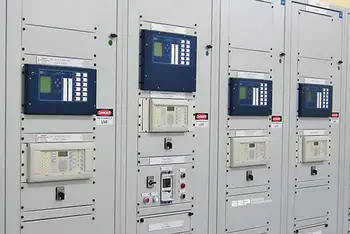
Protective Relay Training - Basic
Our customized live online or in‑person group training can be delivered to your staff at your location.
- Live Online
- 12 hours Instructor-led
- Group Training Available
Regular Price:
$699
Coupon Price:
$599
Rhode Island has granted a New Jersey-based renewable energy firm the right to develop a wind farm in Narragansett Bay that would generate 15 percent of the state's electricity needs in the coming decade, officials said.
DeepwaterWind LLC estimates the project will cost $1 billion to $2 billion and benefit New England, which pays some of the most expensive electricity bills in the nation because it is heavily dependent on natural gas.
No offshore wind farms have been built in the United States, although they have been proposed off Delaware, New Jersey, New York and in the Gulf of Mexico.
DeepwaterWind must still surmount multiple regulatory and financial challenges before construction could start on a project that could take up to seven years to complete. Feuds over wind turbine aesthetics have long bogged down a wind farm proposed off Cape Cod in Massachusetts.
DeepwaterWind CEO Chris Brown said his firm builds turbines on large platforms originally designed for offshore drilling rigs, which means they can operate in deep waters and ideally out of sight of land. He expects to build around 100 turbines in Narragansett Bay.
"What we've really focused on is that we want to be beyond the horizon," Brown said in an interview. "We don't think that you have to choose between, kind of, the view and the environment."
DeepwaterWind is backed by three partners: First Wind, DE Shaw & Co. and Ospraie Management, LLC. Besides Rhode Island, it has recently proposed projects in New Jersey and New York. If those plans come to fruition, the company has agreed to locate its manufacturing headquarters at an industrial park in North Kingstown. The firm now employs 15 full-time staffers, but hopes to eventually employ 800 people in the state.
Gov. Don Carcieri previously set a goal of getting 15 percent of Rhode Island's electricity from wind, a timeline his administration now acknowledges it cannot meet. State energy officials studied Narragansett Bay in April 2007 and identified possible sites for more than 300 turbines.
The strongest winds blow south of Block Island, an affluent resort area where residents pay high rates because their electric plant burns pricey diesel fuel. Several island business owners have even threatened to reduce costs by starting their own power company. As part of the development, DeepwaterWind has proposed powering Block Island with electricity from the wind turbines, which could lower prices.
Several obstacles remain before building could begin.
DeepwaterWind will now pay $3 million so Rhode Island environmental officials can study how the state should utilize its sea floor, just as cities and towns designate certain zones for homes, business and industrial use.
"Think of it as a clear roadmap for development," said Saul Kaplan, executive director of Rhode Island's Economic Development Corp.
The firm must also secure more than 100 permits from a host of state and federal agencies, a process that could take two to four years. Afterward, it must gather enough money to build the project.
Carcieri, a Republican, and lawmakers in the Democratic-dominated General Assembly are still fighting over who will buy the electricity. Without dedicated, long-term buyers, experts fear renewable energy developers will be reluctant to build.
Rhode Island lawmakers passed a bill this year requiring National Grid, the state's dominant power company, to buy electricity from renewable energy projects for at least 10 years at a time. In return, National Grid would have received a payment equal to 3 percent of the renewable energy it bought.
Carcieri vetoed the bill, calling it overly generous to the utility. Instead, he has asked the state Public Utilities Commission to force National Grid to do the same thing but without compensation.
Related News

Seven small UK energy suppliers must pay renewables fees or risk losing licence
Ofgem Renewables Obligations drive supplier payments for renewables fees, feed-in tariffs, and renewable generation, with…
View more

Only one in 10 utility firms prioritise renewable electricity – global study
Utility Renewable Investment Gap highlights Oxford study in Nature Energy: most electric utilities favor fossil…
View more

ATCO Electric agrees to $31 million penalty following regulator's investigation
ATCO Electric administrative penalty underscores an Alberta Utilities Commission probe into a sole-sourced First Nation…
View more
'For now, we're not touching it': Quebec closes door on nuclear power
Quebec Energy Strategy focuses on hydropower, energy efficiency, and new dams as Hydro-Que9bec pursues Churchill…
View more

Tunisia invests in major wind farm as part of longterm renewable energy plan
Sidi Mansour Wind Farm Tunisia will deliver 30 MW as an IPP, backed by UPC…
View more
Energy authority clears TEPCO to restart Niigata nuclear plant
TEPCO Kashiwazaki-Kariwa restart plan clears NRA fitness review, anchored by a seven-point safety code, Niigata…
View more
Sign Up for Electricity Forum’s Newsletter
Stay informed with our FREE Newsletter — get the latest news, breakthrough technologies, and expert insights, delivered straight to your inbox.
Electricity Today T&D Magazine Subscribe for FREE

Stay informed with the latest T&D policies and technologies.
- Timely insights from industry experts
- Practical solutions T&D engineers
- Free access to every issue

