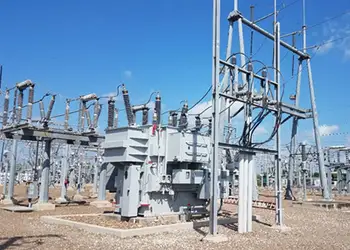
Substation Protection Training - Protect Transformers, Buses and Lines
Our customized live online or in‑person group training can be delivered to your staff at your location.
- Live Online
- 12 hours Instructor-led
- Group Training Available
Regular Price:
$799
Coupon Price:
$699
Chinese scientists made their first successful test of a thermonuclear fusion reactor, raising the energy-hungry country's profile in the new but uncertain technology that promises clean power, state media reported.
Thermonuclear fusion seeks to generate power by joining nuclei of atoms together, releasing energy that can be tapped without producing greenhouse gases but creating a small amount of nuclear waste.
Scientists at the Chinese Academy of Sciences announced they had successfully tried a domestically developed fusion device in the eastern Chinese city of Hefei, Xinhua news agency said.
The scientists called the device "the first of its kind in operation in the world", but the report did not specify what tests it had passed.
Xinhua cited the scientists as saying that deuterium and tritium atoms had been fused together at a temperature of 100 million degrees Celsius for nearly three seconds.
The report did not specify whether the device, called Experimental Advanced Superconducting Tokamak (EAST), had succeeded at producing more energy than it consumed, the main obstacle to making fusion commercially viable.
Today's nuclear power plants employ fission, in which atoms are broken apart, not fused together. Scientists say fusion could potentially produce virtually unlimited, clean energy from readily available resources, such as seawater.
China is a partner in the International Thermonuclear Experimental Reactor (ITER) project, a 500-megawatt experimental reactor to be built in southern France.
The European Union, Japan, South Korea, Russia, the United States and India are also involved in the project, which will seek to mimic the way the sun produces energy.
China, pressed for energy sources as its economy grows by around 10 percent per year, has been increasingly turning to nuclear power.
It plans to spend about 400 billion yuan ($50.7 billion) on building around 30 nuclear reactors by 2020, about three times the number it already has in operation.
Related News

Victims of California's mega-fire will sue electricity company
PG&E Wildfire Lawsuit alleges utility negligence, inadequate infrastructure maintenance, and faulty transmission lines, as victims…
View more
Why electric buses haven't taken over the world—yet
Electric Buses reduce urban emissions and noise, but require charging infrastructure, grid upgrades, and depot…
View more

Bill Gates’ Nuclear Startup Unveils Mini-Reactor Design Including Molten Salt Energy Storage
Natrium small modular reactor pairs a sodium-cooled fast reactor with molten salt storage to deliver…
View more
BC residents split on going nuclear for electricity generation: survey
BC Energy Debate: Nuclear Power and LNG divides British Columbia, as a new survey weighs…
View more

New president at Manitoba Hydro to navigate turmoil at Crown corporation
Jay Grewal Manitoba Hydro Appointment marks the first woman CEO at the Crown utility, amid…
View more
Hydro One: No cut in peak hydro rates yet for self-isolating customers
Hydro One COVID-19 Rate Relief responds to time-of-use pricing, peak rates, and Ontario Energy Board…
View more
Sign Up for Electricity Forum’s Newsletter
Stay informed with our FREE Newsletter — get the latest news, breakthrough technologies, and expert insights, delivered straight to your inbox.
Electricity Today T&D Magazine Subscribe for FREE

Stay informed with the latest T&D policies and technologies.
- Timely insights from industry experts
- Practical solutions T&D engineers
- Free access to every issue

