FERC documents in California trading case to be secret

By Reuters


NFPA 70e Training - Arc Flash

Our customized live online or in‑person group training can be delivered to your staff at your location.
  • Live Online
  • 6 hours Instructor-led
  • Group Training Available
Regular Price:
$199
Coupon Price:
$149
Reserve Your Seat Today
An administrative law judge said recently she would keep secret the responses of some 43 companies to a Federal Energy Regulatory Commission (FERC) order to justify profits gained from Enron-style trading tactics during the California energy crisis.

The documents will be temporarily kept private under an agency order issued on Friday to "try to encourage settlement negotiations," FERC Judge Carmen Cintron told Reuters in a telephone interview.

So far, more than a half-dozen companies or municipalities have reached tentative deals with FERC trial staff to settle allegations that they used manipulative trading tactics to boost their profits in 2000-01.

The settlements involve relatively small amounts of money, ranging from $17,000 to $857,000, compared to demands from California officials for billions in refunds from unfair trading strategies.

In June, FERC commissioners ordered 43 firms that may have used Enron-style strategies to "show cause" why they should not have to repay the profits gained from the use of these strategies. The agency did not quantify the amount of money at stake.

Judge Cintron said she will will hold a hearing on Wednesday to determine when the secret responses will be made public.

Morgan Stanley (MWD) agreed to pay $857,089 in one of the biggest tentative settlements to emerge from closed-door talks hosted by FERC. All settlements must be approved by FERC's three commissioners before they can be finalized.

Other firms that have reached tentative settlements with FERC trial staff are Reliant Resources Inc., Aquila Inc., American Electric Power Co. Inc. and Mirant Corp.

FERC staff has recommended that similar cases brought against the Los Angeles Department of Water and Power and Bonneville Power Administration be dropped.

Cases that are not settled by Nov. 3 will proceed to formal hearings before a FERC administrative law judge.

The cases are pending in docket EL03-137.

Related News
PG&E pleads guilty to 85 counts in 2018 Camp Fire

PG&E Camp Fire Guilty Plea underscores involuntary manslaughter charges as the utility admits sparking Paradise's wildfire; Butte County prosecution, CAL FIRE findings, bankruptcy oversight, victim compensation trust, and safety reforms shape accountability.


Key Points

The legal admission by PG&E to 84 involuntary manslaughter counts and unlawfully starting the 2018 Camp Fire.

✅ 84 involuntary manslaughter counts; unlawful ignition admitted.

✅ $3,486,950 fine, $500,000 DA costs; no prison terms.

✅ $13.5B victim trust, Paradise and Butte County payments.


California utility Pacific Gas and Electric Company pleaded guilty Tuesday to 84 counts of involuntary manslaughter and one count of unlawfully starting the Camp Fire, the deadliest blaze in the state's history.

Butte County District Attorney Michael L. Ramsey said the "historic moment" should be a signal that corporations will be held responsible for "recklessly endangering" lives.
The 84 people "did not need to die," Ramsey said. He said the deaths were "of the most unimaginable horror, being burned to death."

Before sentencing, survivors will testify Wednesday about the losses of their loved ones, and many have pursued lawsuits against the utility seeking accountability.

No individuals will be sent to prison, Ramsey said.

"This is the first time that PG&E or any major utility has been charged with homicide as the result of a reckless fire. It killed a town," Ramsey said, referring to Paradise, which was annihilated by the blaze.
According to court documents filed in March, the company will be fined "no more than $3,486,950," and it must reimburse the Butte County District Attorney's Office $500,000 for the costs of its investigation into the blaze, and under separate oversight a federal judge ordered dividends to be directed to wildfire risk reduction to prioritize safety.

Among other provisions, PG&E must establish a trust, compensating victims of the 2018 Camp Fire and other wildfires to the tune of $13.5 billion as part of its bankruptcy plan, according to the plea agreement included in a regulatory filing.
It has to pay hundreds of millions to the town of Paradise and Butte County and cooperate with prosecutors' investigation, the plea deal says.
PG&E also waived its right to appeal.

"I have heard the pain and the anguish of victims as they've described the loss they continue to endure, and the wounds that can't be healed," PG&E Corporation CEO and President Bill Johnson said after the plea. "No words from me could ever reduce the magnitude of such devastation or do anything to repair the damage. But I hope that the actions we are taking here today will help bring some measure of peace, including aid through a Wildfire Assistance Program the company announced."

Johnson was in court Tuesday, where Butte County Superior Court Judge Michael Deems read the names of each victim as their photos were shown on a screen, CNN affiliate KTLA reported.
Johnson said the utility would never put profits ahead of safety again. He told the judge that PG&E took responsibility for the devastation "with eyes wide open to what happened and to what must never happen again," KTLA reported.

In March, the utility and the state agreed to bankruptcy terms, which included an overhaul of PG&E's board selection process, financial structure and oversight, with rates expected to stabilize in 2025 as reforms take hold.
According to investigators with the California Department of Forestry and Fire Protection, PG&E was responsible for the devastating Camp Fire.

Electrical lines owned and operated by PG&E started the fire November 8, 2018, CAL Fire said in a news release, after the company acknowledged its power lines may have started two fires that day.

"The tinder dry vegetation and Red Flag conditions consisting of strong winds, low humidity and warm temperatures promoted this fire and caused extreme rates of spread," CAL Fire said.
PG&E had previously said it was "probable" that its equipment started the Camp Fire but that it wasn't conclusive whether its lines ignited a second fire, as CAL Fire alleged.
The power company filed for bankruptcy in January 2019 as it came under pressure from billions of dollars in claims tied to deadly wildfires, and other utilities such as Southern California Edison have faced similar lawsuits.


Related News

View more

The Cool Way Scientists Turned Falling Raindrops Into Electricity

Raindrop Triboelectric Energy Harvesting converts falling water into electricity using Teflon (PTFE) on indium tin oxide and an aluminum electrode, forming a transient water bridge; a low frequency nanogenerator for renewable, static electricity harvesting.


Key Points

A method using PTFE, ITO, and an aluminum electrode to turn raindrop impacts into low frequency electrical power.

✅ PTFE on ITO boosts charge transfer efficiency.

✅ Water bridge links electrodes for rapid discharge.

✅ Low frequency output suits continuous energy harvesting.


Scientists at the City University of Hong Kong have used a Teflon-coated surface and a phenomenon called triboelectricity to generate a charge from raindrops. “Here we develop a device to harvest energy from impinging water droplets by using an architecture that comprises a polytetrafluoroethylene [Teflon] film on an indium tin oxide substrate plus an aluminium electrode,” they explain in their new paper in Nature as a step toward cheap, abundant electricity in the long term.

Triboelectricity itself is an old concept. The word means “friction electricity”—from the Greek tribo, to rub or wear down, which is why a diatribe tires you out—and dates back a long, long time. Static electricity is the most famous kind of triboelectric, and related work has shown electricity from the night sky can be harvested as well in niche setups. In most naturally occurring kinds, scientists have studied triboelectric in order to avoid its effects, like explosions inside of grain silos or hospital workers touching off pure oxygen. (Blowing sand causes an electric field, and NASA even worries about static when astronauts eventually land on Mars.)

One of the most studied forms of intentional and useful triboelectric is in systems such as ocean wave generators where the natural friction of waves meets nanogenerators of triboelectric energy. These even already use Teflon, which has natural conductivity that makes it ideal for this job. But triboelectricity is chaotic, and harnessing it generally involves a bunch of complicated, intersecting variables that can vary with the hourly weather. Promises of static electricity charging devices have often been, well, so much hot, sandy wind.

The scientists at City University of Hong Kong used triboelectric ideas to turn falling raindrops into energy. They say previous versions of the same idea were not very efficient, with materials that didn’t allow for high-fidelity transfer of electrical charge. (Many sources of renewable energy aren’t yet as efficient to turn into power, both because of developing technology and because their renewability means even less efficient use could be better than, for example, fossil fuels, and advances in renewable energy storage could help.)

“[A]chieving a high density of electrical power generation is challenging,” the team explains in its paper. “Traditional hydraulic power generation mainly uses electromagnetic generators that are heavy, bulky, and become inefficient with low water supply.” Diversifying how power is generated by water sources such as oceans and rivers is good for the existing infrastructure as well as new installations.

The research team found that as simulated raindrops fell on their device, the way the water accumulated and spread created a link between their two electrodes, one Teflon-coated and the other aluminum. This watery de facto wire link closes the loop and allows accumulated energy to move through the system. Because it’s a mechanical setup, it’s not limited to salty seawater, and because the medium is already water, its potential isn’t affected by ambient humidity either.

Raindrop energy is very low frequency, which means this tech joins many other existing pushes to harvest continuously available, low frequency natural energy, including underwater 'kites' that exploit steady currents. To make an interface that increases “instantaneous power density by several orders of magnitude over equivalent devices,” as the researchers say they’ve done here, could represent a major step toward feasibility in triboelectric generation.


Related News

View more

Power Outage Disrupts Morning Routine for Thousands in London

London, Ontario Power Outage disrupts the electricity grid, causing a citywide blackout, stalled commuters, dark traffic signals, and closed businesses, as London Hydro crews race restoration after a transformer malfunction and infrastructure failures.


Key Points

A blackout caused by a transformer malfunction, disrupting commuters, businesses, and traffic across London, Ontario.

✅ Traffic signals dark; delays and congestion citywide

✅ London Hydro crews repairing malfunctioning transformer

✅ Businesses closed; transit routes delayed and rerouted


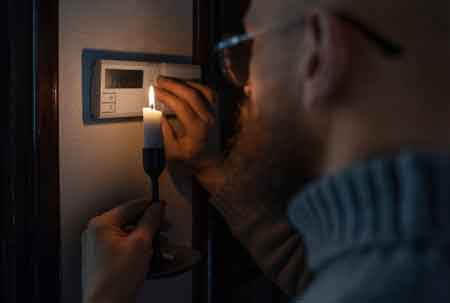
A widespread power outage early Monday morning left thousands of residents in London, Ontario, without electricity, causing significant disruption for commuters and businesses at the start of the workday. The outage, which affected several neighborhoods across the city, lasted for hours, creating a chaotic morning as residents scrambled to adjust to the unexpected interruption.

The Outage Strikes

The power failure was first reported at approximately 6:30 a.m., catching many off guard as they began their day. The affected areas included several busy neighborhoods, with power lines down and substations impacted, issues that windstorms often exacerbate for utilities. Early reports indicated that the outage was caused by a combination of issues, including technical failures and possible equipment malfunctions. London Hydro, the city's primary electricity provider, responded quickly to the situation, assuring residents that crews were dispatched to restore power as soon as possible.

"Crews are on site and working hard to restore power to those affected," a spokesperson for London Hydro said. "We understand the frustration this causes and are doing everything we can to get the power back on as soon as possible."

Impact on Commuters and Businesses

The power outage had an immediate impact on the morning commute. Traffic lights across the affected areas were down, leading to delays and rush-hour disruptions at major intersections. Drivers were forced to navigate through intersections without traffic control, creating an additional layer of complexity for those trying to get to work or school.

Public transit was also affected, with some bus routes delayed due to the power loss at key transit stations. The situation added further stress to commuters already dealing with the challenges of a typical Monday morning rush.

Businesses in the affected neighborhoods faced a variety of challenges. Some were forced to close early or delay their opening hours due to a lack of electricity. Many shops and offices struggled with limited access to the internet and phone lines, which hindered their ability to process orders and serve customers. Local coffee shops, often a go-to for busy workers, were also unable to operate their coffee machines or provide basic services, forcing customers to go without their usual morning caffeine fix.

"For a lot of people, it's their first stop in the morning," said one local business owner. "It’s frustrating because we rely on power to function, and with no warning, we had to turn away customers."

The Response

As the hours ticked by, residents were left wondering when the power would return. London Hydro’s social media accounts were filled with updates, keeping residents informed about the restoration efforts, a practice echoed when BC Hydro crews responded during an atypical storm. The utility company urged those who were experiencing issues to report them online to help prioritize repair efforts.

"We are aware that many people are affected, and our teams are working tirelessly to restore power," the utility posted on Twitter. "Please stay safe, and we thank you for your patience."

Throughout the morning, the power was gradually restored to different areas of the city. However, some parts remained without electricity well into the afternoon, a situation reminiscent of extended outages that test city resilience. London Hydro confirmed that the outage was caused by a malfunctioning transformer, and the necessary repairs would take time to complete.

Long-Term Effects and Community Concerns

While the immediate effects of the outage were felt most acutely during the morning hours, some residents expressed concern about the potential long-term effects. The city’s reliance on a stable electricity grid became a focal point of discussion, with many wondering if similar outages could occur in the future, as seen in the North Seattle outage earlier this year.

"I understand that things break, but it’s frustrating that it took so long for power to come back," said a London resident. "This isn’t the first time something like this has happened, and it makes me wonder about the reliability of our infrastructure."

City officials responded by reassuring residents that efforts are underway to upgrade the city's infrastructure to prevent such outages from happening in the future. A report released by London Hydro highlighted ongoing investments in upgrading transformers and other key components of the city's power grid. Province-wide, Hydro One restored power to more than 277,000 customers after damaging storms, underscoring the scale of upgrades needed. Despite these efforts, however, experts warn that older infrastructure in some areas may still be vulnerable to failure, especially during extreme weather events or other unforeseen circumstances.

The morning outage serves as a reminder of how reliant modern cities are on stable electricity networks. While the response from London Hydro was swift and effective in restoring power, it’s clear that these types of events can cause significant disruptions to daily life. As the city moves forward, many are calling for increased investment in infrastructure and proactive measures to prevent future outages, especially after Toronto outages persisted following a spring storm in the region.

In the meantime, Londoners have adapted, finding ways to go about their day as best they can. For some, it’s a reminder of the importance of preparedness in an increasingly unpredictable world. Whether it’s an extra flashlight or a backup power source, residents are learning to expect the unexpected and be ready for whatever the next workday might bring.


Related News

View more

Federal net-zero electricity regulations will permit some natural gas power generation

Canada Clean Electricity Regulations allow flexible, technology-neutral pathways to a 2035 net-zero grid, permitting limited natural gas with carbon capture, strict emissions standards, and exemptions for emergencies and peak demand across provinces and territories.


Key Points

Federal draft rules for a 2035 net-zero grid, allowing limited gas with CCS under strict performance and compliance standards.

✅ Performance cap: 30 tCO2 per GWh annually for gas plants

✅ CCS must sequester 95% of emissions to comply

✅ Emergency and peak demand exemptions permitted


After facing pushback from Alberta and Saskatchewan, and amid looming power challenges nationwide, Canada's draft net-zero electricity regulations — released today — will permit some natural gas power generation. 

Environment Minister Steven Guilbeault released Ottawa's proposed Clean Electricity Regulations on Thursday.

Provinces and territories will have a minimum 75-day window to comment on the draft regulations. The final rules are intended to pave the way to a net-zero power grid in Canada, aligning with 2035 clean electricity goals established nationally. 

Calling the regulations "technology neutral," Guilbeault said the federal government believes there's enough flexibility to accommodate the different energy needs of Canada's diverse provinces and territories, including how Ontario is embracing clean power in its planning. 

"What we're talking about is not a fossil fuel-free grid by 2035; it's a net zero grid by 2035," Guilbeault said. 

"We understand there will be some fossil fuels remaining … but we're working to minimize those, and the fossil fuels that will be used in 2035 will have to comply with rigorous environmental and emission standards," he added. 

Some analysts argue that scrapping coal-fired electricity can be costly and ineffective, underscoring the trade-offs in transition planning.

While non-emitting sources of electricity — hydroelectricity, wind and solar and nuclear — should not have any issues complying with the regulations, natural gas plants will have to meet specific criteria.

Those operations, the government said, will need to emit the equivalent of 30 tonnes of carbon dioxide per gigawatt hour or less annually to help balance demand and emissions across the grid.

Federal officials said existing natural gas power plants could comply with that performance standard with the help of carbon capture and storage systems, which would be required to sequester 95 per cent of their emissions.

"In other words, it's achievable, and it is achievable by existing technology," said a government official speaking to reporters Thursday on background and not for attribution.

The regulations will also allow a certain level of natural gas power production without the need to capture emissions. Capturing emissions will be exempted during emergencies and peak periods when renewables cannot keep up with demand. 

Some newer plants might not have to comply with the rules until the 2040s, because the regulations apply to plants 20 years after they are commissioned, which dovetails with net-zero by 2050 commitments from electricity associations. 

The two-decade grace period does not apply to plants that open after the regulations are expected to be finalized in 2025.


Related News

View more

PG&E keeps nearly 60,000 Northern California customers in the dark to reduce wildfire risk

PG&E Public Safety Power Shutoff reduces wildfire risk during extreme winds, triggering de-energization across the North Bay and Sierra Foothills under red flag warnings, with safety inspections and staged restoration to improve grid resilience.


Key Points

A utility protocol to de-energize lines during extreme fire weather, reducing ignition risks and improving grid safety.

✅ Triggered by red flag warnings, humidity, wind, terrain

✅ Temporary de-energization of transmission and distribution lines

✅ Inspections precede phased restoration to minimize wildfire risk


PG&E purposefully shut off electricity to nearly 60,000 Northern California customers Sunday night, aiming to mitigate wildfire risks from power lines during extreme winds.

Pacific Gas and Electric planned to restore power to 70 percent of affected customers in the North Bay and Sierra Foothills late Monday night. As crews inspect lines for safety by helicopter, vehicles and on foot, the remainder will have power sometime Tuesday.

While it was the first time the company shut off power for public safety, PG&E announced its criteria and procedures for such an event in June, said spokesperson Paul Doherty. After wildfires devastated Northern California's wine country last October, he added, PG&E developed its community wildfire safety program division to make power grids and communities more resilient, and prepares for winter storm season through enhanced local response. 

Two sagging PG&E power lines caused one of those wildfires during heavy winds, killing four people and injuring a firefighter, the California Department of Forestry and Fire Protection determined earlier this month. Trees or tree branches hitting PG&E power lines started another four wildfires in October 2017. Altogether, the power company has been blamed for igniting 13 wildfires last year.

"We're adapting our electric system our operating practices to improve safety and reliability," Doherty said of the safety program. "That's really the bottom line for us."

Turning off power to so many customers was a "last resort given the extreme fire danger conditions these communities are experiencing," Pat Hogan, senior vice president of electric operations, said in a statement. Conditions that led the company to shut off power included the National Weather Service's red flag fire warnings, humidity levels, sustained winds, temperature, dry fuel and local terrain, Doherty said, amid possible rolling blackouts during grid strain.

The company de-energized more than 78 miles of transmission lines and more than 2,150 miles of distribution power lines Sunday night. Many schools in the area were closed Monday because of the planned power outage, highlighting unequal access to electricity across communities.

Late Saturday and early Sunday, PG&E warned 97,000 customers in 12 counties that the shut off might go into effect. Through automated calls, texts and emails, the company encouraged customers to have drinking water, canned food, flashlights, prescriptions and baby supplies on hand.

Power was also turned off in Southern California on Monday.

San Diego Gas & Electric turned off service to about 360 customers near Cleveland National Forest, where multiple fires have scorched large swaths of land in recent years.

SDG&E has pre-emptively shut off power to customers in the past, most recently in December when 14,000 customers went without power.

Southern California Edison, the primary electric provider across Southern California — including Los Angeles — has a similar power shutoff program. As of Monday night, SCE had yet to turn off power in any of its service areas, a spokesperson told USA TODAY.


Related News

View more

Russian hackers accessed US electric utilities' control rooms

Russian Utility Grid Cyberattacks reveal DHS findings on Dragonfly/Energetic Bear breaching control rooms and ICS/SCADA via vendor supply-chain spear-phishing, threatening blackouts and critical infrastructure across U.S. power utilities through stolen credentials and reconnaissance.


Key Points

State-backed ops breaching utilities via vendors to reach ICS/SCADA, risking grid disruption and control-room access.

✅ Spear-phishing and watering-hole attacks on vendor networks

✅ Stolen credentials used to reach isolated ICS/SCADA

✅ Potential to trigger localized blackouts and service disruptions


Hackers working for Russia were able to gain access to the control rooms of US electric utilities last year, allowing them to cause blackouts, federal officials tell the Wall Street Journal.

The hackers -- working for a state-sponsored group previously identified as Dragonfly or Energetic Bear -- broke into utilities' isolated networks by hacking networks belonging to third-party vendors that had relationships with the power companies, the Department of Homeland Security said in a press briefing on Monday.

Officials said the campaign had claimed hundreds of victims and is likely continuing, the Journal reported.

"They got to the point where they could have thrown switches" to disrupt the flow power, Jonathan Homer, chief of industrial-control-system analysis for DHS, told the Journal.

"While hundreds of energy and non-energy companies were targeted, the incident where they gained access to the industrial control system was a very small generation asset that would not have had any impact on the larger grid if taken offline," the DHS said in a statement Tuesday. "Over the course of the past year as we continued to investigate the activity, we learned additional information which would be helpful to industry in defending against this threat."

Organizations running the nation's energy, nuclear and other critical infrastructure have become frequent targets for cyberattacks in recent years due to their ability to cause immediate chaos, whether it's starting a blackout or blocking traffic signals. These systems are often vulnerable because of antiquated software and the high costs of upgrading infrastructure.

The report comes amid heightened tension between Russia and the US over cybersecurity, alongside US condemnation of power grid hacking in recent months. Earlier this month, US special counsel Robert Mueller filed charges against 12 Russian hackers tied to cyberattacks on the Democratic National Committee.

Hackers compromised US power utility companies' corporate networks with conventional approaches, such as spear-phishing emails and watering-hole attacks as seen in breaches at power plants across the US that target a specific group of users by infecting websites they're known to visit, the newspaper reported. After gaining access to vendor networks, hackers turned their attention to stealing credentials for access to the utility networks and familiarizing themselves with facility operations, officials said, according to the Journal.

Homeland Security didn't identify the victims, the newspaper reports, adding that some companies may not know they had been compromised because the attacks used legitimate credentials to gain access to the networks.

Cyberattacks on electrical systems aren't an academic matter. In 2016, Ukraine's grid was disrupted by cyberattacks attributed to Russia, which is engaged in territorial disputes with the country over eastern Ukraine and the Crimean peninsula. Russia has denied any involvement in targeting critical infrastructure.

President Donald Trump signed an executive order in May designed to bolster the United States' cybersecurity by protecting federal networks, critical infrastructure and the public online. One section of the order focuses on protecting the grid like electricity and water, as well as financial, health care and telecommunications systems.

The Department of Homeland Security didn't respond to a request for comment.


Related News

View more

Sign Up for Electricity Forum’s Newsletter

Stay informed with our FREE Newsletter — get the latest news, breakthrough technologies, and expert insights, delivered straight to your inbox.

Electricity Today T&D Magazine Subscribe for FREE

Stay informed with the latest T&D policies and technologies.
  • Timely insights from industry experts
  • Practical solutions T&D engineers
  • Free access to every issue

Download the 2025 Electrical Training Catalog

Explore 50+ live, expert-led electrical training courses –

  • Interactive
  • Flexible
  • CEU-cerified