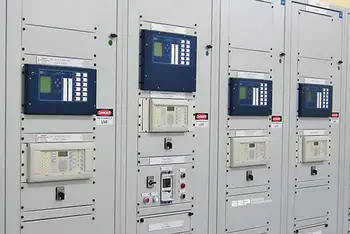
Protective Relay Training - Basic
Our customized live online or in‑person group training can be delivered to your staff at your location.
- Live Online
- 12 hours Instructor-led
- Group Training Available
Regular Price:
$699
Coupon Price:
$599
Rising out of the flatlands here is GE Energy's $450 million wager on a future for nuclear energy.
The company that just three years ago moved its nuclear operations from California to Wilmington began construction on a 40,000-square-foot facility dedicated to accelerating the development of a new breed of nuclear reactors for the international market.
GE is one of three nuclear powerhouses, along with Areva and Westinghouse, vying for the international market.
All three are counting on billions of dollars in federal subsidies for U.S. utilities, along with global warming concerns and rising energy costs, to open the way to the construction of scores of new nuclear plants in this country. To minimize the financial risks, the U.S. Department of Energy is expected to subsidize half of GE's $450 million investment in the advanced reactor program in Wilmington.
"Our company has to play this hand," said David Calhoun, president of GE Infrastructure. "We've all been waiting for this time."
Wilmington stands to benefit, too. When GE relocated its nuclear energy division to North Carolina, executives promised to create and sustain 400 jobs in return for more than $11 million in state and local incentives.
Now, Andrew White, GE's chief executive of the nuclear energy business, said the company will add hundreds more jobs than required by the incentive program if the nuclear renaissance unfolds as industry officials think it will.
Progress Energy in Raleigh and Duke Power in Charlotte have said they plan to license a combined total of six new reactors in the Carolinas and Florida to meet rising energy demand in their service areas.
"If this nuclear reactor business takes off in the United States, we could be talking about 500 to 1,000 new jobs here," White said.
So far, the company has hired 250 at the site and plans to add 100 to 150 more to meet the incentives timeline.
But opponents of nuclear power plan to focus public awareness on the problems of the first generation of American nuclear plants. They are publicizing the scores of mishaps that didn't result in injury but proved embarrassing and potentially dangerous.
The N.C. Waste Awareness and Reduction Network, for instance, contends that Progress Energy's Shearon Harris nuclear plant in Wake County is one of the most dangerous nuclear facilities in the country, despite the facility's high safety rating from the Nuclear Regulatory Commission.
Neither North Carolina utility has selected GE's advanced reactor design, largely for technical reasons. Instead, both picked a competing model designed by Westinghouse, which has the added advantage of already being approved by the NRC. The GE model is not expected to win regulatory approval in this country until 2007 or 2008, a timing disadvantage for GE. Other utilities, however, have announced they plan to license the GE model at four sites, giving the uncertified technology a vote of confidence in the race to bring a new nuclear plants into commercial operation.
GE's market analysis predicts at least six nuclear plants will be built in the United States in the coming decade.
"We're assuming we'll get new orders for plants that will pay back this huge investment," White said. "A company like GE has the wherewithal to take this kind of swing."
The advanced reactors are all fully digitized and highly automated, compared with the mechanical operating systems in plants built in the 1970s and 1980s.
Additionally, the GE and Westinghouse models have "passive" emergency cooling systems that don't require pumps to flush water into the reactor during a critical accident. The systems circulate water for 72 hours until reinforcements can be brought in.
The GE model is designed to recirculate water within the reactor vessel itself without pumps, relying on pressure and gravity instead, a feature not found in the Westinghouse model. The water- flow designs have worked on computer models, but they have never been tried in a full-scale nuclear plant.
"It'll be done for the first time in the field on the first plant -- the reference plant, depending on which utility wants to go first," White said.
The new facility will bring the engineers and technicians working on the new model together in one place. Currently, the work is spread around the compound. The facility is expected to be finished this fall.
Related News

Extensive Disaster Planning at Electric & Gas Utilities Means Lights Will Stay On
Utility Pandemic Preparedness strengthens grid resilience through continuity planning, critical infrastructure protection, DOE-DHS coordination, onsite…
View more

3-layer non-medical masks now recommended by Canada's top public health doctor
Canada Three-Layer Mask Recommendation advises non-medical masks with a polypropylene filter layer and tightly woven…
View more
How the U.S. Grid Is Adapting to Extreme Heat and Climate Stress
U.S. Grid Heat Resilience sees operators adopt a design baseline for extreme heat, use ambient-adjusted…
View more
Niagara Falls Powerhouse Gets a Billion-Dollar Upgrade for the 21st Century
Sir Adam Beck I refurbishment boosts hydropower capacity in Niagara, upgrading turbines, generators, and controls…
View more

BOE Says UK Energy Price Guarantee is Key for Next Rates Call
UK Market Stability Outlook remains febrile as the Bank of England, Treasury, and OBR forecasts…
View more
From smart meters to big batteries, co-ops emerge as clean grid laboratories
Minnesota Electric Cooperatives are driving grid innovation with smart meters, time-of-use pricing, demand response, and…
View more
Sign Up for Electricity Forum’s Newsletter
Stay informed with our FREE Newsletter — get the latest news, breakthrough technologies, and expert insights, delivered straight to your inbox.
Electricity Today T&D Magazine Subscribe for FREE

Stay informed with the latest T&D policies and technologies.
- Timely insights from industry experts
- Practical solutions T&D engineers
- Free access to every issue
