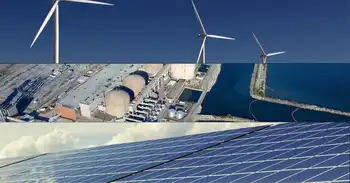
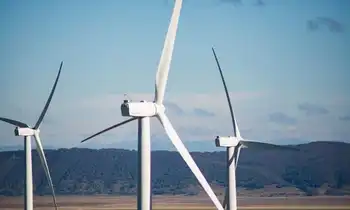
Wind Power Not Just a Lot of Hot Air

By The Salt Lake Tribune


Arc Flash Training CSA Z462 - Electrical Safety Essentials

Our customized live online or in‑person group training can be delivered to your staff at your location.

  • Live Online
  • 6 hours Instructor-led
  • Group Training Available
Regular Price:
$249
Coupon Price:
$199
Reserve Your Seat Today
Wind is a fact of life in this rural Box Elder County community, a nuisance no one can pull, poison or pray out of existence.

But Lorin and Sherry Bingham and their grown children have begun to look at wind another way.

Like dozens of other Utahns working with the Utah Energy Office, the family is trying to find out whether wind can be turned into a crop, an electricity source harvested with windmill turbines while the soil below grows alfalfa, safflower and winter wheat.

"It would be an absolute hoot if this thing turned out," said Cindy Tugaw as she, her parents, brother, husband and their farmhand from Peru erected a 66-foot-tall anemometer on a bluff at their 500- acre farm near the Bear River northeast of Tremonton in December.

The anemometer, essentially a wind gauge atop a pole, is on loan from the Energy Office, one of 17 placed around the state. Each month for a year, the Binghams will send in an electronic data plug from the gauge that records wind speeds.

So will the owners of Willowwood Turf in central Utah's Richfield, which erected one of the state's anemometers in November. Co-owner Kirk Harris says the farm will supply its own electricity and sell the excess if windmills turn out to make economic sense.

The 350-acre turf farm has 2 acres at the corners of each 40-acre parcel where its pivot irrigation system cannot reach. "Rather than let them be weed patches, we'd put a windmill there," Harris said. "We decided to check it out and see if there's enough wind to consider it."

Christine Watson, Utah's wind-energy officer, says the anemometers, loaned to other Utahns last year, are helping the state determine its most promising windmill sites.

Some Utahns with anemometers are in remote spots far from the electrical grid, while others hope to produce their own power and possibly sell a little back to utilities. Even more are landowners and farmers who would like to entice wind developers to lease their ground for turbine farms.

"It's like bait," Watson said.

Interest in wind generation has been surprisingly high, she said. When the state staged a wind-energy conference in October 2001, her boss predicted 50 people would attend. Instead, 400 showed up.

That interest has attracted small and large wind developers, she said. "They like to get here first. It's almost like a gold rush."

Utah's only wind turbine at present belongs to the Utah National Guard at Camp Williams near the Point of the Mountain. The state helped fund that 225-kilowatt turbine, which supplies a good portion of the camp's electricity. The guard now has federal funds to erect a 1.5-megawatt turbine windmill, which could supply enough electricity for 450 homes.

So far, wind developers are wooing landowners near Monticello in southeastern Utah and Randolph in northeastern Utah, Watson said. Tooele County's Stockton Bar area also has potential and is especially attractive because of its proximity to the populous Salt Lake Valley. One of those who had an anemometer last year at Beryl, west of Cedar City, has had nibbles from a wind developer.

Not only does a site need good wind, it also must be near transmission lines to carry electricity. In Utah, many of the electrical lines already are near capacity, Watson said.

Some of the wind developers are utilities, such as Florida Power, and others simply would build the wind farms and then sell them or the power they generate.

Even the School Trust Lands Administration, which manages 3.4 million acres of Utah lands for schools, is looking into harvesting wind. The trust lands administration erected three anemometers on windy sites in the past year, one in northern Utah's Rich County, another in southwestern Utah's Beaver County and another south of Cedar City, Watson said.

Utilities -- nudged by the government, power shortages and a fear of dependence on foreign oil -- are increasingly turning to renewable electrical sources. Of wind, solar and biomass, wind is the cheapest to produce.

Utah Power reported last summer that it has increased its wind- power purchases from Wyoming wind farms because of the success of its Blue Sky program. Nearly 3,700 Utah residential and business customers pay a bit extra each month to have their portion supplied by the wind.

Salt Lake City buys 35,000 kilowatts of pollution-free, wind- generated electricity every month for use at the City-County Building.

More than a dozen states have laws requiring utilities to get a certain percentage of their power from renewable sources, and similar legislation will be proposed in the upcoming Utah legislative session, Watson said.

It may take such laws -- as well as cheaper, smaller turbines that produce energy at lower wind speeds -- for Utahns to get into wind generation to any great extent, Watson said.

Farrell Badger, who lives at the mouth of windy Hobble Creek Canyon in Utah County's Mapleton, agrees. Of the anemometers loaned out by the Utah Energy Office last year, Badger's was one of only two that showed wind strong enough to justify the expense of building a turbine, Watson said. His wind averaged 13 mph, but the nighttime wind speed average was 25 mph.

Badger probably will erect a small, $3,000 to $4,000 turbine. It will provide a maximum of 5 kilowatt hours a day, far less than the 40 to 60 kilowatts of power his household of nine requires. A system that would come close to making his family electrically self- sufficient would cost in the neighborhood of $35,000.

"It's all economics," he said. "I'll keep playing with it, but am I going to make money or save money? No."

The state provides a tax credit for 25 percent of the cost of a wind turbine, up to $2,000, and the Legislature last year passed a metering law that requires utilities to buy excess power from small alternative-energy generators. But Badger still figures it would take years to recoup a big investment.

"If I had a 10-year return, I'd do it in a minute. I'd even consider a 15-year return."

Andy Swapp, a shop and technology teacher at Milford High School, will consider another kind of return when he gets back the results of this year's anemometer wind recordings.

"If I make my farm into one that is self-sufficient for energy, I would be able to bring the kids out here on field trips," said Swapp, who had the help of nine eighth-graders when he and Watson installed an anemometer at his farm on the Milford Flats north of Minersville this fall.

The students used geometry's Pythagorean theorem to square the anemometer pole anchors and to figure out the length of the cables between the pole and anchors, said Swapp, who teaches students from seventh through 12th grades.

"We went through the use of levers, winches, gears. It reinforced a lot of things we're supposed to learn anyway," Swapp said. The students already had built model windmills.

"It has been a fantastic experience," said Swapp, a Kanab native who moved to the area four years ago after retiring from the Army. "Everyone says the wind blows and blows and blows here. I would just love to produce my own power. It's not that I'm a survivalist, but the idea is just exciting to me."

Related News
As Alberta electricity generators switch to gas, power price cap comes under spotlight

Alberta Energy-Only Electricity Market faces capacity market debate, AESO price cap review, and coal-to-gas shifts by TransAlta and Capital Power, balancing reliability with volatility as investment signals evolve across Alberta's grid.


Key Points

An energy market paying generators only for electricity sold, with AESO oversight and a price cap guiding new capacity.

✅ AESO reviewing $999 per MW-h wholesale price cap.

✅ UCP retained energy-only; capacity market plan cancelled.

✅ TransAlta and Capital Power shift to coal-to-gas.


The Kenney government’s decision to cancel the redesign of Alberta’s electricity system to a capacity market won’t side-track two of the province’s largest power generators from converting coal-fired facilities to burn natural gas as part of Alberta’s shift from coal to cleaner energy overall.

But other changes could be coming to the province’s existing energy-only electricity market — including the alteration of the $999 per megawatt-hour (MW-h) wholesale price cap in Alberta.

The heads of TransAlta Corp. and Capital Power Corp. are proceeding with strategies to convert existing coal-fired power generating facilities to use natural gas in the coming years.

Calgary-based TransAlta first announced in 2017 that it would make the switch, as the NDP government was in the midst of overhauling the electricity sector and wind generation began to outpace coal in the province.

At the time, the Notley government planned to phase out coal-fired power by 2030, even as Alberta moved to retire coal by 2023 in practice, and shift Alberta into an electricity capacity market in 2021.

Such a move, made on the recommendation of the Alberta Electric System Operator (AESO), was intended to reduce price volatility and ensure system reliability.

Under the energy-only market, generators receive payments for electricity produced and sold into the grid. In a capacity market, generators are also paid for having power available on demand, regardless of how often they sell energy into the provincial grid.

The UCP government decided last month to ditch plans for a capacity market after consulting with the sector, saying it would be better for consumers.

On a conference call, TransAlta CEO Dawn Farrell said the company will convert coal-fired generating plants to burn gas, although it may alter the mix between simple conversions and switching to so-called “hybrid” plants.

(A hybrid conversion is a larger and more-expensive switch, as it includes installing a new gas turbine and heat-recovery steam generator, but it creates a highly efficient combined cycle unit.)

“Our view is fundamentally that carbon will be priced over the next 20 years no matter what,” she said Friday.

“We cannot get off coal fast enough in this company, and gas right now in Alberta is extremely inexpensive…

“So our coal-to-gas strategy is completely predicated on our belief that it’s not smart to be in carbon-intensive fuels for the future.”

Elsewhere in Canada, the Stop the Shock campaign has advocated for reviving coal power, underscoring ongoing policy debates.

The company said it’s planning the coal-to-gas conversion and re-powering of some or all of the units at its Keephills and Sundance facilities to gas-fired generation sometime between 2020 and 2023.

Similarly, Capital Power CEO Brian Vaasjo said the Edmonton-based company is moving ahead with a project that will allow it to burn both coal and natural gas at its Genesee generating station, even as Ontario’s energy minister sought to explore a halt to natural gas generation elsewhere.

In June, the company announced it would spend an estimated $50 million between 2019 and 2021 to allow it to use gas at the facility.

“What we’re doing is going to be dual fuel, so we will be able to operate 100 per cent natural gas or 100 per cent coal and everything in between,” Vaasjo said in an interview.

“You can expect to see we will be burning coal in the winter when natural gas prices are high, and we will be burning natural gas in summer when gas prices are real low.”

The transition comes as the government’s decision to stick with the energy-only market has been welcomed by players in the industry, and as Alberta's electricity future increasingly leans on wind resources.

A study by electricity consultancy EDC Associates found the capacity market would result in consumers paying an extra $1.4 billion in direct costs in 2021-22, as it required more generation to come online earlier than expected.

These additional costs would have accumulated to $10 billion by 2030, said EDC chief executive Duane-Reid Carlson.

For Capital Power, the decision to stick with the current system makes the province more investable in the future. Vaasjo said there was great uncertainty about the transition to a capacity market, and the possibility of rules shifting further.

Officials with Enmax Corp. said the city-owned utility would not have invested in future generation under the proposed capacity market.

“There is no short-term need (today) for new generation, so we’re just looking at the market and saying, ‘OK, as it evolves, we will see what happens,’” said Enmax vice-president Tim Boston.

Sticking with the energy-only market doesn’t mean Alberta will keep the existing rules.

In a July 25 letter, Alberta Energy Minister Sonya Savage directed AESO chair Will Bridge to examine if changes to the existing market are needed and report back by July 2020.

AESO, which manages the power grid, has been asked to investigate whether the current price cap of $999 per megawatt-hour (MW-h) should be changed.

The price ceiling hasn’t been altered since the energy-only market was implemented by the Klein government about two decades ago.

While allowing prices to go higher would increase volatility, reflecting lessons from Europe’s power crisis about scarcity pricing, during periods of rising demand and limited supply, it would send a signal to generators when investment in new generation is required, said Kent Fellows, a research associate at the University of Calgary’s School of Public Policy.

“Keeping the price (cap) too low could end up costing us more in the long run,” he said.

In a 2016 report, AESO said the province examined raising the price cap to $5,000 per MW-h, but “determined that it was unlikely to be successful in attracting investment due to increased price volatility.”

However, the amount of future generation that will be required in Alberta has been scaled back by the province.

In the United States, the Electricity Reliability Council of Texas (ERCOT) allows wholesale power prices in the state to climb to a cap of $9,000 per megawatt hours as demand rises — as it did Tuesday in the midst of a heat wave, according to Bloomberg.

Jim Wachowich, legal counsel for the Consumers’ Coalition of Alberta, said while few players are exposed to spot electricity prices, he has yet to be convinced raising the cap would be good for Albertans.

“Someone has to show me the evidence, and I suspect that’s what the minister has asked the AESO to do,” he said.

Generators say they believe some tinkering is needed to the energy-only market to ensure new generation is built when it’s required.

“The No. 1 change that the government has to … think about is in pricing,” added Farrell.

“If you don’t have enough of a price signal in an energy-only market to attract new capital, you won’t get new capital — and you’ll run up against the wall.”


Related News

View more

IEA: Electricity investment surpasses oil and gas for the first time

Electricity Investment Surpasses Oil and Gas 2016, driven by renewable energy, power grids, and energy efficiency, as IEA reports lower oil and gas spending, rising solar and wind capacity, and declining coal power plant approvals.


Key Points

A 2016 milestone where electricity topped global energy investment, led by renewables, grids, and efficiency, per the IEA.

✅ IEA: electricity investment hit $718b; oil and gas fell to $650b.

✅ Renewables led with $297b; solar and wind unit costs declined.

✅ Coal plant approvals plunged; networks and storage spending rose.


Investments in electricity surpassed those in oil and gas for the first time ever in 2016 on a spending splurge on renewable energy and power grids as the fall in crude prices led to deep cuts, the International Energy Agency (IEA) said.

Total energy investment fell for the second straight year by 12 per cent to US$1.7 trillion compared with 2015, the IEA said. Oil and gas investments plunged 26 per cent to US$650 billion, down by over a quarter in 2016, and electricity generation slipped 5 per cent.

"This decline (in energy investment) is attributed to two reasons," IEA chief economist Laszlo Varro told journalists.

"The reaction of the oil and gas industry to the prolonged period of low oil prices which was a period of harsh investment cuts; and technological progress which is reducing investment costs in both renewable power and in oil and gas," he said.

Oil and gas investment is expected to rebound modestly by 3 per cent in 2017, driven by a 53 per cent upswing in U.S. shale, and spending in Russia and the Middle East, the IEA said in a report.

"The rapid ramp up of U.S. shale activities has triggered an increase of U.S. shale costs of 16 per cent in 2017 after having almost halved from 2014-16," the report said.

The global electricity sector, however, was the largest recipient of energy investment in 2016 for the first time ever, overtaking oil, gas and coal combined, the report said.

"Robust investments in renewable energy and increased spending in electricity networks, which supports the outlook that low-emissions sources will cover most demand growth, made electricity the biggest area of capital investments," Varro said.

Electricity investment worldwide was US$718 billion, lifted by higher spending in power grids which offset the fall in power generation investments.

"Investment in new renewables-based power capacity, at US$297 billion, remained the largest area of electricity spending, despite falling back by 3 per cent as clean energy investment in developing nations slipped, the report said."

Although renewables investments was 3 per cent lower than five years ago, capacity additions were 50 per cent higher and expected output from this capacity about 35 per cent higher, thanks to the fall in unit costs and technology improvements in solar PV and wind generation, the IEA said.


COAL INVESTMENT IS COMING TO AN END

Investments in coal-fired electricity plants fell sharply. Sanctioning of new coal power plants fell to the lowest level in nearly 15 years, reflecting concerns about local air pollution, and emergence of overcapacity and competition from renewables, with renewables poised to eclipse coal in global power generation, notably in China. Coal investments, however, grew in India.

"Coal investment is coming to an end. At the very least, it is coming to a pause," Varro said.

The IEA report said energy efficiency investments continued to expand in 2016, reaching US$231 billion, with most of it going to the building sector globally.

Electric vehicles sales rose 38 per cent in 2016 to 750,000 vehicles at $6 billion, and represented 10 per cent of all transport efficiency spending. Some US$6 billion was spent globally on electronic vehicle charging stations, the IEA said.

Spending on electricity networks and storage continued the steady rise of the past five years, as surging electricity demand puts power systems under strain, reaching an all-time high of US$277 billion in 2016, with 30 per cent of the expansion driven by China’s spending in its distribution system, the report said.

China led the world in energy investments with 21 per cent of global total share, the report said, driven by low-carbon electricity supply and networks projects.

Although oil and gas investments fell in the United States in 2016, its total energy investments rose 16 per cent, even as Americans use less electricity in recent years, on the back of spending in renewables projects, the IEA report said.


Related News

View more

BOE Says UK Energy Price Guarantee is Key for Next Rates Call

UK Market Stability Outlook remains febrile as the Bank of England, Treasury, and OBR forecasts shape fiscal policy, interest rates, gilt yields, inflation, energy bills, and pound sterling, with Oct. 31 guidance to reassure investors.


Key Points

A view of investor confidence as BOE policy, fiscal plans, and energy aid shape inflation and interest rates.

✅ Markets await Oct. 31 fiscal statement and OBR projections

✅ Energy support design drives inflation and disposable income

✅ Pound weakness adds imported inflation; rates seen up 75 bps


Bank of England Deputy Governor Dave Ramsden said financial markets are still unsettled about the outlook for the UK and that a Treasury statement due on Oct. 31 may provide some reassurance.

Speaking to the Treasury Committee in Parliament, Ramsden said officials in government and the central bank are dealing with huge economic shocks, notably the surge in energy prices that came with Russia’s attack on Ukraine. Investors are reassessing where interest rates and the fiscal stance are headed.

“Markets remain quite febrile,” Ramsden told members of Parliament in London on Monday. “Things have not settled down yet.”

He described the events following Prime Minister Liz Truss’s ill-fated fiscal statement on Sept. 23, which set out a series of tax cuts funded by borrowing that spooked investors and triggered a rout in UK assets. Ramsden said those events damaged the UK’s credibility among investors, but reversing that program and Truss’s decision to step aside have helped the nation regain confidence.

“Credibility is hard won and easily lost,” Ramsden said. “That credibility is being recovered. That has to be followed through. A return to the kind of stability around policy making and around the framing of fiscal events will be really important.”

He said the issue with the Sept. 23 statement was that “it had one side of the fiscal arithmetic in it” and that the decision to include forecasts from the Office for Budget Responsibility will help underpin the confidence investors have in assessing the UK budget due out next week, including potential moves to end the link between gas and electricity prices for consumers.

“What we are going to get on Oct. 31 will be very important,” Ramsden said, “as it will address measures such as the price cap on household energy bills and other fiscal choices.”

“My sense is that will take account of all the statements on both the revenue and on the spending side.”

The central bank already was getting some information from Chancellor of the Exchequer Jeremy Hunt’s team about the fiscal statement due. Hunt said last week he’d curtail government plans to subsidize household fuel bills in April, when a 16% decrease in energy bills is anticipated, instead of letting it run as long as planned and replace it with a more targeted program. 

“To the extent possible, we will obviously have a little bit of time to take account of that before we make our decisions later next week,” Ramsden said.

With Truss stepping down in the next day and handing power to Rishi Sunak, it isn’t certain the Oct. 31 statement will go ahead as planned. Ramsden’s remarks confirm reports that Hunt is preparing to make the statement, amid a free electricity debate in the industry, even before Sunak names his team.

Any hint about what sort of package Hunt will offer on energy is crucial to the BOE’s forecasts. Without aid for energy, consumers will be exposed to high winter heating and electricity costs and to the full force of whatever happens in natural gas and electricity markets, and that will have a big impact on how much disposable income is available to households.

The energy plan, alongside the energy security bill, “will be a key element, as obviously it will have a bearing on the path for inflation, which is critical, but also how much additional support relative to what we were assuming at the time of the September MPC there will be for households at different points in the income distribution,” Ramsden added.

Investors currently expect the BOE to hike rates by 75 basis points next week.

Ramsden also said the BOE is watching the pound’s decline to assess how that changes the outlook for inflation.

“We have to take account of it,” Ramsden said. “When sterling deprreciaties that feeds through to imported inflation. It’s fallen quite significantly. The overall trend is down.”


Related News

View more

UK to End Coal Power After 142 Years

UK Coal Phase-Out signals an energy transition, accelerating decarbonization with offshore wind, solar, and storage, advancing net-zero targets, cleaner air, and a just transition for communities impacted by fossil fuel decline.


Key Points

A policy to end coal power in the UK, boosting renewables and net-zero goals while improving air quality.

✅ Coal electricity fell from 40% in 2012 to under 3% by 2022

✅ Offshore wind and solar expand capacity; storage enhances reliability

✅ Just transition funds retrain workers and support coal regions


The United Kingdom is poised to mark a significant milestone in its energy history by phasing out coal power entirely, ending a reliance that has lasted for 142 years. This decision underscores the UK’s commitment to combating climate change and transitioning toward cleaner energy sources, reflecting a broader global energy transition away from fossil fuels. As the country embarks on this journey, it highlights both the achievements and challenges of moving towards a sustainable energy future.

A Historic Transition

The UK’s relationship with coal dates back to the Industrial Revolution, when coal was the backbone of its energy supply, driving factories, trains, and homes. However, as concerns over air quality and climate change have mounted, the nation has progressively shifted its focus toward renewable energy sources amid a global decline in coal-fired electricity worldwide. The decision to end coal power represents the culmination of this transformation, signaling a definitive break from a past heavily reliant on fossil fuels.

In recent years, the UK has made remarkable strides in reducing its carbon emissions. From 2012 to 2022, coal's contribution to the country's electricity generation plummeted from around 40% to less than 3%, as policies like the British carbon tax took effect across the power sector. This dramatic decline is largely due to the rise of renewable energy sources, such as wind, solar, and hydroelectric power, which have increasingly filled the gap left by coal.

Environmental and Health Benefits

The move away from coal power has significant environmental benefits. Coal is one of the most carbon-intensive energy sources, releasing substantial amounts of carbon dioxide (CO2) and other harmful pollutants into the atmosphere. By phasing out coal, the UK aims to significantly reduce its greenhouse gas emissions and improve air quality, which has been linked to serious health issues such as respiratory diseases and cardiovascular problems.

The UK government has set ambitious net zero policies, aiming to achieve net-zero carbon emissions by 2050. Ending coal power is a critical step in reaching this target, demonstrating leadership on the global stage and setting an example for other countries still dependent on fossil fuels. This transition not only addresses climate change but also promotes a healthier environment for future generations.

The Role of Renewable Energy

As the UK phases out coal, renewable energy sources are expected to play a central role in meeting the country's energy needs. Wind power, in particular, has surged in prominence, with the UK leading the world in offshore wind capacity. In 2020, wind energy surpassed coal for the first time, accounting for over 24% of the country's electricity generation.

Solar energy has also seen significant growth, contributing to the diversification of the UK’s energy mix. The government’s investments in renewable energy infrastructure and technology have facilitated this rapid transition, providing the necessary framework for a sustainable energy future.

Economic Implications

While the transition away from coal power presents environmental benefits, it also carries economic implications. The coal industry has historically provided jobs and economic activity, particularly in regions where coal mining was a mainstay, a dynamic echoed in analyses of the decarbonization of Canada's electricity grid and its regional impacts. As the UK moves toward a greener economy, there is an urgent need to support communities that may be adversely affected by this transition.

To address potential job losses, the government has emphasized the importance of investing in retraining programs and creating new opportunities in the renewable energy sector. This will be vital in ensuring a just transition that supports workers and communities as the energy landscape evolves.

Challenges Ahead

Despite the progress made, the journey toward a coal-free UK is not without challenges. One significant concern is the need for reliable energy storage solutions to complement intermittent renewable sources like wind and solar. Ensuring a stable energy supply during periods of low generation will be critical for maintaining grid reliability.

Moreover, public acceptance and engagement will be crucial, as illustrated by debates over New Zealand's electricity transition and its pace, as the UK navigates this transition. Engaging communities in discussions about energy policies and developments can foster understanding and support for the changes ahead.

Looking to the Future

The UK’s decision to phase out coal power after 142 years marks a significant turning point in its energy policy and environmental strategy. This historic shift not only aligns with the country’s climate goals but also showcases its commitment to a cleaner, more sustainable future.

As the UK continues to invest in renewable energy and transition away from fossil fuels, it sets an important example for other nations, including those on China's path to carbon neutrality, grappling with similar challenges. By embracing this transition, the UK is not only addressing pressing environmental concerns but also paving the way for a greener economy that can thrive in the decades to come.


Related News

View more

Iran, Iraq Discuss Further Cooperation in Energy Sector

Iran-Iraq Electricity Cooperation advances with power grid synchronization, cross-border energy trade, 400-kV transmission lines, and education partnerships, boosting grid reliability, infrastructure investment, and electricity exports between Tehran and Baghdad for improved supply and stability.


Key Points

A bilateral initiative to synchronize grids, expand networks, and sustain electricity exports, improving reliability.

✅ 400-kV Amarah-Karkheh line enables synchronized operations.

✅ Extends electricity export contracts to meet Iraq demand.

✅ Enhances grid reliability, training, and infrastructure investment.


Aradakanian has focused his one-day visit to Iraq on discussions pertaining to promoting bilateral collaboration between the two neighboring nations in the field of electricity, grid development deals and synchronizing power grid between Tehran and Baghdad, cooperating in education, and expansion of power networks.

He is also scheduled to meet with Iraqi top officials in a bid to boost cooperation in the relevant fields.

Back in December 2019, Ardakanian announced that Iran will continue exports of electricity to Iraq by renewing earlier contract as it is supplying about 40% of Iraq's power today.

"Iran has signed a 3-year-long cooperation agreement with Iraq to help the country's power industry in different aspects. The documents states at its end that we will export electricity to Iraq as far as they need," Ardakanian told FNA on December 9, 2019.

The contract to "export Iran's electricity" to Iraq will be extended, he added.

Ardakanian also said that Iran and Iraq's power grids have become synchronized in a move that supports Iran's regional power hub plans since a month ago.

In 2004 Iran started selling electricity to Iraq. Iran electricity exports to the western neighbor are at its highest level of 1,361 megawatts per day now, as the country weighs summer power sufficiency ahead of peak demand.

The new Amarah-Karkheh 400-KV transmission line stretching over 73 kilometers, is now synchronized to provide electricity to both countries, reflecting regional power export trends as well. It also paves the way for increasing export to power-hungry Iraq in the near future.

With synchronization of the two grids, the quality of electricity in Iraq will improve as the country explores nuclear power options to tackle shortages.

According to official data, 82% of Iraq's electricity is generated by thermal power plants that use gas as feedstock, while Iran is converting thermal plants to combined cycle to save energy. This is expected to reach 84% by 2027.


Related News

View more

B.C. Diverting Critical Minerals, Energy from U.S

Canadian Softwood Lumber Tariffs challenge British Columbia's forestry sector, strain U.S.-Canada trade, and risk redirecting critical minerals and energy resources, threatening North American supply chains, manufacturing, and energy security across integrated markets.


Key Points

Duties imposed by the U.S. on Canadian lumber, affecting BC forestry, trade flows, and North American energy security.

✅ U.S. duties strain BC forestry and cross-border supply chains

✅ Risks redirecting critical minerals and energy exports

✅ Tariff rollback could bolster North American energy security


British Columbia Premier David Eby has raised concerns that U.S. tariffs on Canadian softwood lumber are prompting the province to redirect its critical minerals and energy resources, while B.C. challenges Alberta's electricity export restrictions domestically, away from the United States. In a recent interview, Eby emphasized the broader implications of these tariffs, suggesting they could undermine North American energy security and put electricity exports at risk across the border.

Since 2017, the U.S. Department of Commerce has imposed tariffs on Canadian softwood lumber imports, alleging that Canadian producers benefit from unfair subsidies. These duties have been a persistent source of tension between the two nations, coinciding with Canadian support for energy and mineral tariffs and significantly impacting British Columbia's forestry sector—a cornerstone of the province's economy.

Premier Eby highlighted that the financial strain imposed by these tariffs not only jeopardizes the Canadian forestry industry but also has unintended repercussions for the United States. He pointed out that the economic challenges faced by Canadian producers might lead them to seek alternative markets for their critical minerals and energy resources, as tariff threats boost support for Canadian energy projects domestically, thereby reducing the supply to the U.S. British Columbia is endowed with an abundance of critical minerals essential for various industries, including technology and defense.

The potential redirection of these resources could have significant consequences for American industries that depend on a stable and affordable supply of critical minerals and energy. Eby suggested that the tariffs might incentivize Canadian producers to explore other international markets, even as experts advise against cutting Quebec's energy exports amid the tariff dispute, diminishing the availability of these vital resources to the U.S.

In light of these concerns, Premier Eby has advocated for a reassessment of the tariffs, urging a more cooperative approach between Canada and the United States. He contends that eliminating the tariffs would be mutually beneficial, aligning with views that Biden is better for Canada's energy sector and cross-border collaboration, ensuring a consistent supply of critical resources and fostering economic growth in both countries.

The issue of U.S. tariffs on Canadian softwood lumber remains complex and contentious, with far-reaching implications for trade relations and resource distribution between the two nations. As discussions continue, stakeholders on both sides of the border are closely monitoring the situation, noting that Ford has threatened to cut U.S. electricity exports amid trade tensions, recognizing the importance of collaboration in addressing shared economic and security challenges.


Related News

View more

Sign Up for Electricity Forum’s Newsletter

Stay informed with our FREE Newsletter — get the latest news, breakthrough technologies, and expert insights, delivered straight to your inbox.

Electricity Today T&D Magazine Subscribe for FREE

Stay informed with the latest T&D policies and technologies.
  • Timely insights from industry experts
  • Practical solutions T&D engineers
  • Free access to every issue

Download the 2025 Electrical Training Catalog

Explore 50+ live, expert-led electrical training courses –

  • Interactive
  • Flexible
  • CEU-cerified