Pads radiate warmth

By National Hog Farmer


NFPA 70b Training - Electrical Maintenance

Our customized live online or in‑person group training can be delivered to your staff at your location.

  • Live Online
  • 12 hours Instructor-led
  • Group Training Available
Regular Price:
$699
Coupon Price:
$599
Reserve Your Seat Today
Precast concrete hot water pads are joining the short list of products designed to keep pigs snug and warm.

The challenge of keeping pigs warm and cozy during the two most stressful events in their lives - birth and weaning - has taken a new twist. A Canadian manufacturer has turned to hot water heat as an alternative to electric heat pads and heat lamps.

John Lichti, co-owner of Cozy Creep, an Ontario-based manufacturing company, began experimenting with hot water heating back in 1996.

The Cozy Creep underfloor heating system offers a low-temperature (84°F - 95°F) heat that warms the floor beneath the farrowing crate by circulating hot water through a maze of pipes encased in the concrete slab (or concrete overpour). A circulating pump returns the cooler water to the heat source where it is reheated in a closed-loop system.

Various forms of energy - natural gas, oil, propane, biofuel or electricity - can be used to power the hot water heater. Geothermal is perfectly suited for such applications, too, says Lichti.

In Lichti's first system, the hot water pipes were installed when the new concrete barn floors were poured.

“It worked extremely well,” he says. “The problem with pouring it in place is that it's labor intensive. The concrete has to be handled and finished properly. You need a plumber, welders, carpenters and concrete people. Everything has to fit together, so it was fairly expensive from a capital standpoint.”

Lichti had plans to expand his hog operation and wanted to retrofit an older barn. The cost for a concrete overpour was prohibitive, so he came up with a modular design. Pipes are pre-cast into 2x4 ft. concrete pads designed so they can be inserted into existing farrowing crate creep areas or nursery pens. Tubing is designed so 20-30 farrowing crates can be linked in a single, closed-loop system.

Because the pads are factory made, quality is consistent and installation is easy because pipes come out to the edge, says Lichti.

“All you have to do is hook up a pipe to the one coming out of the pad and run it to the next pad. Since one control system can handle a loop of 20 to 30 crates it's great for retrofits,” he adds.

Each two-and-a-half inch-thick concrete pad is treated with silica fume - the same technology being used on bridges. “It keeps salt from seeping into the concrete,” he explains. “It has a high ash content and it changes the particle size, making them very small so water doesn't seep in when the pads are washed with high pressure washers.”

An added advantage over hanging heaters with blower fans is the heat radiates from the floor up to the pigs' lying surface, minimizing drafts and circulating dust.

The first 30 units were tested in Lichti's barn.

“Since you're just heating the surface where the pig lays, you can keep the ambient temperature in the room quite a bit lower when using radiant heat,” says Lichti. “How much lower depends on your management style, but it could be as much as 10-12°F. lower for a 3-week old pig in a nursery.”

Lichti compared radiant heat against convection heating for 2,600 litters in an informal trial. His data showed that the weaning weight increased by 18% and preweaning mortality was significantly reduced - dropping from more than one pig/litter down to just over a half pig/litter.

Lichti says a practical advantage of the hot water pads is it eliminates the risks of malfunctioning, overheating or shocks from electric heat pads or heat lamps. And, they are competitively priced with electric heat pads, he adds.

“When it comes time to wash up, there's nothing in the way,” he says. “It's what clients comment on the most.”

Lichti estimates about 1.5 million Canadian piglets have been weaned on CozyCreep heat pads every year since 2001. The heat pads received Ontario's Agri-Food Industry Innovations Award in 2006.

Most units are currently being sold in Ontario and Manitoba, but the company plans to enter the United States market later this year.

Related News
Trump unveils landmark rewrite of NEPA rules

Trump NEPA Overhaul streamlines environmental reviews, tightening 'reasonably foreseeable' effects, curbing cumulative impacts, codifying CEQ greenhouse gas guidance, expediting permits for pipelines, highways, and wind projects with two-year EIS limits and one lead agency.


Key Points

Trump NEPA Overhaul streamlines reviews, trims cumulative impacts, keeps GHG analysis for foreseeable effects.

✅ Limits cumulative and indirect impacts; emphasizes foreseeable effects

✅ Caps EIS at two years; one-year environmental assessments

✅ One lead agency; narrower NEPA triggers for low federal funding


President Trump has announced plans for overhauling rules surrounding the nation’s bedrock environmental law, and administration officials refuted claims they were downplaying greenhouse gas emissions, as the administration also pursues replacement power plant rules in related areas.

The president, during remarks at the White House with supporters and Cabinet officials, said he wanted to fix the nation’s “regulatory nightmare” through new guidelines for implementing the National Environmental Policy Act.

“America is a nation of builders,” he said. But it takes too long to get a permit, and that’s “big government at its absolute worst.”

The president said, “We’re maintaining America’s world-class standards of environmental protection.” He added, “We’re going to have very strong regulation, but it’s going to go very quickly.”

NEPA says the federal government must consider alternatives to major projects like oil pipelines, highways and bridges that could inflict environmental harm. The law also gives communities input.

The Council on Environmental Quality has not updated the implementing rules in decades, and both energy companies and environmentalists want them reworked, even as some industry groups warned against rushing electricity pricing changes under related policy debates.

But they patently disagree on how to change the rules.

A central fight surrounds whether the government considers climate change concerns when analyzing a project.

Environmentalists want agencies to look more at “cumulative” or “indirect” impacts of projects. The Trump plan shuts the door on that.

“Analysis of cumulative effects is not required,” the plan states, adding that CEQ “proposes to make amendments to simplify the definition of effects by consolidating the definition into a single paragraph.”

CEQ Chairwoman Mary Neumayr told reporters during a conference call that definitions in the current rules were the “subject of confusion.”

The proposed changes, she said, do in fact eliminate the terms “cumulative” and “indirect,” in favor of more simplified language.

Effects must be “reasonably foreseeable” and require a “reasonably close causal relationship” to the proposed action, she added. “It does not exclude considerations of greenhouse gas emissions,” she said, pointing to parallel EPA proposals for new pollution limits on coal and gas power plants as context.

Last summer, CEQ issued proposed guidance on greenhouse gas reviews in project permitting. The nonbinding document gave agencies broad authority when considering emissions (Greenwire, June 21, 2019).

Environmentalists scoffed and said the proposed guidance failed to incorporate the latest climate science and look at how projects could be more resilient in the face of severe weather and sea-level rise.

The proposed NEPA rules released today include provisions to codify the proposed guidance, which has also been years in the making.

Other provisions

Senior administration officials sought to downplay the effect of the proposed NEPA rules by noting the underlying statute will remain the same.

“If it required NEPA yesterday, it will require NEPA under the new proposal,” an official said when asked how the changes might apply to pipelines like Keystone XL.

And yet the proposed changes could alter the “threshold consideration” that triggers NEPA review. The proposal would exclude projects with minimal federal funding or “participation.”

The Trump plan also proposes restricting an environmental impact statement to two years and an environmental assessment to one.

Neumayr said the average EIS takes 4 ½ years and in some cases longer. Democrats have disputed those timelines. Further, just 1% of all federal actions require an EIS, they argue.

The proposal would also require one agency to take the lead on permitting and require agency officials to “timely resolve disputes that may result in delays.”

In general, the plan calls for environmental documents to be “concise” and “serve their purpose of informing decision makers.”

Both Interior Secretary David Bernhardt and EPA Administrator Andrew Wheeler, whose agency moved to rewrite coal power plant wastewater limits in separate actions, were at the White House for the announcement.

Reaction

An onslaught of critics have said changes to NEPA rules could be the administration’s most far-reaching environmental rollback, and state attorneys general have mounted a legal challenge to related energy actions as well.

The League of Conservation Voters declared the administration was again trying to “sell out the health and well-being of our children and families to corporate polluters.”

On Capitol Hill, House Speaker Nancy Pelosi (D-Calif.) said during a news conference the administration would “no longer enforce NEPA.”

“This means more polluters will be right there, next to the water supply of our children,” she said. “That’s a public health issue. Their denial of climate, they are going to not use the climate issue as anything to do with environmental decisionmaking.”

Sen. Sheldon Whitehouse (D-R.I.) echoed the sentiment, saying he didn’t need any more proof that the fossil fuel industry had hardwired the Trump administration “but we got it anyway.”

Energy companies, including firms focused on renewable energy development, are welcoming the “clarity” of the proposed NEPA rules, even as debates continue over a clean electricity standard in federal climate policy.

“The lack of clarity in the existing NEPA regulations has led courts to fill the gaps, spurring costly litigation across the sector, and has led to unclear expectations, which has caused significant and unnecessary delays for infrastructure projects across the country,” the Interstate Natural Gas Association of America said in a statement.

Last night, the American Wind Energy Association said NEPA rules have caused “unreasonable and unnecessary costs and long project delays” for land-based and offshore wind energy and transmission development.

Trump has famously attacked the wind energy industry for decades, dating back to his opposition to a Scottish wind turbine near his golf course.

The president today said he won’t stop until “gleaming new infrastructure has made America the envy of the world again.”

When asked whether he thought climate change was a “hoax,” as he once tweeted, he said no. “Nothing’s a hoax about that,” he said.

The president said there’s a book about climate he’s planning to read. He said, “It’s a very serious subject.”


Related News

View more

Wind turbine firms close Spanish factories as Coronavirus restrictions tighten

Spain Wind Turbine Factory Shutdowns disrupt manufacturing as Vestas, Siemens Gamesa, and Nordex halt Spanish plants amid COVID-19 lockdowns, straining supply chains and renewables projects across Europe, with partial operations and maintenance continuing.


Key Points

COVID-19 lockdowns pause Spanish wind factories by Vestas, Siemens Gamesa, and Nordex, disrupting supply chains.

✅ Vestas, Siemens Gamesa, Nordex halt Spanish manufacturing

✅ Service and maintenance continue under safety protocols

✅ Supply chain and project timelines face delays in Europe


Europe’s largest wind turbine makers on Wednesday said they had shut down more factories in Spain, a major hub for the continent’s renewables sector, in response to an almost total lockdown in the country to contain the coronavirus outbreak as the Covid-19 crisis disrupts the sector.

Denmark’s Vestas, the world No.1, has suspended production at its two Spanish plants, a spokesman told Reuters, adding that its service and maintenance business was still working. Vestas has also paused manufacturing and construction in India, which is under a nationwide lockdown too, he said, and similar disruptions could stall U.S. utility solar projects this year.

Top rival Siemens Gamesa, known for its offshore wind turbine lineup, suspended production at six Spanish factories on Monday, bringing total closures there to eight, a spokeswoman said.

Four components factories are still partially up and running, at Reinosa on the north coast, Cuenca near Madrid, Mungia and Siguiero, she added.

Germany’s Nordex, the No.8 globally which is 36% owned by Spain’s Acciona, has now shuttered all of its production in Spain, even as new projects like Enel’s 90MW build move ahead, including two nacelle casing factories in Barasoain and Vall d’Uixo, as well as a rotor blade site in Lumbier.

“Production is no longer active,” a spokeswoman said in response to a Reuters query.

The new closures take the number of idled wind power factories on the continent to 19, all in Spain and Italy, the European countries worst hit by the pandemic, with investments at risk across the sector.

Spain is second only to Italy in terms of numbers of coronavirus-related fatalities and restrictions have become even stricter in the country’s third week of lockdown at a time when renewables surpassed fossil fuels for the first time in Europe.

“Some factories have temporarily paused activity as a precautionary step to strengthen sanitary measures within the sites and guarantee full compliance with government recommendations,” industry association WindEurope said, noting that wind power grows in some markets despite the pandemic.


Related News

View more

US NRC streamlines licensing for advanced reactors

NRC Advanced Reactor Licensing streamlines a risk-informed, performance-based, technology-inclusive pathway for advanced non-light water reactors, aligning with NEIMA to enable predictable regulatory reviews, inherent safety, clean energy deployment, and industrial heat, hydrogen, and desalination applications.


Key Points

A risk-informed, performance-based NRC pathway streamlining licensing for advanced non-light water reactors.

✅ Aligned with NEIMA: risk-informed, performance-based, tech-inclusive

✅ Predictable licensing for advanced non-light water reactor designs

✅ Enables clean heat, hydrogen, desalination beyond electricity


The US Nuclear Regulatory Commission (NRC) voted 4-0 to approve the implementation of a more streamlined and predictable licensing pathway for advanced non-light water reactors, aligning with nuclear innovation priorities identified by industry advocates, the Nuclear Energy Institute (NEI) announced, and amid regional reliability measures such as New England emergency fuel stock plans that have drawn cost scrutiny.

This approach is consistent with the Nuclear Energy Innovation and Modernisation Act (NEIMA), a nuclear innovation act passed in 2019 by the US Congress calling for the development of a risk-informed, performance-based and technology inclusive licensing process for advanced reactor developers.

NEI Chief Nuclear Officer Doug True said: “A modernised regulatory framework is a key enabler of next-generation nuclear technologies that, amid ACORE’s challenge to DOE subsidy proposals in energy market proceedings, can help us meet our energy needs while protecting the climate. The Commission’s unanimous approval of a risk-informed and performance-based licensing framework paves the way for regulatory reviews to be aligned with the inherent safety characteristics, smaller reactor cores and simplified designs of advanced reactors.”

Over the last several years the industry’s Licensing Modernisation Project, sponsored by US Department of Energy, led by Southern Nuclear, and supported by NEI’s Advanced Reactor Regulatory Task Force, and influenced by a presidential order to bolster uranium and nuclear energy, developed the guidance for this new framework. Amid shifts in the fuel supply chain, including the U.S. ban on Russian uranium, this approach will inform the development of a new rule for licensing advanced reactors, which NEIMA requires.

“A well-defined licensing path will benefit the next generation of nuclear plants, especially as regions consider New England market overhaul efforts, which could meet a wide range of applications beyond generating electricity such as producing heat for industry, desalinating water, and making hydrogen – all without carbon emissions,” True noted.


Related News

View more

Are Norwegian energy firms ‘best in class’ for environmental management?

CO2 Tax for UK Offshore Energy Efficiency can accelerate adoption of aero-derivative gas turbines, flare gas recovery, and combined cycle power, reducing emissions on platforms like Equinor's Mariner and supporting net zero goals.


Key Points

A carbon price pushing operators to adopt efficient turbines, flare recovery, and combined cycle to cut emissions.

✅ Aero-derivative turbines beat industrial units on efficiency

✅ Flare gas recovery cuts routine flaring and fuel waste

✅ Combined cycle raises efficiency and lowers emissions


By Tom Baxter

The recent Energy Voice article from the Equinor chairman concerning the Mariner project heralding a ‘significant point of reference’ for growth highlighted the energy efficiency achievements associated with the platform.

I view energy efficiency as a key enabler to net zero, and alongside this the UK must start large-scale storage to meet system needs; it is a topic I have been involved with for many years.

As part of my energy efficiency work, I investigated Norwegian practices and compared them with the UK.

There were many differences, here are three;


1. Power for offshore installations is usually supplied from gas turbines burning fuel from the oil and gas processing plant, and even as the UK's offshore wind supply accelerates, installations convert that to electricity or couple the gas turbine to a machine such as a gas compressor.

There are two main generic types of gas turbine – aero-derivative and industrial. As the name implies aero-derivatives are aviation engines used in a static environment. Aero-derivative turbines are designed to be energy efficient as that is very import for the aviation industry.

Not so with industrial type gas turbines; they are typically 5-10% less efficient than a comparable aero-derivative.

Industrial machines do have some advantages – they can be cheaper, require less frequent maintenance, they have a wide fuel composition tolerance and they can be procured within a shorter time frame.

My comparison showed that aero-derivative machines prevailed in Norway because of the energy efficiency advantages – not the case in the UK where there are many more offshore industrial gas turbines.

Tom Baxter is visiting professor of chemical engineering at Strathclyde University and a retired technical director at Genesis Oil and Gas Consultants


2. Offshore gas flaring is probably the most obvious source of inefficient use of energy with consequent greenhouse gas emissions.

On UK installations gas is always flared due to the design of the oil and gas processing plant.

Though not a large quantity of gas, a continuous flow of gas is routinely sent to flare from some of the process plant.

In addition the flare requires pilot flames to be maintained burning at all times and, while Europe explores electricity storage in gas pipes, a purge of hydrocarbon gas is introduced into the pipes to prevent unsafe air ingress that could lead to an explosive mixture.

On many Norwegian installations the flare system is designed differently. Flare gas recovery systems are deployed which results in no flaring during continuous operations.

Flare gas recovery systems improve energy efficiency but they are costly and add additional operational complexity.


3. Returning to gas turbines, all UK offshore gas turbines are open cycle – gas is burned to produce energy and the very hot exhaust gases are vented to the atmosphere. Around 60 -70% of the energy is lost in the exhaust gases.

Some UK fields use this hot gas as a heat source for some of the oil and gas treatment operations hence improving energy efficiency.

There is another option for gas turbines that will significantly improve energy efficiency – combined cycle, and in parallel plans for nuclear power under the green industrial revolution aim to decarbonise supply.

Here the exhaust gases from an open cycle machine are taken to a separate turbine. This additional turbine utilises exhaust heat to produce steam with the steam used to drive a second turbine to generate supplementary electricity. It is the system used in most UK power stations, even as UK low-carbon generation stalled in 2019 across the grid.

Open cycle gas turbines are around 30 – 40% efficient whereas combined cycle turbines are typically 50 – 60%. Clearly deploying a combined cycle will result in a huge greenhouse gas saving.

I have worked on the development of many UK oil and gas fields and combined cycle has rarely been considered.

The reason being is that, despite the clear energy saving, they are too costly and complex to justify deploying offshore.

However that is not the case in Norway where combined cycle is used on Oseberg, Snorre and Eldfisk.

What makes the improved Norwegian energy efficiency practices different from the UK – the answer is clear; the Norwegian CO2 tax.

A tax that makes CO2 a significant part of offshore operating costs.

The consequence being that deploying energy efficient technology is much easier to justify in Norway when compared to the UK.

Do we need a CO2 tax in the UK to meet net zero – I am convinced we do. I am in good company. BP, Shell, ExxonMobil and Total are supporting a carbon tax.

Not without justification there has been much criticism of Labour’s recent oil tax plans, alongside proposals for state-owned electricity generation that aim to reshape the power market.

To my mind Labour’s laudable aims to tackle the Climate Emergency would be much better served by supporting a CO2 tax that complements the UK's coal-free energy record by strengthening renewable investment.


Related News

View more

Ameren, Safe Electricity urge safety near downed lines

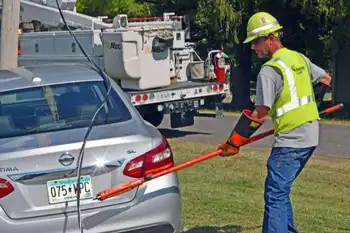
Downed Power Line Vehicle Safety: Follow stay-in-the-car protocol, call 911, avoid live wires and utility poles, and use the bunny hop to escape only for fire. Electrical hazards demand emergency response caution.


Key Points

Stay in the car, call 911, and use a bunny hop escape only if fire threatens during downed power line incidents.

✅ Stay in vehicle; tell bystanders to keep back and call 911.

✅ Exit only for fire; jump clear and bunny hop away.

✅ Treat all downed lines as live; avoid paths to ground.


Ameren Illinois and Safe Electricity are urging the public to stay in their cars and call 911 in the event of an accident involving a power pole that brings down power lines on or around the car.

In a media simulation Tuesday at the Ameren facility on West Lafayette Avenue, Ameren Illinois employees demonstrated the proper way to react if a power line has fallen on or around a vehicle, as some utilities consider on-site staffing measures during outbreaks. Although the situation might seem rare, Illinois motorists alone hit 3,000 power poles each year, said Krista Lisser, communications director for Safe Energy.

“We want to get the word out that, if you hit a utility pole and a live wire falls on your vehicle, stay in your car,” Lisser said. “Our first reaction is we panic and think we need to get out, a sign of the electrical knowledge gap many people have. That’s not the case, you need to stay in because, when that live wire comes down, electricity is all around you. You may not see it, it may not arc, it may not flash, you may not know if there’s electricity there.”

Should someoneinvolved in such an accident see a good Samaritan attempting to help, he should try to tell the would-be rescuer to stay back to prevent injury to the Samaritan, Ameren Illinois Communications Executive Brian Bretsch said.

“We have seen instances where someone comes up and wants to help you,” Bretsch said. “You want to yell, ‘Please stay away from the vehicle. Everyone is OK. Please stay away.’ You’ll see … instances every now and then where the Samaritan will come up, create that path to ground and get injured, and there are also climbers seeking social media glory who put themselves at risk.”

The only instance in which one should exit a car in the vicinity of a downed wire is if the vehicle is on fire and there is no choice but to exit. In that situation, those in the car should “bunny hop” out of the car by jumping from the car without touching the car and the ground at the same time, Bretsch and Lisser said.

After the initial jump, those escaping the vehicle should continue jumping with both feet together and hands tucked in and away from danger until they are safely clear of the downed wire.

It’s important for everyone to be informed, because an encounter with a live wire could easily result in serious injury, as in the Hydro One worker injury case, or death, Lisser said.

“They’re so close to our roads, especially in our rural communities, that it’s quite a common occurrence,” Lisser said. “Just stay away from (downed lines), especially after storms and amid grid oversight warnings that highlight reliability risks … Always treat a downed line as a live wire. Never assume the line is dead.”


Related News

View more

Surging electricity demand is putting power systems under strain around the world

Global Electricity Demand Surge strains power markets, fuels price volatility, and boosts coal and gas generation as renewables lag, driving emissions, according to the IEA, with grids and clean energy investment crucial through 2024.


Key Points

A surge in power use that strained supply, raised prices, and drove power-sector CO2 emissions to record highs.

✅ 6% demand growth in 2021; largest absolute rise ever

✅ Coal up 9%; gas +2%; renewables +6% could not meet demand

✅ Prices doubled vs 2020; volatility hit EU, China, India


Global electricity demand surged above pre-pandemic levels in 2021, creating strains in major markets, pushing prices to unprecedented levels and driving the power sector’s emissions to a record high. Electricity is central to modern life and clean electricity is pivotal to energy transitions, but in the absence of faster structural change in the sector, rising demand over the next three years could result in additional market volatility and continued high emissions, according an IEA report released today.

Driven by the rapid economic rebound, and more extreme weather conditions than in 2020, including a colder than average winter, last year’s 6% rise in global electricity demand was the largest in percentage terms since 2010 when the world was recovering from the global financial crisis. In absolute terms, last year’s increase of over 1 500 terawatt-hours was the largest ever, according to the January 2022 edition of the IEA’s semi-annual Electricity Market Report.

The steep increase in demand outstripped the ability of sources of electricity supply to keep pace in some major markets, with shortages of natural gas and coal leading to volatile prices, demand destruction and negative effects on power generators, retailers and end users, notably in China, Europe and India. Around half of last year’s global growth in electricity demand took place in China, where demand grew by an estimated 10%, highlighting that Asia is set to use half of global electricity by 2025 according to the IEA. China and India suffered from power cuts at certain points in the second half of the year because of coal shortages.

“Sharp spikes in electricity prices in recent times have been causing hardship for many households and businesses around the world and risk becoming a driver of social and political tensions,” said IEA Executive Director Fatih Birol. “Policy makers should be taking action now to soften the impacts on the most vulnerable and to address the underlying causes. Higher investment in low-carbon energy technologies including renewables, energy efficiency and nuclear power – alongside an expansion of robust and smart electricity grids – can help us get out of today’s difficulties.”

The IEA’s price index for major wholesale electricity markets almost doubled compared with 2020 and was up 64% from the 2016-2020 average. In Europe, average wholesale electricity prices in the fourth quarter of 2021 were more than four times their 2015-2020 average, and wind and solar generated more electricity than gas in the EU during the year.  Besides Europe, there were also sharp price increases in Japan and India, while they were more moderate in the United States where gas supplies were less perturbed.

Electricity produced from renewable sources grew by 6% in 2021, but it was not enough to keep up with galloping demand. Coal-fired generation grew by 9%, with soaring electricity and coal use serving more than half of the increase in demand and reaching a new all-time peak as high natural gas prices led to gas-to-coal switching. Gas-fired generation grew by 2%, while nuclear increased by 3.5%, almost reaching its 2019 levels. In total, carbon dioxide (CO2) emissions from power generation rose by 7%, also reaching a record high, after having declined the two previous years.

“Emissions from electricity need to decline by 55% by 2030 to meet our Net Zero Emissions by 2050 Scenario, but in the absence of major policy action from governments, those emissions are set to remain around the same level for the next three years,” said Dr Birol. “Not only does this highlight how far off track we currently are from a pathway to net zero emissions by 2050, but it also underscores the massive changes needed for the electricity sector to fulfil its critical role in decarbonising the broader energy system.”

For 2022-2024, the report anticipates electricity demand growing 2.7% a year on average, although the Covid-19 pandemic and high energy prices bring some uncertainty to this outlook. Renewables are set to grow by 8% per year on average, and low-emissions sources are expected to serve more than 90% of net demand growth during this period. We expect nuclear-based generation to grow by 1% annually during the same period.

As a consequence of slowing electricity demand growth and significant renewables additions, fossil fuel-based generation is expected to stagnate in the coming years, and renewables are set to surpass coal by 2025 with coal-fired generation falling slightly as phase-outs and declining competitiveness in the United States and Europe are balanced by growth in markets like China, where electricity demand trends remain a puzzle in recent analyses, and India. Gas-fired generation is seen growing by around 1% a year.


Related News

View more

Sign Up for Electricity Forum’s Newsletter

Stay informed with our FREE Newsletter — get the latest news, breakthrough technologies, and expert insights, delivered straight to your inbox.

Electricity Today T&D Magazine Subscribe for FREE

Stay informed with the latest T&D policies and technologies.
  • Timely insights from industry experts
  • Practical solutions T&D engineers
  • Free access to every issue

Download the 2025 Electrical Training Catalog

Explore 50+ live, expert-led electrical training courses –

  • Interactive
  • Flexible
  • CEU-cerified