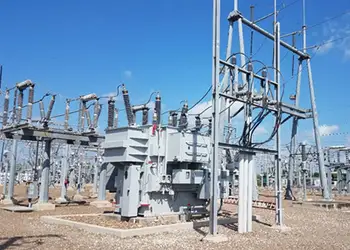
Substation Protection Training - Protect Transformers, Buses and Lines
Our customized live online or in‑person group training can be delivered to your staff at your location.
- Live Online
- 12 hours Instructor-led
- Group Training Available
Regular Price:
$799
Coupon Price:
$699
A nuclear power plant reactor in southern York County returned to service after a cracked pipe in the cooling system forced owner Exelon Nuclear to shut the reactor down October 7.
The shutdown was the second at the Peach Bottom Nuclear Station in 15 months and the third since 2003.
The reactor, which had been off line for three weeks for refueling and maintenance, was only two hours into its restart when an equipment operator noticed a leak in a pipe used to test the cooling system, said April Schilpp, spokeswoman for the plant.
The leak posed no risk to the public or plant workers and no radiation was released, she said.
Plant shutdowns are costly for the operators because they must buy replacement energy from other sources. But Schilpp said cost was not a consideration in Exelon's decision to shut down.
"Our first concern is safety," she said. "If a shutdown is required, even as a precaution, that will be our first concern."
The Union of Concerned Scientists, a national nuclear watchdog group, called on the U.S. Nuclear Regulatory Commission, which licenses nuclear plants, to require more aggressive preventive maintenance programs at nuclear plants to prevent unplanned shutdowns.
The group warns that the age of the nation's commercial nuclear fleet increases the risk of a mechanical breakdown that could cause a radiation release. More than half of the 104 nuclear reactors in use in the nation were built before 1979.
In a recent report, the union said that 36 of 51 unplanned shutdowns experienced by the industry since the late 1960s were the result of weak quality assurance programs.
Industry officials agreed with the report's assertion that maintenance was critical to plant safety, but they disagreed with the report's conclusion that the industry is unsafe. The Nuclear Energy Institute, which represents plant owners and operators, said the number of unplanned outages has declined since the late 1990s.
The leaking pipe that led to the shutdown at Peach Bottom was not on the plant's maintenance schedule because it was only used for testing, Schilpp said.
Peach Bottom has two operating reactors. The Unit 3 reactor was not affected by the incident and continued operating, Schilpp said. The plant produces enough electricity to power about 2.2 million households.
Technicians were performing a test of Unit 2's safety cooling system when the leak was discovered at about 6 p.m. October 7. Water was seeping from a 3- to 4-inch crack in the pipe, according to a U.S. Nuclear Regulatory Commission report. The leak was stopped by closing a valve. The pipe was repaired.
The incident prompted the plant to declare an "unusual event," the lowest of four emergency classifications used by the NRC.
The incident was of low significance because the cracked water line is used only for testing and is not an active part of the reactor cooling system, Schilpp said. But the company declared the unusual event because the pipe connects directly to the reactor cooling system, she said.
Related News
Toronto Power Outages Persist for Hundreds After Spring Storm
Toronto Hydro Storm Outages continue after strong winds and heavy rain, with crews restoring power,…
View more

Iran to Become Regional Hub for Renewable Energies
Iran Renewable Energy Strategy targets productivity first, then wind power expansion, investment, and exports, overcoming…
View more

EU opens consultation on Dutch electricity market reforms to tackle shortages
Dutch electricity market consultation invites stakeholder input on EU reforms, supply security, and market design.…
View more
Electricity complaints filed by Texans reach three-year high, report says
Texas Electricity Complaints surged to a three-year high, highlighting Public Utility Commission data on billing…
View more

Next Offshore Wind in U.S. Can Compete With Gas, Developer Says
Offshore Wind Cost Competitiveness is rising as larger turbines boost megawatt output, cut LCOE, and…
View more

City of Vancouver named Clean Energy Champion for Bloedel upgrades
BC Hydro Clean Energy Champions highlights Vancouver's Bloedel Conservatory electrification with a massive heat pump,…
View more
Sign Up for Electricity Forum’s Newsletter
Stay informed with our FREE Newsletter — get the latest news, breakthrough technologies, and expert insights, delivered straight to your inbox.
Electricity Today T&D Magazine Subscribe for FREE

Stay informed with the latest T&D policies and technologies.
- Timely insights from industry experts
- Practical solutions T&D engineers
- Free access to every issue

