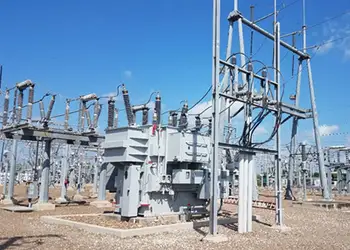
Substation Protection Training - Protect Transformers, Buses and Lines
Our customized live online or in‑person group training can be delivered to your staff at your location.
- Live Online
- 12 hours Instructor-led
- Group Training Available
Regular Price:
$799
Coupon Price:
$699
The Seacoast's steamy weather on Tuesday didn't set a temperature record, but was expected to contribute to one for energy use.
ISO New England, operator of the regional power grid, expected a one-day record-breaker for power usage. Public Service of New Hampshire also predicted customers in the Granite State would surpass the record for peak power demand.
PSNH spokesman Martin Murray said the company's record demand of 2,122 megawatts was set on July 27, 2005. He said Monday's peak power demand was 2,120 megawatts, the second-highest recording.
Murray said Tuesday's numbers would not be known until today, but he expected the continued heat and humidity would cause the record to be broken.
State Climatologist David Brown said Tuesday was the hottest day of the year so far, with 90-degree temperatures across the state.
"This is the real first heat wave we've had in the state in the past two years," Brown said.
The heat, however, didn't break local records. The highest temperature in Portsmouth for July 18 was 98 degrees in 1998, according to Brown. The hottest temperature ever recorded in New Hampshire was 106 degrees on July 4, 1911, in Nashua.
Given that temperatures weren't extreme, Murray said he thought the record power demand was not because customers were using their air cond itioners more than past summers; it was because more people now have air conditioners.
"Now they sell (small) air conditioners for $100. People say, Ñ’Well, I can afford that,'" Murray said.
"We have evolved as a region that used most of its energy in the wintertime to a region that has peak usage in the summer," he continued. "That's a relatively recent phenomenon over last 10 years. I think it's because, as a society, we want to retain those creature comforts; we want to work and live in a cool, air-conditioned environment."
Luckily, Murray said, utility companies in the region have been able to keep up with this latest demand for power. New England power plants collectively produce between 30,000 and 33,000 megawatts of power, Murray said. Tuesday's predicted energy record for the New England was expected to surpass 27,000 megawatts.
Related News

U.S Bans Russian Uranium to Bolster Domestic Industry
U.S. Russian Uranium Import Ban reshapes nuclear fuel supply, bolstering energy security, domestic enrichment, and…
View more

Energy-insecure households in the U.S. pay 27% more for electricity than others
Community Solar for Low-Income Homes expands energy equity by delivering renewable energy access, predictable bill…
View more

Learn how fees and usage impacts your electricity bill in new online CER tool
CER Interactive Electricity Bill Tool compares provincial electricity prices, fees, taxes, and usage. Explore household…
View more
Hydro One will keep running its U.S. coal plant indefinitely, it tells American regulators
Hydro One-Avista Merger outlines a utility acquisition shaped by Washington regulators, Colstrip coal plant depreciation,…
View more

BC Hydro completes major milestone on Site C transmission line work
Site C 500 kV transmission lines strengthen the BC Hydro grid, linking the new substation…
View more

Over 30% of Global Electricity from Renewables
Global Renewable Electricity Milestone signals solar, wind, hydro, and geothermal surpass 30% of power generation,…
View more
Sign Up for Electricity Forum’s Newsletter
Stay informed with our FREE Newsletter — get the latest news, breakthrough technologies, and expert insights, delivered straight to your inbox.
Electricity Today T&D Magazine Subscribe for FREE

Stay informed with the latest T&D policies and technologies.
- Timely insights from industry experts
- Practical solutions T&D engineers
- Free access to every issue

