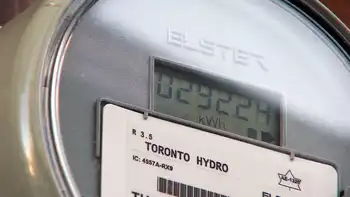
Average household electricity bills in Ontario will rise between $5 and $15 a month starting in April as the new Liberal government pushed its first law through the legislature recently.
The legislation imposes a two-tier rate system.
Electricity will cost 4.7 cents a kilowatt-hour for the first 750 kilowatt-hours used in a month. That's an increase of nine per cent over the 4.3-cent cap imposed by former Conservative premier Ernie Eves in Autumn 2003.
Above that threshold, which about 55 per cent of Ontario households cross, the price will be 5.5 cents per kilowatt-hour, a jump of close to 30 per cent.
Still, because the price of power comprises only about half the bill, the government estimates the overall increase for homeowners will be about six to 12 per cent. Farms and small businesses will see their bills jump between 15 and 18 per cent.
The legislation, which passed by a vote of 65-20 with the Opposition Tories and New Democrats voting against it, will see energy-intensive households pay about $50 or more a month for power.
A small grocery store or pizzeria, for example, could pay $250 more.
The higher rates will take effect April 1 to allow consumers time to get used to the idea of paying more for power, and Energy Minister Dwight Duncan has said consumers can ease the pain simply by using less.
The Liberal government said it had no choice but to break a campaign promise to leave the rate cap in place given the multibillion-dollar deficit facing the province and the hundreds of millions of dollars it was costing taxpayers.
"I'm pleased in the sense that the legislation has passed and we're able to address a major problem that was created by the previous government," Duncan said recently.
The new price caps are to stay in effect until May 1, 2005, at the latest, by which time a new permanent pricing system will be put in place.
Starting in March, local utilities will be able to recover money they lost under a freeze imposed on distribution rates, but would have to collect the funds from consumers over four years.
Eves imposed the price freeze amid a consumer revolt over soaring hydro bills following his decision to throw open the market to competition in May last year.
While rates were frozen for about half the energy market - households, small businesses and farmers - prices still fluctuate on the wholesale market, with taxpayers picking up the difference.
To date, wholesale prices have averaged 5.8 cents a kilowatt-hour - about 30 per cent above the cap - at a cost to the treasury of more than $800 million.
Critics had also assailed the freeze as counterproductive to conservation.
UK Coal-Free Energy Transition highlights the West Burton A closure, accelerating renewable energy, wind, solar, nuclear, energy storage, smart grid upgrades, decarbonization, and net-zero goals while ensuring reliability, affordability, and a just transition for workers.
Key Points
A nationwide shift from coal power to renewables, storage, and nuclear to meet net-zero while maintaining reliability.
✅ West Burton A closure ends UK coal-fired generation
✅ Government backs a just transition and worker retraining
The United Kingdom marks a historic turning point in its energy transition with the closure of the West Burton A Power Station in Nottinghamshire. This coal-fired power plant, once a symbol of the nation's industrial might, has now delivered its final watts of electricity to the grid, signalling the end of coal power generation in the UK.
A Landmark Shift Towards Clean Energy
The closure of West Burton A reflects a dramatic shift in the UK's energy landscape. Coal, the backbone of the UK's power generation for decades, is being phased out in favour of renewable energy sources like wind, solar, and nuclear. This transition aligns with the UK's ambitious net-zero emissions target, which aims to radically decarbonize the country's economy by 2050, though progress can falter, as when low-carbon generation stalled in 2019 amid changing market conditions.
Changing Energy Landscape
In the past, coal-fired power plants provided reliable, on-demand power. However, growing awareness of their significant environmental impact, particularly their contribution to climate change, has accelerated the move away from coal. The UK government has set clear targets for eliminating coal power generation, and the industry has seen a steady decline as the share of coal fell to record lows in the electricity system.
Renewables Fill the Gap
The remarkable growth of renewable energy sources has enabled the transition away from coal. Wind and solar power, in particular, have experienced rapid development and falling costs, and in 2016 wind generated more electricity than coal for the first time. The UK now boasts substantial offshore and onshore wind farms and extensive solar installations. Additionally, investments in nuclear power and emerging energy storage technologies are increasing the reliability and diversity of the UK's power grid.
Economic and Social Impacts
The closure of the last coal-fired power station carries both economic and social impacts. While this change represents a victory for environmentalists, marked by milestones like a full week without coal power in Britain, the end of coal mining and power generation will lead to job losses in communities traditionally reliant on these industries. The government has committed to supporting affected regions and facilitating a "just transition" for workers by retraining and creating new opportunities in the clean energy sector.
Global Implications
The UK's commitment to a coal-free future serves as a powerful example for other nations seeking to decarbonize their energy systems, including peers where Alberta's last coal plant closed recently. The nation's experience demonstrates that a transition to renewable energy sources is both possible and necessary. However, it also highlights the importance of careful planning and addressing the social and economic impacts of such a rapid energy revolution.
The Road Ahead
While the closure of West Burton A Power Station marks a historic milestone, the UK's transition to clean energy is far from complete. Maintaining a reliable and affordable energy supply, even as coal-free power records raise questions about energy bills, will require continued investment in renewable energy sources, energy storage, and advanced grid technologies.
US Renewable Power Outlook 2030 projects surging capacity, solar PV and wind growth, grid modernization, and favorable tax credits, detailing market trends, CAGR, transmission expansion, and policy drivers shaping clean energy generation and consumption.
Key Points
A forecast of US power capacity, generation, and consumption, highlighting solar, wind, tax credits, and grid modernization.
✅ Targets 48.4% renewable capacity share by 2030
✅ Strong growth in solar PV and onshore wind installations
✅ Investment and tax credits drive grid and transmission upgrades
GlobalData’s latest report, ‘United States Power Market Outlook to 2030, Update 2021 – Market Trends, Regulations, and Competitive Landscape’ discusses the power market structure of the United States and provides historical and forecast numbers for capacity, generation and consumption up to 2030. Detailed analysis of the country’s power market regulatory structure, competitive landscape and a list of major power plants are provided. The report also gives a snapshot of the power sector in the country on broad parameters of macroeconomics, supply security, generation infrastructure, transmission and distribution infrastructure, about a quarter of U.S. electricity from renewables in recent years, electricity import and export scenario, degree of competition, regulatory scenario, and future potential. An analysis of the deals in the country’s power sector is also included in the report.
Renewable power held a 19% share of the US’s total power capacity in 2020, and in that year renewables became the second-most prevalent source in the U.S. electricity mix by generation; this share is expected to increase significantly to 48.4% by 2030. Favourable policies introduced by the US Government will continue to drive the country’s renewable sector, particularly solar photovoltaics (PV) and wind power, with wind now the most-used renewable source in the U.S. generation mix. Installed renewable capacity* increased from 16.5GW in 2000 to 239.2GW in 2020, growing at a compound annual growth rate (CAGR) of 14.3%. By 2030, the cumulative renewable capacity is expected to rise to 884.6GW, growing at a CAGR of 14% from 2020 to 2030. Despite increase in prices of renewable equipment, such as solar modules, in 2021, the US renewable sector will show strong growth during the 2021 to 2030 period as this increase in equipment prices are short term due to supply chain disruptions caused by the Covid-19 pandemic.
The expansion of renewable power capacity during the 2000 to 2020 period has been possible due to the introduction of federal schemes, such as Production Tax Credits, Investment Tax Credits and Manufacturing Tax Credits. These have massively aided renewable installations by bringing down the cost of renewable power generation and making it at par with power generated from conventional sources. Over the last few years, the cost of solar PV and wind power installations has declined sharply, and by 2023 wind, solar, and batteries made up most of the utility-scale pipeline across the US, highlighting investor confidence. Since 2010, the cost of utility-scale solar PV projects decreased by around 82% while onshore wind installations decreased by around 39%. This has supported the rapid expansion of the renewable market. However, the price of solar equipment has risen due to an increase in raw material prices and supply shortages. This may slightly delay the financing of some solar projects that are already in the pipeline.
The US will continue to add significant renewable capacity additions during the forecast period as industry outlooks point to record solar and storage installations over the coming years, to meet its target of reaching 80% clean energy by 2030. In November 2021, President Biden signed a $1tr Infrastructure Bill, within which $73bn is designated to renewables. This includes not just renewable capacity building, but also strengthening the country’s power grid and laying new high voltage transmission lines, both of which will be key to driving solar and wind power capacity additions as wind power surges in the U.S. electricity mix nationwide.
The US was one of the worst hit countries in the world due to the Covid-19 pandemic in 2020. With respect to the power sector, the electricity consumption in the country declined by 2.5% in 2020 as compared to 2019, even as renewable electricity surpassed coal in 2022 in the generation mix, highlighting continued structural change. Power plants that were under construction faced delays due to unavailability of components due to supply chain disruptions and unavailability of labour due to travel restrictions.
According to the US Energy Information Administration, 61 power projects, having a total capacity of 2.4GWm which were under construction during March and April 2020 were delayed because of the Covid-19 pandemic. Among renewable power technologies, solar PV and wind power projects were the most badly affected due to the pandemic.
In March and April 2020, 53 solar PV projects, having a total capacity of 1.3GW, and wind power projects, having a total capacity of 1.2GW, were delayed due to the Covid-19 pandemic. Moreover, several states suspended renewable energy auctions due to the pandemic.
For instance, New York State Energy Research and Development Authority (NYSERDA) had issued a new offshore wind solicitation for 1GW and up to 2.5GW in April 2020, but this was suspended due to the Covid-19 pandemic. In July 2020, the authority relaunched the tender for 2.5GW of offshore wind capacity, with a submission deadline in October 2020.
To ease the financial burden on consumers during the pandemic, more than 1,000 utilities in the country announced disconnection moratoria and implemented flexible payment plans. Duke Energy, American Electric Power, Dominion Power and Southern California Edison were among the major utilities that voluntarily suspended disconnections.
Hydro-Qubec Electricity Theft Ring exposed after a utility investigation into identity theft, rental property fraud, and conspiracies using stolen customer data; arrests, charges, and a tip line highlight ongoing enforcement.
Key Points
A five-year identity-theft scheme defrauding Hydro-Qubec through utility accounts leading to arrests and fraud charges.
✅ Five arrests; 25 counts: fraud, conspiracy, identity theft
✅ Losses up to $300,000 in electricity, 2014-2019
✅ Tip line: 1-877-816-1212 for suspected Hydro-Qubec fraud
Five people have been arrested in connection with an electricity theft ring alleged to have operated for five years, a pattern seen in India electricity theft arrests as well.
The thefts were allegedly committed by the owners of rental properties who used stolen personal information to create accounts with Hydro-Québec, which also recently dealt with a manhole fire outage affecting thousands.
The utility alleges that between 2014 and 2019, Mario Brousseau, Simon Brousseau-Ouellette and their accomplices defrauded Hydro-Québec of up to $300,000 worth of electricity, highlighting concerns about consumption trends as residential electricity use rose during the pandemic. It was impossible for Hydro-Québec’s customer service section to detect the fraud because the information on the accounts, while stolen, was also genuine, even as the utility reported pandemic-related losses later on.
The suspects are expected to face 25 counts of fraud, conspiracy and identity theft, issues that Ontario utilities warn about regularly.
Hydro-Québec noted the thefts were detected through an investigation by the utility into 10 fraud cases, a process that can lead to retroactive charges for affected accounts.
Anyone concerned that a fraud is being committed against Hydro-Québec, or wary of scammers threatening shutoffs, is urged to call 1-877-816-1212.
Wisconsin Solar and Wind Energy advances as rooftop solar, utility-scale farms, and NREL perovskite solar cells improve efficiency; wind turbines gain via wake modeling, yaw control, and grid-scale battery storage to cut carbon emissions.
Key Points
It is Wisconsin's growth in rooftop and utility-scale solar plus optimized wind turbines to cut carbon emissions.
✅ Perovskite solar cells promise higher efficiency, need longevity
✅ Wake modeling and yaw control optimize wind farm output
✅ Batteries and bids can offset reliance on natural gas
Solar energy in Wisconsin continued to grow in 2019, as more homeowners had rooftop panels installed and big utilities started building multi-panel solar farms.
Wind power is increasing more slowly in the state. However, renewable power developers are again coming forward with proposals for multiple turbines.
Nationally, researchers are working on ways to get even more energy from solar and wind, with the U.S. moving toward 30% electricity from wind and solar in coming years, as states like Wisconsin aim to reduce their carbon emissions over the next few decades.
One reason solar energy is growing in Wisconsin is due to the silicon panels becoming more efficient. But scientists haven't finished trying to improve panel efficiency. The National Renewable Energy Laboratory (NREL) in Golden, Col., is one of the research facilities experimenting with brushing a lab-made solution called perovskite onto a portion of a panel called a solar cell.
In a demonstration video supplied by NREL, senior scientist Maikel van Hest said that, in the lab anyway, the painted cell and its electrical connections called contacts, produce more energy:
"There you go! That's how you paint a perovskite solar cell. And you imagine that ultimately what you could do is you could see a company come in with a truck in front of your house and they would basically paint on the contacts first, dry those, and paint the perovskite over it. That you would have photovoltaic cells on the side of your house, put protective coating on it, and we're done."
Another NREL scientist, David Moore, says the new solar cells could be made faster and help meet what's expected to be a growing global demand for energy. However, Moore says the problem has been lack of stability.
"A solar cell with perovskites will last a couple years. We need to get that to 20-25 years, and that's the big forefront in perovskite research, is getting them to last longer," Moore told members of the Society of Environmental Journalists during a recent tour of NREL.
Another part of improving renewable energy is making wind turbines more productive. At NREL's Insight Center, a large screen showing energy model simulations dominates an otherwise darkened room. Visualization scientist Nicholas Brunhart-Lupo points to a display on the screen that shows how spinning turbines at one edge of a wind farm can cause an airflow called a wake, which curtails the power generation of other turbines.
"So what we find in these simulations is these four turbines back here, since they have this used air, this low-velocity wake being blown to their faces, they're only generating about 20% of the energy they should be generating," he explains.
Brunhart-Lupo says the simulations can help wind farm developers with placement of turbines as well as adjustments to the rotor and blades called the yaw system.
Continued progress with renewables may be vital to any state or national pledges to reduce use of fossil fuels and carbon emissions linked to climate change, including Biden's solar expansion plan as a potential pathway. Some scientists say to limit a rise in global temperature, there must be a big decline in emissions by 2050.
But even utilities that say they support use of more renewables, as why the grid isn't 100% renewable yet makes clear, aren't ready to let go of some energy sources. Jonathan Adelman of Xcel Energy, which serves part of Western Wisconsin, says Xcel is on track to close its last two coal-fired power plants in Minnesota. But he says the company will need more natural gas plants, even though they wouldn't run as often.
"It's not perfect. And it is in conflict with our ultimate goal of being carbon-free," says Adelman. "But if we want to facilitate the transition, we still need resources to help that happen."
Some in the solar industry would like utilities that say they need more natural gas plants to put out competitive bids to see what else might be possible. Solar advocates also note that in some states, energy regulators still favor the utilities.
Meanwhile, solar slowly marches ahead, including here in southeastern Wisconsin, as Germany's solar power boost underscores global momentum.
On the roof of a ranch-style home in River Hills, a work crew from the major solar firm Sunrun recently installed mounting brackets for solar panels.
Sunrun Public Policy Director Amy Heart says she supports research into more efficient renewables. But she says another innovation may have to come in the way regulators think.
"Instead of allowing and thinking about from the perspective of the utility builds the power plant, they replace one plant with another one, they invest in the infrastructure; is really thinking about how can these distributed solutions like rooftop solar, peer-to-peer energy sharing, and especially rooftop solar paired with batteries how can that actually reduce some of what the utility needs?
Large-scale energy storage batteries are already being used in some limited cases. But energy researchers continue to make improvements to them, too, with cheap solar batteries beginning to make widespread adoption more feasible as scientists race to reduce the expected additional harm of climate change.
Oil and Gas Profitability Decline reflects shale-driven oversupply, OPEC-Russia dynamics, LNG exports, renewables growth, and weak demand, signaling compressed margins for producers, stressed petrodollar budgets, and shifting energy markets post-Covid.
Key Points
A sustained squeeze on hydrocarbon margins from agile shale supply, weaker OPEC leverage, and expanding renewables.
✅ Shale responsiveness caps prices and erodes industry rents
✅ OPEC-Russia cuts face limited impact versus US supply
✅ Renewables and EVs slow long-term oil and gas demand
The oil-price crash of March 2020 will probably not last long. As in 2014, when the oil price dropped below $50 from $110 in a few weeks, this one will trigger a temporary collapse of the US shale industry. Unless the coronavirus outbreak causes Armageddon, cheap oil will also support policymakers’ efforts to help the global economy.
But there will be at least one important and lasting difference this time round — and it has major market and geopolitical implications.
The oil price crash is a foretaste of where the whole energy sector was going anyway — and that is down.
It may not look that way at first. Saudi Arabia will soon realise, as it did in 2015, that its lethal decision to pump more oil is not only killing US shale but its public finances as well. Riyadh will soon knock on Moscow’s door again. Once American shale supplies collapse, Russia will resume co-operation with Saudi Arabia.
With the world economy recovering from the Covid-19 crisis by then, and with electricity demand during COVID-19 shifting, moderate supply cuts by both countries will accelerate oil market recovery. In time, US shale producers will return too.
Yet this inevitable bounceback should not distract from two fundamental factors that were already remaking oil and gas markets. First, the shale revolution has fundamentally eroded industry profitability. Second, the renewables’ revolution will continue to depress growth in demand.
The combined result has put the profitability of the entire global hydrocarbon industry under pressure. That means fewer petrodollars to support oil-producing countries’ national budgets, including Canada's oil sector exposures. It also means less profitable oil companies, which traditionally make up a large segment of stock markets, an important component of so many western pension funds.
Start with the first factor to see why this is so. Historically, the geological advantages that made oil from countries such as Saudi Arabia so cheap to produce were unique. Because oil and gas were produced at costs far below the market price, the excess profits, or “rent”, enjoyed by the industry were very large.
Furthermore, collusion among low-cost producers has been a winning strategy. The loss of market share through output cuts was more than compensated by immediately higher prices. It was the raison d’être of Opec.
The US shale revolution changed all this, exposing the limits of U.S. energy dominance narratives. A large oil-producing region emerged with a remarkable ability to respond quickly to price changes and shrink its costs over time. Cutting back cheap Opec oil now only increases US supplies, with little effect on world prices.
That is why Russia refused to cut production this month. Even if its cuts did boost world prices — doubtful given the coronavirus outbreak’s huge shock to demand — that would slow the shrinkage of US shale that Moscow wants.
Shale has affected the natural gas industry even more. Exports of US liquefied natural gas now put an effective ceiling on global prices, and debates over a clean electricity push have intensified when gas prices spike.
On top of all this, there is also the renewables’ revolution, though a green revolution has not been guaranteed in the near term. Around the world, wind and solar have become ever-cheaper options to generate electricity. Storage costs have also dropped and network management improved. Even in the US, renewables are displacing coal and gas. Electrification of vehicle fleets will damp demand further, as U.S. electricity, gas, and EVs face evolving pressures.
Eliminating fossil fuel consumption completely would require sustained and costly government intervention, and reliability challenges such as coal and nuclear disruptions add to the complexity. That is far from certain. Meanwhile, though, market forces are depressing the sector’s usual profitability.
The end of oil and gas is not immediately around the corner. Still, the end of hydrocarbons as a lucrative industry is a distinct possibility. We are seeing that in dramatic form in the current oil price crash. But this collapse is merely a message from the future.
ITER Nuclear Fusion advances tokamak magnetic confinement, heating deuterium-tritium plasma with superconducting magnets, targeting net energy gain, tritium breeding, and steam-turbine power, while complementing laser inertial confinement milestones for grid-scale electricity and 2025 startup goals.
Key Points
ITER Nuclear Fusion is a tokamak project confining D-T plasma with magnets to achieve net energy gain and clean power.
✅ Tokamak magnetic confinement with high-temp superconducting coils
✅ Deuterium-tritium fuel cycle with on-site tritium breeding
✅ Targets net energy gain and grid-scale, low-carbon electricity
It sounds like the stuff of dreams: a virtually limitless source of energy that doesn’t produce greenhouse gases or radioactive waste. That’s the promise of nuclear fusion, often described as the holy grail of clean energy by proponents, which for decades has been nothing more than a fantasy due to insurmountable technical challenges. But things are heating up in what has turned into a race to create what amounts to an artificial sun here on Earth, one that can provide power for our kettles, cars and light bulbs.
Today’s nuclear power plants create electricity through nuclear fission, in which atoms are split, with next-gen nuclear power exploring smaller, cheaper, safer designs that remain distinct from fusion. Nuclear fusion however, involves combining atomic nuclei to release energy. It’s the same reaction that’s taking place at the Sun’s core. But overcoming the natural repulsion between atomic nuclei and maintaining the right conditions for fusion to occur isn’t straightforward. And doing so in a way that produces more energy than the reaction consumes has been beyond the grasp of the finest minds in physics for decades.
But perhaps not for much longer. Some major technical challenges have been overcome in the past few years and governments around the world have been pouring money into fusion power research as part of a broader green industrial revolution under way in several regions. There are also over 20 private ventures in the UK, US, Europe, China and Australia vying to be the first to make fusion energy production a reality.
“People are saying, ‘If it really is the ultimate solution, let’s find out whether it works or not,’” says Dr Tim Luce, head of science and operation at the International Thermonuclear Experimental Reactor (ITER), being built in southeast France. ITER is the biggest throw of the fusion dice yet.
Its $22bn (£15.9bn) build cost is being met by the governments of two-thirds of the world’s population, including the EU, the US, China and Russia, at a time when Europe is losing nuclear power and needs energy, and when it’s fired up in 2025 it’ll be the world’s largest fusion reactor. If it works, ITER will transform fusion power from being the stuff of dreams into a viable energy source.
Constructing a nuclear fusion reactor ITER will be a tokamak reactor – thought to be the best hope for fusion power. Inside a tokamak, a gas, often a hydrogen isotope called deuterium, is subjected to intense heat and pressure, forcing electrons out of the atoms. This creates a plasma – a superheated, ionised gas – that has to be contained by intense magnetic fields.
The containment is vital, as no material on Earth could withstand the intense heat (100,000,000°C and above) that the plasma has to reach so that fusion can begin. It’s close to 10 times the heat at the Sun’s core, and temperatures like that are needed in a tokamak because the gravitational pressure within the Sun can’t be recreated.
When atomic nuclei do start to fuse, vast amounts of energy are released. While the experimental reactors currently in operation release that energy as heat, in a fusion reactor power plant, the heat would be used to produce steam that would drive turbines to generate electricity, even as some envision nuclear beyond electricity for industrial heat and fuels.
Tokamaks aren’t the only fusion reactors being tried. Another type of reactor uses lasers to heat and compress a hydrogen fuel to initiate fusion. In August 2021, one such device at the National Ignition Facility, at the Lawrence Livermore National Laboratory in California, generated 1.35 megajoules of energy. This record-breaking figure brings fusion power a step closer to net energy gain, but most hopes are still pinned on tokamak reactors rather than lasers.
In June 2021, China’s Experimental Advanced Superconducting Tokamak (EAST) reactor maintained a plasma for 101 seconds at 120,000,000°C. Before that, the record was 20 seconds. Ultimately, a fusion reactor would need to sustain the plasma indefinitely – or at least for eight-hour ‘pulses’ during periods of peak electricity demand.
A real game-changer for tokamaks has been the magnets used to produce the magnetic field. “We know how to make magnets that generate a very high magnetic field from copper or other kinds of metal, but you would pay a fortune for the electricity. It wouldn’t be a net energy gain from the plant,” says Luce.
One route for nuclear fusion is to use atoms of deuterium and tritium, both isotopes of hydrogen. They fuse under incredible heat and pressure, and the resulting products release energy as heat
The solution is to use high-temperature, superconducting magnets made from superconducting wire, or ‘tape’, that has no electrical resistance. These magnets can create intense magnetic fields and don’t lose energy as heat.
“High temperature superconductivity has been known about for 35 years. But the manufacturing capability to make tape in the lengths that would be required to make a reasonable fusion coil has just recently been developed,” says Luce. One of ITER’s magnets, the central solenoid, will produce a field of 13 tesla – 280,000 times Earth’s magnetic field.
The inner walls of ITER’s vacuum vessel, where the fusion will occur, will be lined with beryllium, a metal that won’t contaminate the plasma much if they touch. At the bottom is the divertor that will keep the temperature inside the reactor under control.
“The heat load on the divertor can be as large as in a rocket nozzle,” says Luce. “Rocket nozzles work because you can get into orbit within minutes and in space it’s really cold.” In a fusion reactor, a divertor would need to withstand this heat indefinitely and at ITER they’ll be testing one made out of tungsten.
Meanwhile, in the US, the National Spherical Torus Experiment – Upgrade (NSTX-U) fusion reactor will be fired up in the autumn of 2022, while efforts in advanced fission such as a mini-reactor design are also progressing. One of its priorities will be to see whether lining the reactor with lithium helps to keep the plasma stable.
Choosing a fuel Instead of just using deuterium as the fusion fuel, ITER will use deuterium mixed with tritium, another hydrogen isotope. The deuterium-tritium blend offers the best chance of getting significantly more power out than is put in. Proponents of fusion power say one reason the technology is safe is that the fuel needs to be constantly fed into the reactor to keep fusion happening, making a runaway reaction impossible.
Deuterium can be extracted from seawater, so there’s a virtually limitless supply of it. But only 20kg of tritium are thought to exist worldwide, so fusion power plants will have to produce it (ITER will develop technology to ‘breed’ tritium). While some radioactive waste will be produced in a fusion plant, it’ll have a lifetime of around 100 years, rather than the thousands of years from fission.
At the time of writing in September, researchers at the Joint European Torus (JET) fusion reactor in Oxfordshire were due to start their deuterium-tritium fusion reactions. “JET will help ITER prepare a choice of machine parameters to optimise the fusion power,” says Dr Joelle Mailloux, one of the scientific programme leaders at JET. These parameters will include finding the best combination of deuterium and tritium, and establishing how the current is increased in the magnets before fusion starts.
The groundwork laid down at JET should accelerate ITER’s efforts to accomplish net energy gain. ITER will produce ‘first plasma’ in December 2025 and be cranked up to full power over the following decade. Its plasma temperature will reach 150,000,000°C and its target is to produce 500 megawatts of fusion power for every 50 megawatts of input heating power.
“If ITER is successful, it’ll eliminate most, if not all, doubts about the science and liberate money for technology development,” says Luce. That technology development will be demonstration fusion power plants that actually produce electricity, where advanced reactors can build on decades of expertise. “ITER is opening the door and saying, yeah, this works – the science is there.”
Whether you would prefer Live Online or In-Person
instruction, our electrical training courses can be
tailored to meet your company's specific requirements
and delivered to your employees in one location or at
various locations.