CSA Z462 Arc Flash Training - Electrical Safety Compliance
Our customized live online or in‑person group training can be delivered to your staff at your location.

- Live Online
- 6 hours Instructor-led
- Group Training Available
Regular Price:
$249
Coupon Price:
$199
Milwaukee-based We Energies has received $25 million from the U.S. Department of Energy to reduce mercury emissions at its coal-fired power plant in Presque Isle, Mich.
The pilot project is part of a strategy to reduce emissions from all Wisconsin Energy plants by 2013.
If successful, the project could provide an example for utilities across the country to cut emissions of mercury -- a toxic byproduct of coal-burning.
The We Energies project, scheduled to be designed and installed over the next year and begin operation in fall 2005, would be the first in the nation at a plant that burns low-sulfur coal from the western United States.
"If we can demonstrate this technology at Presque Isle, we may need it at some of our other plants over the course of the next 10 years, depending on how research and development related to controlling mercury emissions from western coal progresses," said Kris McKinney, manager of environmental strategy at We Energies.
Mercury is a toxin that is of growing concern to environmental regulators, particularly because of birth defects and learning disabilities in children whose mothers ate fish tainted with mercury. The state Department of Natural Resources says 40 percent of the mercury emitted in the state comes from coal-fired power plants.
In a recent report, the Natural Resources Defense Council said Wisconsin Energy Corp., the parent of We Energies, ranked 19th in the nation in 2002, among utilities generating the most mercury emissions.
A growing body of science has pointed to the dangers of eating too much mercury-laden fish, prompting the DNR in 2001 to dramatically broaden its fish consumption advisory from 341 lakes to all of the more than 15,000 lakes in Wisconsin.
Last month, the Food and Drug Administration and the Environmental Protection Agency issued an advisory warning pregnant and nursing women and young children to eat albacore tuna no more than once a week because of mercury poisoning. The same warning urged pregnant and nursing women to avoid eating shark, swordfish, king mackerel and tilefish.
The federal grant for We Energies has been in the works for years but was finalized now that the state Public Service Commission approved the Presque Isle emission control project, McKinney said. The commission's vote last month means utility ratepayers will pay for $28 million of the project while the federal grant will cover the remainder.
The potential commercial applications of the technology are huge, according to the Department of Energy.
It could result in the annual reduction of 14 million tons of mercury emitted into the atmosphere every year. That's more than one- fourth of all the mercury emitted by those plants, according to the National Energy Technology Laboratory, an arm of the energy department.
Under the five-year project, We Energies and its consultants will install a baghouse, a vacuum-like emissions control structure on three of the nine coal-fired boilers at the Presque Isle plant. Powdered activated carbon would then capture 70 percent to 90 percent of the boilers' mercury emissions.
The process -- patented by the utility industry's research arm, Electric Power Research Institute of Palo Alto, Calif. -- is one of several different technologies utilities are exploring as a way to reduce mercury emissions and comply with pending state and federal regulations.
Engineers designing the Presque Isle project also expect to sharply reduce emissions of other toxins, including sulfur dioxide and nitrogen oxide, by using this technology, McKinney said.
The project also would mark the first time that a utility could continuously measure the amount of mercury being emitted by a plant, he said.
Related News

B.C. ordered to pay $10M for denying Squamish power project
Greengen Misfeasance Ruling details a B.C. Supreme Court decision awarding $10.125 million over wrongfully denied…
View more

A new nuclear reactor in the U.S. starts up. It's the first in nearly seven years
Vogtle Unit 3 Initial Criticality marks the startup of a new U.S. nuclear reactor, initiating…
View more
Michigan Public Service Commission grants Consumers Energy request for more wind generation
Consumers Energy Wind Expansion gains MPSC approval in Michigan, adding up to 525 MW of…
View more
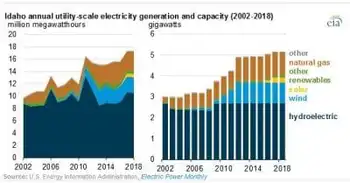
Idaho gets vast majority of electricity from renewables, almost half from hydropower
Idaho Renewable Energy 2018 saw over 80% in-state utility-scale power from hydropower, wind, solar, biomass,…
View more

NY Governor Cuomo Announces Green New Deal Included in 2019 Executive Budget
New York Green New Deal accelerates clean energy and climate action, targeting carbon neutrality with…
View more

Ontario First Nations urge government to intervene in 'urgently needed' electricity line
East-West Transmission Project Ontario connects Thunder Bay to Wawa, facing OEB bidding, Hydro One vs…
View more
Sign Up for Electricity Forum’s Newsletter
Stay informed with our FREE Newsletter — get the latest news, breakthrough technologies, and expert insights, delivered straight to your inbox.
Electricity Today T&D Magazine Subscribe for FREE

Stay informed with the latest T&D policies and technologies.
- Timely insights from industry experts
- Practical solutions T&D engineers
- Free access to every issue

