Distribution System Modeling for Feeder Representation
By Kyle Comstock, Senior Vice President, Grid Modernization, Itron
By Kyle Comstock, Senior Vice President, Grid Modernization, Itron

Request for Quotation Service
Buyers Submit Free RFQs to top suppliers, no obligation.
Suppliers Browse real project RFQs directly from buyers.
Trust Electricity Forum 40 years connection buyers and suppliers.
Distribution system modeling is the process of creating a mathematical representation of an electrical distribution network to analyze system behavior, load flow, and operational performance.
It defines network topology, component characteristics, and load behavior, enabling calculation of voltage, current, and power flow across feeders and distribution circuits.
The model links topology, electrical parameters, and load representation via power-flow equations to produce outputs such as voltage profiles, system losses, feeder loading, and phase imbalance. These outputs form the basis for evaluating how distribution networks perform under real operating conditions.
This representation is necessary because distribution systems are not static. Switching operations, load variations, and distributed energy resources continuously change system conditions, altering power-flow paths, phase loading, and voltage behavior across the network. Without an accurate model that reflects these dynamics, engineering analysis becomes unreliable and planning decisions lose validity.
To remain useful, distribution system modeling must reflect the as-operated system, not just the as-designed network. Even small differences in switching configuration or load representation can lead to incorrect results, including inaccurate voltage calculations, improper equipment settings, and flawed system planning.
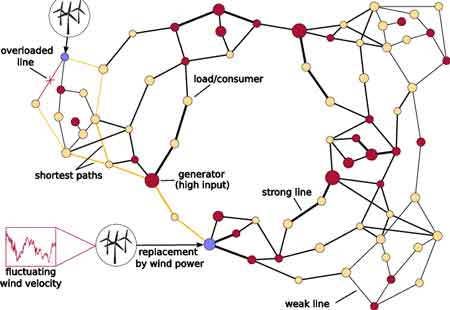
Distribution system modeling begins with a detailed representation of network topology. This includes feeder layouts, branching structures, normally open points, and switching configurations that determine how power is routed through the system. Unlike transmission networks, distribution systems are typically radial but can include reconfiguration paths that must be explicitly modeled.
Each physical component is then translated into electrical parameters. Conductors are represented by impedance values that govern voltage drop and losses. Transformers include ratios, impedance, and loading characteristics. Switches define system connectivity and must reflect actual operating states to maintain model accuracy. This level of representation aligns with Grid Modeling, but distribution system modeling focuses specifically on feeder-level detail and unbalanced behavior.
Download our FREE Electrical Training Catalog and explore a full range of expert-led electrical training courses.

Load representation introduces another layer of complexity. Loads are not uniform and do not behave consistently under changing voltage conditions. They may be modeled as constant power, constant impedance, or voltage dependent elements, depending on the level of accuracy required. In modern systems, load models increasingly incorporate time variation and customer behavior patterns.
A defining characteristic of distribution systems is phase imbalance. Single-phase connections, uneven loading, and distributed generation create asymmetrical conditions that cannot be captured using simplified assumptions. These imbalances introduce phase coupling, neutral current flow, and localized voltage deviations that directly affect equipment performance and protection behavior. For this reason, three-phase unbalanced modeling is essential for any analysis intended to reflect real feeder behavior.
An incorrect topology leads to misreported switching states, resulting in invalid load-flow results and inaccurate voltage calculations. These errors propagate through the model and can result in improper equipment settings, incorrect voltage regulation strategies, and flawed planning decisions that affect system performance.
Different modeling approaches are used depending on the level of accuracy required and the purpose of the analysis. Balanced modeling simplifies calculations by assuming equal conditions across phases, but it is limited in its ability to reflect real-world distribution systems.
Unbalanced modeling represents each phase independently and captures the effects of uneven loading, distributed generation, and phase-specific voltage variation. This approach is required for accurate voltage analysis and is widely used in modern distribution studies.
Static models evaluate a single operating condition, such as peak demand. While useful for baseline assessments, they do not capture how the system evolves over time. Time-series modeling addresses this limitation by evaluating system behavior across multiple time intervals, incorporating load variations, DER output, and switching events.
Topological modeling ensures that connectivity reflects the actual system configuration, including switching operations and feeder reconfiguration. Load modeling further refines the representation by defining how demand responds to voltage and time.
These modeling approaches establish the structural foundation used by Power System Simulation, where different operating scenarios are evaluated.
The distribution system model functions as the backbone of system understanding. It represents both the physical layout and electrical behavior of the network, providing a consistent reference point for analysis, planning, and operational decision-making.
In operational environments, the value of the model depends on how closely it reflects the as-operated system. A model that represents design intent but not actual switching conditions introduces risk. Even small discrepancies in topology can lead to incorrect power flow results, misleading voltage calculations, and reduced confidence in engineering analysis.
An as-operated model captures real-time or near real-time system configuration, ensuring that analysis reflects actual conditions. This is essential for coordinating planning and operations, particularly when evaluating system changes or integrating new resources.
The model also supports advanced applications such as feeder analysis, voltage control, and system validation. It serves as a central reference, enabling different systems and studies to operate from a consistent understanding of network behavior. This becomes especially important in studies such as a Grid Interconnection Study, where accurate feeder representation determines system capability.
Distribution system modeling enables detailed feeder analysis by identifying voltage drop, overload conditions, and loss distribution across the network. Engineers use this information to assess system performance and identify areas requiring corrective action.
Stay informed with our FREE Digital Twins, Simulation & Planning Newsletter — get the latest news, breakthrough technologies, and expert insights, delivered straight to your inbox.
Voltage regulation studies rely on accurate models to evaluate how regulators and capacitors maintain acceptable voltage levels under varying load conditions. Small modeling errors can lead to incorrect control settings and degraded performance.
Distributed energy resource integration introduces additional complexity. Solar generation, energy storage, and electric vehicles create bidirectional power flow, reverse loading conditions, and localized voltage rise that must be represented accurately. Without a reliable model, the impact of these resources cannot be properly evaluated.
Planning studies use distribution models to assess load growth, system expansion, and infrastructure upgrades. These studies depend on an accurate representation of both current conditions and the expected evolution of the system.
Applications such as Hosting Capacity Analysis rely directly on model accuracy to determine how much distributed generation a feeder can support without violating voltage or thermal limits.
Distribution system modeling defines how the system is represented. It establishes the structure, parameters, and relationships that describe network behavior.
Simulation applies conditions to that model to evaluate the system response under different scenarios. Tools within Grid Simulation use the model to analyze faults, switching operations, and performance under changing conditions.
A digital twin extends the model by synchronizing it with real-time data. A Digital Twin Power System continuously updates system representation based on field measurements, enabling ongoing monitoring and operational insight.
Maintaining clear separation between these concepts prevents overlap and ensures that each page within the cluster owns its specific intent.
The value of distribution system modeling follows a direct chain of dependency. The model defines structure, input data defines conditions, analysis produces results, and those results inform engineering decisions.
If the topology is incorrect, the switching states are misrepresented. If switching states is wrong, power flow calculations become invalid. This leads to inaccurate voltage profiles, which in turn result in poor planning decisions, incorrect voltage regulation strategies, and reduced system reliability.
For example, an incorrect load model may underestimate voltage drop along a feeder. This can lead to improper regulator settings and unacceptable voltage levels under actual operating conditions. The consequence is not theoretical. It directly affects system performance and system stability under load.
Distribution system models are simplified representations of complex physical systems. Their accuracy depends on the quality of data and the discipline used to maintain them.
Data quality remains one of the most significant constraints. Incomplete or outdated information leads to incorrect topology and unreliable results. Topology errors are particularly critical because they affect the entire network representation.
Model maintenance is continuous. Distribution systems change frequently due to switching operations, asset upgrades, and new connections. The model must be updated to reflect the as-operated system, not just the original design assumptions.
Validation and testing are essential to maintain confidence in the model. Model outputs must be compared against measured system data, and discrepancies must be resolved to prevent error accumulation in planning and operational studies.
Distribution system modeling may also interact with broader infrastructure such as a District Energy System, where electrical and thermal systems must be evaluated together.
Distribution system modeling provides the foundation for understanding how power flows through the network and how system conditions evolve under real operating conditions. It enables accurate analysis of voltage behavior, load distribution, and system performance across a wide range of scenarios.
Without an accurate model, engineering analysis becomes unreliable, and decisions lose credibility. With a well-maintained and validated model, utilities gain visibility into system behavior and the ability to plan, operate, and adapt with confidence.
Distribution system models require continuous validation, testing, and updates to maintain alignment with real system conditions as the network evolves.
Advantages To Instructor-Led Training – Instructor-Led Course, Customized Training, Multiple Locations, Economical, CEU Credits, Course Discounts.
Request For QuotationWhether you would prefer Live Online or In-Person instruction, our electrical training courses can be tailored to meet your company's specific requirements and delivered to your employees in one location or at various locations.