Why Industrial Electricity Basics Matters
This 12-hour live online instructor-led course is built around real facility examples, on-camera meter demonstrations, worked exercises and a participant workbook. Participants learn to work safely, read drawings, take measurements correctly and find common faults with confidence from their first weeks on the job.
New workers make most of their costly mistakes in their first year. Typical examples are the wrong meter setting, a missed absence-of-voltage test, a misread schematic, or a replaced part that was never the problem. These mistakes cause injuries, equipment damage and lost production.
HVAC and maintenance technicians face the same problem from a different direction. Compressors, fans, pumps and controls depend on three-phase power, contactors, overloads, capacitors and drives, yet many technicians were never taught how the electrical side of their equipment works.
A solid understanding of industrial electricity lets new workers ask the right questions, follow a journeyperson safely, troubleshoot logically instead of guessing, and recognize when a task is beyond their training. For employers, it shortens onboarding, reduces downtime and supports a qualified electrical worker program.
Course Overview
Day 1 builds the foundation:
- electrical theory and Ohm's Law,
- series and parallel circuits,
- safe meter use and test instruments,
- single-phase and three-phase power,
- transformers and facility distribution,
- reading single-line diagrams, schematics and ladder diagrams.
Day 2 applies the foundation to real equipment:
- overcurrent protection,
- conductors and wiring methods,
- grounding and bonding,
- motors and motor control,
- HVAC equipment electrical systems,
- systematic troubleshooting,
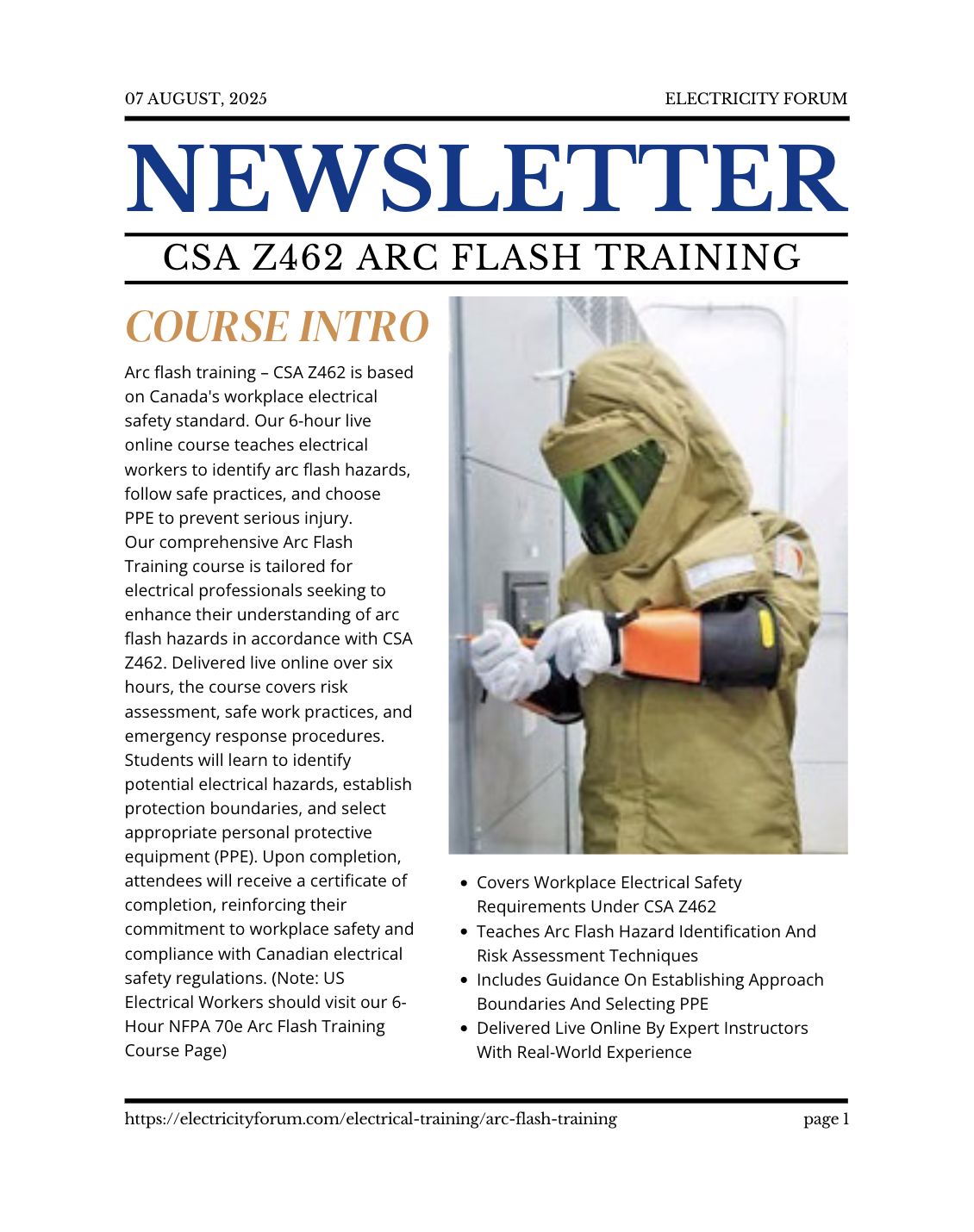
- electrical safety under NFPA 70E or CSA Z462,
- maintenance practices under NFPA 70B or CSA Z463.
US and Canadian voltages, codes and standards are covered throughout.
Learning Outcomes
Participants will be able to:
- Apply Ohm's Law and the power formula to explain how voltage, current, resistance and power behave in series, parallel, single-phase and three-phase circuits.
- Select and safely use multimeters, clamp meters, voltage testers and insulation testers, and verify the absence of voltage correctly.
- Read single-line diagrams, schematics and ladder diagrams to trace power and control circuits in a facility.
- Identify the purpose of transformers, switchgear, panelboards, motor control centers, overcurrent devices, conductors and grounding systems.
- Explain how motors, starters, contactors, overloads, capacitors and VFDs operate in industrial and HVAC equipment.
- Troubleshoot common faults such as open circuits, short circuits, ground faults, overloads and failed control components using a systematic, meter-based method.
- Recognize shock and arc flash hazards and apply NFPA 70E or CSA Z462 safe work practices, including lockout/tagout and PPE, within the limits of their training.