Grid Edge Sensors for Lateral Monitoring and Distribution Control
By Balaji Santhanam, Director, Hubbell Incorporated
By Balaji Santhanam, Director, Hubbell Incorporated
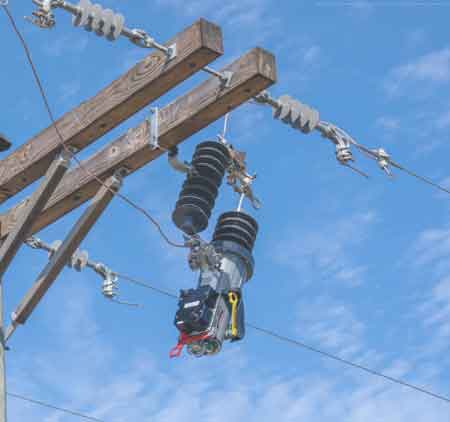

Grid edge sensors deliver lateral monitoring, oscillography, GPS time stamping, and secure cellular connectivity to support distribution automation, DER visibility, wildfire mitigation, and fleet-level control decisions at scale.
Most sustained distribution faults originate beyond the main feeder protection zone. Yet automation investment has historically concentrated at substations and feeder reclosers, leaving the majority of lateral circuits electrically blind. That imbalance now creates measurable reliability, wildfire, and safety exposure.
A single feeder may support 20 to 50 laterals. Multiply that across a service territory, and the visibility gap becomes exponential. The engineering question is no longer whether lateral sensing is technically possible. It is whether continued operational uncertainty at that scale remains acceptable.
When lateral faults are inferred rather than measured, dispatch decisions depend on customer calls, feeder lockouts, and patrol verification. Each delay increases outage duration and amplifies mechanical stress on upstream devices.
Traditional lateral protection relied on fuses or basic overcurrent devices with no communications, no oscillography, and no event sequencing. They operated as terminal devices rather than coordinated control points.
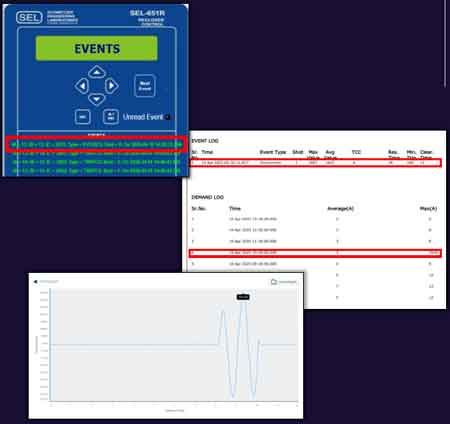
Modern grid-edge sensors offer integrated current and voltage sensing, programmable load profiling, waveform capture, and GPS-synchronized event recording with millisecond precision. This transforms laterals from passive appendages into timestamped intelligence nodes.
That intelligence layer integrates with broader Grid Edge Intelligence strategies, shifting system awareness from feeder-centric to branch-aware. Protection engineers can validate coordination logic using actual sequence-of-events data rather than assumptions.
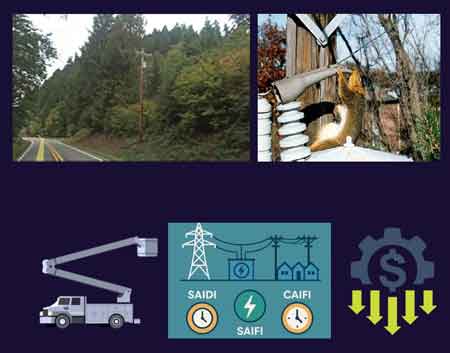
Consider vegetation contact on a single-phase lateral during high winds. Without localized sensing, upstream reclosers may attempt multiple reclosing sequences before lockout. Each operation increases mechanical wear, elevates arc flash exposure, and expands the outage footprint.

If the marginal fault current fails to clear promptly, conductor damage can escalate into ignition risk under red flag conditions. What begins as a lateral event can evolve into feeder wide disruption and regulatory exposure.
Grid edge sensors equipped with visible status indicators and fast-trip capability constrain that cascade. Fault isolation becomes localized. Upstream devices remain stable. The operational blast radius narrows.
This is not an incremental improvement. It is containment discipline.
The central constraint is deployment scale. A feeder automation program might involve a handful of devices. Lateral automation multiplies that count by an order of magnitude.
Cellular LPWAN, private LTE, and hybrid RF backhaul models have reduced total cost of ownership to levels comparable to legacy AMI systems. However, communications latency, bandwidth aggregation, and cybersecurity exposure expand proportionally with device count.
Leveraging AMI Data infrastructure can reduce redundant communications investments, but AMI networks were not designed for protection-grade telemetry. Engineers must evaluate whether latency variability remains within acceptable thresholds for event reporting and coordination validation.
This is a model uncertainty issue. Protection timing discipline cannot rely on infrastructure that was optimized for billing intervals rather than fault-clearing analytics.
Thousands of lateral devices introduce a governance challenge. Trip curves, sensitive ground-fault thresholds, DER reverse-flow logic, and wildfire mitigation profiles must be applied consistently.
Configuration drift is not hypothetical. A single improperly calibrated device during wildfire season can fail to trip under marginal fault conditions or trip as a nuisance under normal load.
Effective lateral deployment requires integration with Utility Network Device Management systems that enforce settings control, credential governance, firmware lifecycle management, and SCADA gateway oversight.
Firmware updates and audit logs are not administrative conveniences. They are operational risk controls.
High DER penetration alters lateral current profiles. Rooftop solar clusters may export power during low-load conditions, creating reverse-current signatures that resemble fault events under simplistic magnitude thresholds.
Grid edge sensors must distinguish legitimate reverse flow from abnormal waveform patterns. Coupling sensing with Electrical Fault Detection analytics allows waveform-based classification beyond simple overcurrent logic.
Yet calibration discipline is essential. Over-tuning increases nuisance operations. Under-tuning increases missed fault exposure. Seasonal load variation and inverter harmonic distortion complicate threshold selection.
This is where engineering judgment replaces algorithmic optimism.
Lateral event intelligence must feed into ADMS environments to refine fault-location estimation and sectionalization decisions.
However, high-resolution oscillography at scale can overwhelm event pipelines. Filtering logic and priority tagging are mandatory. Not every transient warrants dispatch.
When wildfire mitigation profiles are activated, sensitive trip settings may reduce ignition risk but increase temporary outage frequency. Control room leadership must consciously accept this tradeoff. Reliability metrics and public safety objectives do not always align.
That decision carries operational accountability.
When scaled effectively, grid-edge sensors directly contribute to broader Power System Reliability frameworks. Fault location accuracy improves. Patrol time decreases. Oscillography archives support root cause analysis.
But the technology alone does not deliver resilience. Data governance, protection coordination audits, communications validation, and disciplined threshold management determine the outcome.
The engineering decision is therefore organizational as much as technical. Deploying grid edge sensors expands system awareness. Managing them determines whether that awareness translates into measurable reliability and risk reduction.
Stay informed with our FREE Asset Intelligence & Predictive Maintenance Newsletter — get the latest news, breakthrough technologies, and expert insights, delivered straight to your inbox.
Advantages To Instructor-Led Training – Instructor-Led Course, Customized Training, Multiple Locations, Economical, CEU Credits, Course Discounts.
Request For QuotationWhether you would prefer Live Online or In-Person instruction, our electrical training courses can be tailored to meet your company's specific requirements and delivered to your employees in one location or at various locations.