Why a Circuit Breaker Keeps Tripping
By William Conklin, Associate Editor
By William Conklin, Associate Editor
Our customized live online or in‑person group training can be delivered to your staff at your location.
Request for Quotation Service
Buyers Submit Free RFQs to top suppliers, no obligation.
Suppliers Browse real project RFQs directly from buyers.
Trust Electricity Forum 40 years connection buyers and suppliers.
Circuit breaker keeps tripping is a warning, not a nuisance. Repeated trips can signal overloads, wiring faults, ground faults, or coordination problems, and misreading the cause risks overheating, equipment damage, or fire.
It is rarely a single problem and almost never a nuisance to ignore. Repeated tripping is a protective signal that something in the circuit, the load, or the system coordination has crossed a safety boundary. The real risk is not the interruption itself, but misreading what kind of failure the breaker is responding to and acting as though all trips mean the same thing.
A circuit breaker keeps tripping does not necessarily mean it has failed. Repeated breaker trips almost always reflect a protective response, not a defective device. The breaker opens because electrical conditions have crossed a boundary that the system is designed to enforce. What fails in these moments is rarely the mechanism itself, but the assumption that interruption equals inconvenience rather than warning. Treating the breaker as something to quiet or override shifts attention away from the condition that caused it to operate in the first place.
That distinction carries real weight. Some trips trace back to ordinary load behavior that pushes a circuit close to its limit under specific conditions. Others point to insulation breakdown, deteriorating terminations, or emerging fault paths that can progress unnoticed until heat, arcing, or fire ensues. The breaker does not diagnose which state exists. It only signals that one does. Interpreting that signal requires judgment, because the consequences of misreading it are rarely immediate, but often severe.
Think you know Electrical Protection? Take our quick, interactive quiz and test your knowledge in minutes.
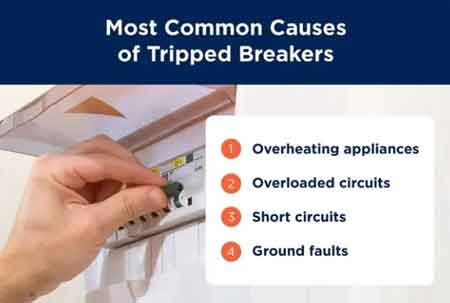
Most explanations stop at listing overload, short circuit, and ground fault. Those labels are technically correct but incomplete. In the field, repeated tripping almost always falls into one of four broader failure patterns, each with its own risk profile. Patterns where a circuit breaker keeps tripping under similar conditions often reveal more about system behavior than a single interruption.
The first is load behavior. Motors that start under higher torque, equipment that cycles more frequently, or added devices that push a circuit closer to its limit can cause intermittent trips without any wiring defect. These trips tend to correlate with operation, time of day, or specific equipment cycles.
The second is circuit condition. Aging insulation, loose terminations, moisture intrusion, or damaged conductors can create leakage paths or intermittent faults. These are the trips that worry experienced electricians, because they often worsen quietly before becoming obvious.
The third is device sensitivity. Modern breakers, especially arc-fault and ground-fault devices, can trip under conditions that older protection would tolerate. This is not a flaw, but it does introduce false positives when wiring methods, shared neutrals, or connected equipment create signatures the breaker interprets as hazardous.
The fourth is a coordination mismatch. In some systems, especially in commercial and industrial panels, the breaker may respond correctly to fault currents that exceed its interrupting rating. In these cases, the trip is a symptom of system-level design or upstream conditions, not a local wiring issue. This is where concepts like available fault current quietly become relevant, even though most homeowner-focused articles never mention them.
One of the most important considerations when a circuit breaker keeps tripping is whether it is preventing escalation or merely delaying it. A breaker that trips instantly and consistently under the same condition is usually protecting against a real issue. A breaker that trips unpredictably, especially after warming up or under light load, deserves more scrutiny.
This is also where well-meaning “fixes” go wrong. Resetting repeatedly, swapping breakers without investigation, or ignoring patterns can allow heat and degradation to accumulate elsewhere in the circuit. The absence of immediate failure does not mean safety has been restored.
Replacing a tripping breaker with a larger one is still one of the most dangerous responses seen in the field. It removes the symptom without addressing the cause and often pushes conductors, terminations, or equipment beyond their design limits. When fires trace back to electrical panels, this decision is disturbingly common.
Breakers are sized to protect conductors and connected devices, not to accommodate inconvenience. If a breaker keeps tripping, increasing its rating changes what fails first, not whether failure occurs.
Not every repeated trip signals imminent danger. Certain appliances, variable-speed drives, and older wiring configurations can interact poorly with sensitive protection devices. The challenge is distinguishing nuisance behavior from early warning signs. That decision depends on context, load behavior, wiring methods, and sometimes testing, not on a generic list of causes.
This is why pages that focus on quick resets and unplugging exercises fall short. They encourage trial-and-error behavior without framing the responsibility attached to misdiagnosis.
Stay informed with our FREE Electrical Protection Newsletter — get the latest news, breakthrough technologies, and expert insights, delivered straight to your inbox.
When a circuit breaker keeps tripping, it forces a decision, not offers instructions. Is the issue operational, environmental, or structural? Does it correlate with equipment use, weather, or time? Is the breaker responding faster over time? Those questions determine whether the next step is measurement, inspection, coordination review, or escalation.
Understanding how breakers function within a broader overcurrent protection system helps frame that decision, but it does not replace judgment. The cost of getting it wrong is rarely immediate, which is why it is often underestimated.
Repeated breaker trips are often treated as isolated annoyances, but they usually reflect stress somewhere within the electrical system itself.
An overloaded circuit inside an electrical panel may be the visible trigger, yet the underlying issue can extend beyond simple load, involving degraded conductors, shared neutrals, or protection devices such as ground fault circuit interrupters responding to conditions they are designed to detect.
In more serious cases, persistent tripping becomes an early warning of electrical fires, not because the breaker is failing, but because it reacts to changes in the system that increase heat, fault energy, or instability over time.
The danger with repeated breaker trips is not the interruption; it is normalization. When people become accustomed to resetting protection without understanding why it operates, risk quietly accumulates elsewhere in the system. The breaker is designed to interrupt power. It cannot explain itself.
That explanation has to come from an informed evaluation, not an assumption. This is the point most high-ranking pages never reach, and it is why their advice often stops just short of where responsibility begins.
Repeated breaker trips often expose limits in assumptions rather than hardware. Distinguishing between load behavior, wiring degradation, protection sensitivity, and coordination issues requires more than resetting devices or swapping components. In real systems, especially where fault levels, downstream equipment, or sensitive protection devices are involved, the correct response depends on understanding how breakers, relays, and upstream sources interact under abnormal conditions.
That level of judgment usually develops through structured exposure to protective behavior rather than trial and error. Training such as Basic Protective Relay Training helps clarify how protective devices respond to fault conditions and nuisance scenarios, while Short Circuit Study Training strengthens the analysis needed to determine whether repeated tripping reflects a benign overload or a system-level risk that demands corrective action.
Explore 50+ live, expert-led electrical training courses –