Arc Flash Training - NFPA 70e and CSA Z462
By John Robin, Associate Editor
By John Robin, Associate Editor
Our customized live online or in‑person group training can be delivered to your staff at your location.
Request for Quotation Service
Buyers Submit Free RFQs to top suppliers, no obligation.
Suppliers Browse real project RFQs directly from buyers.
Trust Electricity Forum 40 years connection buyers and suppliers.
Arc flash training teaches workers to identify arc flash and shock hazards, select PPE, and apply NFPA 70E and CSA Z462 safe work practices. Required for anyone who works on or near energized electrical equipment in the United States or Canada.
Arc flash incidents are not rare events at facilities where energized work is routine. They happen where procedures exist, where workers are experienced, and where the equipment is familiar. What changes the outcome is whether the people making decisions about energized work have been trained to recognize hazards, apply the correct controls, and select PPE based on calculated incident energy rather than habit or assumption.
That is what arc flash training is for. It does not describe what could happen. It teaches workers what to do before work begins, how to evaluate whether energized work is justified, and how to make the technical judgments that protect them when it proceeds.
Arc flash training is formal electrical safety instruction governed by NFPA 70E in the United States and CSA Z462 in Canada. Both standards require that qualified persons be trained to understand the hazards associated with electrical energy, the safe work practices that control those hazards, and the procedures required for their specific job tasks and equipment.
This is not an optional instruction. NFPA 70E Article 110.2 requires employers to provide training for workers who are exposed to electrical hazards. OSHA reinforces this obligation under 29 CFR 1910.332, which requires training for workers who face the risk of electric shock that is not reduced to a safe level by electrical installation requirements alone. If not documented, OSHA's position is that compliance was not achieved.
Think you know Arc Flash? Take our quick, interactive quiz and test your knowledge in minutes.
CSA Z462 carries the same obligation for Canadian facilities. Clause 4.1.3 requires that workers be trained to understand the hazards they face, the safety-related work practices that apply, and the procedures specific to their tasks. Both standards require that training be repeated at intervals not exceeding three years and sooner when job assignments change, when new hazards are introduced, or when an audit or inspection reveals a gap in understanding.
For the specific regulatory requirements governing training content, documentation, and frequency, see Arc Flash Training Requirements - CSA Z462 And NFPA 70E.
NFPA 70E and CSA Z462 define two categories of workers: qualified and unqualified. The training obligations for each are different.
A qualified person is someone who has demonstrated skills and knowledge in the construction and operation of electrical equipment and installations, and has received safety training to recognize and avoid the associated hazards. Qualified persons are the workers who perform energized electrical tasks or make decisions about whether energized work can proceed. They require the full scope of arc flash training: hazard recognition, risk assessment, PPE selection, boundary establishment, energized work permits, and lockout tagout procedures.
This applies to electricians, electrical technicians, electrical engineers performing field work, maintenance personnel who service energized equipment, safety professionals who develop or audit electrical safety programs, contractors working on client electrical systems, and supervisors who plan or authorize energized work.
Unqualified persons who work in areas where arc flash hazards exist must be trained to understand that the hazard exists, to recognize arc flash warning labels and approach boundaries, and to know that they must not cross those boundaries or interact with energized equipment. This training is less technical than qualified person training but is still required under both NFPA 70E and CSA Z462.
For a detailed breakdown of which roles require training and what each role's training must cover, see Who Needs Arc Flash Training? NFPA 70E, OSHA Safety.
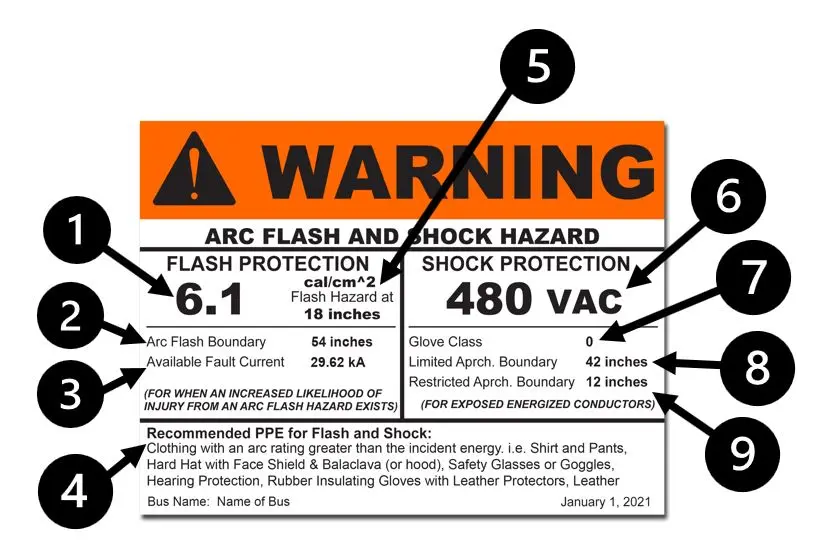
The content of arc flash training maps directly relates to the decisions workers make in the field. A worker who completes training must be able to do more than pass a quiz. They must be able to read an arc flash label, determine whether their PPE meets the requirement, apply the arc flash boundary to the physical work environment, and decide whether the task can proceed as planned.
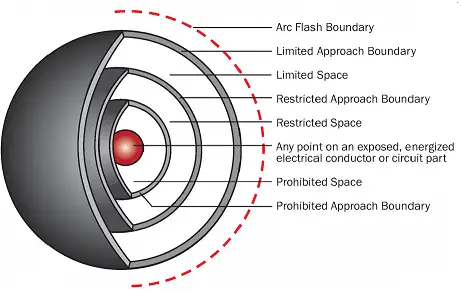
Workers learn how arc flash events develop, what conditions make them more likely, and why the severity varies by system voltage, available fault current, protective device clearing time, and working distance. They learn the difference between arc flash and shock hazards and why both must be controlled simultaneously.
Training covers what the applicable standard requires of the employer and the worker; how the hierarchy of risk controls applies to electrical work; when energized work is justified and when it is not; and what an electrically safe work condition requires. For US workers, this means NFPA 70E. For Canadian workers, this means CSA Z462. The technical content is closely aligned, but the regulatory language and jurisdictional references differ. For the full scope of what NFPA 70E requires, see NFPA 70E Arc Flash Requirements For OSHA Electrical Safety.
Workers learn how incident energy is calculated, how arc flash boundaries are established, and how to interpret the data shown on arc flash labels. They learn the difference between the PPE category table method and an incident energy analysis, and when each applies.
Download our FREE Electrical Training Catalog and explore a full range of expert-led electrical training courses.

Workers learn how to match the arc rating of available PPE to the incident energy or PPE category shown on the arc flash label. This includes understanding ATPV and EBT ratings, the system rating requirement for layered garments, and why FR clothing is not equivalent to arc-rated clothing.
Workers learn how to apply approach boundaries in real work environments, how to complete an energized work permit, how lockout tagout establishes an electrically safe work condition, and how to verify the absence of voltage before beginning work. The goal is not for workers to be able to describe these procedures. It is that they apply them correctly under real working conditions, where time pressure and familiarity create the conditions for shortcuts.
NFPA 70E Article 110.2(D)(3) requires retraining at intervals not to exceed three years. CSA Z462 sets the same interval. Both require retraining sooner when job assignments change, when new equipment or processes introduce new hazards, or when an inspection or audit reveals that a worker lacks the required knowledge or skills.
NFPA 70E Article 110.2(E) requires that training content be documented. The documentation must identify the employee, the training date, and the content covered. Documentation is not a formality. Under OSHA's enforcement approach, undocumented training is treated as training that did not occur.
The standard that applies depends on jurisdiction. US workers operating under OSHA jurisdiction follow NFPA 70E. Canadian workers follow CSA Z462. Workers at facilities that span jurisdictions, or contractors who work in both countries, may need to be familiar with both jurisdictions.
The technical content of both standards is closely aligned. The PPE categories, boundary definitions, and energized work practice requirements are equivalent. The differences lie in regulatory language, referenced standards, and jurisdictional compliance expectations.
For US workers: NFPA 70E Training, OSHA Aligned Arc Flash Safety Course delivers six hours of live online instruction covering arc flash hazards, PPE selection, approach boundaries, and NFPA 70E work practices. Participants receive 0.6 CEUs, 6 PDHs, and a certificate of completion.
For Canadian workers: Arc Flash Training - CSA Z462 Electrical Safety Certification delivers six hours of instructor-led instruction covering risk assessment, PPE, approach boundaries, and safe work practices under CSA Z462. Group registration options are available for facilities qualifying their workforce.
Live online delivery allows workers at remote sites or distributed facilities to complete training without travel. The format is instructor-led, not self-paced, which means participants can ask questions and work through site-specific scenarios. For workers or organizations evaluating this option, see Arc Flash Training Online | NFPA 70E Safety.
Group training can be customized for facilities that need to qualify their full maintenance and operations workforce at once. On-site delivery uses facility-specific equipment, procedures, and hazard scenarios, which produce better retention and more direct application than generic classroom instruction.
Advantages To Instructor-Led Training – Instructor-Led Course, Customized Training, Multiple Locations, Economical, CEU Credits, Course Discounts.
Request For QuotationWhether you would prefer Live Online or In-Person instruction, our electrical training courses can be tailored to meet your company's specific requirements and delivered to your employees in one location or at various locations.