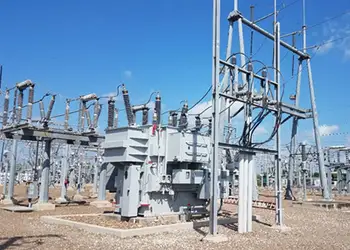
Substation Protection Training - Protect Transformers, Buses and Lines
Our customized live online or in‑person group training can be delivered to your staff at your location.
- Live Online
- 12 hours Instructor-led
- Group Training Available
Regular Price:
$799
Coupon Price:
$699
A New York utility found Sept. 11 debris in a manhole next to Ground Zero four years ago - but didn't launch a systematic search of its underground vaults, the New York Daily News has learned.
The revelation followed the recent discovery of more than 200 human remains in another manhole at the site.
It also followed the recent announcement that the city will undertake a block-by-block search of every underground utility space from Barclay to Albany streets and from Broadway to west of the World Financial Center.
On Oct. 27, 2002 - just over a year after the attacks - a Consolidated Edison crew working a block north of Ground Zero stumbled on a U.S. Secret Service bulletproof vest, mixed with debris at the bottom of a manhole.
The Secret Service had an office in 7 World Trade Center, a block away from the manhole at Barclay and Greenwich streets.
That find made it clear back in 2002 that debris from the attacks somehow managed to end up in at least one subterranean vault.
But at the time, Con Edison did not make an effort to search every manhole in the area, spokesman Mike Clendenin confirmed.
"I don't think we would have been in a position" to do a systematic search, Clendenin told The News. "Our role was to go in where they let us go in if a vault had to be replaced."
If workers had searched vault by vault, they might have discovered back in 2002 the 200-plus human remains found four years later just 300 feet away, in a manhole on the western edge of the site.
Clendenin said Con Ed crews have entered the vast majority of underground vaults around Ground Zero since Sept. 11 to repair or replace cable, but he said he could not say for sure if every one had been inspected.
Charles Maikish, head of the Lower Manhattan Command Control Center, the state agency overseeing Ground Zero reconstruction, said there had been a systematic search of manholes in the months after Sept. 11.
When pressed, however, Maikish conceded that Con Ed and Verizon somehow missed nine manholes that were "abandoned" after the attacks.
Seven of the nine were buried under a service road built after Sept. 11, and two are in the middle of busy West Street.
City officials also conceded that workers didn't excavate deeply enough before building the road - meaning WTC debris was buried when the road was paved in March 2002.
Inspectors looking for human remains have discovered pieces of the fallen towers there.
Meanwhile, officials also are eying the vacant lot where the St. Nicholas Greek Orthodox Church once stood, between Cedar and Liberty streets, in the southwestern corner of the site.
The city fears WTC debris was buried when a parking lot for construction equipment was created in the spring of 2002.
"Here, too, it is possible that the excavation for the construction of this site was not deep enough to ensure that all WTC debris was removed," the city said in its recent announcement.
Both the service road and the former church site will be excavated in the coming months.
Related News
Cheaper electricity rate for customers on First Nations not allowed, Manitoba appeal court rules
Manitoba Hydro Court Ruling affirms the Public Utilities Board exceeded its jurisdiction by ordering a…
View more

UK windfarms generate record amount of electricity during Storm Malik
UK Wind Power Record as Storm Malik boosts renewable electricity, with National Grid reporting 19,500…
View more
Power firms win UK subsidies for new Channel cables project
UK Electricity Interconnectors secure capacity market subsidies, supporting winter reliability with seabed cables to France…
View more

Abu Dhabi seeks investors to build hydrogen-export facilities
ADNOC Hydrogen Export Projects target global energy transition, courting investors and equity stakes for blue…
View more
Electricity subsidies to pulp and paper mills to continue, despite NB Power's rising debt
NB Power Pulp and Paper Subsidies lower electricity rates for six New Brunswick mills using…
View more
NB Power signs three deals to bring more Quebec electricity into the province
NB Power and Hydro-Québec Electricity Agreements expand clean hydroelectric exports, support Mactaquac dam refurbishment, add…
View more
Sign Up for Electricity Forum’s Newsletter
Stay informed with our FREE Newsletter — get the latest news, breakthrough technologies, and expert insights, delivered straight to your inbox.
Electricity Today T&D Magazine Subscribe for FREE

Stay informed with the latest T&D policies and technologies.
- Timely insights from industry experts
- Practical solutions T&D engineers
- Free access to every issue
