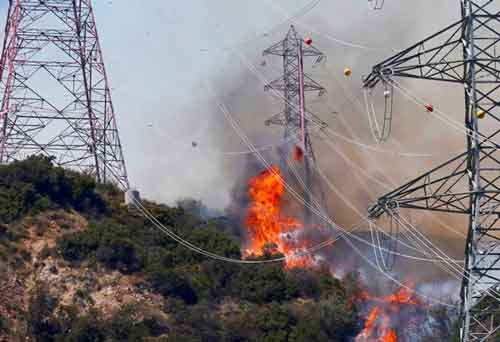
By -- Source, the Contra Costa Times


NFPA 70b Training - Electrical Maintenance

Our customized live online or in‑person group training can be delivered to your staff at your location.
  • Live Online
  • 12 hours Instructor-led
  • Group Training Available
Regular Price:
$699
Coupon Price:
$599
Reserve Your Seat Today
Pacific Gas & Electric Co. filed a $4.1 billion claim against the state on Wednesday, saying that by forcing its hydroelectric dams to remain under state regulatory authority, lawmakers broke a promise to the company that was part of California's 1996 electricity deregulation law.

The claim was filed exactly one year after Gov. Gray Davis signed into law the bill that put the state into the electricity-buying business, and a week after California Attorney General Bill Lockyer filed a lawsuit charging that PG&E broke promises it made to the state when PG&E formed a holding company.

The bill -- passed last year to adjust to a worsening electricity situation -- barred PG&E from selling its power-producing dams to corporate affiliates, or anyone else, because the state wanted to keep regulatory authority over the rates charged for electricity from those power plants.

PG&E claims that provision breached a regulatory contract in the original electricity restructuring law, which opened the state's wholesale electricity markets to competition and encouraged utilities to sell off fossil-fuel power plants.

"The state failed to hold up its end of the bargain, and it prevented us from being able to sell the power under FERC regulation," said PG&E spokesman Ron Low.

State representatives responded angrily to the latest move by the San Francisco-based company, which also is seeking through bankruptcy proceedings to move its power plants out from under state authority.

Gov. Gray Davis' spokesman, Steve Maviglio, called PG&E's newest filing "another salvo against the taxpayers of this state."

Gary Cohen, general counsel for the state Public Utilities Commission, which regulates PG&E, called the development "a frivolous act of desperation."

"Once it became clear that deregulation meant vastly higher costs of electricity to California consumers and businesses, the legislature wisely stepped in to prevent PG&E from selling off any more of its generation assets, particularly its extensive hydroelectric facilities," Cohen added. "PG&E has become a corporate scofflaw, completely indifferent to the interests of the people and businesses who it is obligated to serve."

The claim was filed just before a one-year statute of limitations was set to expire in the State Victim Compensation and Government Claims Board. The board has 45 days to act, after which PG&E would be allowed under state law to file a lawsuit against the state.

PG&E's claim is based on its estimate of the market value of its hydroelectric facilities -- $4.1 billion -- although those same dams are included in a portfolio of assets that PG&E's bankruptcy plan will shift among corporate affiliates in exchange for $1.2 billion.

Low said the different valuations reflected the difference in the nature of the transactions. "You're confusing transfers and sales," Low said. "To emerge from the bankruptcy and pay the creditors, we have to transfer the assets."

Also Thursday, PG&E got a boost from Wall Street, where Standard & Poor's, a leading bond-rating firm, said the regulated and unregulated businesses that would emerge from the breakup of PG&E's regulated utility could achieve investment grade ratings for $9.5 billion in debt that they plan to issue.

That's crucial, because PG&E's plan to emerge from bankruptcy-- which counts on the bankruptcy judge to end state regulation of the hydroelectric dams and some other assets -- includes a guarantee that creditors won't be left holding junk bonds.

Both moves, the PG&E claim and the S&P announcement, came after a rough day for PG&E in bankruptcy court, where the judge signaled some reservations about the viability of PG&E's plan to pay creditors and bring its utility unit out of bankruptcy.

But the S&P note gave a thinly veiled warning to opponents of PG&E's plan. While the bankruptcy judge indicated a willingness to consider an alternative plan from state regulators, "any material deviation from (PG&E's) proposed plan could result in a lower rating," the rating firm said.

Low, the PG&E spokesman, said the S&P note "demonstrates the viability and credibility of PG&E's plan."

Related News
Why an energy crisis and $5 gas aren't spurring a green revolution

U.S. Energy Transition Delays stem from grid bottlenecks, permitting red tape, solar tariff uncertainty, supply-chain shocks, and scarce affordable EVs, risking deeper fossil fuel lock-in despite climate targets for renewables, transmission expansion, and decarbonization.


Key Points

Delays driven by grid limits, permitting, and supply shocks that slow renewables, transmission, EVs, and decarbonization.

✅ Grid interconnection and transmission backlogs stall renewables

✅ Tariff probes and supply chains disrupt utility-scale solar

✅ Permitting, policy gaps, and EV costs sustain fossil fuel use


Big solar projects are facing major delays. Plans to adapt the grid to clean energy are confronting mountains of red tape. Affordable electric vehicles are in short supply.

The United States is struggling to squeeze opportunity out of an energy crisis that should have been a catalyst for cleaner, domestically produced power. After decades of putting the climate on the back burner, the country is finding itself unprepared to seize the moment and at risk of emerging from the crisis even more reliant on fossil fuels.

10 steps you can take to lower your carbon footprint
The problem is not entirely unique to the United States. Across the globe, climate leaders are warning that energy shortages including coal and nuclear disruptions prompted by Russia’s unprovoked invasion of Ukraine and high gas prices driven by inflation threaten to make the energy transition an afterthought — potentially thwarting efforts to keep global temperature rise under 1.5 degrees Celsius.

“The energy crisis exacerbated by the war in Ukraine has seen a perilous doubling down on fossil fuels by the major economies,” U.N. Secretary General António Guterres said at a conference in Vienna on Tuesday, according to prepared remarks. He warned governments and investors that a failure to immediately and more aggressively embrace clean energy could be disastrous for the planet.

U.S. climate envoy John F. Kerry suggested that nations are falling prey to a flawed logic that fossil fuels will help them weather this period of instability, undermining U.S. national security and climate goals, which has seen gas prices climb to a record-high national average of $5 per gallon. “You have this new revisionism suggesting that we have to be pumping oil like crazy, and we have to be moving into long-term [fossil fuel] infrastructure building,” he said at the Time100 Summit in New York this month. “We have to push back.”

Climate envoy John F. Kerry attends the Summit of the Americas in Los Angeles on June 8. Kerry has criticized the tendency to turn toward fossil fuels in times of uncertainty. (Apu Gomes/AFP/Getty Images)
In the United States — the world’s second-largest emitter of greenhouse gases after China — the hurdles go beyond the supply-chain crisis and sanctions linked to the war in Ukraine. The country’s lofty goals for all carbon pollution to be gone from the electricity sector by 2035 and for half the cars sold to be electric by 2030 are jeopardized by years of neglect of the electrical grid, regulatory hurdles that have set projects back years, and failures by Congress and policymakers to plan ahead.
The challenges are further compounded by plans to build costly new infrastructure for drilling and exporting natural gas that will make it even harder to transition away from the fossil fuel.

“We are running into structural challenges preventing consumers and businesses from going cleaner, even at this time of high oil and gas prices,” said Paul Bledsoe, a climate adviser in the Clinton administration who now works on strategy at the Progressive Policy Institute, a center-left think tank. “It is a little alarming that even now, Congress is barely talking about clean energy.”

Consumers are eager for more wind and solar. Companies looking to go carbon-neutral are facing growing waitlists for access to green energy, and a Pew Research Center poll in late January found that two-thirds of Americans want the United States to prioritize alternative energy over fossil fuel production.

But lawmakers have balked for more than a decade at making most of the fundamental economic and policy changes such as a clean electricity standard that experts widely agree are crucial to an orderly and accelerated energy transition. The United States does not have a tax on carbon, nor a national cap-and-trade program that would reorient markets toward lowering emissions. The unraveling in Congress of President Biden’s $1.75 trillion Build Back Better plan has added to the head winds that green-energy developers face, even as climate law results remain mixed.

Vice President Harris tours electric school buses at Meridian High School in Falls Church, Va., on May 20. (Mandel Ngan/AFP/Getty Images)
“There is literally nothing pushing this forward in the U.S. beyond the tax code and some state laws,” said Heather Zichal, a former White House climate adviser who is now the chief executive of the American Clean Power Association.

The effects of the U.S. government’s halting approach are being felt by solar-panel installers, who saw the number of projects in the most recent quarter fall to the lowest level since the pandemic began. There was 24 percent less solar installed in the first quarter of 2022 than in the same quarter of 2021.

The holdup largely stems from a Commerce Department investigation into alleged tariff-dodging by Chinese manufacturers. Faced with the potential for steep retroactive penalties, hundreds of industrial-scale solar projects were frozen in early April. Weak federal policies to encourage investment in solar manufacturing left American companies ill-equipped to fill the void.

“We shut down multiple projects and had to lay off dozens of people,” said George Hershman, chief executive of SOLV Energy, which specializes in large solar installations. SOLV, like dozens of other solar companies, is now scrambling to reassemble those projects after the administration announced a pause of the tariffs.

Meanwhile, adding clean electricity to the aging power grid has become an increasingly complicated undertaking, given the failure to plan for adequate transmission lines and long delays connecting viable wind and solar projects to the electricity network.


Related News

View more

PG&E says power lines may have started 2 California fires

PG&E Wildfire Blackouts highlight California power shutoffs as high winds and suspected transmission line faults trigger evacuations, CPUC investigations, and grid safety reviews, with utilities weighing risk, compliance, and resilience during Santa Ana conditions.


Key Points

PG&E Wildfire Blackouts are outages during wind-driven fire threats linked to power lines, spurring CPUC investigations.

✅ Wind and line faults suspected amid Lafayette evacuations

✅ CPUC to probe shutoffs, notifications, and compliance

✅ Utilities plan more outages as Santa Ana winds return


Pacific Gas & Electric Co. power lines may have started two wildfires over the weekend in the San Francisco Bay Area, the utility said Monday, even though widespread blackouts were in place to prevent downed lines from starting fires during dangerously windy weather.

The fires described in PG&E reports to state regulators match blazes that destroyed a tennis club and forced evacuations in Lafayette, about 20 miles (32 kilometres) east of San Francisco.

The fires began in a section of town where PG&E had opted to keep the lights on. The sites were not designated as a high fire risk, the company said.

Powerful winds were driving multiple fires across California and forcing power shut-offs intended to prevent blazes, even as electricity prices are soaring across the state as well.

More than 900,000 power customers -- an estimated 2.5 million people -- were in the dark at the height of the latest planned blackout, nearly all of them in PG&E's territory in Northern and central California. By Monday evening a little less than half of those had their service back. But some 1.5 million people in 29 counties will be hit with more shut-offs starting Tuesday because another round of strong winds is expected, a reminder of grid stress during heat waves that test capacity, the utility said.

Southern California Edison had cut off power to 25,000 customers and warned that it was considering disconnecting about 350,000 more as power supply lapses and Santa Ana winds return midweek.

PG&E is under severe financial pressure after its equipment was blamed for a series of destructive wildfires and its 2018 Camp Fire guilty plea compounded liabilities during the past three years. Its stock dropped 24% Monday to close at $3.80 and was down more than 50% since Thursday.

The company reported last week that a transmission tower may have caused a Sonoma County fire that has forced 156,000 people to evacuate.

PG&E told the California Public Utilities Commission that a worker responded to a fire in Lafayette late Sunday afternoon and was told firefighters believed contact between a power line and a communication line may have caused it.

A worker went to another fire about an hour later and saw a fallen pole and transformer. Contra Costa Fire Department personnel on site told the worker they were looking at the transformer as a potential ignition source, a company official wrote.

Separately, the company told regulators that it had failed to notify 23,000 customers, including 500 with medical conditions, before shutting off their power earlier this month during windy weather.

Before a planned blackout, power companies are required to notify customers and take extra care to get in touch with those with medical problems who may not be able to handle extended periods without air conditioning or may need power to run medical devices.

PG&E said some customers had no contact information on file. Others were incorrectly thought to be getting electricity.

After that outage, workers discovered 43 cases of wind-related damage to power lines, transformers and other equipment.

Jennifer Robison, a PG&E spokeswoman, said the company is working with independent living centres to determine how best to serve people with disabilities.

The company faced a growing backlash from regulators and lawmakers, and a judge's order on wildfire risk spending added pressure as well.

U.S. Rep. Josh Harder, a Democrat from Modesto, said he plans to introduce legislation that would raise PG&E's taxes if it pays bonuses to executives while engaging in blackouts.

The Public Utilities Commission plans to open a formal investigation into the blackouts and the broader climate policy debate surrounding reliability within the next month, allowing regulators to gather evidence and question utility officials. If rules are found to be broken, they can impose fines up to $100,000 per violation per day, said Terrie Prosper, a spokeswoman for the commission.

The commission said Monday it also plans to review the rules governing blackouts, will look to prevent utilities from charging customers when the power is off and will convene experts to find grid improvements that might lessen blackouts during next year's fire season, as debates over rate stability in 2025 continue across PG&E's service area.

The state can't continue experiencing such widespread blackouts, "nor should Californians be subject to the poor execution that PG&E in particular has exhibited," Marybel Batjer, president of the California Public Utilities Commission, said in a statement.


Related News

View more

Wall Street Backs Rick Perry’s $19 Billion Data Center Venture

Wall Street backs Rick Perry’s $19 billion nuclear-powered data center venture, Fermi America, combining nuclear energy, AI infrastructure, and data centers to meet soaring electricity demand and attract major investors betting on America’s clean energy technology future.


What is "Wall Street Backs Rick Perry’s $19 Billion Nuclear-Powered Data Center Venture”?

Wall Street is backing Rick Perry’s $19 billion nuclear-powered data center venture because it combines the explosive growth of AI with the promise of clean, reliable nuclear energy.

✅ Addresses AI’s massive power demands with nuclear generation

✅ Positions Fermi America as a pioneer in energy-tech convergence

✅ Reflects investor confidence in long-term clean energy solutions

Former Texas Governor and U.S. Energy Secretary Rick Perry has returned to the energy spotlight, this time leading a bold experiment at the intersection of nuclear power and artificial intelligence. His startup, Fermi America, headquartered in Amarillo, Texas, went public this week with an initial valuation of $19 billion after its shares surged 55 percent above the opening price on the first day of trading.

The company aims to tackle one of the most pressing challenges in modern technology: the staggering energy demand of AI data centers. “Artificial intelligence, which is getting more and more embedded in all parts of our lives, the servers that host the data for artificial intelligence are stored in these massive warehouses called data centers,” said Houston Chronicle energy reporter Claire Hao. “And data centers use a ton of electricity.”

Fermi America’s plan, Hao explained, is as ambitious as it is unconventional. Fermi America has a proposal to build what it claims will be the world’s largest data center, powered by what it asserts will be the country’s largest nuclear complex. So very ambitious plans.”

According to the company’s roadmap, Fermi aims to bring its first mega reactor online by 2032, followed by three additional large reactors. In the meantime, the firm intends to integrate natural gas and solar energy by the end of next year to support early-stage operations.

While much of the energy sector’s attention has turned toward small modular reactors, Fermi’s approach focuses on traditional large-scale nuclear technology. “What Fermi is talking about building are large traditional reactors,” Hao said. “These very large traditional reactors are a tried and true technology. But the nuclear industry has a history of taking a very long time to build them, and they are also very expensive to build.” She noted that the most recent example, completed in 2023 by a Georgia utility, came in $17 billion over budget and several years late.

To mitigate such risks, Fermi has recruited specialists with international experience. “They’ve hired folks that have successfully built these projects in China and in other countries where it has been a lot smoother to build these,” Hao said. “Fermi wants to try to make it a quicker process.”

Perry’s involvement lends both visibility and controversy. In addition to co-founding the company, Griffin Perry, his son, plays a role in its management. The firm has hinted that it might even name reactors after former President Donald Trump, under whom Perry served as Secretary of Energy. Perry has framed the project as part of a national effort to regain technological ground. “He really wants to help the U.S. catch up to countries like China when it comes to delivering nuclear power for the AI race,” Hao explained. “He says we’re already behind.”

Despite the fanfare, Fermi America is still a fledgling enterprise. Founded in January and announced publicly in June, the company reported a $6.4 million loss in the first half of the year and has yet to generate any revenue. Still, its IPO exceeded expectations, opening at $21 a share and closing above $32 on the first day.

“I think that just shows there’s a lot of hype on Wall Street around artificial intelligence-related ventures,” Hao said. “Fermi, in the four months since it announced itself as a company, has found a lot of different ways to grab people’s attention.”

For now, the project represents both a technological gamble and a test of investor faith — a fusion of nuclear ambition and AI optimism that has Wall Street watching closely.


Related Articles


View more

What Will Drive Utility Revenue When Electricity Is Free?

AI-Powered Utility Customer Experience enables transparency, real-time pricing, smart thermostats, demand response, and billing optimization, helping utilities integrate distributed energy resources, battery storage, and microgrids while boosting customer satisfaction and reducing costs.


Key Points

An approach where utilities use AI and real-time data to personalize service, optimize billing, and cut energy costs.

✅ Real-time pricing aligns retail and wholesale market signals

✅ Device control via smart thermostats and home energy management

✅ Analytics reveal appliance-level usage and personalized savings


The latest electric utility customer satisfaction survey results from the American Customer Satisfaction Index (ACSI) Energy Utilities report reveal that nearly every investor-owned utility saw customer satisfaction go down from 2018 to 2019. Residential customers are sending a clear message in the report: They want more transparency and control over energy usage, billing and ways to reduce costs.

With both customer satisfaction and utility revenues on the decline, utilities are facing daunting challenges to their traditional business models amid flat electricity demand across many markets today. That said, it is the utilities that see these changing times as an opportunity to evolve that will become the energy leaders of tomorrow, where the customer relationship is no longer defined by sales volume but instead by a utility company's ability to optimize service and deliver meaningful customer solutions.

We have seen how the proliferation of centralized and distributed renewables on the grid has already dramatically changed the cost profile of traditional generation and variability of wholesale energy prices. This signals the real cost drivers in the future will come from optimizing energy service with things like batteries, microgrids and peer-to-peer trading networks. In the foreseeable future, flat electricity rates may be the norm, or electricity might even become entirely free as services become the primary source of utility revenue.

The key to this future is technological innovation that allows utilities to better understand a customer’s unique needs and priorities and then deliver personalized, well-timed solutions that make customers feel valued and appreciated as their utility helps them save and alleviates their greatest pain points.

I predict utilities that adopt new technologies focused on customer experience, aligned with key utility trends shaping the sector, and deliver continual service improvements and optimization will earn the most satisfied, most loyal customers.

To illustrate this, look at how fixed pricing today is applied for most residential customers. Unless you live in one of the states with deregulated utilities where most customers are free to choose a service provider in a competitive marketplace, as consumers in power markets increasingly reshape offerings, fixed-rate tariffs or time-of-use tariffs might be the only rate structures you have ever known, though new utility rate designs are being tested nationwide today. These tariffs are often market distortions, bearing little relation to the real-time price that the utility pays on the wholesale market.

It can be easy enough to compare the rate you pay as a consumer and the market rate that utilities pay. The California ISO has a public dashboard -- as do other grid operators -- that shows the real-time marginal cost of energy. On a recent Friday, for example, a buyer in San Francisco could go to the real-time market and procure electricity at a rate of around 9.5 cents per kilowatt-hour (kWh), yet a residential customer can pay the utility PG&E between 22 cents and 49 cents per kWh amid major changes to electric bills being debated, depending on usage.

The problem is that utility customers do not usually see this data or know how to interpret it in a way that helps add value to their service or drive down the cost.

This is a scenario ripe for innovation. Artificial intelligence (AI) technologies are beginning to be applied to give customers the transparency and control over the energy they desire, and a new type of utility is emerging using real-time pricing signals from wholesale markets to give households hassle-free energy savings. Evolve Energy in Texas is developing a utility service model, even as Texas utilities revisit smart home network strategies, that delivers electricity to consumers at real-time market prices and connects to smart thermostats and other connected devices in the home for simple monitoring and control -- all managed via an intuitive consumer app.

My company, Bidgely, partners with utilities and energy retailers all over the world to apply artificial intelligence and machine learning algorithms to customer data in order to bring transparency to their electricity bills, showing exactly where the customers’ money is going down to the appliance and offering personalized, actionable advice on how to save.

Another example is from energy management company Keewi. Its wireless outlet adaptors are revealing real-time energy usage information to Texas A&M dorm residents as well as providing students the ability to conserve energy through controlling items in their rooms from their smartphones.

These are but a few examples of innovations among many in play that answer the consumer demand for increased transparency and control over energy usage.

Electric service providers will be closely watching how consumers respond to AI-driven innovation, including providers in traditionally regulated markets that are exploring equitable regulation approaches now, to stay aligned with policy and customer expectations. While regulated utilities have no reason to fear that their customers might sign up with a competitor, they understand that the revenues from electricity sales are going down and the deployment of distributed energy resources is going up. Both trends were reflected in a March report from Bloomberg New Energy Finance (via ThinkProgress) that claimed unsubsidized storage projects co-located with solar or wind are starting to compete with coal and gas for dispatchable power. Change is coming to regulated markets, and some of that change can be attributed to customer dissatisfaction with utility service.

Like so many industries before, the utility-customer relationship is on track to become less about measuring unit sales and more about driving revenue through services and delivering the best customer value. Loyal customers are most likely to listen and follow through on the utility’s advice and to trust the utility for a wide range of energy-related products and services. Utilities that make customer experience the highest priority today will emerge tomorrow as the leaders of a new energy service era.


Related News

View more

Philippines wants Canada's help to avoid China, U.S

Philippines-Canada Indo-Pacific Partnership strengthens ASEAN cooperation, maritime security, and South China Sea diplomacy, balancing U.S.-China rivalry through a rules-based order, trade diversification, and middle-power engagement to foster regional stability and sustainable growth.


Key Points

A strategic pact to balance U.S.-China rivalry, back ASEAN, and advance maritime security and a rules-based order

✅ Prioritizes ASEAN-led cooperation and regional diplomacy

✅ Supports maritime security and South China Sea stability

✅ Diversifies trade, infrastructure, energy, and education ties


The Philippines finds itself caught in a geopolitical tug-of-war between the United States and China, two superpowers with competing interests in the Indo-Pacific region. To navigate this complex situation, the Philippines is seeking closer ties with Canada, a middle power with a strong focus on diplomacy and regional cooperation and a deepening U.S.-Canada energy and minerals partnership that reinforces shared strategic interests.

The Philippines, like many Southeast Asian nations, desires peace and stability for continued economic growth. However, the intensifying rivalry between the U.S. and China threatens to disrupt this. Territorial disputes in the South China Sea, where China claims vast swathes of waters contested by the Philippines, are a major point of contention. The Philippines has a long-standing alliance with the U.S., whose current administration is viewed as better for Canada's energy sector by some observers, but it also has growing economic ties with China. This delicate balancing act is becoming increasingly difficult.

This is where Canada enters the picture. The Philippines sees Canada as a potential bridge between the two superpowers. Foreign Affairs Secretary Enrique Manalo emphasizes that the future of the Indo-Pacific shouldn't be dictated by "great power rivalry." Canada, with its emphasis on peaceful solutions and its strong relationships with both the U.S. and China, despite electricity exports at risk from periodic trade tensions, presents a welcome alternative.

There are several reasons why the Philippines views Canada as a natural partner. First, Canada's Indo-Pacific strategy prioritizes the Association of Southeast Asian Nations (ASEAN), a regional bloc that includes the Philippines, and reflects trade policy debates in Ottawa where Canadians support tariffs on energy and minerals. This focus on regional cooperation aligns with the Philippines' desire for a united ASEAN voice.

Second, Canada offers the Philippines opportunities for economic diversification. While China is a significant trading partner, the Philippines wants to lessen its dependence on any single power. Canada's expertise in areas like agriculture, infrastructure, education, and renewable energy aligns with the Philippines' clean energy commitment and development goals.

Third, Canada's experience in peacekeeping and maritime security can be valuable to the Philippines. The Philippines faces challenges in the South China Sea, and Canada's commitment to a rules-based international order resonates with the Philippines' desire for peaceful resolution of territorial disputes.

Canada, for its part, sees the Philippines as a strategically important partner in the Indo-Pacific. A stronger Philippines contributes to a more stable region, which aligns with Canada's own interests. Additionally, closer ties with the Philippines open doors for increased Canadian trade and investment in Southeast Asia, including in critical minerals supply chains and energy projects.

The Philippines' pursuit of a middle ground between the U.S. and China is not without its challenges. Balancing strong relationships with both powers requires careful diplomacy, even as tariff threats boost support for Canadian energy projects domestically. However, Canada's emergence as a potential partner offers the Philippines a much-needed counterweight and a path towards regional stability and economic prosperity.

By working together, Canada and the Philippines can promote peaceful solutions, strengthen regional cooperation, and ensure that the Indo-Pacific remains a place of opportunity for all nations, not just superpowers.


Related News

View more

Japanese utilities buy into vast offshore wind farm in UK

Japan Offshore Wind Investment signals Japanese utilities entering UK offshore wind, as J-Power and Kansai Electric buy into Innogy's Triton Knoll, leveraging North Sea expertise, 9.5MW turbines, and 15-year fixed-rate contracts.


Key Points

Japanese utilities buying UK offshore wind stakes to import expertise, as J-Power and Kansai join Innogy's Triton Knoll.

✅ $900M deal: J-Power 25%, Kansai Electric ~16% in Innogy unit

✅ Triton Knoll: 860MW, up to 90 9.5MW turbines, 15-year fixed PPA

✅ Goal: Transfer North Sea expertise to develop Japan offshore wind


Two of Japan's biggest power companies will buy around 40% of a German-owned developer of offshore wind farms in the U.K., seeking to learn from Britain's lead in this sector, as highlighted by a UK offshore wind milestone this week, and bring the know-how back home.

Tokyo-based Electric Power Development, better known as J-Power, will join Osaka regional utility Kansai Electric Power in investing in a unit of Germany's Innogy.

The deal, estimated to be worth around $900 million, will give J-Power a 25% stake and Kansai Electric a roughly 16% share. It will mark the first investment in an offshore wind project by Japanese power companies, as other markets shift strategies, with Poland backing wind over nuclear signaling broader momentum.

Innogy plans to start up the 860-megawatt Triton Knoll offshore wind project -- one of the biggest of its kind in the world -- in the North Sea in 2021. The vast installation will have up to 90 9.5MW turbines and sell its output to local utilities under a 15-year fixed-rate contract.

J-Power, which supplies mainly fossil-fuel-based electricity to Japanese regional utilities, will set up a subsidiary backed by the government-run Development Bank of Japan to participate in the Innogy project. Engineers will study firsthand construction and maintenance methods.

While land-based wind turbines are proliferating worldwide, offshore wind farms have progressed mainly in Europe, though U.S. offshore wind competitiveness is improving in key markets. Installed capacity totaled more than 18,000MW at the end of 2017, which at maximum capacity can produce as much power as 18 nuclear reactors.

Japan has hardly any offshore wind farms in commercial operation, and has little in the way of engineering know-how in this field or infrastructure for linking such installations to the land power grid, with a recent Japan grid blackout analysis underscoring these challenges. But there are plans for a total of 4,000MW of offshore wind power capacity, including projects under feasibility studies.

J-Power set up a renewable energy division in June to look for opportunities to expand into wind and geothermal energy in Japan, and efforts like a Japan hydrogen energy system are emerging to support decarbonization. Kansai Electric also seeks know-how for increasing its reliance on renewable energy, even as it hurries to restart idled nuclear reactors.

They are not the only Japanese investors is in this field. In Asia, trading house Marubeni will invest in a Taiwanese venture with plans for a 600MW offshore wind farm.


Related News

View more

Sign Up for Electricity Forum’s Newsletter

Stay informed with our FREE Newsletter — get the latest news, breakthrough technologies, and expert insights, delivered straight to your inbox.

Electricity Today T&D Magazine Subscribe for FREE

Stay informed with the latest T&D policies and technologies.
  • Timely insights from industry experts
  • Practical solutions T&D engineers
  • Free access to every issue

Live Online & In-person Group Training

Advantages To Instructor-Led Training – Instructor-Led Course, Customized Training, Multiple Locations, Economical, CEU Credits, Course Discounts.

Request For Quotation

Whether you would prefer Live Online or In-Person instruction, our electrical training courses can be tailored to meet your company's specific requirements and delivered to your employees in one location or at various locations.