Substation Protection Training - Protect Transformers, Buses and Lines
Our customized live online or in‑person group training can be delivered to your staff at your location.
- Live Online
- 12 hours Instructor-led
- Group Training Available
Regular Price:
$799
Coupon Price:
$699
Under the state's stringent goal to reduce carbon emissions, cities including Burbank and Glendale are trying to decide how to handle their stakes in a Utah coal power plant that provides up to half of their energy needs.
Walking away could mean selling short a $3.2 billion investment that could pay back millions in low-cost power in 15 years, at the cost of roughly 15 million tons in carbon-dioxide emissions per year.
At a coordinating committee in November, the plant's California clients agreed to set aside funds to study how CO2 reduction technology can be applied at the Intermountain Power Plant in Delta, Utah.
Ned Bassin of Glendale Water and Power said the utility receives 20 percent of its electricity from the plant.
"Until we turn it down, I think we have significant influence and a stake in IPP," Bassin said. "... IPP is one of the cleaner coal fire power plants."
The 1,800-megawatt plant operated by 23 Utah cities under the Intermountain Power Agency was built with $3.2 billion in loans shouldered by six California cities.
In exchange, Los Angeles, Burbank, Glendale, Anaheim, Pasadena and Riverside receive some 75 percent of its electricity until 2027.
But legislation signed by Gov. Arnold Schwarzenegger in September to put a 25 percent dent in greenhouse-gas emissions by 2020 - including from out-of-state power suppliers - has complicated the deal.
It came to a head in recent months when IPA asked its California clients to renew by Jan. 1 their contracts to 2044. The cities, under pressure from the Sierra Club and other environmental groups, turned down the offer.
Burbank was the exception, and the episode was an embarrassment for the City Council and Mayor Todd Campbell, a committed environmentalist.
At a meeting today, the council will put the contract on hold after the power agency agreed to extend the signing deadline until 2023 - the loans will be paid off in about 2020.
Campbell, a former policy analyst with the Natural Resources Defense Council, said the city had signed the contract to retain transmission rights that could apply toward "green" energy projects - including redeveloping the coal plant into something that's "environmentally responsible."
"We do not want to remain on coal," he said. "We want to retain the assets the city of Burbank purchased. If we don't have a contract, we lose our rights to resources down the line. To do that would be a mistake."
It's a model in use by Glendale, which uses the same transmission lines to carry power purchased from a Wyoming wind farm, Bassin said.
Reed Searle, Intermountain's general manager, said the plant's Utah owners will try to work with its West Coast partners to cut CO2 emissions.
"It's not easy for us if you can't renew your contracts," he said.
Related News

Energize America: Invest in a smarter electricity infrastructure
Smart Grid Modernization unites distributed energy resources, energy storage, EV charging, advanced metering, and bidirectional…
View more
Battery-electric buses hit the roads in Metro Vancouver
TransLink Electric Bus Pilot launches zero-emission service in Metro Vancouver, cutting greenhouse gas emissions with…
View more

Turning thermal energy into electricity
Near-Field Thermophotovoltaics captures radiated energy across a nanoscale gap, using thin-film photovoltaic cells and indium…
View more
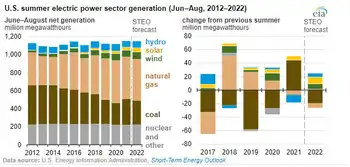
EIA expects solar and wind to be larger sources of U.S. electricity generation this summer
US Summer Electricity Outlook 2022 projects rising renewable energy generation as utility-scale solar and wind…
View more

Huge offshore wind turbine that can power 18,000 homes
Siemens Gamesa SG 14-222 DD advances offshore wind with a 14 MW direct-drive turbine, 108…
View more

Investor: Hydro One has too many unknowns to be a good investment
Hydro One investment risk reflects Ontario government influence, board shakeup, Avista acquisition uncertainty, regulatory hearings,…
View more
Sign Up for Electricity Forum’s Newsletter
Stay informed with our FREE Newsletter — get the latest news, breakthrough technologies, and expert insights, delivered straight to your inbox.
Electricity Today T&D Magazine Subscribe for FREE

Stay informed with the latest T&D policies and technologies.
- Timely insights from industry experts
- Practical solutions T&D engineers
- Free access to every issue
