Protective Relay Training - Basic
Our customized live online or in‑person group training can be delivered to your staff at your location.
- Live Online
- 12 hours Instructor-led
- Group Training Available
Regular Price:
$699
Coupon Price:
$599
China's government has announced generous support for its photovoltaic companies, which are aiming to become market leaders and be the first to supply solar power at just 10 cents US per kilowatt-hour (kWh).
Subsidies are coming at just the right time for the country's flagging solar companies as well as for companies in countries like Germany and Canada, looking for new export opportunities.
Because exports account for about 98 per cent of Chinese photovoltaic (PV) companies' revenue, they have been especially hard hit by the drop in demand due to the current global financial turmoil, forcing the government to take steps to "rebalance" the industry as reported by Lou Schwartz on April 13.
According to a report in the English edition of Digitimes (published in Taiwan) on December 8, 2008, there were 350 Chinese PV companies doing business in mid-2008, but at least 200 of those companies had stopped production or folded altogether by the end of the year.
By introducing subsidies and a raft of other incentives to develop a domestic solar market, China's government is now giving its homegrown industry a much-needed shot in the arm.
Subsidies for solar modules on buildings of at least 50 kW were announced in March. These could be as high as 20 Renminbi Yuan (RMB; around US $3) per watt capacity according to the Ministry of Finance and the Ministry of Housing and Urban-Rural Development. That is enough to cover the entire production costs of solar modules in China, leaving only the installation costs to be met.
Solar modules will, however, have to measure up when it comes to efficiency standards: monocrystalline solar cells will need to have an efficiency of at least 16 per cent; polycrystalline solar cells an efficiency of 14 percent; and thin film of 6 per cent.
Solar energy to power hospitals and schools and government buildings will get special incentives under the government scheme.
Furthermore, rural households in remote regions will be helped to harness energy from the sun. A total of 80,000 solar panel "micro systems" are to be installed in remote villages in the southwest province of Sichuan, and many people will have a supply of electricity to light up their homes, cook their meals and power electric devices for the first time. Canadian Solar won the contract in April 2009. A total of 1.6 MW is to be installed.
The Chinese government has been slow to introduce solar energy subsidies, but has entered the fray after a fall in the price of polycrystalline silicon. Though the subsidies for 2009 are modest in scale at just US $60 million and there is an initial cap of 20 MW, the amount will be reviewed every year and experts say that it may be substantially increased.
However, China's solar energy industry has signaled the subsidies are just a stepping stone to reaching its strategic goal of producing lost cost, reliable solar energy that can compete with conventional sources. According to a report in China.org.cn, leading Chinese companies aim to reduce the cost of producing solar energy to 1 RMB or about 15 cents US per kWh by 2012.
However, two companies, Yingli Green Energy and SDIC Huajing Power, have submitted a bid to build a 10-MW solar power plant to provide electricity to the national grid at a price of RMB 0.69 per kWh or 10 cents US per kWh. At that price, solar energy will be just about as cheap as coal when it comes to producing electricity in China.
To achieve their ambitious solar goals, Chinese companies are partnering with German ones. In April, Germany's Q Cells and China's solar wafer manufacturer Solar LDK announced a joint venture partnership to develop large-scale solar power plants in Europe and China. The first projects, including a 40-MW power plant, are already in the pipeline.
The scale of the funds that the Chinese government is investing in clean energy and in upgrading its national electricity grid for renewable energy has taken the world by surprise. According to a report by the Center for American Progress, China's green stimulus spending is six times higher than the equivalent amount that the U.S. government is investing as a percentage of their respective economies.
However, China has a lot of catching up to do.
About 50 MW of installed solar capacity was added in 2008, more than double the 20 MW in 2007, but still a relatively small amount. According to some studies, the demand in China for new solar modules could be as high as 232 MW each year from now on until 2012. The government has announced plans to expand the installed capacity to 1,800 MW by 2020.
By way of comparison, 3,800 MW of solar capacity are estimated to have been installed in Germany in 2007.
If Chinese companies manage to develop low cost, reliable solar modules, then the sky is the limit for a country that is desperate to reduce its dependence on coal and oil imports as well as the pressure on its environment by using clean, renewable energy.
Related News
Renewables surpass coal in US energy generation for first time in 130 years
Renewables Overtake Coal in the US, as solar, wind, and hydro expand grid share; EIA…
View more
It's CHEAP but not necessarily easy: Crosbie introduces PCs' Newfoundland electricity rate reduction strategy
Crosbie Hydro Energy Action Plan outlines rate mitigation for Muskrat Falls, leveraging Nalcor oil revenues,…
View more
How Ukraine Will Keep the Lights On This Winter
Ukraine Winter Energy Strategy strengthens the power grid through infrastructure repairs, electricity imports, renewable integration,…
View more
$1.6 Billion Battery Plant Charges Niagara Region for Electric Vehicle Future
Ontario EV Battery Separator Plant anchors Canada's EV supply chain, with Asahi Kasei producing lithium-ion…
View more
Alberta Electricity market needs competition
Alberta Electricity Market faces energy-only vs capacity debate as transmission, distribution, and administration fees surge;…
View more
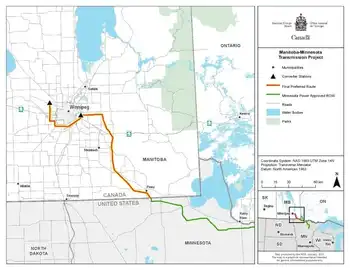
$453M Manitoba Hydro line to Minnesota could face delay after energy board recommendation
Manitoba-Minnesota Transmission Project faces NEB certificate review, with public hearings, Indigenous consultation, and cross-border approval…
View more
Sign Up for Electricity Forum’s Newsletter
Stay informed with our FREE Newsletter — get the latest news, breakthrough technologies, and expert insights, delivered straight to your inbox.
Electricity Today T&D Magazine Subscribe for FREE

Stay informed with the latest T&D policies and technologies.
- Timely insights from industry experts
- Practical solutions T&D engineers
- Free access to every issue

