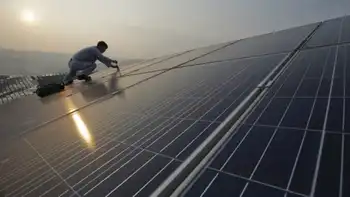
Energy Panel Hears Conflicting Interests

By Associated Press


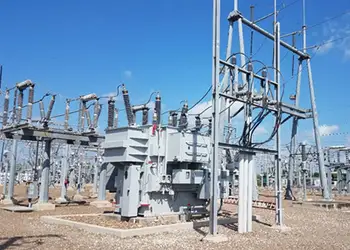
NFPA 70b Training - Electrical Maintenance

Our customized live online or in‑person group training can be delivered to your staff at your location.
  • Live Online
  • 12 hours Instructor-led
  • Group Training Available
Regular Price:
$699
Coupon Price:
$599
Reserve Your Seat Today
A Bush administration panel on how to speed energy development in the Rockies heard recently from companies frustrated by what they consider bureaucratic delays and individuals fearful that oil and gas drilling will scar their land.

The Rocky Mountain Energy Council, made up of state and federal land managers, is studying how to increase energy production and avoid lawsuits blocking development in Colorado, Wyoming, Montana, Utah and New Mexico. It is an offshoot of the White House Task Force on Energy Project Streamlining.

Industry representatives told the council's first public meeting that its work is long overdue because energy demands keep rising.

Landowners said they fear the council is only interested in boosting production, with no concern for the environment or for ranchers whose land could end up dotted with wells.

"I'm more than concerned. I'm jittery," said Josh Joshwick, a commissioner in southwest Colorado's La Plata County, a hotbed of natural gas production since the 1980s.

"This council is not an end run around environmental regulations," said Robbie Roberts, head of the Environmental Protection Agency office in Denver and interim council chairman.

The council is simply trying to avoid the duplication of effort and find ways to make it easier for companies to do business, Roberts said. He said the council is also looking at ways to increase development of renewable energy, such as wind and solar power.

The Bush administration and energy companies are homing in on the region because it holds vast oil, gas and coal deposits.

A recent report by the Center of the American West at the University of Colorado said the region contains about 31 percent of the country's coal reserves, 41 percent of known and estimated natural gas reserves and 30 percent of the oil reserves in the Lower 48 states.

The government's role is key because so much of the land is public. Most of the 261 million acres overseen by the Bureau of Land Management is in 12 Western states. The Bush administration has directed the BLM to remove obstacles to development on its land.

The federal government retained many of the mineral rights when it granted homesteads in the West. Companies that buy or lease the rights are usually required to negotiate with landowners, but can drill over their objections.

Donna House, a Navajo from northern New Mexico, said while energy development has taken place for decades on reservations, tribal governments weren't invited to join the council. She contended the government also is ignoring federal laws designed to preserve Indian culture and sacred sites.

Robert Middleton, director of the White House task force, said he is working with Sen. Ben Nighthorse Campbell, R-Colo., to make sure tribes are represented on the council.

Industry representatives encouraged the panel to find ways to cut the time it takes to get a permit on federal land. Bruce Hinchey, president of the Petroleum Association of Wyoming, said the average wait for a permit ranges from 150 to 180 days.

Related News
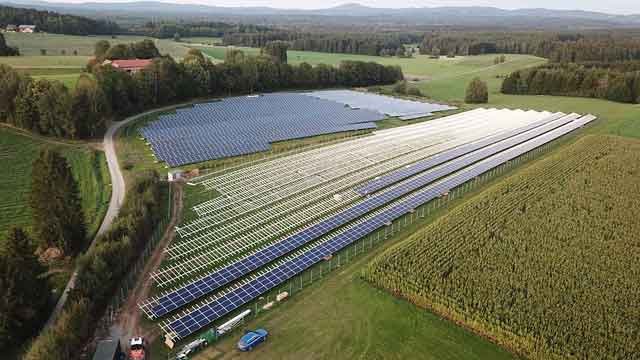
Cabinet Of Ministers Of Ukraine - Prime Minister: Our Goal In The Energy Sector Is To Synchronize Ukraine's Integrated Power System With Entso-e

Ukraine's EU Energy Integration aims for ENTSO-E synchronization, electricity market liberalization, EU Green Deal alignment, energy efficiency upgrades, hydrogen development, and streamlined grid connections to accelerate reform, market pricing, and sustainable growth.


Key Points

Ukraine's EU Energy Integration syncs with ENTSO-E, liberalizes power markets, and aligns with the EU Green Deal.

✅ ENTSO-E grid synchronization and cross-border trade readiness

✅ Electricity market liberalization and market-based pricing

✅ EU Green Deal alignment: efficiency, hydrogen, coal regions


Ukraine's goal in the energy sector is to ensure the maximum integration of energy markets with EU markets, and in line with the EU plan to dump Russian energy that is reshaping the region, synchronization of Ukraine's integrated energy system with ENTSO-E while leaning on electricity imports as needed to maintain stability. Prime Minister Denys Shmyhal emphasized in his statement at the Fourth Ukraine Reform Conference underway through July 7-8 in Vilnius, the Republic of Lithuania.

The Head of Government presented a plan of reforms in Ukraine until 2030. In particular, energy sector reform and environmental protection, according to the PM, include the liberalization of the electricity market, with recent amendments to the market law guiding implementation, the simplification of connection to the electrical grid system and the gradual transition to market electricity prices, alongside potential EU emergency price measures under discussion, and the monetization of subsidies for vulnerable groups.

"Ukraine shares and fully supports the EU's climate ambitions and aims to synchronize its policies in line with the EU Green Deal, including awareness of Hungary's energy alignment with Russia to ensure coherent regional planning. The interdepartmental working group has determined priority areas for cooperation with the European Union: energy efficiency, hydrogen, transformation of coal regions, waste management," said the Prime Minister.

According to Denys Shmyhal, Ukraine has supported the EU's climate ambitions to move towards climate-neutral development by 2050 within the framework of the European Green Deal and should become an integral part of it in order not only to combat the effects of climate change in synergy with the EU but, as the country prepares for winter energy challenges and strengthens resilience, within the economic strategy development aimed to enhance security and create new opportunities for Ukrainian business, with continued energy security support from partners bolstering implementation.


Related News

View more

Opinion: Nuclear Beyond Electricity

Nuclear decarbonization leverages low-carbon electricity, process heat, and hydrogen from advanced reactors and SMRs to electrify industry, buildings, and transport, supporting net-zero strategies and grid flexibility alongside renewables with dispatchable baseload capacity.


Key Points

Nuclear decarbonization uses reactors to supply low-carbon power, heat, and hydrogen, cutting emissions across industry.

✅ Advanced reactors and SMRs enable high-temperature process heat

✅ Nuclear-powered electrolysis and HTSE produce low-carbon hydrogen

✅ District heating from reactors reduces pollution and coal use


By Dr Henri Paillere, Head of the Planning and Economics Studies Section of the IAEA

Decarbonising the power sector will not be sufficient to achieving net-zero emissions, with assessments indicating nuclear may be essential across sectors. We also need to decarbonise the non-power sectors - transport, buildings and industry - which represent 60% of emissions from the energy sector today. The way to do that is: electrification with low-carbon electricity as much as possible; using low-carbon heat sources; and using low-carbon fuels, including hydrogen, produced from clean electricity.
The International Energy Agency (IEA) says that: 'Almost half of the emissions reductions needed to reach net zero by 2050 will need to come from technologies that have not reached the market today.' So there is a need to innovate and push the research, development and deployment of technologies. That includes nuclear beyond electricity.

Today, most of the scenario projections see nuclear's role ONLY in the power sector, despite ongoing debates over whether nuclear power is in decline globally, but increased electrification will require more low-carbon electricity, so potentially more nuclear. Nuclear energy is also a source of low-carbon heat, and could also be used to produce low-carbon fuels such as hydrogen. This is a virtually untapped potential.

There is an opportunity for the nuclear energy sector - from advanced reactors, next-gen nuclear small modular reactors, and non-power applications - but it requires a level playing field, not only in terms of financing today's technologies, but also in terms of promoting innovation and supporting research up to market deployment. And of course technology readiness and economics will be key to their success.

On process heat and district heating, I would draw attention to the fact there have been decades of experience in nuclear district heating. Not well spread, but experience nonetheless, in Russia, Hungary and Switzerland. Last year, we had two new projects. One floating nuclear power plant in Russia (Akademik Lomonosov), which provides not only electricity but district heating to the region of Pevek where it is connected. And in China, the Haiyang nuclear power plant (AP1000 technology) has started delivering commercial district heating. In China, there is an additional motivation to reducing emissions, namely to cut air pollution because in northern China a lot of the heating in winter is provided by coal-fired boilers. By going nuclear with district heating they are therefore cutting down on this pollution and helping with reducing carbon emissions as well. And Poland is looking at high-temperature reactors to replace its fleet of coal-fired boilers and so that's a technology that could also be a game-changer on the industry side.

There have also been decades of research into the production of hydrogen using nuclear energy, but no real deployment. Now, from a climate point of view, there is a clear drive to find substitute fuels for the hydrocarbon fuels that we use today, and multiple new nuclear stations are seen by industry leaders as necessary to meet net-zero targets. In the near term, we will be able to produce hydrogen with electrolysis using low-carbon electricity, from renewables and nuclear. But the cheapest source of low-carbon power is from the long-term operation of existing nuclear power plants which, combined with their high capacity factors, can give the cheapest low-carbon hydrogen of all.

In the mid to long term, there is research on-going with processes that are more efficient than low-temperature electrolysis, which is high temperature steam electrolysis or thermal splitting of water. These may offer higher efficiencies and effectiveness but they also require advanced reactors that are still under development. Demonstration projects are being considered in several countries and we at the IAEA are developing a publication that looks into the business opportunities for nuclear production of hydrogen from existing reactors. In some countries, there is a need to boost the economics of the existing fleet, especially in the electricity systems where you have low or even negative market prices for electricity. So, we are looking at other products that have higher values to improve the competitiveness of existing nuclear power plants.

The future means not only looking at electricity, but also at industry and transport, and so integrated energy systems. Electricity will be the main workhorse of our global decarbonisation effort, but through heat and hydrogen. How you model this is the object of a lot of research work being done by different institutes and we at the IAEA are developing some modelling capabilities with the objective of optimising low-carbon emissions and overall costs.

This is just a picture of what the future might look like: a low-carbon power system with nuclear lightwater reactors (large reactors, small modular reactors and fast reactors) drawing on the green industrial revolution reactor waves in planning; solar, wind, anything that produces low-carbon electricity that can be used to electrify industry, transport, and the heating and cooling of buildings. But we know there is a need for high-temperature process steam that electricity cannot bring but which can be delivered directly by high-temperature reactors. And there are a number of ways of producing low-carbon hydrogen. The beauty of hydrogen is that it can be stored and it could possibly be injected into gas networks that could be run in the future on 100% hydrogen, and this could be converted back into electricity.

So, for decarbonising power, there are many options - nuclear, hydro, variable renewables, with renewables poised to surpass coal in global generation, and fossil with carbon capture and storage - and it's up to countries and industries to invest in the ones they prefer. We find that nuclear can actually reduce the overall cost of systems due to its dispatchability and the fact that variable renewables have a cost because of their intermittency. There is a need for appropriate market designs and the role of governments to encourage investments in nuclear.

Decarbonising other sectors will be as important as decarbonising electricity, from ways to produce low-carbon heat and low-carbon hydrogen. It's not so obvious who will be the clear winners, but I would say that since nuclear can produce all three low-carbon vectors - electricity, heat and hydrogen - it should have the advantage.
We at the IAEA will be organising a webinar next month with the IEA looking at long-term nuclear projections in a net-zero world, building on IAEA analysis on COVID-19 and low-carbon electricity insights. That will be our contribution from the point of view of nuclear to the IEA's special report on roadmaps to net zero that it will publish in May.


Related News

View more

Global use of coal-fired electricity set for biggest fall this year

Global Coal Power Decline 2019 signals a record fall in coal-fired electricity as China plateaus, India dips, and the EU and US accelerate renewables, curbing carbon emissions and advancing the global energy transition.


Key Points

A record 2019 drop in global coal power as renewables rise and demand slows across China, India, the EU, and the US.

✅ 3% global fall in coal-fired electricity in 2019.

✅ China plateaus; India declines for first time in decades.

✅ EU and US shift to renewables and gas, cutting emissions.


The world’s use of coal-fired electricity is on track for its biggest annual fall on record this year after more than four decades of near-uninterrupted growth that has stoked the global climate crisis.

Data shows that coal-fired electricity is expected to fall by 3% in 2019, or more than the combined coal generation in Germany, Spain and the UK last year and could help stall the world’s rising carbon emissions this year.

The steepest global slump on record is likely to emerge in 2019 as India’s reliance on coal power falls for the first time in at least three decades this year, and China’s coal power demand plateaus, reflecting the broader global energy transition underway.

Both developing nations are using less coal-fired electricity due to slowing economic growth in Asia as well as the rise of cleaner energy alternatives. There is also expected to be unprecedented coal declines across the EU and the US as developed economies turn to clean forms of energy such as low-cost solar power to replace ageing coal plants.

In almost 40 years the world’s annual coal generation has fallen only twice before: in 2009, in the wake of the global financial crisis, and in 2015, following a slowdown in China’s coal plants amid rising levels of deadly air pollution.

The research was undertaken by the Centre for Research on Energy and Clean Air , the Institute for Energy Economics and Financial Analysis and the UK climate thinktank Sandbag.

The researchers found that China’s coal-fired power generation was flatlining, despite an increase in the number of coal plants being built, because they were running at record low rates. China builds the equivalent of one large new coal plant every two weeks, according to the report, but its coal plants run for only 48.6% of the time, compared with a global utilisation rate of 54% on average.

The findings come after a report from Global Energy Monitor found that the number of coal-fired power plants in the world is growing, because China is building new coal plants five times faster than the rest of the world is reducing their coal-fired power capacity.

The report found that in other countries coal-fired power capacity fell by 8GW in the 18 months to June but over the same period China increased its capacity by 42.9GW.

In a paper for the industry journal Carbon Brief, the researchers said: “A 3% reduction in power sector coal use could imply zero growth in global CO2 emissions, if emissions changes in other sectors mirror those during 2018.”

However, the authors of the report have warned that despite the record coal power slump the world’s use of coal remained far too high to meet the climate goals of the Paris agreement, and some countries are still seeing increases, such as Australia’s emissions rise amid increased pollution from electricity and transport.

The US – which is backing out of the Paris agreement – has made the deepest cuts to coal power of any developed country this year by shutting coal plants down in favour of gas power and renewable energy, with utilities such as Duke Energy facing investor pressure to disclose climate plans. By the end of August the US had reduced coal by almost 14% over the year compared with the same months in 2018.

The EU reported a record slump in coal-fired electricity use in the first half of the year of almost a fifth compared with the same months last year. This trend is expected to accelerate over the second half of the year to average a 23% fall over 2019 as a whole. The EU is using less coal power in favour of gas-fired electricity – which can have roughly half the carbon footprint of coal – and renewable energy, helped by policies such as the UK carbon tax that have slashed coal-fired generation.

We will not stay quiet on the escalating climate crisis and we recognise it as the defining issue of our lifetimes. The Guardian will give global heating, wildlife extinction and pollution the urgent attention they demand. Our independence means we can interrogate inaction by those in power. It means Guardian reporting will always be driven by scientific facts, never by commercial or political interests.

We believe that the problems we face on the climate crisis are systemic and that fundamental societal change is needed. We will keep reporting on the efforts of individuals and communities around the world who are fearlessly taking a stand for future generations and the preservation of human life on earth. We want their stories to inspire hope. We will also report back on our own progress as an organisation, as we take important steps to address our impact on the environment.


Related News

View more

Why Canada should invest in "macrogrids" for greener, more reliable electricity

Canadian electricity transmission enables grid resilience, long-distance power trade, and decarbonization by integrating renewables, hydroelectric storage, and HVDC links, providing backup during extreme weather and lowering costs to reach net-zero, clean energy targets.


Key Points

An interprovincial high-voltage grid that shares clean power to deliver reliable, low-cost decarbonization.

✅ Enables resilience by sharing power across weather zones

✅ Integrates renewables with hydro storage via HVDC links

✅ Lowers decarbonization costs through interprovincial trade


As the recent disaster in Texas showed, climate change requires electricity utilities to prepare for extreme events. This “global weirding” is leaving Canadian electricity grids increasingly exposed to harsh weather that leads to more intense storms, higher wind speeds, heatwaves and droughts that can threaten the performance of electricity systems.

The electricity sector must adapt to this changing climate while also playing a central role in mitigating climate change. Greenhouse gas emissions can be reduced a number of ways, but the electricity sector is expected to play a central role in decarbonization, including powering a net-zero grid by 2050 across Canada. Zero-emissions electricity can be used to electrify transportation, heating and industry and help achieve emissions reduction in these sectors.

Enhancing long-distance transmission is viewed as a cost-effective way to enable a clean and reliable power grid, and to lower the cost of meeting our climate targets. Now is the time to strengthen transmission links in Canada, with concepts like a western Canadian electricity grid gaining traction.


Insurance for climate extremes
An early lesson from the Texas power outages is that extreme conditions can lead to failures across all forms of power supply. The state lost the capacity to generate electricity from natural gas, coal, nuclear and wind simultaneously. But it also lacked cross-border transmission to other electricity systems that could have bolstered supply.

Join thousands of Canadians who subscribe to free evidence-based news.
Long-distance transmission offers the opportunity to escape the correlative clutch of extreme weather, by accessing energy and spare capacity in areas not beset by the same weather patterns. For example, while Texas was in its deep freeze, relatively balmy conditions in California meant there was a surplus of electricity generation capability in that region — but no means to get it to Texas. Building new transmission lines and connections across broader regions, including projects like a hydropower line to New York that expand access, can act as an insurance policy, providing a back-up for regions hit by the crippling effects of climate change.

A transmission tower crumpled under the weight of ice.
The 1998 Quebec ice storm left 3.5 million Quebecers and a million Ontarians, as well as thousands in in New Brunswick, without power. CP Photo/Robert Galbraith
Transmission is also vulnerable to climate disruptions, such as crippling ice storms that leave wires temporarily inoperable. This may mean using stronger poles when building transmission, or burying major high-voltage transmission links, or deploying superconducting cables to reduce losses.

In any event, more transmission links between regions can improve resilience by co-ordinating supply across larger regions. Well-connected grids that are larger than the areas disrupted by weather systems can be more resilient to climate extremes.


Lowering the cost of clean power
Adding more transmission can also play a role in mitigating climate change. Numerous studies have found that building a larger transmission grid allows for greater shares of renewables onto the grid, ultimately lowering the overall cost of electricity.

In a recent study, two of us looked at the role transmission could play in lowering greenhouse gas emissions in Canada’s electricity sector. We found the cost of reducing greenhouse gas emissions is lower when new or enhanced transmission links can be built between provinces.

Average cost increase to electricity in Canada at different levels of decarbonization, with new transmission (black) and without new transmission (red). New transmission lowers the cost of reducing greenhouse gas emissions. (Authors), Author provided
Much of the value of transmission in these scenarios comes from linking high-quality wind and solar resources with flexible zero-emission generation that can produce electricity on demand. In Canada, our system is dominated by hydroelectricity, but most of this hydro capacity is located in five provinces: British Columbia, Manitoba, Ontario, Québec and Newfoundland and Labrador.

In the west, Alberta and Saskatchewan are great locations for building low-cost wind and solar farms. Enhanced interprovincial transmission would allow Alberta and Saskatchewan to build more variable wind and solar, with the assurance that they could receive backup power from B.C. and Manitoba when the wind isn’t blowing and the sun isn’t shining.

When wind and solar are plentiful, the flow of low cost energy can reverse to allow B.C. and Manitoba the opportunity to better manage their hydro reservoir levels. Provinces can only benefit from trading with each other if we have the infrastructure to make that trade possible.

A recent working paper examined the role that new transmission links could play in decarbonizing the B.C. and Alberta electricity systems. We again found that enabling greater electricity trade between B.C. and Alberta can reduce the cost of deep cuts to greenhouse gas emissions by billions of dollars a year. Although we focused on the value of the Site C project, in the context of B.C.'s clean energy shift, the analysis showed that new transmission would offer benefits of much greater value than a single hydroelectric project.

The value of enabling new transmission links between Alberta and B.C. as greenhouse gas emissions reductions are pursued. (Authors), Author provided
Getting transmission built
With the benefits that enhanced electricity transmission links can provide, one might think new projects would be a slam dunk. But there are barriers to getting projects built.

First, electricity grids in Canada are managed at the provincial level, most often by Crown corporations. Decisions by the Crowns are influenced not simply by economics, but also by political considerations. If a transmission project enables greater imports of electricity to Saskatchewan from Manitoba, it raises a flag about lost economic development opportunity within Saskatchewan. Successful transmission agreements need to ensure a two-way flow of benefits.

Second, transmission can be expensive. On this front, the Canadian government could open up the purse strings to fund new transmission links between provinces. It has already shown a willingness to do so.

Lastly, transmission lines are long linear projects, not unlike pipelines. Siting transmission lines can be contentious, even when they are delivering zero-emissions electricity. Using infrastructure corridors, such as existing railway right of ways or the proposed Canadian Northern Corridor, could help better facilitate co-operation between regions and reduce the risks of siting transmission lines.

If Canada can address these barriers to transmission, we should find ourselves in an advantageous position, where we are more resilient to climate extremes and have achieved a lower-cost, zero-emissions electricity grid.


Related News

View more

NB Power signs three deals to bring more Quebec electricity into the province

NB Power and Hydro-Québec Electricity Agreements expand clean hydroelectric exports, support Mactaquac dam refurbishment, add grid interconnections, and advance decarbonization, climate goals, reliability, and transmission capacity across Atlantic Canada and U.S. markets through 2040.


Key Points

Deals for hydro exports, Mactaquac upgrades, and new interconnections to improve reliability and cut emissions.

✅ 47 TWh to NB by 2040 over existing transmission lines

✅ HQ expertise to address Mactaquac concrete swelling

✅ Talks on new interconnections for Atlantic and U.S. exports


NB Power and Hydro-Quebec have signed three deals that will see Quebec sell more electricity to New Brunswick and provide help with the refurbishment of the Mactaquac hydroelectric generating station.

Under the first agreement, Hydro-Quebec will export 47 terawatt hours of electricity to New Brunswick between now and 2040 over existing power lines — expanding on an agreement in place since 2012 and on related regional agreements such as the Churchill Falls deal in Newfoundland and Labrador.

The second deal will see Hydro-Quebec share expertise for part of the refurbishment of the Mactaquac dam to extend the useful life of the generating station until at least 2068, when the 670 megawatt facility on the St. John River will be 100 years old.

Since the 1980s, concrete portions of the facility have been affected by a chemical reaction that causes the concrete to swell and crack.

Hydro-Quebec has been dealing with the same problem, and has developed expertise in addressing the issue.

“This is why we have signed a technical collaboration agreement between Hydro-Quebec and us for part of the refurbishment of the Mactaquac generating station,” NB Power president Gaetan Thomas said Friday.

Eric Martel, CEO of Hydro-Quebec, said hydroelectric plants provide long-term clean power that’s important in the fight against climate change as the province has ruled out nuclear power for now.

“We understand how important it is to ensure the long term sustainability of these facilities and we are happy to share the expertise that Hydro-Quebec has acquired over the years,” Martel said.

The refurbishment of the Mactaquac generating station is expected to cost between $2.9 billion and $3.5 billion. Once the work begins, each of the facility’s six generators will have to be taken offline for months at a time, and Thomas said that’s where the increased power from Quebec, supported by Hydro-Quebec's capacity expansion in recent years, will come into use.

He expects the power could cost about $100 million per year but will be much cheaper than other sources.

The third agreement calls for talks to begin for the construction of additional power connections between Quebec and New Brunswick to increase exports to Atlantic Canada and the United States, where transmission constraints have limited incremental deliveries in recent years.

“Building new interconnections and allowing for increased power transfer between our systems could be mutually beneficial, even as historic tensions in Newfoundland and Labrador linger. More than ever, we are looking to the future,” Martel said.

“Partnering will permit us to seize new business opportunities together and pool our effort to support de-carbonization, including Hydro-Quebec's non-fossil strategy that is now underway, and fight against climate change, both here and in our neighbourhood market,” he said. 


Related News

View more

Octopus Energy Makes Inroads into US Renewables

Octopus Energy US Renewables Investment signals expansion into the US clean energy market, partnering with CIP for solar and battery storage projects to decarbonize the grid, boost resilience, and scale smart grid innovation nationwide.


Key Points

Octopus Energy's first US stake in solar and battery storage with CIP to expand clean power and grid resilience.

✅ Partnership with Copenhagen Infrastructure Partners

✅ Portfolio of US solar and battery storage assets

✅ Supports decarbonization, jobs, and grid modernization


Octopus Energy, a UK-based renewable energy provider known for its innovative approach to clean energy solutions and the rapid UK offshore wind growth shaping its home market, has announced its first investment in the US renewable energy market. This strategic move marks a significant milestone in Octopus Energy's expansion into international markets and underscores its commitment to accelerating the transition towards sustainable energy practices globally.

Investment Details

Octopus Energy has partnered with Copenhagen Infrastructure Partners (CIP) to acquire a stake in a portfolio of solar and battery storage projects located across the United States. This investment reflects Octopus Energy's strategy to diversify its renewable energy portfolio and capitalize on opportunities in the rapidly growing US solar-plus-storage sector, which is attracting record investment.

Strategic Expansion

By entering the US market, Octopus Energy aims to leverage its expertise in renewable energy technologies and innovative energy solutions, as companies like Omnidian expand their global reach in project services. The partnership with CIP enables Octopus Energy to participate in large-scale renewable projects that contribute to decarbonizing the US energy grid and advancing climate goals.

Commitment to Sustainability

Octopus Energy's investment aligns with its overarching commitment to sustainability and reducing carbon emissions. The portfolio of solar and battery storage projects not only enhances energy resilience but also supports local economies through job creation and infrastructure development, bolstered by new US clean energy manufacturing initiatives nationwide.

Market Opportunities

The US renewable energy market presents vast opportunities for growth, driven by favorable regulatory policies, declining technology costs, and increasing demand for clean energy solutions, with US solar and wind growth accelerating under supportive plans. Octopus Energy's entry into this market positions the company to capitalize on these opportunities and establish a foothold in North America's evolving energy landscape.

Innovation and Impact

Octopus Energy is known for its customer-centric approach and technological innovation in energy services. By integrating smart grid technologies, digital platforms, and consumer-friendly tariffs, Octopus Energy aims to empower customers to participate in the energy transition actively.

Future Prospects

Looking ahead, Octopus Energy plans to expand its presence in the US market and explore additional opportunities in renewable energy development and energy storage, including surging US offshore wind potential in the coming years. The company's strategic investments and partnerships are poised to drive continued growth, innovation, and sustainability across global energy markets.

Conclusion

Octopus Energy's inaugural investment in US renewables underscores its strategic vision to lead the transition towards a sustainable energy future. By partnering with CIP and investing in solar and battery storage projects, Octopus Energy not only strengthens its position in the US market but also reinforces its commitment to advancing clean energy solutions worldwide. As the global energy landscape evolves, including trillion-dollar offshore wind outlook, Octopus Energy remains dedicated to driving positive environmental impact and delivering value to stakeholders through renewable energy innovation and investment.


Related News

View more

Sign Up for Electricity Forum’s Newsletter

Stay informed with our FREE Newsletter — get the latest news, breakthrough technologies, and expert insights, delivered straight to your inbox.

Electricity Today T&D Magazine Subscribe for FREE

Stay informed with the latest T&D policies and technologies.
  • Timely insights from industry experts
  • Practical solutions T&D engineers
  • Free access to every issue

Download the 2025 Electrical Training Catalog

Explore 50+ live, expert-led electrical training courses –

  • Interactive
  • Flexible
  • CEU-cerified