Italy's top oil and gas group to build new power plant to fight blackouts

By Reuters


NFPA 70e Training - Arc Flash

Our customized live online or in‑person group training can be delivered to your staff at your location.

  • Live Online
  • 6 hours Instructor-led
  • Group Training Available
Regular Price:
$199
Coupon Price:
$149
Reserve Your Seat Today
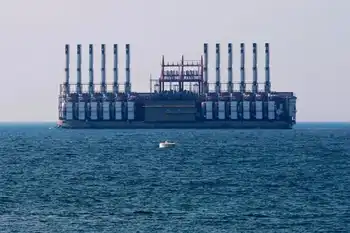
Italy's top oil and gas group Eni said on Tuesday it had started building a 1,170 megawatt power plant in southern Italy which would help reduce the country's reliance on imports and cut the risk of blackouts.

Italy, which depends heavily on ageing power stations and has to rely on imports to meet its electricity needs, has been stung by outages recently due to record summer electricity demand and supply problems with Electricite de France [EDF.UL].

Eni said in a statement the first unit of the combined cycle plant would be completed in the spring of 2005.

The oil and gas giant, which is flexing its muscles in a liberalising electricity market, said the new plant would be the biggest in its power division which has other three plants and would help the group to hit a 6,000 MW capacity target in 2006.

State-controlled Eni said investment in the project amounted to 550 million euros.

Italian electricity companies ordered country-wide power cuts on June 26 for the first time since 1981 as a heat wave brought the national power grid close to collapse.

Italy's dominant multi-utility Enel ((ENEI.MI)) earlier this month decided to add 1,600 MW of power capacity through a combination of re-activation of idled capacity and a new plant, to help prevent a recurrence of the blackouts, which affected some six million people.

Related News
Tesla (TSLA) Wants to Become an Electricity Retailer

Tesla Energy Ventures Texas enters the deregulated market as a retail electricity provider, leveraging ERCOT, battery storage, solar, and grid software to enable virtual power plants and customer energy trading with Powerwall and Megapack assets.


Key Points

Tesla Energy Ventures Texas is Tesla's retail power unit selling grid and battery energy and enabling solar exports.

✅ ERCOT retail provider; sells grid and battery-stored power

✅ Uses Powerwall/Megapack; supports virtual power plants

✅ Targets Tesla owners; enables solar export and trading


Last week, Tesla Energy Ventures, a new subsidiary of electric car maker Tesla Inc. (TSLA), filed an application to become a retail electricity provider in the state of Texas. According to reports, the company plans to sell electricity drawn from the grid to customers and from its battery storage products. Its grid transaction software may also enable customers for its solar panels to sell excess electricity back to the smart grid in Texas.1

For those who have been following Tesla's fortunes in the electric car industry, the Palo Alto, California-based company's filing may seem baffling. But the move dovetails with Tesla's overall ambitions for its renewable energy business, as utilities face federal scrutiny of climate goals and electricity rates.

Why Does Tesla Want to Become an Electricity Provider?
The simple answer to that question is that Tesla already manufactures devices that produce and store power. Examples of such devices are its electric cars, which come equipped with lithium ion batteries, and its suite of battery storage products for homes and enterprises. Selling power generated from these devices to consumers or to the grid is a logical next step.


Tesla's move will benefit its operations. The filing states that it plans to build a massive battery storage plant near its manufacturing facility in Austin. The plant will provide the company with a ready and cheap source of power to make its cars.

Tesla's filing should also be analyzed in the context of the Texas grid. The state's electricity market is fully deregulated, unlike regions debating grid privatization approaches, and generated about a quarter of its overall power from wind and solar in 2020.2 The Biden administration's aggressive push toward clean energy is only expected to increase that share.

After a February fiasco in the state grid resulted in a shutdown of renewable energy sources and skyrocketing natural gas prices, Texas committed to boosting the role of battery storage in its grid. The Electricity Reliability Council of Texas (ERCOT), the state's grid operator, has said it plans to install 3,008 MW of battery storage by the end of 2022, a steep increase from the 225 MW generated at the end of 2020.3 ERCOT's proposed increase in installation represents a massive market for Tesla's battery unit.

Tesla already has considerable experience in this arena. It has built battery storage plants in California and Australia and is building a massive battery storage unit in Houston, according to a June Bloomberg report.4 The unit is expected to service wholesale power producers. Besides this, the company plans to "drum up" business among existing customers for its batteries through an app and a website that will allow them to buy and sell power among themselves, a model also being explored by Octopus Energy in international talks.

Tesla Energy Ventures: A Future Profit Center?
Tesla's foray into becoming a retail electricity provider could boost the top line for its energy services business, even as issues like power theft in India highlight retail market challenges. In its last reported quarter, the company stated that its energy generation and storage business brought in $810 million in revenues.

Analysts have forecast a positive future for its battery storage business. Alex Potter from research firm Piper Sandler wrote last year that battery storage could bring in more than $200 billion per year in revenue and grow up to a third of the company's overall business.5

Immediately after the news was released, Morningstar analyst Travis Miller wrote that Tesla does not represent an immediate threat to other major players in Texas's retail market, where providers face strict notice obligations illustrated when NT Power was penalized for delayed disconnection notices, such as NRG Energy, Inc. (NRG) and Vistra Corp. (VST). According to him, the company will initially target its own customers to "complement" its offerings in electric cars, battery, charging, and solar panels.6

Further down the line, however, Tesla's brand name and resources may work to its advantage. "Tesla's brand name recognition gives it an advantage in a hypercompetitive market," Miller wrote, adding that the car company's entry confirmed the firm's view that consumer technology or telecom companies will try to enter retail energy markets, where policy shifts like Ontario rate reductions can shape customer expectations.


Related News

View more

The Need for Electricity During the COVID-19 Pandemic

US utilities COVID-19 resilience shows electric utilities maintaining demand stability, reaffirming earnings guidance, and accessing the bond market for low-cost financing, as Dominion, NextEra, and Con Edison manage recession risks.


Key Points

It is the sector's capacity to sustain demand, financing access, and guidance despite pandemic recession pressures.

✅ Bond market access locks in low-cost, long-term debt

✅ Stable residential load offsets industrial weakness

✅ Guidance largely reaffirmed by major utilities


Dominion Energy (D) expects "incremental residential load" gains, consistent with COVID-19 electricity demand patterns, as a result of COVID-19 fallout. Southern Company CEO Tom Fanning says his company is "nowhere near" a need to review earnings guidance because of a potential recession, in a region where efficiency and demand response can help level electricity demand for years.

Sempra Energy (SRE) has reaffirmed earnings per share guidance for 2020 and 2021, as well timing for the sale of assets in Chile and Peru, and peers such as Duke Energy's renewables plan have reaffirmed capital investments to deliver cleaner energy and economic growth. And Xcel Energy (XEL) says it still "hasn’t seen material impact on its business."

Several electric utilities have demonstrated ability to tap the bond market, in line with utility sector trends in recent years, to lock in low-cost financing, as America moves toward broader electrification, despite ongoing turmoil. Their ranks include Dominion Energy, renewable energy leader NextEra Energy (NEE) and Consolidated Edison (ED), which last week sold $1 billion of 30-year bonds at a coupon rate of just 3.95 percent.

It’s still early days for US COVID-19 fallout. And most electric companies have yet to issue guidance. That’s understandable, since so much is still unknown about the virus and the damage it will ultimately do to human health and the global economy. But so far, the US power industry is showing typical resilience in tough times, as it coordinates closely with federal partners to maintain reliability.

Will it last? We won’t know for certain until there’s a lot more data. NextEra is usually first to report its Q1 earnings reports and detailed guidance. But that’s not expected until April 23. And companies may delay financials further, should the virus and efforts to control it impede collection and analysis of data, and as they address electricity shut-off risks affecting customers.


Related News

View more

Almost 500-mile-long lightning bolt crossed three US states

Longest Lightning Flash Record confirmed by WMO: a 477.2-mile megaflash spanning Mississippi, Louisiana, and Texas, detected by satellite sensors, highlighting Great Plains supercell storms, lightning safety, and extreme weather monitoring advancements.


Key Points

It is the WMO-verified 477.2-mile megaflash across MS, LA, and TX, detected via satellites.

✅ Spanned 477.2 miles across Mississippi, Louisiana, and Texas

✅ Verified by WMO using space-based lightning detection

✅ Occurs in megaflash-prone regions like the U.S. Great Plains


An almost 500-mile long bolt of lightning that lit up the sky across three US states has set a new world record for longest flash, scientists have confirmed.

The lightning bolt, extended a total of 477.2 miles (768 km) and spread across Mississippi, Louisiana, and Texas.

The previous record was 440.6 miles (709 km) and recorded in Brazil in 2018.

Lightning rarely extends over 10 miles and usually lasts under a second, yet utilities plan for severe weather when building long-distance lines such as the TransWest Express transmission project to enhance reliability.

Another lightning flash recorded in 2020 - in Uruguay and Argentina - has also set a new record for duration at 17.1 seconds. The previous record was 16.7 seconds.

"These are extraordinary records from lightning flash events," Professor Randall Cerveny, the WMO's rapporteur of weather and climate extremes, said.

According to the WMO, both records took place in areas prone to intense storms that produce 'megaflashes', namely the Great Plains region of the United States and the La Plata basin of South America's southern cone, where utilities adapting to climate change is an increasing priority.

Professor Cerveny added that greater extremes are likely to exist and are likely to be recorded in the future thanks to advances in space-based lightning detection technology.

The WMO warned that lightning was a hazard and urged people in both regions and around the world to take caution during storms, which can lead to extensive disruptions like the Tennessee power outages reported after severe weather.

"These extremely large and long-duration lightning events were not isolated but happened during active thunderstorms," lightning specialist Ron Holle said in a WMO statement.

"Any time there is thunder heard, it is time to reach a lightning-safe place".

Previously accepted WMO 'lightning extremes' include a 1975 incident in which 21 people were killed by a single flash of a lightning as they huddled inside a tent in Zimbabwe, and modern events show how dangerous weather can also cut electricity for days, as with the Hong Kong typhoon outages that affected families.

In another incident, 469 people were killed when lightning struck the Egyptian town of Dronka in 1994, causing burning oil to flood the town, and major incidents can also disrupt infrastructure, as seen during the LA power outage following a substation fire.

The WMO notes that the only lightning-safe locations are "substantial" buildings with wiring and plumbing, and dedicated lightning protection training helps reinforce these guidelines, rather than structures such as bus stops or those found at beaches.

Fully enclosed metal-topped vehicles are also considered reliably safe, and regional storm safety tips offer additional guidance.


Related News

View more

France nuclear power stations to limit energy output due to high river temps

France Nuclear Heatwave Restrictions signal reduced nuclear power along the Rhone River as EDF imposes output limits due to high water temperatures, grid needs, with minimal price impact amid strong solar and exports.


Key Points

Temporary EDF output limits at Rhone River reactors due to hot water, protecting ecosystems and grid reliability.

✅ EDF expects halved output at Bugey and Saint Alban.

✅ Cuts align with water temperature and discharge rules.

✅ Weekend midday curtailments offset by solar supply.


The high temperature warning has come early this year but will affect fewer nuclear power plants. High temperatures could halve nuclear power production, with river temperature limits at plants along France's Rhone River this week. 

Output restrictions are expected at two nuclear plants in eastern France due to high temperature forecasts, nuclear operator EDF said. It comes several days ahead of a similar warning that was made last year but will affect fewer plants, and follows a period when power demand has held firm during lockdowns across Europe.

The hot weather is likely to halve the available power supply from the 3.6 GW Bugey plant from 13 July and the 2.6 GW Saint Alban plant from 16 July, the operator said.

However, production will be at least 1.8 GW at Bugey and 1.3 GW at Saint Alban to meet grid requirements, and may change according to grid needs, the operator said.

Kpler analyst Emeric de Vigan said the restrictions were likely to have little effect on output in practice. Cuts are likely only at the weekend or midday when solar output was at its peak so the impact on power prices would be slim.

He said the situation would need monitoring in the coming weeks, however, noting it was unusually early in the summer for nuclear-powered France to see such restrictions imposed.

Water temperatures at the Bugey plant already eclipsed the initial threshold for restrictions on 9 July, as European power hits records during the heatwave. They are currently forecast to peak next week and then drop again, Refinitiv data showed.

"France is currently net exporting large amounts of power – and, despite a nuclear power dispute with Germany, single nuclear units' supply restrictions will not have the same effect as last year," Refinitiv analyst Nathalie Gerl said.

The Garonne River in southern France has the highest potential for critical levels of warming, but its Golfech plant is currently offline for maintenance until mid-August, as Europe faces nuclear losses, the data showed.

"(The restrictions were) to be expected and it will probably occur more often," Greenpeace campaigner Roger Spautz said.

"The authorities must stick to existing regulations for water discharges. Otherwise, the ecosystems will be even more affected," he added.


Related News

View more

Octopus Energy and Ukraine's DTEK enter Energy Talks

Octopus Energy and DTEK Partnership explores licensing the Kraken platform to rebuild Ukraine's power grid, enabling real-time analytics, smart-home integration, renewable energy orchestration, and distributed resilience amid ongoing attacks on critical energy infrastructure.


Key Points

Collaboration to deploy Kraken and renewables to modernize Ukraine's grid with analytics, smart control, and resilience.

✅ Kraken licensing for grid operations and customer analytics

✅ Shift to distributed solar, wind, and smart-home devices

✅ Real-time monitoring to mitigate outages and cyber risks


Octopus Energy, a prominent UK energy firm, has begun preliminary conversations with Ukraine's DTEK regarding potential collaboration to refurbish Ukraine's heavily damaged electric infrastructure as ongoing strikes threaten the power grid across the country.

Persistent assaults by Russia on Ukraine's power network, including a five-hour attack on Kyiv's grid, have led to significant electricity shortages in numerous regions.

Octopus Energy, the largest electricity and second-largest gas supplier in the UK, collaborates with energy firms in 17 countries using its Kraken software platform, and Ukraine joined Europe's power grid with unprecedented speed to bolster resilience. This platform is currently being trialled by the Abu Dhabi National Energy Company (Taqa) for power and water customers in the UAE.

A spokesperson from Octopus revealed to The National that the company is "in the early stages of discussions with DTEK to explore potential collaborative opportunities.”

One of the possibilities being considered is licensing Octopus's Kraken technology platform to DTEK, a platform that presently serves 54 million customer accounts globally.

Russian drone and missile attacks, which initially targeted Ukrainian ports and export channels last summer, shifted focus to energy infrastructure by October, ahead of the winter season as authorities worked to protect electricity supply before winter across the country.

These initial talks between Octopus CEO Greg Jackson and DTEK CEO Maxim Timchenko took place at the World Economic Forum in Davos, set against the backdrop of these ongoing challenges.

DTEK, Ukraine's leading private energy provider, might integrate Octopus's advanced Kraken software to manage and optimize data systems ranging from large power plants to smart-home devices, with a growing focus on protecting the grid against emerging threats.

Kraken is described by Octopus as a comprehensive technology platform that supports the entire energy supply chain, from generation to billing. It enables detailed analytics, real-time monitoring, and control of energy devices like heat pumps and electric vehicles, underscoring the need to counter cyber weapons that can disrupt power grids as systems become more connected.

Octopus Energy, with its focus on renewable sources, can also assist Ukraine in transitioning its power infrastructure from centralized coal-fired power stations, which are vulnerable targets, to a more distributed network of smaller solar and wind projects.

DTEK, serving approximately 3.5 million customers in the Kyiv, Donetsk, and Dnipro regions, is already engaged in renewable initiatives. The company constructed a wind farm in southern Ukraine within nine months last year and has plans for additional projects in Italy and Croatia.

Emphasizing the importance of rebuilding Ukraine's economy, Timchenko recently expressed at Davos the need for Ukrainian and international companies to work together to create a sustainable future for Ukraine, noting that incidents such as Russian hackers accessed U.S. control rooms highlight the urgency.


Related News

View more

Elizabeth May wants a fully renewable electricity grid by 2030. Is that possible?

Green Party Mission Possible 2030 outlines a rapid transition to renewable energy, electric vehicles, carbon pricing, and grid modernization, phasing out oil and gas while creating green jobs, public transit upgrades, and building retrofits.


Key Points

A Canadian climate roadmap to decarbonize by 2030 via renewables, EVs, carbon pricing, and grid upgrades.

✅ Ban on new gas cars by 2030; accelerate EV adoption and charging.

✅ 100 percent renewable-powered grid with interprovincial links.

✅ Just transition: retraining, green jobs, and building retrofits.


Green Party Leader Elizabeth May has a vision for Canada in 2030. In 11 years, all new cars will be electric. A national ban will prohibit anyone from buying a gas-powered vehicle. No matter where you live, charging stations will make driving long distances easy and affordable. Alberta’s oil industry will be on the way out, replaced by jobs in sectors such as urban farming, renewable energy and retrofitting buildings for energy efficiency. The electric grid will be powered by 100 per cent renewable energy as Canada’s race to net-zero accelerates.

It’s all part of the Greens’ “Mission Possible” – a detailed plan released Monday with a level of ambition made clear by its very name. May insists it’s the only way to confront the climate crisis head-on before it’s too late.

“We have to set our targets on what needs to be done. You can’t negotiate with physics,” May told CTV’s Power Play on Monday.

But is that 2030 vision realistic?

CTVNews.ca spoke with experts in economics, political policy, renewable energy and climate science to explore how feasible May’s plan is, how much it would cost and what transitioning to an environmentally-centred economy would look like for everyday Canadians.


MOVING TO A GREEN ECONOMY

Recent polling from Nanos Research shows that the environment and climate change is the top issue among voters this election.

If the Greens win a majority on Oct. 21 – an outcome that May herself acknowledged isn’t likely – it would signal a major restructuring of the Canadian economy.

According to the party’s platform, jobs in the fuels sectors, such as oil and gas production in Alberta, would eventually disappear. The Greens say those job losses would be replaced by opportunities in a variety of fields including renewable energy, farming, public transportation, manufacturing, construction and information technology.

The party would also introduce a guaranteed livable income and greater support for technical and educational training to help workers transition to new jobs.

But Jean-Thomas Bernard, an economist who specializes in energy markets, said plenty of people in today’s energy sector, such as oil and gas workers, wouldn’t have the skills to make that transition.

“Quite a few of these jobs have low technical requirements. Driving a truck is driving a truck. So quite few of these people will not have the capacity to be recycled into well-paid jobs in the renewable sector,” he said.

“Maybe this would be for the young generation, but not people who are 40, 45, 50.”

Ryan Katz-Rosene is an associate professor at the University of Ottawa who researches environmental policy. He says May’s overall pitch is technically possible but would require a huge amount of enthusiasm on behalf of the public. 

“The plan in itself is not physically impossible. It is theoretically achievable. But it would require a major, major change in the urgency and the level of action, the level of investment, the level of popular urgency, the level of political commitment,” he said.

“But it’s not completely fantastical in it being theoretically impossible.”


PHASING OUT BITUMEN PRODUCTION

Katz-Rosene said that, under the Greens’ plan, Canadians would need to pay for a bold carbon pricing plan that helps shift the country away from fossil fuels and has significant implications for electricity grids, he said. It would also mean dramatically upscaling the capacity of Canada’s existing electrical grid to account for millions of new electric cars, reflecting the need for more electricity to hit net-zero as demand grows.

 “Given Canada’s slow attempt to climate action and pretty lacklustre results in these years, to be frank, this plan is very, very difficult to achieve. We’re talking 11 years from now. But things change, people change, and sometimes that change can occur very quickly. Just look at the type of climate mobilization we’re seen among young people in the last year, or the last five years.”

Bernard, the economist, is less optimistic. He cited international agreements such as the Kyoto Protocol from 1997 and the more recent Paris Climate Agreement and said that little has come of those plans.

A climate solution with teeth, he suggests, would need to be global – something that no federal government can completely control.

“I find a lot this talk to be overly optimistic. I don’t know why we keep having this talk that is overly optimistic,” he said, adding that he believes humankind is already beyond the point of being able to stop irreversible climate change. 

“I think we are moving toward a mess, but the effort to control that is still not there.”

As for transitioning away from Canada’s oil industry, Bernard said May’s plan simply wouldn’t work.

“Trying to block some oil production here and there means more oil will be produced elsewhere,” he said. “Canada could become a clean country, but worldwide it would not be much.”

Mike Hudema, a climate organizer with Greenpeace Canada, thinks the Green Party’s promises for 2030 are big – and that’s kind of the point.

“They are definitely ambitious, but ambition is exactly what these times call for.  Unfortunately our government has delayed acting on this problem for so long that we have a very short timeline which we have to turn the ship,” he said.

“So this is the type of ambition that the science is calling for. So yes, I believe that if we here in Canada were to put our minds to addressing this problem, then we have the ability to reach it in that 2030 timeframe.”

In a statement to CTVNews.ca, a Green Party spokesperson said the 2030 timeline is intended to meet the 45 per cent reduction in emissions by 2030 as laid out by the Intergovernmental Panel on Climate Change.

“If we miss the 2030 target, we risk triggering runaway global warming,” the spokesperson said.


GREENING THE GRID BY 2030

Greening Canada’s existing electric grid – a goal May has pegged to 2030 – is quite feasible, Katz-Rosene said, and cleaning up Canada’s electricity is critical to meeting climate pledges. Already, 82 per cent of the country’s electric grid is run off of renewable resources, which makes Canada a world leader in the field, he said.

Hudema agrees.

“It is feasible. Canada does have a grid already that has a lot of renewables in it. So yes we can definitely make it over the hump and complete the transition. But we do need investments in our electric grid infrastructure to ensure a certain capability. That comes with tremendous job growth. That’s the exciting part that people keep missing,” Hudema said.

But Bernard said switching the grid to 100 per cent renewables would be quite difficult. He suggested that the Greens’ 2030 vision would require Ontario and Quebec’s hydro production to help power the Prairies.

“To think we could boost (hydro production) much more in order to meet Saskatchewan and Alberta’s needs? Oh boy. To do this before 2030? I think that’s not reasonable, not feasible.”

In a statement to CTV News, the Greens said their strategy includes building new connections between eastern Manitoba and western Ontario to transmit clean energy. They would also upgrade existing connections between New Brunswick and Nova Scotia and between B.C. and Alberta to boost reliability.

A number of “micro-grids” in local communities capable of storing clean energy would help reduce the dependency on nationwide distribution systems, the party said.

Even so, the Greens acknowledged that, by 2030, some towns and cities will still be using some fossil fuels, and that even by 2050 – the goal for achieving overall carbon neutrality – some “legacy users” of fossil fuels will remain.

However, according to party projections, the emissions of these “legacy users” would be at most 8 per cent of today’s levels and those emissions would be “more than completely offset” by re-forestation and new technologies, such as CO2 capture and storage.


ELECTRIC VEHICLE REVOLUTION

The Green Party’s platform promises to revolutionize the Canadian auto sector. By 2030, all new cars made in Canada would be electric and federal EV sales regulations would prohibit the sale of cars powered by gasoline.

Danny Harvey, a geography professor with the University of Toronto who specializes in renewable energy, said he thinks May’s plan for making a 100 per cent renewable-powered electric grid is feasible.

On cars, however, he thinks the emphasis on electric vehicles is “misplaced.”

“At this point in time we should be requiring automobiles to transition, by 2030, to making cars that can go three times further on a litre of gasoline than at present. This would require selling only advanced hybrid-electric vehicles (HEVs), which would run entirely on gasoline (like current HEVs),” he said.

“After that, and when the grid is fully ready, we could make the transition to fully electric or plugin hybrid electric vehicles, possibly using H2 for long-distance driving.”

At the moment, zero-emissions vehicles account for just over 2 per cent of annual vehicle sales in Canada. Katz-Rosene said that “isn’t a whole lot,” but the industry is on an exponential growth curve that doesn’t show any signs of slowing.

The trouble with May’s 2030 goal on electric vehicles, he said, has to do with Canadians’ taste in vehicles. In short: Canadians like trucks.

“The biggest obstacle I see is that I don’t even think it’s possible to get a light-duty truck, a Ford F150, in an electric model in Canada. And that’s the most popular type of vehicle,” he said.

However, if a zero emissions truck were on the market – something that automakers are already working on – then that could potentially shake things up, especially if the government introduces incentives for electric vehicles and higher taxes on gasoline, he said.


WHAT ABOUT THE COST?

CTVNews.ca reached out to the Green Party to ask how it would pay to revamp the electrical grid. The party did not give a precise figure but said that the plan “has been estimated to cost somewhat less” than the Trans Mountain Pipeline expansion.

The Greens have vowed to scrap the expansion and put that money toward the project.

Upgrading the electric grid to 100 per cent sustainable energy would also be a cost-effective, long-term solution, the Greens believe, though critics say Ottawa is making electricity more expensive for Albertans amid the transition.

“Current projects for renewable energy in Canada and worldwide are consistently at lower capital and operating costs than any type of fossil, hydro or nuclear energy project,” the party spokesperson said.

The party’s platform includes other potential sources of money, including closing tax loopholes for the wealthy, cracking down on offshore tax dodging and a new corporate tax on e-commerce companies, such as Facebook, Amazon and Netflix. The Greens have also vowed to eliminate all fossil fuel subsidies.

As for the economic realities, Katz-Rosene acknowledged that May’s plan may appeal to “radical” voters who view economic growth as anathema to addressing climate change.

But while May’s plan would be disruptive, it isn’t anti-capitalist, he said.

“It’s restrained capitalism. But it by no means an anti-capitalist platform, and none of the parties have an anti-capitalist platform by any stretch of the imagination,” Katz-Rosene said.

From an economist’s perspective, Bernard said the plan is still “very costly” and that taxes can only go so far.

“In the end, no corporation operates at a loss. At some stage, these taxes have to go to the users,” he said.

But conversations around money must also consider the cost of inaction on climate change, Hudema said.

“Costing (Elizabeth May) is always a concern and how we’re going to afford these things is something we definitely need to keep top of mind. But within that conversation we need to look at what is the cost of not doing what is in line with what the science is saying. I would say that cost is much more substantial.”

“The forecast, if we don’t act – it’s astronomical.”


Related News

View more

Sign Up for Electricity Forum’s Newsletter

Stay informed with our FREE Newsletter — get the latest news, breakthrough technologies, and expert insights, delivered straight to your inbox.

Electricity Today T&D Magazine Subscribe for FREE

Stay informed with the latest T&D policies and technologies.
  • Timely insights from industry experts
  • Practical solutions T&D engineers
  • Free access to every issue

Live Online & In-person Group Training

Advantages To Instructor-Led Training – Instructor-Led Course, Customized Training, Multiple Locations, Economical, CEU Credits, Course Discounts.

Request For Quotation

Whether you would prefer Live Online or In-Person instruction, our electrical training courses can be tailored to meet your company's specific requirements and delivered to your employees in one location or at various locations.