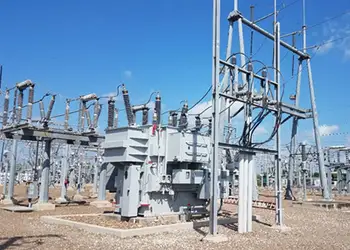
Substation Protection Training - Protect Transformers, Buses and Lines
Our customized live online or in‑person group training can be delivered to your staff at your location.
- Live Online
- 12 hours Instructor-led
- Group Training Available
Regular Price:
$799
Coupon Price:
$699
Energy demand in South Korea, the world's fourth-biggest oil buyer, is set to grow slightly faster than last year due to an improving economy, their energy ministry said recently.
However, the Ministry of Commerce, Industry and Energy said in a statement that the value of South Korea's energy imports are likely to be steady in 2004 because of an expected decline in global prices of oil and liquefied natural gas (LNG).
South Korea, which imports all of its crude oil, is also the world's second-largest buyer of LNG, a super-cooled natural gas. The statement read: "Energy consumption -- including oil, coal, natural gas and nuclear energy -- is expected to grow to 225 million tonnes of oil equivalent (TOE) in 2004, up 4.5 percent from an estimated 215 million TOE in 2003."
According to The Ministry's statement, the demand in 2003 grew 3.0 percent.
The economy, Asia's fourth-biggest, is expected to grow 5.2 percent in 2004 after an estimated 2.9 percent rise in 2003, according to the latest forecast by Seoul's central bank.
The value of energy imports would probably be little changed at $37.8 billion this year compared with $38.0 billion in 2003 as global prices of oil and liquefied natural gas are likely to decline, the ministry said.
The import price of a barrel of crude into South Korea is forecast to fall to $27.2 per barrel in 2004 on cost, insurance and freight (CIF) basis from an estimated $28.7 a barrel last year, the statement said.
The price for LNG is expected to fall to $232.6 per tonne this year from an estimated $257.4 per tonne in 2003, it said.
The portion of the energy imports in the country's total import value would fall to 18.2 percent this year from 21.3 percent last year, it said.
By energy source, the share of oil in the country's energy mix may continue to shrink, while those of natural gas and nuclear energy are forecast to grow, it said. The 2004 energy forecast shows South Korea's energy demand growth is likely to plateau at three to five percent in the coming years versus a 7.5 percent growth seen in the 1990s, the ministry said.
Related News
Berlin urged to remove barriers to PV
Germany Solar Cap Removal would accelerate photovoltaics, storage, and renewables, replacing coal and nuclear during…
View more

Data Centers May Increase Canadian Electricity Bills
Analysts warn that rising data-center and AI demand threatens to push energy infrastructure costs onto…
View more
Franklin Energy and Consumers Energy Support Small Businesses During COVID-19 with Virtual Energy Coaching
Consumers Energy Virtual Energy Coaching connects Michigan small businesses with remote efficiency experts to cut…
View more

Is 5G a waste of electricity? Experts say it's complicated
5G Energy Costs highlight base station power consumption, carrier electricity bills, and carbon emissions in…
View more
Share of coal in UK's electricity system falls to record lows
UK Coal Phase-Out marks record-low coal generation as the UK grid shifts to renewable power,…
View more

Hydro One stock has too much political risk to recommend, Industrial Alliance says
Hydro One Avista merger faces regulatory scrutiny in Washington, Oregon, and Idaho, as political risk…
View more
Sign Up for Electricity Forum’s Newsletter
Stay informed with our FREE Newsletter — get the latest news, breakthrough technologies, and expert insights, delivered straight to your inbox.
Electricity Today T&D Magazine Subscribe for FREE

Stay informed with the latest T&D policies and technologies.
- Timely insights from industry experts
- Practical solutions T&D engineers
- Free access to every issue
