NERC: Outages Began Along Line In Ohio

By


NFPA 70e Training - Arc Flash

Our customized live online or in‑person group training can be delivered to your staff at your location.

  • Live Online
  • 6 hours Instructor-led
  • Group Training Available
Regular Price:
$199
Coupon Price:
$149
Reserve Your Seat Today
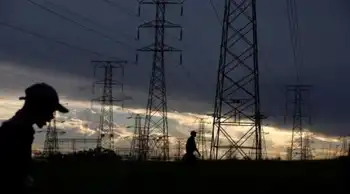
The investigation into this week's power outages zeroed in Friday on an Ohio transmission line that appeared to have been the first one to crash.

The North American Electric Reliability Council said late Friday that the 345 kilovolt Chamberlain-Harding line near Cleveland was the first to trip off line on Thursday afternoon. It was followed in short order by five other Ohio lines and other transmission lines and power plants in the Midwest, Canada and the Northeast.

NERC noted that the reason the Chamberlain line went down was not known. The investigation into the incident is continuing.

The Midwest and East Coast are connected via a U.S.-Canadian transmission system known as the Lake Erie Loop where NERC officials said Friday the trouble was concentrated.

Related News
Heatwave Sparks Unprecedented Electricity Demand Across Eastern U.S

Eastern U.S. Heatwave Electricity Demand surges to record peak load, straining the power grid, lifting wholesale prices, and prompting demand response, conservation measures, and load shedding to protect grid reliability during extreme temperatures.


Key Points

It is the record peak load from extreme heat, straining grids, lifting wholesale prices, and prompting demand response.

✅ Peak electricity use stresses regional power grid.

✅ Prices surge; conservation and demand response urged.

✅ Utilities monitor load, avoid outages via load shedding.


As temperatures soar to unprecedented highs across the Eastern United States, a blistering heatwave has triggered record-breaking electricity demand. This article delves into the causes behind the surge in energy consumption, its impact on the power grid, and measures taken to manage the strain during this extraordinary weather event.

Intensifying Heatwave Conditions

The Eastern U.S. is currently experiencing one of its hottest summers on record, with temperatures climbing well above seasonal norms. This prolonged heatwave has prompted millions of residents to rely heavily on air conditioning and cooling systems to escape the sweltering heat, with electricity struggles worsening in several communities, driving up electricity usage to peak levels.

Strain on Power Grid Infrastructure

The surge in electricity demand during the heatwave has placed significant strain on the region's power grid infrastructure, with supply-chain constraints complicating maintenance and equipment availability during peak periods.

Record-breaking Energy Consumption

The combination of high temperatures and increased cooling demands has led to record-breaking energy consumption levels across the Eastern U.S. States like New York, Pennsylvania, and Maryland have reported peak electricity demand exceeding previous summer highs, with blackout risks drawing heightened attention from operators, highlighting the extraordinary nature of this heatwave event.

Impact on Energy Costs and Supply

The spike in electricity demand during the heatwave has also affected energy costs and supply dynamics. Wholesale electricity prices have surged in response to heightened demand, contributing to sky-high energy bills for many households, reflecting the market's response to supply constraints and increased operational costs for power generators and distributors.

Management Strategies and Response

Utility companies and grid operators have implemented various strategies to manage electricity demand and maintain grid reliability during the heatwave. These include voluntary conservation requests, load-shedding measures, and real-time monitoring of grid conditions to prevent power outages while avoiding potential blackouts or disruptions.

Community Outreach and Public Awareness

Amidst the heatwave, community outreach efforts play a crucial role in raising public awareness about energy conservation and safety measures. Residents are encouraged to conserve energy during peak hours, adjust thermostat settings, and utilize energy-efficient appliances to alleviate strain on the power grid and reduce overall energy costs.

Climate Change and Resilience

The intensity and frequency of heatwaves are exacerbated by climate change, underscoring the importance of building resilience in energy infrastructure and adopting sustainable practices. Investing in renewable energy sources, improving energy efficiency and demand response programs that can reduce peak demand, and implementing climate adaptation strategies are essential steps towards mitigating the impacts of extreme weather events like heatwaves.

Looking Ahead

As the Eastern U.S. navigates through this heatwave, stakeholders are focused on implementing lessons learned from California's grid response to enhance preparedness and resilience for future climate-related challenges. Collaborative efforts between government agencies, utility providers, and communities will be crucial in developing comprehensive strategies to manage energy demand, promote sustainability, and safeguard public health and well-being during extreme weather events.

Conclusion

The current heatwave in the Eastern United States has underscored the critical importance of reliable and resilient energy infrastructure in meeting the challenges posed by extreme weather conditions. By prioritizing energy efficiency, adopting sustainable energy practices, and fostering community resilience, stakeholders can work together to mitigate the impacts of heatwaves and ensure a sustainable energy future for generations to come.


Related News

View more

Trump unveils landmark rewrite of NEPA rules

Trump NEPA Overhaul streamlines environmental reviews, tightening 'reasonably foreseeable' effects, curbing cumulative impacts, codifying CEQ greenhouse gas guidance, expediting permits for pipelines, highways, and wind projects with two-year EIS limits and one lead agency.


Key Points

Trump NEPA Overhaul streamlines reviews, trims cumulative impacts, keeps GHG analysis for foreseeable effects.

✅ Limits cumulative and indirect impacts; emphasizes foreseeable effects

✅ Caps EIS at two years; one-year environmental assessments

✅ One lead agency; narrower NEPA triggers for low federal funding


President Trump has announced plans for overhauling rules surrounding the nation’s bedrock environmental law, and administration officials refuted claims they were downplaying greenhouse gas emissions, as the administration also pursues replacement power plant rules in related areas.

The president, during remarks at the White House with supporters and Cabinet officials, said he wanted to fix the nation’s “regulatory nightmare” through new guidelines for implementing the National Environmental Policy Act.

“America is a nation of builders,” he said. But it takes too long to get a permit, and that’s “big government at its absolute worst.”

The president said, “We’re maintaining America’s world-class standards of environmental protection.” He added, “We’re going to have very strong regulation, but it’s going to go very quickly.”

NEPA says the federal government must consider alternatives to major projects like oil pipelines, highways and bridges that could inflict environmental harm. The law also gives communities input.

The Council on Environmental Quality has not updated the implementing rules in decades, and both energy companies and environmentalists want them reworked, even as some industry groups warned against rushing electricity pricing changes under related policy debates.

But they patently disagree on how to change the rules.

A central fight surrounds whether the government considers climate change concerns when analyzing a project.

Environmentalists want agencies to look more at “cumulative” or “indirect” impacts of projects. The Trump plan shuts the door on that.

“Analysis of cumulative effects is not required,” the plan states, adding that CEQ “proposes to make amendments to simplify the definition of effects by consolidating the definition into a single paragraph.”

CEQ Chairwoman Mary Neumayr told reporters during a conference call that definitions in the current rules were the “subject of confusion.”

The proposed changes, she said, do in fact eliminate the terms “cumulative” and “indirect,” in favor of more simplified language.

Effects must be “reasonably foreseeable” and require a “reasonably close causal relationship” to the proposed action, she added. “It does not exclude considerations of greenhouse gas emissions,” she said, pointing to parallel EPA proposals for new pollution limits on coal and gas power plants as context.

Last summer, CEQ issued proposed guidance on greenhouse gas reviews in project permitting. The nonbinding document gave agencies broad authority when considering emissions (Greenwire, June 21, 2019).

Environmentalists scoffed and said the proposed guidance failed to incorporate the latest climate science and look at how projects could be more resilient in the face of severe weather and sea-level rise.

The proposed NEPA rules released today include provisions to codify the proposed guidance, which has also been years in the making.

Other provisions

Senior administration officials sought to downplay the effect of the proposed NEPA rules by noting the underlying statute will remain the same.

“If it required NEPA yesterday, it will require NEPA under the new proposal,” an official said when asked how the changes might apply to pipelines like Keystone XL.

And yet the proposed changes could alter the “threshold consideration” that triggers NEPA review. The proposal would exclude projects with minimal federal funding or “participation.”

The Trump plan also proposes restricting an environmental impact statement to two years and an environmental assessment to one.

Neumayr said the average EIS takes 4 ½ years and in some cases longer. Democrats have disputed those timelines. Further, just 1% of all federal actions require an EIS, they argue.

The proposal would also require one agency to take the lead on permitting and require agency officials to “timely resolve disputes that may result in delays.”

In general, the plan calls for environmental documents to be “concise” and “serve their purpose of informing decision makers.”

Both Interior Secretary David Bernhardt and EPA Administrator Andrew Wheeler, whose agency moved to rewrite coal power plant wastewater limits in separate actions, were at the White House for the announcement.

Reaction

An onslaught of critics have said changes to NEPA rules could be the administration’s most far-reaching environmental rollback, and state attorneys general have mounted a legal challenge to related energy actions as well.

The League of Conservation Voters declared the administration was again trying to “sell out the health and well-being of our children and families to corporate polluters.”

On Capitol Hill, House Speaker Nancy Pelosi (D-Calif.) said during a news conference the administration would “no longer enforce NEPA.”

“This means more polluters will be right there, next to the water supply of our children,” she said. “That’s a public health issue. Their denial of climate, they are going to not use the climate issue as anything to do with environmental decisionmaking.”

Sen. Sheldon Whitehouse (D-R.I.) echoed the sentiment, saying he didn’t need any more proof that the fossil fuel industry had hardwired the Trump administration “but we got it anyway.”

Energy companies, including firms focused on renewable energy development, are welcoming the “clarity” of the proposed NEPA rules, even as debates continue over a clean electricity standard in federal climate policy.

“The lack of clarity in the existing NEPA regulations has led courts to fill the gaps, spurring costly litigation across the sector, and has led to unclear expectations, which has caused significant and unnecessary delays for infrastructure projects across the country,” the Interstate Natural Gas Association of America said in a statement.

Last night, the American Wind Energy Association said NEPA rules have caused “unreasonable and unnecessary costs and long project delays” for land-based and offshore wind energy and transmission development.

Trump has famously attacked the wind energy industry for decades, dating back to his opposition to a Scottish wind turbine near his golf course.

The president today said he won’t stop until “gleaming new infrastructure has made America the envy of the world again.”

When asked whether he thought climate change was a “hoax,” as he once tweeted, he said no. “Nothing’s a hoax about that,” he said.

The president said there’s a book about climate he’s planning to read. He said, “It’s a very serious subject.”


Related News

View more

EU outlines $300 billion plan to dump Russian energy

REPowerEU Plan accelerates the EU's shift from Russian fossil fuels with renewable energy, energy efficiency, solar, wind, heat pumps, faster permits, and energy security measures by 2027, backed by grants, loans, and grid investments.


Key Points

EU plan to quit Russian fossil fuels via renewables and efficiency, with faster permits, by 2027.

✅ €300bn in grants and loans for efficiency and renewables

✅ Streamlined permits; solar mandate on new buildings

✅ Targets 2027 independence; cuts Russian gas, oil, coal


The European Union’s executive arm moved Wednesday to jump-start plans for the 27-nation bloc to abandon Russian energy amid the Kremlin’s war in Ukraine, proposing a nearly 300 billion-euro ($315 billion) package that includes more efficient use of fuels and faster rollout of renewable power, even as rolling back electricity prices remains challenging.

The European Commission’s investment initiative is meant to help the 27 EU countries start weaning themselves off Russian fossil fuels this year, a move many see as a wake-up call to ditch fossil fuels across Europe. The goal is to deprive Russia, the EU’s main supplier of oil, natural gas and coal, of tens of billions in revenue and strengthen EU climate policies.

“We are taking our ambition to yet another level to make sure that we become independent from Russian fossil fuels as quickly as possible,” European Commission President Ursula von der Leyen said in Brussels when announcing the package, dubbed REPowerEU.

With no end in sight to Russia’s war in Ukraine and European energy security shaken, amid what some describe as an energy nightmare for the region, the EU is rushing to align its geopolitical and climate interests for the coming decades. It comes amid troubling signs that have raised concerns about energy supplies that the EU relies on and have no quick replacements for, including Russia cutting off member nations Poland and Bulgaria after they refused a demand to pay for natural gas in rubles.

The bloc’s dash to ditch Russian energy stems from a combination of voluntary and mandatory actions. Both reflect the political discomfort of helping fund Russia’s military campaign in a country that neighbors the EU and wants to join the bloc.

An EU ban on coal from Russia is due to start in August, and the bloc has pledged to try to reduce demand for Russian gas by two-thirds by year's end, while debating gas price cap strategies to curb volatility. Meanwhile, a proposed EU oil embargo has hit a roadblock from Hungary and other landlocked countries that worry about the cost of switching to alternative sources.

In a bid to swing Hungary behind the oil phaseout, the REPowerEU package expects oil investment funding of around 2 billion euros for member nations highly dependent on Russian oil.

Energy savings and renewables form the cornerstones of the package, which would be funded mainly by an economic stimulus program put in place to help member countries overcome the slump triggered by the coronavirus pandemic.

The European Commission said the price tag for abandoning Russian fossil fuels completely by a 2027 target date is 210 billion euros. Its package includes 56 billion euros for energy efficiency and 86 billion euros for renewables.

Von der Leyen cited a total funding pot of 72 billion euros in grants and 225 billion euros for loans.

The European Commission also proposed ways to streamline the approval processes in EU countries for renewable projects, which can take up to a decade to get through red tape, as part of a broader effort to revamp the electricity market across Europe. The commission said approval times need to fall to as little as a year or less.

It put forward a specific plan on solar energy, seeking to double photovoltaic capacity by 2025 and pushing for a phased-in obligation to install solar panels on new buildings.

Simone Tagliapietra, an energy expert at the Bruegel think tank in Brussels, called REPowerEU a “jumbo package” whose success will ultimately depend on political will in the bloc’s national capitals, with examples such as Germany’s 200 billion euro energy price shield illustrating the scale of national responses.

“Most of the actions entailed in the plan require either national implementation or strong coordination among member states,” Tagliapietra said. “The extent to which countries really engage is going to be defining.”

The German energy think tank Agora Energiewende said the EU’s plan “gives too little attention to concrete initiatives that reduce fossil fuel demand in the short term and thereby misses the opportunity to simultaneously enhance Europe’s energy security and meet Europe’s climate objectives.”

The group's research shows rapidly expanding solar, wind parks and use of heat pumps for low-temperature heat in industry and buildings could be done faster than constructing new liquefied natural gas terminals or gas infrastructure, said Matthias Buck, its director for Europe.

The European Commission’s recommendations on short-term national actions to cut demand for Russian energy, which include potential emergency measures to limit electricity prices as well, coincide with deliberations underway in the bloc since last year on setting more ambitious EU energy-efficiency and renewable targets for 2030.

Those targets, being negotiated by the European Parliament and national governments, are part of the bloc’s commitments to a 55% cut in greenhouse gases by decade's end, compared with 1990 emissions, and to climate neutrality by 2050.

Von der Leyen urged the European Parliament and national governments to deepen the commission’s July proposal for an energy efficiency target of 9% and renewable energy goal of 40% by 2030. She said those objectives should be 13% and 45%, respectively.

Belgium, the Netherlands, Germany and Denmark plan to build North Sea wind farms to help cut carbon emissions.


Related News

View more

Taiwan's economic minister resigns over widespread power outage

Taiwan Power Blackout disrupts Taipei and commercial hubs after a Taoyuan natural gas plant error, triggering nationwide outage, grid failure, elevator rescues, power rationing, and the economic minister's resignation, as CPC Corporation restores supply.


Key Points

A nationwide Taiwan outage from human error at a Taoyuan gas plant, triggering rationing and a minister's resignation.

✅ Human error disrupted natural gas supply at Taoyuan plant

✅ 6.68 million users affected; grid failure across cities

✅ Minister Lee resigned; President Tsai ordered a review


Taiwan's economic minister resigned after power was knocked out in many parts of Taiwan, with regional parallels such as China power cuts highlighting grid vulnerabilities, including capital Taipei's business and high-end shopping district, due to an apparent "human error" at a key power plant.

Economic Affairs minister Lee Chih-kung tendered his resignation verbally to Premier Lin Chuan, United Daily News reported, citing a Cabinet spokesman. Lin accepted the resignation, the spokesman said according to the daily.

As many as 6.68 million households and commercial units saw their power supply cut or disrupted on Tuesday after "human error" disrupted natural gas supply at a power plant in northern Taiwan's Taoyuan, the semi-official Central News Agency reported, citing the government-controlled oil company CPC Corporation as saying.

The company added that power at the plant, Taiwan's biggest natural gas power plant, resumed two minutes later.

In New Taipei City, there were at least 27,000 reported cases of people being stuck in lifts. Photos in social media also showed huge crowds stranded in lift lobby in Taipei's iconic 101-storey Taipei 101 building.

Power rationing was implemented beginning 6pm, and, as seen in the National Grid short supply warning in other markets, such steps aim to stabilize supply, Central News Agency said. Power supply was gradually being restored beginning at about 9:40pm. news reports said.

President Tsai Ing-wen apologised for the blackout, noting parallels with Japan's near-blackouts that underscored grid resilience, and said that she has ordered all relevant departments to produce clear report in the shortest time possible.

"Electricity is not just a problem about people's livelihoods but also a national security issue. A comprehensive review must be carried out to find out how the electric power system can be so easily paralysed by human error," said Ms Tsai in a Facebook post.

Taiwan has been at risk of a power shortage after a recent typhoon knocked down a power transmission tower in Hualien county along the eastern coast of Taiwan, rather than a demand-driven slowdown like the China power demand drop during pandemic factory shutdowns. This reduced the electricity supply by 1.3million kilowatts, or about 4 per cent of the operating reserve.

That was followed by the breakdown of a power generator at Taiwan's largest power plant, which further reduced the operating reserve by 1.5 per cent.

The situation is worsened by the ongoing heatwave that has hit Taiwan, with temperatures soaring to 38 degrees Celsius over the past week.

As a result, the government had imposed the rationing of electricity, and, highlighting how regional strains such as China's power woes can ripple into global markets, switched off all air-conditioning in many of its Taipei offices, a move that drew some public backlash.


Related News

View more

Trump's Proposal to Control Ukraine's Nuclear Plants Sparks Controversy

US Control of Ukraine Nuclear Plants sparks debate over ZNPP, Zaporizhzhia, sovereignty, safety, ownership, and international cooperation, as Washington touts utility expertise, investment, and modernization to protect critical energy infrastructure amid conflict.


Key Points

US management proposal for Ukraine's nuclear assets, notably ZNPP, balancing sovereignty, safety, and investment.

✅ Ukraine retains ownership; any transfer requires parliament approval.

✅ ZNPP safety risks persist amid occupation near active conflict.

✅ International reactions split: sovereignty vs. cooperation and investment.


In a recent phone call with Ukrainian President Volodymyr Zelenskyy, U.S. President Donald Trump proposed that the United States take control of Ukraine's nuclear power plants, including the Zaporizhzhia Nuclear Power Plant (ZNPP), which has been under Russian occupation since early in the war and where Russia is reportedly building power lines to reactivate the plant amid ongoing tensions. Trump suggested that American ownership of these plants could be the best protection for their infrastructure, a proposal that has sparked controversy in policy circles, and that the U.S. could assist in running them with its electricity and utility expertise.

Ukrainian Response

President Zelenskyy promptly addressed Trump's proposal, stating that while the conversation focused on the ZNPP, the issue of ownership was not discussed. He emphasized that all of Ukraine's nuclear power plants belong to the Ukrainian people and that any transfer of ownership would require parliamentary approval . Zelenskyy clarified that while the U.S. could invest in and help modernize the ZNPP, ownership would remain with Ukraine.

Security Concerns

The ZNPP, Europe's largest nuclear facility, has been non-operational since its occupation by Russian forces in 2022. The plant's location near active conflict zones raises significant safety risks that the IAEA has warned of in connection with attacks on Ukraine's power grids, and its future remains uncertain. Ukrainian officials have expressed concerns about potential Russian provocations, such as explosions, especially after UN inspectors reported mines at the Zaporizhzhia plant near key facilities, if and when Ukraine attempts to regain control of the plant.

International Reactions

The proposal has elicited mixed reactions both within Ukraine and internationally. Some Ukrainian officials view it as an opportunistic move by the U.S. to gain control over critical infrastructure, while others see it as a potential avenue for modernization and investment, alongside expanding wind power that is harder to destroy in wartime. The international community remains divided on the issue, with some supporting Ukraine's sovereignty over its nuclear assets and others advocating for a possible agreement on power plant attacks to ensure the plant's safety and future operation.

President Trump's proposal to have the U.S. take control of Ukraine's nuclear power plants has sparked significant controversy. While the U.S. offers expertise and investment, Ukraine maintains that ownership of its nuclear assets is a matter of national sovereignty, even as it has resumed electricity exports to bolster its economy. The situation underscores the complex interplay between security, sovereignty, and international cooperation in conflict zones.


Related News

View more

Its Electric Grid Under Strain, California Turns to Batteries

California Battery Storage is transforming grid reliability as distributed energy, solar-plus-storage, and demand response mitigate rolling blackouts, replace peaker plants, and supply flexible capacity during heat waves and evening peaks across utilities and homes.


Key Points

California Battery Storage uses distributed and utility batteries to stabilize power, shift solar, and curb blackouts.

✅ Supplies flexible capacity during peak demand and heat waves

✅ Enables demand response and replaces gas peaker plants

✅ Aggregated assets form virtual power plants for grid support


Last month as a heat wave slammed California, state regulators sent an email to a group of energy executives pleading for help to keep the lights on statewide. “Please consider this an urgent inquiry on behalf of the state,” the message said.

The manager of the state’s grid was struggling to increase the supply of electricity because power plants had unexpectedly shut down and demand was surging. The imbalance was forcing officials to order rolling blackouts across the state for the first time in nearly two decades.

What was unusual about the emails was whom they were sent to: people who managed thousands of batteries installed at utilities, businesses, government facilities and even homes. California officials were seeking the energy stored in those machines to help bail out a poorly managed grid and reduce the need for blackouts.

Many energy experts have predicted that batteries could turn homes and businesses into mini-power plants that are able to play a critical role in the electricity system. They could soak up excess power from solar panels and wind turbines and provide electricity in the evenings when the sun went down or after wildfires and hurricanes, which have grown more devastating because of climate change in recent years. Over the next decade, the argument went, large rows of batteries owned by utilities could start replacing power plants fueled by natural gas.

But that day appears to be closer than earlier thought, at least in California, which leads the country in energy storage. During the state’s recent electricity crisis, more than 30,000 batteries supplied as much power as a midsize natural gas plant. And experts say the machines, which range in size from large wall-mounted televisions to shipping containers, will become even more important because utilities, businesses and homeowners are investing billions of dollars in such devices.

“People are starting to realize energy storage isn’t just a project or two here or there, it’s a whole new approach to managing power,” said John Zahurancik, chief operating officer at Fluence, which makes large energy storage systems bought by utilities and large businesses. That’s a big difference from a few years ago, he said, when electricity storage was seen as a holy grail — “perfect, but unattainable.”

On Friday, Aug. 14, the first day California ordered rolling blackouts, Stem, an energy company based in the San Francisco Bay Area, delivered 50 megawatts — enough to power 20,000 homes — from batteries it had installed at businesses, local governments and other customers. Some of those devices were at the Orange County Sanitation District, which installed the batteries to reduce emissions by making it less reliant on natural gas when energy use peaks.

John Carrington, Stem’s chief executive, said his company would have provided even more electricity to the grid had it not been for state regulations that, among other things, prevent businesses from selling power from their batteries directly to other companies.

“We could have done two or three times more,” he said.

The California Independent System Operator, which manages about 80 percent of the state’s grid, has blamed the rolling blackouts on a confluence of unfortunate events, including extreme weather impacts on the grid that limited supply: A gas plant abruptly went offline, a lack of wind stilled thousands of turbines, and power plants in other states couldn’t export enough electricity. (On Thursday, the grid manager urged Californians to reduce electricity use over Labor Day weekend because temperatures are expected to be 10 to 20 degrees above normal.)

But in recent weeks it has become clear that California’s grid managers also made mistakes last month, highlighting the challenge of fixing California’s electric grid in real time, that were reminiscent of an energy crisis in 2000 and 2001 when millions of homes went dark and wholesale electricity prices soared.

Grid managers did not contact Gov. Gavin Newsom’s office until moments before it ordered a blackout on Aug. 14. Had it acted sooner, the governor could have called on homeowners and businesses to reduce electricity use, something he did two days later. He could have also called on the State Department of Water Resources to provide electricity from its hydroelectric plants.

Weather forecasters had warned about the heat wave for days. The agency could have developed a plan to harness the electricity in numerous batteries across the state that largely sat idle while grid managers and large utilities such as Pacific Gas & Electric scrounged around for more electricity.

That search culminated in frantic last-minute pleas from the California Public Utilities Commission to the California Solar and Storage Association. The commission asked the group to get its members to discharge batteries they managed for customers like the sanitation department into the grid. (Businesses and homeowners typically buy batteries with solar panels from companies like Stem and Sunrun, which manage the systems for their customers.)

“They were texting and emailing and calling us: ‘We need all of your battery customers giving us power,’” said Bernadette Del Chiaro, executive director of the solar and storage association. “It was in a very last-minute, herky-jerky way.”

At the time of blackouts on Aug. 14, battery power to the electric grid climbed to a peak of about 147 megawatts, illustrating how virtual power plants can rapidly scale, according to data from California I.S.O. After officials asked for more power the next day, that supply shot up to as much as 310 megawatts.

Had grid managers and regulators done a better job coordinating with battery managers, the devices could have supplied as much as 530 megawatts, Ms. Del Chiaro said. That supply would have exceeded the amount of electricity the grid lost when the natural gas plant, which grid managers have refused to identify, went offline.

Officials at California I.S.O. and the public utilities commission said they were working to determine the “root causes” of the crisis after the governor requested an investigation.

Grid managers and state officials have previously endorsed the use of batteries, using AI to adapt as they integrate them at scale. The utilities commission last week approved a proposal by Southern California Edison, which serves five million customers, to add 770 megawatts of energy storage in the second half of 2021, more than doubling its battery capacity.

And Mr. Zahurancik’s company, Fluence, is building a 400 megawatt-hour battery system at the site of an older natural gas power plant at the Alamitos Energy Center in Long Beach. Regulators this week also approved a plan to extend the life of the power plant, which was scheduled to close at the end of the year, to support the grid.

But regulations have been slow to catch up with the rapidly developing battery technology.

Regulators and utilities have not answered many of the legal and logistical questions that have limited how batteries owned by homeowners and businesses are used. How should battery owners be compensated for the electricity they provide to the grid? Can grid managers or utilities force batteries to discharge even if homeowners or businesses want to keep them charged up for their own use during blackouts?

During the recent blackouts, Ms. Del Chiaro said, commercial and industrial battery owners like Stem’s customers were compensated at the rates similar to those that are paid to businesses to not use power during periods of high electricity demand. But residential customers were not paid and acted “altruistically,” she said.


Related News

View more

Sign Up for Electricity Forum’s Newsletter

Stay informed with our FREE Newsletter — get the latest news, breakthrough technologies, and expert insights, delivered straight to your inbox.

Electricity Today T&D Magazine Subscribe for FREE

Stay informed with the latest T&D policies and technologies.
  • Timely insights from industry experts
  • Practical solutions T&D engineers
  • Free access to every issue

Live Online & In-person Group Training

Advantages To Instructor-Led Training – Instructor-Led Course, Customized Training, Multiple Locations, Economical, CEU Credits, Course Discounts.

Request For Quotation

Whether you would prefer Live Online or In-Person instruction, our electrical training courses can be tailored to meet your company's specific requirements and delivered to your employees in one location or at various locations.