Substation Protection Training - Protect Transformers, Buses and Lines
Our customized live online or in‑person group training can be delivered to your staff at your location.
- Live Online
- 12 hours Instructor-led
- Group Training Available
Regular Price:
$799
Coupon Price:
$699
Minor hockey parents are in for a jolt.
This month's jump in electricity rates will mean a spike in ice rental costs next season. For many families, the increase will wipe out any potential savings from the federal budget's introduction of a new tax credit for children's sports programs.
At the A and AA levels of the Greater Toronto Hockey League, rising electricity costs figure to mean fee increases of at least $50 per player — much more on teams that book extra ice time, as most do, and more for tournament play.
"It's getting crazy," says John Cook, director of operations for the privately owned five-pad Westwood and four-surface Chesswood arenas, where electricity costs soared by 25 per cent in their last fiscal year. "Our biggest expense is hydro."
Electricity rates in Toronto increased 5.8 per cent as of May 1, with rates elsewhere in the GTA jumping even more. Electricity represents 18 per cent of Westwood's total operating cost, said Cook. In July 2005, Westwood paid $42,119 for electricity, up from $20,444 the previous summer (including the addition of one extra pad).
Against such cost increases, the federal government's plans for a $500 tax credit — which will save a parent approximately $80 on his or her taxes — on sports registration fees won't go very far.
"Hell, they spend more than that on a stick today," said John Gardner, president of the GTHL and chairman of minor hockey for the Ontario Hockey Federation.
Gardner pointed out that the government has yet to define what activities will qualify for the tax credit and, in any case, the credit won't kick in until 2007. And then there's the issue of coming up with a system for issuing tax receipts.
He wishes the government would simply subsidize electricity costs for minor hockey.
So does Kevin Gordon, whose 14-year-old son will play bantam AA hockey in the GTHL next season. For him, the proposed tax credit "will mean I'll be able to buy one more Xbox game."
Gordon is the ice convenor for the North Toronto Hockey Association, which has 10 GTHL teams and has increased charges this year by $700 per team — or roughly $50 a player — to pay for the more expensive ice. The Scarborough Young Bruins are upping costs $100 a player to $870 to cover ice and contingencies. Those increases don't include the extra hour a week of practice most teams want. Every extra hour will add at least another $50 increase per player in costs.
Elinor Gillespie, general manager of the Etobicoke Canucks, said her organization paid slightly more than $33,000 for ice last year. She is budgeting $35,000 this season and $41,000 next season. That includes one hour of ice per week per team.
"If a team wants two hours (per week), it will have it in its own budget," she said.
House leagues, which primarily play at subsidized, city-owned arenas, are expecting only modest increases in ice fees. But at private arenas, where many teams have to go for additional ice time, costs are jumping.
Gordon said he has been quoted about $300 an hour for ice time at De La Salle Arena during the weekend from September through March. Mid-week prime-time hours preferred by adult programs can reach $450 per hour at private rinks.
"I expect everything to go up," Gordon said. "Hydro is the No.1 expense for compressors and that is the No.1 reason I've been given for the increase."
At the AAA elite level, which can cost upwards of $5,000 a year, Toronto Young National general manager Terry Weir is figuring on at least a 5 per cent increase in ice costs, more in some arenas because they didn't raise fees last year.
"Just look at the energy costs," Weir said. "Private rinks won't absorb that."
Related News
Nelson, B.C. Gets Charged Up on a New EV Fast-Charging Station
Nelson DC Fast-Charging EV Station delivers 50-kilowatt DCFC service at the community complex, expanding EV…
View more
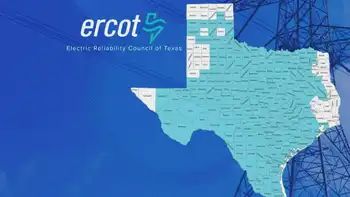
More Polar Vortex 2021 Fallout (and Texas Two-Step): Monitor For ERCOT Identifies Improper Payments For Ancillary Services
ERCOT Ancillary Services Clawback and VOLL Pricing summarize PUCT and IMM actions on load shed,…
View more
When paying $1 for a coal power plant is still paying too much
San Juan Generating Station eyed for $1 coal-plant sale, as Farmington and Acme propose CCS…
View more
New Electricity Auctions Will Drive Down Costs for Ontario's Consumers
IESO Capacity Auctions will competitively procure resources for Ontario electricity needs, boosting reliability and resource…
View more
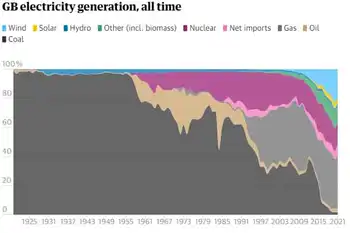
Energy dashboard: how is electricity generated in Great Britain?
Great Britain electricity generation spans renewables and baseload: wind, solar, nuclear, gas, and biomass, supported…
View more
Clean energy jobs energize Pennsylvania: Clean Energy Employment Report
Pennsylvania Clean Energy Employment surges, highlighting workforce growth in energy efficiency, solar, wind, grid and…
View more
Sign Up for Electricity Forum’s Newsletter
Stay informed with our FREE Newsletter — get the latest news, breakthrough technologies, and expert insights, delivered straight to your inbox.
Electricity Today T&D Magazine Subscribe for FREE

Stay informed with the latest T&D policies and technologies.
- Timely insights from industry experts
- Practical solutions T&D engineers
- Free access to every issue
