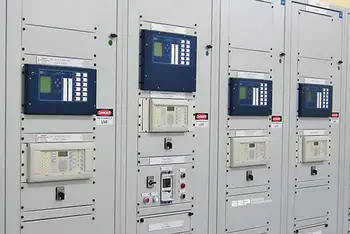
Protective Relay Training - Basic
Our customized live online or in‑person group training can be delivered to your staff at your location.
- Live Online
- 12 hours Instructor-led
- Group Training Available
Regular Price:
$699
Coupon Price:
$599
Delegates from six of the world's biggest greenhouse gas polluters - including the United States - gathered recently for the first time to figure out how private industry can help curb global warming.
The Bush administration is promoting this voluntary effort as a practical way to develop clean-energy technology to tackle climate change. But an environmental expert dismissed it as busy-work that would not be as effective as the requirements imposed by the international Kyoto Protocol on global warming.
Initially skeptical, the U.S. administration accepts the reality of global climate change, which has been associated with stronger hurricanes, severe droughts, intense heat waves and the melting of polar ice.
Greenhouse gases, notably carbon dioxide emitted by motor vehicles and coal-fired power plants, trap heat like the glass walls of a greenhouse, causing Earth to warm up.
More than 300 delegates from the six countries - Australia, China, India, Japan and South Korea, in addition to the United States - met recently in California for the first working sessions of the Asia-Pacific Partnership on Clean Development and Climate.
These six countries account for about half of the world's emissions of climate-heating greenhouse gases. Only one of the six, Japan, is committed to reducing greenhouse gas emissions by 2012 under the Kyoto agreement.
Unveiled last July in Laos and formalized with a high-level meeting in Australia in January, the partnership aims to spur development of cleaner, more energy-efficient technologies, said Paula Dobriansky, under secretary of state for democracy and global affairs in a telephone briefing as the meetings proceeded at Lawrence Livermore National Laboratory.
The California meeting was the first chance for working groups to discuss "concrete steps," Dobriansky said, adding that the group was aiming for "tangible results over these next six months."
The Bush administration has requested $52 million for fiscal 2007 for this program spread among the departments of State, Energy and Commerce and the Environmental Protection Agency.
James Connaughton, chairman of the White House Council on Environmental Quality, dismissed a question about the seemingly low level of U.S. government financial backing.
"(That) perspective is completely turned around," Connaughton said in the telephone briefing. "Only with private sector investment does the technology get deployed. The government does not go out into the world and spend the several trillion dollars that are about to be spent on the technologies that are going to be the solutions to this problem."
Government's role, he said, is to guide investment.
David Doniger, a former Clinton administration expert on climate change now with the nonprofit Natural Resources Defense Council, said that without limits on greenhouse gas emissions, the partnership will be ineffectual.
"The partnership is symptomatic of the Bush administration failure to do anything serious at home or abroad about global warming, because it's all voluntary," Doniger said by telephone.
Over the past 30 years, the Earth has warmed by 1.08 degrees Fahrenheit (0.6 degrees Celsius); over the last 100 years, it has warmed by 1.44 degrees F. (0.8 Celsius), according to NASA's Goddard Institute for Space Studies.
Related News

China's electric power woes cast clouds on U.S. solar's near-term future
China Power Rationing disrupts the solar supply chain as coal shortages, price controls, and dual-control…
View more
Britain breaks record for coal-free power generation - but what does this mean for your energy bills?
UK Coal-Free Electricity Record highlights rapid growth in renewables as National Grid phases out coal;…
View more
ABL Secures Contract for UK Subsea Power
ABL has secured a contract for the UK Subsea Power Link, highlighting ABL Group’s marine…
View more
China to build 525-MW hydropower station on Yangtze tributary
Baima Hydropower Station advances China renewable energy on the Wujiang River, a Yangtze tributary in…
View more

Pennsylvania lawmaker drafts bill requiring data centers to pay grid costs
Pennsylvania Data Center Grid Costs are the focus of draft legislation requiring large-load projects to…
View more
Balancing Act: Germany's Power Sector Navigates Energy Transition
Germany January Power Mix shows gas-fired generation rising, coal steady, and nuclear phaseout impacts, amid…
View more
Sign Up for Electricity Forum’s Newsletter
Stay informed with our FREE Newsletter — get the latest news, breakthrough technologies, and expert insights, delivered straight to your inbox.
Electricity Today T&D Magazine Subscribe for FREE

Stay informed with the latest T&D policies and technologies.
- Timely insights from industry experts
- Practical solutions T&D engineers
- Free access to every issue
