By Moreover, Mr. Adams added, households who don't sign contracts are eligible for a possible rebate from Ontario Power Generation Inc. OPG's revenue has been capped at 3.8=A2 KWh, so anything it earns over that amount will be paid back to consumer


NFPA 70e Training - Arc Flash

Our customized live online or in‑person group training can be delivered to your staff at your location.

  • Live Online
  • 6 hours Instructor-led
  • Group Training Available
Regular Price:
$199
Coupon Price:
$149
Reserve Your Seat Today
-- Should You Lock In Your Electricity Price? The heat wave that gripped Ontario for the past week didn't just drive up the mercury on thermometers -- it boosted the price of electricity in the province's newly deregulated market.

Electricity skyrocketed to as much as $4.71 a kilowatt hour (KWh) during peak hours this week. That's steep, considering the average price for power in May and June was 2.9=A2 KWh and 3.5=A2 KWh, respectively. (A kilowatt hour is equal to burning 10 100-watt lightbulbs for one hour.)

This got a lot of households wondering whether those long-term, fixed-price contracts that door-to-door salesmen tried to hawk prior to May 1 were a good idea after all. As of May 1, Ontario consumers had the choice of taking their electricity from their local utility at a floating rate, or buying it from a retailer offering a long-term, fixed price contract.

Based on what's currently available, contracts go for 5.69=A2 KWh to 6.07=A2 KWh for a three-year deal, or 5.95=A2 KWh to 6.2=A2 KWh for five years.

Retailers are launching a new sales push, trying to capitalize on this week's price volatility -- as demonstrated by Direct Energy Marketing Ltd. introducing a three-year contract with an escape clause after one year if customers aren't happy.

So, is the fixed-price contract worth it?

Paul Massara, president of Direct Energy, a large electricity and gas retailer, believes it is. The long-term contract, he said, offers customers "peace of mind" about hydro. "We are entering into the summer period and you are starting to see volatile prices. People want certainty, peace of mind. They don't want to watch everyday price spikes and everything else happening."

Under Ontario's reforms, the price of electricity floats and is set by demand-and-supply forces. Before May 1, the price charged to consumers was roughly 4.3=A2 KWh.

Mr. Massara compares the fixed-price contracts to mortgages. "You don't know what you are going to get in floating interest rates, so you get certainty by locking in your mortgage rate.

"We don't know where prices are going. We don't have a crystal ball, but what we can tell you is that there will be a lot of volatility," particularly in the summer and winter months, when demand is high. "People are going to have to get used to price volatility unless they lock in at a fixed price product -- and there's a lot of people who want that security."

On the opposite side is Tom Adams, executive director of Energy Probe, an industry watchdog. He said consumers should not rush out and sign contracts based on the events of the past week. "Newspapers always tell us when the price goes up, but they don't have space when the price goes down, so consumers often get the impression that prices do nothing but go up."

He said during the last spike in natural gas prices, in the spring of 2001, gas retailers signed up thousands of customers for five-year deals at up to 33=A2 per cubic metre. Gas is now available in the 15=A2 to 20=A2 per cubic metre range. "There's a cautionary lesson here -- don't panic about the price spikes."

Mr. Adams compares the fixed-price contract to insuring your car's windshield. "Over a lifetime of driving, you know you'll replace a couple of windshields. But if you insure your windshield, you don't pay for two windshields -- you pay for 10." Similarly, it's in the customers' best interest to stay floating and avoid fixed bills, he said.

Related News

Proposed underground power line could bring Iowa wind turbine electricity to Chicago

SOO Green Underground Transmission Line proposes an HVDC corridor buried along Canadian Pacific railroad rights-of-way to deliver Iowa wind energy to Chicago, enhance grid interconnection, and reduce landowner disruption from new overhead lines.


Key Points

A proposed HVDC project burying lines along a railroad to move Iowa wind power to Chicago and link two grids.

✅ HVDC link from Mason City, IA, to Plano, IL

✅ Buried in Canadian Pacific railroad right-of-way

✅ Connects MISO and PJM grids for renewable exchange


The company behind a proposed underground transmission line that would carry electricity generated mostly by wind turbines in Iowa to the Chicago area said Monday that the $2.5 billion project could be operational in 2024 if regulators approve it, reflecting federal transmission funding trends seen recently.

Direct Connect Development Co. said it has lined up three major investors to back the project. It plans to bury the transmission line in land that runs along existing Canadian Pacific railroad tracks, hopefully reducing the disruption to landowners. It's not unusual for pipelines or fiber optic lines to be buried along railroad tracks in the land the railroad controls.

CEO Trey Ward said he "believes that the SOO Green project will set the standard regarding how transmission lines are developed and constructed in the U.S."

A similar proposal from a different company for an overhead transmission line was withdrawn in 2016 after landowners raised concerns, even as projects like the Great Northern Transmission Line advanced in the region. That $2 billion Rock Island Clean Line was supposed to run from northwest Iowa into Illinois.

The new proposed line, which was first announced in 2017, would run from Mason City, Iowa, to Plano, Ill., a trend echoed by Canadian hydropower to New York projects. The investors announced Monday were Copenhagen Infrastructure Partners, Jingoli Power and Siemens Financial Services.

The underground line would also connect two different regional power operating grids, as seen with U.S.-Canada cross-border transmission approvals in recent years, which would allow the transfer of renewable energy back and forth between customers and producers in the two regions.

More than 36 percent of Iowa's electricity comes from wind turbines across the state.

Jingoli Power CEO Karl Miller said the line would improve the reliability of regional power operators and benefit utilities and corporate customers in Chicago, even amid debates such as Hydro-Quebec line opposition in the Northeast.


Related News

View more

Spain plans switch to 100% renewable electricity by 2050

Spain 2050 Renewable Energy Plan drives decarbonisation with wind and solar, energy efficiency, fossil fuel bans, and Paris Agreement targets, enabling net-zero power, emissions cuts, and just transition measures for workers and coal regions.


Key Points

A roadmap to 100 percent renewable power by 2050, deep emissions cuts, and a just transition aligned with Paris goals.

✅ Adds 3,000 MW of wind and solar each year through 2030

✅ Bans new fossil fuel drilling, hydrocarbon extraction, and fracking

✅ Targets 35% energy efficiency gains and 35% green power by 2030


Spain has launched an ambitious plan to switch its electricity system entirely to renewable sources, similar to California's 100% clean electricity mandate, by 2050 and completely decarbonise its economy soon after.

By mid-century, as EU electricity demand projections suggest increases, greenhouse gas emissions would be slashed by 90% from 1990 levels under Spain’s draft climate change and energy transition law.

To do this, the country’s social democratic government is committing to installing at least 3,000MW of wind and solar power capacity every year in the next 10 years ahead.

New licences for fossil fuel drills, hydrocarbon exploitation and fracking wells, will be banned, and a fifth of the state budget will be reserved for measures that can mitigate climate change. This money will ratchet upwards from 2025.

Christiana Figueres, a former executive secretary of the UN’s framework convention on climate change (UNFCCC), hailed the draft Spanish law as “an excellent example of the Paris agreement”. She added: “It sets a long-term goal, provides incentives on scaling up emissions technologies and cares about a good transition for the workforce.”

Under the plan, “just transition” contracts will be drawn up, similar to the £220m package announced in October, that will shut most Spanish coalmines in return for a suite of early retirement schemes, re-skilling in clean energy jobs, and environmental restoration. These deals will be partly financed by auction returns from the sale of emissions rights.

The government has already scrapped a controversial “sun tax” that halted Spain’s booming renewables sector earlier this decade, even as IEA analysis finds solar the cheapest electricity worldwide, and the new law will also mandate a 35% electricity share for green energy by 2030.

James Watson, chief executive of the SolarPower Europe trade association, said the law was “a wake-up call to the rest of the world” amid debate on the global energy transition today.

Energy efficiency will also be improved by 35% within 11 years, and government and public sector authorities will be able to lease only buildings that have almost zero energy consumption.

Laurence Tubiana, chief executive of the European Climate Foundation, and former French climate envoy who helped draft the Paris accord, described the agreement as groundbreaking and inspirational. “By planning on going carbon neutral, Spain shows that the battle against climate change is deadly serious, that they are ready to step up and plan to reap the rewards of decarbonisation,” she said.

However, the government’s hold on power is fragile. With just a quarter of parliamentary seats it will depend on the more leftwing Podemos and liberal Ciudadanos parties to pass the climate plan.

No dates were included in the legislation for phaseouts of coal or nuclear energy, and, echoing UK net zero policy shifts, a ban on new cars with petrol or diesel engines was delayed until 2040.


Related News

View more

Duke Energy will spend US$25bn to modernise its US grid

Duke Energy Clean Energy Strategy targets smart grid upgrades, wind and solar expansion, efficient gas, and high-reliability nuclear, cutting CO2, boosting decarbonization, and advancing energy efficiency and reliability for the Carolinas.


Key Points

A plan investing in smart grids, renewables, gas, and nuclear to cut CO2 and enhance reliability and efficiency by 2030.

✅ US$25bn smart grid upgrades; US$11bn renewables and gas

✅ 40% CO2 reduction and >80% low-/zero-carbon generation by 2030

✅ 2017 nuclear fleet 95.64% capacity factor; ~90 TWh carbon-free


The US power group Duke Energy plans to invest US$25bn on grid modernization over the 2017-2026 period, including the implementation of smart grid technologies to cope with the development of renewable energies, along with US$11bn on the expansion of renewable (wind and solar) and gas-fired power generation capacities.

The company will modernize its fleet and expects more than 80% of its power generation mix to come from zero and lower CO2 emitting sources, aligning with nuclear and net-zero goals, by 2030. Its current strategy focuses on cutting down CO2 emissions by 40% by 2030. Duke Energy will also promote energy efficiency and expects cumulative energy savings - based on the expansion of existing programmes - to grow to 22 TWh by 2030, i.e. the equivalent to the annual usage of 1.8 million households.

#google#

Duke Energy’s 11 nuclear generating units posted strong operating performance in 2017, as U.S. nuclear costs hit a ten-year low, providing the Carolinas with nearly 90 billion kilowatt-hours of carbon-free electricity – enough to power more than 7 million homes.

Globally, China's nuclear program remains on a steady development track, underscoring broader industry momentum.

“Much of our 2017 success is due to our focus on safety and work efficiencies identified by our nuclear employees, along with ongoing emphasis on planning and executing refueling outages to increase our fleet’s availability for producing electricity,” said Preston Gillespie, Duke Energy chief nuclear officer.

Some of the nuclear fleet’s 2017 accomplishments include, as a new U.S. reactor comes online nationally:

  • The 11 units achieved a combined capacity factor of 95.64 percent, second only to the fleet’s 2016 record of 95.72 percent, marking the 19th consecutive year of attaining a 90-plus percent capacity factor (a measure of reliability).
  • The two units at Catawba Nuclear Station produced more than 19 billion kilowatt-hours of electricity, and the single unit at Harris Nuclear Plant generated more than 8 billion kilowatt-hours, both setting 12-month records.
  • Brunswick Nuclear Plant unit 2 achieved a record operating run.
  • Both McGuire Nuclear Station units completed their shortest refueling outages ever and unit 1 recorded its longest operating run.
  • Oconee Nuclear Station unit 2 achieved a fleet record operating run.

The Robinson Nuclear Plant team completed the station’s 30th refueling outage, which included a main generator stator replacement and other life-extension activities, well ahead of schedule.

“Our nuclear employees are committed to providing reliable, clean electricity every day for our Carolinas customers,” added Gillespie. “We are very proud of our team’s 2017 accomplishments and continue to look for additional opportunities to further enhance operations.”


Related News

View more

Toronto Power Outages Persist for Hundreds After Spring Storm

Toronto Hydro Storm Outages continue after strong winds and heavy rain, with crews restoring power, clearing debris and downed lines. Safety alerts and real-time updates guide affected neighborhoods via website and social media.


Key Points

Toronto Hydro Storm Outages are weather-related power cuts; crews restore service safely and share public updates.

✅ Crews prioritize areas with severe damage and limited access

✅ Report downed power lines; keep a safe distance

✅ Check website and social media for restoration updates


In the aftermath of a powerful spring storm that swept through Toronto on Tuesday, approximately 400 customers remain without power as of Sunday. The storm, which brought strong winds and heavy rain that caused severe flooding in some areas, led to significant damage across the city, including downed trees and power lines. Toronto Hydro crews have been working tirelessly to restore service, similar to efforts by Sudbury Hydro crews in Northern Ontario, focusing on areas with the most severe damage. While many customers have had their power restored, the remaining outages are concentrated in neighborhoods where access is challenging due to debris and fallen infrastructure.

Toronto Hydro has assured residents that restoration efforts are ongoing and that they are prioritizing safety and efficiency, in step with recovery from damaging storms in Ontario across the province. The utility company has urged residents to report any downed power lines and to avoid approaching them, as they may still be live and dangerous, and notes that utilities sometimes rely on mutual aid deployments to speed restoration in large-scale events. Additionally, Toronto Hydro has been providing updates through their website and social media channels, keeping the public informed about the status of power restoration in affected areas.

The storm's impact has also led to disruptions in other services, and power outages in London disrupted morning routines for thousands earlier in the week. Some public transportation routes experienced delays due to debris on tracks, and several schools in the affected areas were temporarily closed. City officials are coordinating with various agencies to address these issues and ensure that services return to normal as quickly as possible, even as Quebec contends with widespread power outages after severe windstorms.

Residents are advised to stay updated on the situation through official channels and to exercise caution when traveling in storm-affected areas. Toronto Hydro continues to work diligently to restore power to all customers and appreciates the public's patience during this challenging time, a challenge echoed when Texas utilities struggled to restore power during Hurricane Harvey.


Related News

View more

Hydro One reports $1.1B Q2 profit boosted by one-time gain due to court ruling

Hydro One Q2 Earnings surge on a one-time gain from a court ruling on a deferred tax asset, lifting profit, revenue, and adjusted EPS at Ontario's largest utility regulated by the Ontario Energy Board.


Key Points

Hydro One Q2 earnings jumped on an $867M court gain, with revenue at $1.67B and adjusted EPS improving to $0.39.

✅ One-time gain: $867M from tax appeal ruling.

✅ Revenue: $1.67B vs $1.41B last year.

✅ Adjusted EPS: $0.39 vs $0.26.


Hydro One Ltd., following the Peterborough Distribution sale transaction closing, reported a second-quarter profit of $1.1 billion, boosted by a one-time gain related to a court decision.

The power utility says it saw a one-time gain of $867 million in the quarter due to an Ontario court ruling on a deferred tax asset appeal that set aside an Ontario Energy Board decision earlier.

Hydro One says the profit amounted to $1.84 per share for the quarter ended June 30, amid investor concerns about uncertainties, up from $155 million or 26 cents per share a year earlier.

Shares also moved lower after the Ontario government announced leadership changes, as seen when Hydro One shares fell on the news in prior trading.

On an adjusted basis, it says it earned 39 cents per share for the quarter, despite earlier profit plunge headlines, up from an adjusted profit of 26 cents per share in the same quarter last year.

Revenue totalled $1.67 billion, up from $1.41 billion in the second quarter of 2019, while other Canadian utilities like Manitoba Hydro face heavy debt burdens.

Hydro One is Ontario’s largest electricity transmission and distribution provider, and its CEO compensation has drawn scrutiny in the province.


Related News

View more

UK low-carbon electricity generation stalls in 2019

UK low-carbon electricity 2019 saw stalled growth as renewables rose slightly, wind expanded, nuclear output fell, coal hit record lows, and net-zero targets demand faster deployment to cut CO2 intensity below 100gCO2/kWh.


Key Points

Low-carbon sources supplied 54% of UK power in 2019, up just 1TWh; wind grew, nuclear fell, and coal dropped to 2%.

✅ Wind up 8TWh; nuclear down 9TWh amid outages

✅ Fossil fuels 43% of generation; coal at 2%

✅ Net-zero needs 15TWh per year added to 2030


The amount of electricity generated by low-carbon sources in the UK stalled in 2019, Carbon Brief analysis shows.

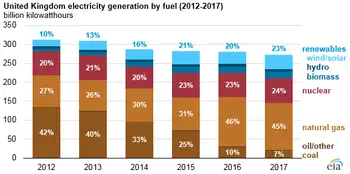
Low-carbon electricity output from wind, solar, nuclear, hydro and biomass rose by just 1 terawatt hour (TWh, less than 1%) in 2019. It represents the smallest annual increase in a decade, where annual growth averaged 9TWh. This growth will need to double in the 2020s to meet UK climate targets while replacing old nuclear plants as they retire.

Some 54% of UK electricity generation in 2019 came from low-carbon sources, including 37% from renewables and 20% from wind alone, underscoring wind's leading role in the power mix during key periods. A record-low 43% was from fossil fuels, with 41% from gas and just 2% from coal, also a record low. In 2010, fossil fuels generated 75% of the total.

Carbon Brief’s analysis of UK electricity generation in 2019 is based on figures from BM Reports and the Department for Business, Energy and Industrial Strategy (BEIS). See the methodology at the end for more on how the analysis was conducted.

The numbers differ from those published earlier in January by National Grid, which were for electricity supplied in Great Britain only (England, Wales and Scotland, but excluding Northern Ireland), including via imports from other countries.

Low-carbon low
In 2019, the UK became the first major economy to target net-zero greenhouse gas emissions by 2050, increasing the ambition of its legally binding Climate Change Act.

To date, the country has cut its emissions by around two-fifths since 1990, with almost all of its recent progress coming from the electricity sector.

Emissions from electricity generation have fallen rapidly in the decade since 2010 as coal power has been almost phased out and even gas output has declined. Fossil fuels have been displaced by falling demand and by renewables, such as wind, solar and biomass.

But Carbon Brief’s annual analysis of UK electricity generation shows progress stalled in 2019, with the output from low-carbon sources barely increasing compared to a year earlier.

The chart below shows low-carbon generation in each year since 2010 (grey bars) and the estimated level in 2019 (red). The pale grey bars show the estimated future output of existing low-carbon sources after old nuclear plants retire and the pale red bars show the amount of new generation needed to keep electricity sector emissions to less than 100 grammes of CO2 per kilowatt hour (gCO2/kWh), the UK’s nominal target for the sector.

 Annual electricity generation in the UK by fuel, terawatt hours, 2010-2019. Top panel: fuel by fuel. Bottom panel: cumulative total generation from all sources. Source: BEIS energy trends, BM Reports and Carbon Brief analysis. Chart by Carbon Brief using Highcharts.
As the chart shows, the UK will require significantly more low-carbon electricity over the next decade as part of meeting its legally binding climate goals.

The nominal 100gCO2/kWh target for 2030 was set in the context of the UK’s less ambitious goal of cutting emissions to 80% below 1990 levels by 2050. Now that the country is aiming to cut emissions to net-zero by 2050, that 100gCO2/kWh indicator is likely to be the bare minimum.

Even so, it would require a rapid step up in the pace of low-carbon expansion, compared to the increases seen over the past decade. On average, low-carbon generation has risen by 9TWh each year in the decade since 2010 – including a rise of just 1TWh in 2019.

Given scheduled nuclear retirements and rising demand expected by the Committee on Climate Change (CCC) – with some electrification of transport and heating – low-carbon generation would need to increase by 15TWh each year until 2030, just to meet the benchmark of 100gCO2/kWh.

For context, the 3.2 gigawatt (GW) Hinkley C new nuclear plant being built in Somerset will generate around 25TWh once completed around 2026. The world’s largest offshore windfarm, the 1.2GW Hornsea One scheme off the Yorkshire coast, will generate around 5TWh each year.

The new Conservative government is targeting 40GW of offshore wind by 2030, up from today’s figure of around 8GW. If policies are put in place to meet this goal, then it could keep power sector emissions below 100gCO2/kWh, depending on the actual performance of the windfarms built.

However, new onshore wind and solar, further new nuclear or other low-carbon generation, such as gas with carbon capture and storage (CCS), is likely to be needed if demand is higher than expected, or if the 100gCO2/kWh benchmark is too weak in the context of net-zero by 2050.

The CCC says it is “likely” to “reflect the need for more rapid deployment” of low-carbon towards net-zero emissions in its advice on the sixth UK carbon budget for 2033-2037, due in September.

Trading places
Looking more closely at UK electricity generation in 2019, Carbon Brief’s analysis shows why there was so little growth for low-carbon sources compared to the previous year.

There was another increase for wind power in 2019 (up 8TWh, 14%), with record wind generation as several large new windfarms were completed including the 1.2GW Hornsea One project in October and the 0.6GW Beatrice offshore windfarm in Q2 of 2019. But this was offset by a decline for nuclear (down 9TWh, 14%), due to ongoing outages for reactors at Hunterston in Scotland and Dungeness in Kent.

(Analysis of data held by trade organisation RenewableUK suggests some 0.6GW of onshore wind capacity also started operating in 2019, including the 0.2GW Dorenell scheme in Moray, Scotland.)

As a result of these movements, the UK’s windfarms overtook nuclear for the first time ever in 2019, becoming the country’s second-largest source of electricity generation, and earlier, wind and solar together surpassed nuclear in the UK as momentum built. This is shown in the figure below, with wind (green line, top panel) trading places with nuclear (purple) and gas (dark blue) down around 25% since 2010 but remaining the single-largest source.

 Annual electricity generation in the UK by fuel, terawatt hours, 2010-2019. Top panel: fuel by fuel. Bottom panel: cumulative total generation from all sources. Source: BEIS energy trends, BM Reports and Carbon Brief analysis. Chart by Carbon Brief using Highcharts.
The UK’s currently suspended nuclear plants are due to return to service in January and March, according to operator EDF, the French state-backed utility firm. However, as noted above, most of the UK’s nuclear fleet is set to retire during the 2020s, with only Sizewell B in Suffolk due to still be operating by 2030. Hunterston is scheduled to retire by 2023 and Dungeness by 2028.

Set against these losses, the UK has a pipeline of offshore windfarms, secured via “contracts for difference” with the government, at a series of auctions. The most recent auction, in September 2019, saw prices below £40 per megawatt hour – similar to current wholesale electricity prices.

However, the capacity contracted so far is not sufficient to meet the government’s target of 40GW by 2030, meaning further auctions – or some other policy mechanism – will be required.

Coal zero
As well as the switch between wind and nuclear, 2019 also saw coal fall below solar for the first time across a full year, echoing the 2016 moment when wind outgenerated coal across the UK, after it suffered another 60% reduction in electricity output. Just six coal plants remain in the UK, with Aberthaw B in Wales and Fiddlers Ferry in Cheshire closing in March.

Coal accounted for just 2% of UK generation in 2019, a record-low coal share since centralised electricity supplies started to operate in 1882. The fuel met 40% of UK needs as recently as 2012, but has plummeted thanks to falling demand, rising renewables, cheaper gas and higher CO2 prices.

The reduction in average coal generation hides the fact that the fuel is now often not required at all to meet the UK’s electricity needs. The chart below shows the number of days each year when coal output was zero in 2019 (red line) and the two previous years (blue).

 Cumulative number of days when UK electricity generation from renewable sources has been higher than that from fossil fuels. Source: BEIS energy trends, BM Reports and Carbon Brief analysis. Chart by Carbon Brief using Highcharts.
The 83 days in 2019 with zero coal generation amount to nearly a quarter of the year and include the record-breaking 18-day stretch without the fuel.

Great Britain has been running for a record TWO WEEKS without using coal to generate electricity – the first time this has happened since 1882.

The country’s grid has been coal-free for 45% of hours in 2019 so far.https://www.carbonbrief.org/countdown-to-2025-tracking-the-uk-coal-phase-out …

Coal generation was set for significant reductions around the world in 2019 – including a 20% reduction for the EU as a whole – according to analysis published by Carbon Brief in November.

Notably, overall UK electricity generation fell by another 9TWh in 2019 (3%), bringing the total decline to 58TWh since 2010. This is equivalent to more than twice the output from the Hinkley C scheme being built in Somerset. As Carbon Brief explained last year, falling demand has had a similar impact on electricity-sector CO2 emissions as the increase in output from renewables.

This is illustrated by the fact that the 9TWh reduction in overall generation translated into a 9TWh (6%) cut in fossil-fuel generation during 2019, with coal falling by 10TWh and gas rising marginally.

Increasingly renewable
As fossil-fuel output and overall generation have declined, the UK’s renewable sources of electricity have continued to increase. Their output has risen nearly five-fold in the past decade and their share of the UK total has increased from 7% in 2010 to 37% in 2019.

As a result, the UK’s increasingly renewable grid is seeing more minutes, hours and days during which the likes of wind, solar and biomass collectively outpace all fossil fuels put together, and on some days wind is the main source as well.

The chart below shows the number of days during each year when renewables generated more electricity than fossil fuels in 2019 (red line) and each of the previous four years (blue lines). In total, nearly two-fifths of days in 2019 crossed this threshold.

 Cumulative number of days when the UK has not generated any electricity from coal. Source: BEIS energy trends, BM Reports and Carbon Brief analysis. Chart by Carbon Brief using Highcharts.
There were also four months in 2019 when renewables generated more of the UK’s electricity than fossil fuels: March, August, September and December. The first ever such month came in September 2018 and more are certain to follow.

National Grid, which manages Great Britain’s high-voltage electricity transmission network, is aiming to be able to run the system without fossil fuels by 2025, at least for short periods. At present, it sometimes has to ask windfarm operators to switch off and gas plants to start running in order to keep the electricity grid stable.

Note that biomass accounted for 11% of UK electricity generation in 2019, nearly a third of the total from all renewables. Some two-thirds of the biomass output is from “plant biomass”, primarily wood pellets burnt at Lynemouth in Northumberland and the Drax plant in Yorkshire. The remainder was from an array of smaller sites based on landfill gas, sewage gas or anaerobic digestion.

The CCC says the UK should “move away” from large-scale biomass power plants, once existing subsidy contracts for Drax and Lynemouth expire in 2027.

Using biomass to generate electricity is not zero-carbon and in some circumstances could lead to higher emissions than from fossil fuels. Moreover, there are more valuable uses for the world’s limited supply of biomass feedstock, the CCC says, including carbon sequestration and hard-to-abate sectors with few alternatives.

Methodology
The figures in the article are from Carbon Brief analysis of data from BEIS Energy Trends chapter 5 and chapter 6, as well as from BM Reports. The figures from BM Reports are for electricity supplied to the grid in Great Britain only and are adjusted to include Northern Ireland.

In Carbon Brief’s analysis, the BM Reports numbers are also adjusted to account for electricity used by power plants on site and for generation by plants not connected to the high-voltage national grid. This includes many onshore windfarms, as well as industrial gas combined heat and power plants and those burning landfill gas, waste or sewage gas.

By design, the Carbon Brief analysis is intended to align as closely as possible to the official government figures on electricity generated in the UK, reported in BEIS Energy Trends table 5.1.

Briefly, the raw data for each fuel is in most cases adjusted with a multiplier, derived from the ratio between the reported BEIS numbers and unadjusted figures for previous quarters.

Carbon Brief’s method of analysis has been verified against published BEIS figures using “hindcasting”. This shows the estimates for total electricity generation from fossil fuels or renewables to have been within ±3% of the BEIS number in each quarter since Q4 2017. (Data before then is not sufficient to carry out the Carbon Brief analysis.)

For example, in the second quarter of 2019, a Carbon Brief hindcast estimates gas generation at 33.1TWh, whereas the published BEIS figure was 34.0TWh. Similarly, it produces an estimate of 27.4TWh for renewables, against a BEIS figure of 27.1TWh.

National Grid recently shared its own analysis for electricity in Great Britain during 2019 via its energy dashboard, which differs from Carbon Brief’s figures.


Related News

View more

Sign Up for Electricity Forum’s Newsletter

Stay informed with our FREE Newsletter — get the latest news, breakthrough technologies, and expert insights, delivered straight to your inbox.

Electricity Today T&D Magazine Subscribe for FREE

Stay informed with the latest T&D policies and technologies.
  • Timely insights from industry experts
  • Practical solutions T&D engineers
  • Free access to every issue

Live Online & In-person Group Training

Advantages To Instructor-Led Training – Instructor-Led Course, Customized Training, Multiple Locations, Economical, CEU Credits, Course Discounts.

Request For Quotation

Whether you would prefer Live Online or In-Person instruction, our electrical training courses can be tailored to meet your company's specific requirements and delivered to your employees in one location or at various locations.