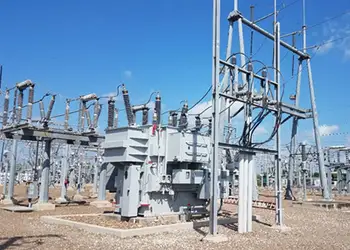
Substation Protection Training - Protect Transformers, Buses and Lines
Our customized live online or in‑person group training can be delivered to your staff at your location.
- Live Online
- 12 hours Instructor-led
- Group Training Available
Regular Price:
$799
Coupon Price:
$699
The restructuring advisory panel met with industry officials.
With more than a dozen power plants in some stage of development across Oklahoma and proposals to open the state's electric market to competitive forces, some wonder whether the aging transmission system can handle the increased load.
If an overhaul of Oklahoma's transmission system is needed, how much would it cost?
Most importantly, who would pay for the upgrade? Taxpayers, customers, or the industry?
A panel known as the Electric Restructuring Advisory Committee was formed to provide the answers to those questions. Committee members met Wednesday at the University of Tulsa to discuss the issue with industry officials.
A report on their findings will be submitted to the Legislature by the end of the year.
Oklahoma's power grid is part of a regional grid managed by the Southwest Power Pool. Nick Brown, SPP senior vice president, said Oklahoma and the other seven states in the SPP are not facing the same circumstances that led to the energy crisis in California, where demand outpaced capacity.
"You can put that out of your mind right now," Brown said. "The transmission facilities in the state of Oklahoma are very adequate to serve native load."
Although the system can support existing demand, it may not be able support the expected growth in consumption, officials said.
Demand for power in Oklahoma is expected to grow 26 percent to 14,350 megawatts by 2010, said Stanton Hadley of the Oak Ridge National Laboratory in Tennessee. The current capacity of the state's transmission system, however, is 13,300 megawatts, Hadley said. Meanwhile, companies have announced plans to build 13,500 megawatts of new power generation in the state,
Asked if Oklahoma's power grid could support future demand, Brown said, "We have no clue until a specific request for transmission service is made."
Hadley indicated that power prices in Oklahoma could drop due to a supply glut created by the construction of several proposed power plants in the state.
State Rep. John Wright, one of nine committee members, questioned Hadley's assumption, saying lower power prices are highly unlikely, especially if utilities are deregulated and allowed to market power outside the state.
"The supplier is going to chase the highest price in the marketplace," Wright said. "If I can obtain a higher price for my electrons in Kansas City, I'm shipping all of it up there."
California-based Calpine Corp. is spending about $20 million on transmission improvements in order to ship electricity from a power plant being built near Coweta to markets throughout the region. Also, Tulsa-based Public Service Company of Oklahoma has plans to spend about $40 million on transmission upgrades over the next few years, a company official said.
Consumers shouldn't bear the cost of upgrades to the state's transmission system, said Jim Satrom of Oklahoma Industrial Energy Consumers, a group of about 20 companies with industrial operations in Oklahoma. Satrom said the funding of such improvements "ought to be a taxpayer issue."
Altogether, OIEC members spend about $100 million a year on electricity, Satrom said.
"Many of our members operate on very thin profit margins," he said. "If a mistake is made which results in an increase in the cost of electricity, many of our members could be faced with having to shut down plants."
Oklahoma power prices, in addition to being the lowest in the region, are among the lowest in the nation, Satrom said. Electric restructuring could jeopardize the state's low consumer rates, he said.
"Even a small error in this process can have disastrous results."
Related News

U.S Bans Russian Uranium to Bolster Domestic Industry
U.S. Russian Uranium Import Ban reshapes nuclear fuel supply, bolstering energy security, domestic enrichment, and…
View more

Hydro-Quebec shocks cottage owner with $5,300 in retroactive charges
Hydro-Quebec back-billing arises from analogue meter errors and estimated consumption, leading to arrears for electricity…
View more

Sens. Wyden, Merkley Introduce Bill to Ensure More Wildfire Resilient Power Grid
Wildfire Resilient Power Grid Act proposes DOE grants for utility companies to fund wildfire mitigation,…
View more

France Demonstrates the Role of Nuclear Power Plants
France Nuclear Power Strategy illustrates a low-carbon, reliable baseload complementing renewables in the energy transition,…
View more

Learn how fees and usage impacts your electricity bill in new online CER tool
CER Interactive Electricity Bill Tool compares provincial electricity prices, fees, taxes, and usage. Explore household…
View more
Hydro-Québec will refund a total of $535 million to customers who were account holders in 2018 or 2019
Hydro-Québec Bill 34 Refund issues $535M customer credits tied to electricity rates, consumption-based rebates, and…
View more
Sign Up for Electricity Forum’s Newsletter
Stay informed with our FREE Newsletter — get the latest news, breakthrough technologies, and expert insights, delivered straight to your inbox.
Electricity Today T&D Magazine Subscribe for FREE

Stay informed with the latest T&D policies and technologies.
- Timely insights from industry experts
- Practical solutions T&D engineers
- Free access to every issue
