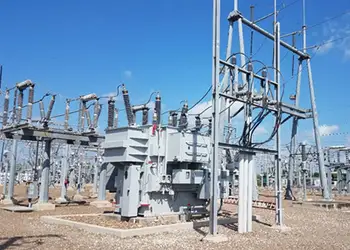
Substation Protection Training - Protect Transformers, Buses and Lines
Our customized live online or in‑person group training can be delivered to your staff at your location.
- Live Online
- 12 hours Instructor-led
- Group Training Available
Regular Price:
$799
Coupon Price:
$699
Twenty years after Sweden alerted the world to the meltdown at Chernobyl, it aims to phase out nuclear power and end dependency on fossil fuels, putting the country in the vanguard of green energy policy.
With soaring oil prices, rising demand, uncertain supply and the need to cut greenhouse gas emissions, energy is in focus and the European Union is calling for coordinated policy.
But the Nordic region - united by history, a shared concern for the environment and a harsh climate which puts heavy demand on power - is divided on energy, not least nuclear power.
When a reactor at a nuclear plant in the Ukrainian town of Chernobyl exploded in 1986 and spewed radioactivity across Europe, the Nordic region was on the front-line: its pristine lakes and forests were polluted and Arctic reindeer meat and lichen contaminated.
Long before radiation on a Swedish power worker's shoes alerted the world to history's worst nuclear accident, Sweden had voted to get rid of atomic energy, in a 1980 referendum.
It now aims to break with fossil fuels by 2020, when it also wants greenhouse gas emissions, blamed by many for global warming, cut by 25 percent against 1990 levels.
"We have to transform into a non-oil economy," said Stefan Edman, who heads the Swedish government's oil dependency panel. "We have very high ambitions, although I don't think it is realistic that not a drop of oil will be used in 2020."
Sweden has already cut oil use in home heating by 70 percent in the last 20 years and has kept consumption flat in industry since 1994, despite a 70 percent increase in production.
The big challenge will be to do something about oil used in the transport sector, where it accounts for 98 percent of energy used, said Professor Christian Azar at Chalmers University of Technology in Gothenburg, also on the oil panel.
"If we could achieve a 50 percent reduction, that would be an enormous achievement."
While worries about oil prices and supply and climate change are major drivers, the government also hopes that environmental technology will be a money-spinner for Swedish companies.
"Sweden has a chance to be an international model and a successful actor in export markets for alternative solutions," said Mona Sahlin, minister for sustainable development.
"The aim is to break dependence on fossil fuels by 2020. By then, no home will need oil for heating. By then, no motorist will be obliged to use petrol as the sole option available. By then, there will be better alternatives to oil."
Sweden produces around 35 percent of its energy from oil and with nuclear power on the way out, finding alternative power sources is a priority.
In Finland, however, nuclear power is seen as part of the future and its fifth atomic power plant - the first built in Europe for more than a decade - is due to come online in 2009.
"The main reason was increasing demand for energy," said Anneli Nikula, spokesman for private power generation firm Teollisuuden Voima, which owns the new power plant.
Finland does not want to rely on neighbors Russia, Sweden and Norway for power and has many old fossil fuel plants which have to be replaced in order to meet climate change goals.
"Cutting down carbon dioxide emissions has sparked debate on nuclear energy in many European countries," said Nikula. "The second coming of nuclear energy is true."
In Norway and Denmark, atomic power has never been an option.
In the 1970s, when other Western nations were building nuclear plants, Norway started developing the vast oil and gas reserves that make it the world's third biggest oil exporter behind Saudi Arabia and Russia.
But the fact that hydropower dams still generate almost all the nation's electricity has dampened environmental concerns.
Controversy surrounds opening up new areas of the Arctic for oil exploration, and using natural gas to supplement hydropower to meet growing demand. But opposition to nuclear power is so entrenched that the center-left government did not even mention it when outlining its policies on taking office in October.
"Nuclear power is not an option for Norway", Oil and Energy Minister Odd Roger Enoksen told Reuters.
Denmark -- home to Vestas, the world's largest wind turbine maker -- hopes use of sustainable sources such as wind and biofuels will reach 36 percent by 2025, from 25 percent in 2003.
It also uses oil and gas from its North Sea fields and the government's 20-year energy plan emphasises keeping that industry competitive.
Iceland also aims to become the world's first oil-free nation, setting its sights on 2050, by shifting cars, buses, trucks and ships over to non-polluting hydrogen.
By then, in theory, the only oil used on the volcanic North Atlantic island would be in planes. About 70 percent of energy needs are already met by geothermal or hydropower -- only the transport sector is still hooked on oil.
For all these countries, the speed of change will depend on the price of oil. As Azar at Chalmers University put it: "The political momentum will drop as fast as the oil price."
Related News
Is Ontario's Power Cost-Effective?
Ontario Nuclear Power Costs highlight LCOE, capex, refurbishment outlays, and waste management, compared with renewables,…
View more
Cooperation agreement for Rosatom and Russian Academy
Rosatom-RAS Cooperation drives joint R&D in nuclear energy, nuclear medicine, fusion, particle accelerators, laser technologies,…
View more
Global oil demand to decline in 2020 as Coronavirus weighs heavily on markets
COVID-19 Impact on Global Oil Demand 2020 signals an IEA forecast of declining consumption as…
View more
British carbon tax leads to 93% drop in coal-fired electricity
Carbon Price Support, the UK carbon tax on power, slashed coal generation, cut CO2 emissions,…
View more
Heat Waves Push U.S. Grid Under Stress as Transmission Faces Limits
US Grid Resilience faces real-time tests as extreme heat collides with rising AI and data…
View more
EDP Plans to Reject $10.9 Billion-China Three Gorges Bid
EDP Takeover Bid Rejection signals pushback on China Three Gorges' acquisition bid, as investors, shareholders,…
View more
Sign Up for Electricity Forum’s Newsletter
Stay informed with our FREE Newsletter — get the latest news, breakthrough technologies, and expert insights, delivered straight to your inbox.
Electricity Today T&D Magazine Subscribe for FREE

Stay informed with the latest T&D policies and technologies.
- Timely insights from industry experts
- Practical solutions T&D engineers
- Free access to every issue
