Winds too fickle at Boston City Hall

By Boston Globe


NFPA 70e Training

Our customized live online or in‑person group training can be delivered to your staff at your location.
  • Live Online
  • 6 hours Instructor-led
  • Group Training Available
Regular Price:
$199
Coupon Price:
$149
Reserve Your Seat Today
Of all the adjectives for little-loved City Hall Plaza in Boston, "windswept" may be the most commonly used.

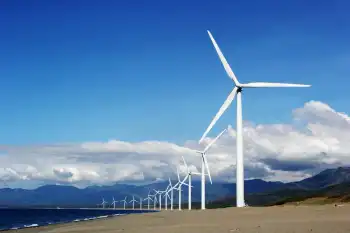
But it turns out the plaza isn't being swept by the right kind of wind. At least not for an electric-generating wind turbine.

Three months after Mayor Thomas M. Menino first floated the idea of installing a windmill somewhere on the bricked-over swale abutting the city's seat of government, engineers have concluded there are too many unpredictable and dangerous gusts and downdrafts as wind bounces off the nearby buildings.

A long-blade turbine would be at serious risk of being damaged - or even getting blown over - if installed in the plaza, according to Menino's chief energy and environmental aide, James W. Hunt.

However, the same study, conducted at no charge to Menino by Second Wind Inc., a Somerville wind-energy consulting firm, concluded that the roof of City Hall itself is ideal for installing a "microturbine" device later this spring. That will generate about enough energy for a half-dozen computers and desk lamps for municipal workers.

Also, Menino is scheduled to announce today that the city school department is studying six school sites as possible locations for wind turbines, based on their locations atop windy hills or at the gusty harbor front. The locations are: Charlestown High School; Dever Elementary and McCormack Middle Schools on Columbia Point in Dorchester; Madison Park Technical-Vocational High School in Roxbury; Ohrenberger Elementary School in West Roxbury; Umana Middle School Academy in East Boston; and the West Roxbury Education Complex, formerly known as West Roxbury High School.

Menino stressed that there will be extensive community meetings before any turbines are approved on school grounds, but officials think they could offer big benefits both for energy-effi ciency and education.

"This is a wonderful opportunity for our students to see up close on a daily basis the power of new technology in creating a cleaner, greener environment," School Superintendent Carol R. Johnson said. "These turbines will serve as outdoor classrooms for our students and help prepare them for the jobs of tomorrow" in designing, building, and installing renewable-energy systems.

Hunt, who got the order in October to investigate putting a turbine on the plaza, said he was disappointed by the study's finding. City officials were originally imagining a unit on the plaza comparable to the 100,000-watt model operating at the Local 103 International Brotherhood of Electrical Workers union hall in Dorchester, alongside the Southeast Expressway.

The microturbine planned for City Hall's roof, donated by Southwest Windpower of Flagstaff, Ariz., will produce only 1,800 watts, less than 2 percent as much as the Local 103 wind turbine. Its blades are about 6 feet long, about a tenth as long as the blades on the Local 103 turbine. Depending on how strong and steady the wind is blowing, the City Hall unit would provide enough energy to power up to 10 computers or one hallway's worth of lights.

But, Hunt said, "It's not about the wind power. It's about the demonstration value. We're excited about having people coming to City Hall to do their business see such a tangible sign of the city's commitment to renewable energy."

The Southwest Windpower device coming to City Hall is similar to one installed by former president George H. W. Bush at his family home in Kennebunkport, Maine, in the fall.

Besides the high-visibility projects planned at City Hall and schools, Menino aides have also begun working with the Boston Redevelopment Authority to add a wind-energy section to the city zoning code. Hunt said the effort aims to provide clear guidance and rules for installing three kinds of turbines within city limits: big units such as the Local 103 turbine; smaller, free-standing units that produce fewer than 100,000 watts; and "building-integrated" small turbines such as the unit planned for the City Hall roof.

Related News
Group of premiers band together to develop nuclear reactor technology

Small Modular Reactors in Canada are advancing through provincial collaboration, offering nuclear energy, clean power and carbon reductions for grids, remote communities, and mines, with factory-built modules, regulatory roadmaps, and pre-licensing by the nuclear regulator.


Key Points

Compact, factory-built nuclear units for clean power, cutting carbon for grids, remote communities, and industry.

✅ Provinces: Ontario, Saskatchewan, New Brunswick collaborate

✅ Targets coal replacement, carbon cuts, clean baseload power

✅ Modular, factory-made units; 5-10 year deployment horizon


The premiers of Ontario, Saskatchewan and New Brunswick have committed to collaborate on developing nuclear reactor technology in Canada. 

Doug Ford, Scott Moe and Blaine Higgs made the announcement and signed a memorandum of understanding on Sunday in advance of a meeting of all the premiers. 

They will be working on the research, development and building of small modular reactors as a way to help their individual provinces reduce carbon emissions and move away from non-renewable energy sources like coal. 

Small modular reactors are easy to construct, are safer than large reactors and are regarded as cleaner energy than coal, the premiers say. They can be small enough to fit in a school gym. 

SMRs are actually not very close to entering operation in Canada, though Ontario broke ground on its first SMR at Darlington recently, signaling early progress. Natural Resources Canada released an "SMR roadmap" last year, with a series of recommendations about regulation readiness and waste management for SMRs.

In Canada, about a dozen companies are currently in pre-licensing with the Canadian Nuclear Safety Commission, which is reviewing their designs.

"Canadians working together, like we are here today, from coast to coast, can play an even larger role in addressing climate change in Canada and around the world," Moe said.  

Canada's Paris targets are to lower total emissions 30 per cent below 2005 levels by 2030, and nuclear's role in climate goals has been emphasized by the federal minister in recent remarks. Moe says the reactors would help Saskatchewan reach a 70 per cent reduction by that year.

The provinces' three energy ministries will meet in the new year to discuss how to move forward and by the fall a fully-fledged strategy for the reactors is expected to be ready.

However, don't expect to see them popping up in a nearby field anytime soon. It's estimated it will take five to 10 years before they're built. 

Ford lauds economic possibilities
The provincial leaders said it could be an opportunity for economic growth, estimating the Canadian market for this energy at $10 billion and the global market at $150 billion.

Ford called it an "opportunity for Canada to be a true leader." At a time when Ottawa and the provinces are at odds, Higgs said it's the perfect time to show unity. 

"It's showing how provinces come together on issues of the future." 

P.E.I. premier predicts unity at Toronto premiers' meeting
No other premiers have signed on to the deal at this point, but Ford said all are welcome and "the more, the merrier."

But developing new energy technologies is a daunting task. Higgs admitted the project will need national support of some kind, though he didn't specify what. The agreement signed by the premiers is also not binding. 

About 8.6 per cent of Canada's electricity comes from coal-fired generation. In New Brunswick that figure is much higher — 15.8 per cent — and New Brunswick's small-nuclear debate has intensified as New Brunswick Premier Blaine Higgs has said he worries about his province's energy producers being hit by the federal carbon tax.

Ontario has no coal-fired power plants, and OPG's SMR commitment aligns with its clean electricity strategy today. In Saskatchewan, burning coal generates 46.6 per cent of the province's electricity.

How would it work?
The federal government describes small modular reactors (SMRs) as the "next wave of innovation" in nuclear energy technology, and collaborations like the OPG and TVA partnership are advancing development efforts, and an "important technology opportunity for Canada."

Traditional nuclear reactors used in Canada typically generate about 800 megawatts of electricity, and Ontario is exploring new large-scale nuclear plants alongside SMRs, or enough to power about 600,000 homes at once (assuming that 1 megawatt can power about 750 homes).

The International Atomic Energy Agency (IAEA), the UN organization for nuclear co-operation, considers a nuclear reactor to be "small" if it generates under 300 megawatts.

Designs for small reactors ranging from just 3 megawatts to 300 megawatts have been submitted to Canada's nuclear regulator, the Canadian Nuclear Safety Commission, for review as part of a pre-licensing process, while plans for four SMRs at Darlington outline a potential build-out pathway that regulators will assess.

Ford rallying premiers to call for large increase in federal health transfers
Such reactors are considered "modular" because they're designed to work either independently or as modules in a bigger complex (as is already the case with traditional, larger reactors at most Canadian nuclear power plants). A power plant could be expanded incrementally by adding additional modules.

Modules are generally designed to be small enough to make in a factory and be transported easily — for example, via a standard shipping container.

In Canada, there are three main areas where SMRs could be used:

Traditional, on-grid power generation, especially in provinces looking for zero-emissions replacements for CO2-emitting coal plants.
Remote communities that currently rely on polluting diesel generation.
Resource extraction sites, such as mining and oil and gas.


Related News

View more

B.C. Hydro adds more vehicle charging stations across southern B.C.

BC Hydro EV Charging Stations expand provincewide with DC fast chargers, 80% in 30 minutes at 35 c/kWh, easing range anxiety across Vancouver, Vancouver Island, Coquihalla Highway, East Kootenay, between Kamloops and Prince George.


Key Points

Public DC fast-charging network across B.C. enabling 80% charge in 30 minutes to cut EV range anxiety.

✅ 28 new stations added; 30 launched in 2016

✅ 35 c/kWh; about $3.50 per tank equivalent

✅ Coverage: Vancouver, Island, Coquihalla, East Kootenay


B.C. Hydro is expanding its network of electric vehicle charging stations.

The Crown utility says 28 new stations complete the second phase of its fast-charging network and are in addition to the 30 stations opened in 2016.

Thirteen of the stations are in Metro Vancouver, seven are on Vancouver Island, including one at the Pacific Rim Visitor Centre near Tofino, another is in Campbell River, and two have opened on the Coquihalla segment of B.C.'s Electric Highway at the Britton Creek rest area.

A further six stations are located throughout the East Kootenay and B.C. Hydro says the next phase of its program will connect drivers travelling between Kamloops and Prince George, while stations in Prince Rupert are also being planned.

BC Hydro has also opened a fast charging site in Lillooet, illustrating expansion into smaller communities.

Hydro spokeswoman Mora Scott says the stations can charge an electric vehicle to 80 per cent in just 30 minutes, at a cost of 35 cents per kilowatt hour.

Mora Scott says that translates to roughly $3.50 for the equivalent of a full tank of gas in the average four-cylinder car.

“The number of electric vehicles on B.C. roads is increasing, there’s currently around 9,000 across the province, and we actually expect that number to rise to 300,000 by 2030,” Scott says in a news release.

In partnership with municipalities, regional districts and several businesses, B.C. Hydro has been installing charging stations throughout the province since 2012 with support from the provincial and federal governments and programs such as EV charger rebates available to residents.

Scott says the utility wants to ensure the stations are placed where drivers need them so charging options are available provincewide.

“One big thing that we know drivers of electric vehicles worry about is the concept called range anxiety, that the stations aren’t going to be where they need them,” she says.

Several models of electric vehicle are now capable of travelling up to 500 kilometres on a single charge, says Scott.

BC Hydro president Chris O’Riley says the new charging sites will encourage electric vehicle drivers to explore B.C. this summer.


Related News

View more

Ireland: We are the global leaders in taking renewables onto the grid

Ireland 65% Renewable Grid Capability showcases world leading integration of intermittent wind and solar, smart grid flexibility, EU-SysFlex learnings, and the Celtic Interconnector to enhance stability, exports, and energy security across the European grid.


Key Points

Ireland can run its isolated power system with 65% variable wind and solar, informing EU grid integration and scaling.

✅ 65% system non-synchronous penetration on an isolated grid

✅ EU-SysFlex roadmap supports large-scale renewables integration

✅ Celtic Interconnector adds 700MW capacity and stability


Ireland is now able to cope with 65% of its electricity coming from intermittent electricity sources like wind and solar, as highlighted by Ireland's green electricity outlook today – an expertise Energy Minister Denish Naugthen believes can be replicated on a larger scale as Europe moves towards 50% renewable power by 2030.

Denis Naughten is an Irish politician who serves as Minister for Communications, Climate Action and Environment since May 2016.

Naughten spoke to editor Frédéric Simon on the sidelines of a EURACTIV event in the European  Parliament to mark the launch of EU-SysFlex, an EU-funded project, which aims to create a long-term roadmap for the large-scale integration of renewable energy on electricity grids.

What is the reason for your presence in Brussels today and the main message that you came to deliver?

The reason that I’m here today is that we’re going to share the knowledge what we have developed in Ireland, right across Europe. We are now the global leaders in taking variable renewable electricity like wind and solar onto our grid.

We can take a 65% loading on to the grid today – there is no other isolated grid in the world that can do that. We’re going to get up to 75% by 2020. This is a huge technical challenge for any electricity grid and it’s going to be a problem that is going to grow and grow across Europe, even as Europe's electricity demand rises in the coming years, as we move to 50% renewables onto our grid by 2030.

And our knowledge and understanding can be used to help solve the problems right across Europe. And the sharing of technology can mean that we can make our own grid in Ireland far more robust.

What is the contribution of Ireland when it comes to the debate which is currently taking place in Europe about raising the ambition on renewable energy and make the grid fit for that? What are the main milestones that you see looking ahead for Europe and Ireland?

It is a challenge for Europe to do this, but we’ve done it Ireland. We have been able to take a 65% loading of wind power on our grid, with Irish wind generation hitting records recently, so we can replicate that across Europe.

Yes it is about a much larger scale and yes, we need to work collaboratively together, reflecting common goals for electricity networks worldwide – not just in dealing with the technical solutions that we have in Ireland at the fore of this technology, but also replicating them on a larger scale across Europe.

And I believe we can do that, I believe we can use the learnings that we have developed in Ireland and amplify those to deal with far bigger challenges that we have on the European electricity grid.

Trialogue talks have started at European level about the reform of the electricity market. There is talk about decentralised energy generation coming from small-scale producers. Do you see support from all the member states in doing that? And how do you see the challenges ahead on a political level to get everyone on board on such a vision?

I don’t believe there is a political problem here in relation to this. I think there is unanimity across Europe that we need to support consumers in producing electricity for self-consumption and to be able to either store or put that back into the grid.

The issues here are more technical in nature. And how you support a grid to do that. And who actually pays for that. Ireland is very much a microcosm of the pan-European grid and how we can deal with those challenges.

What we’re doing at the moment in Ireland is looking at a pilot scheme to support consumers to generate their own electricity to meet their own needs and to be able to store that on site.

I think in the years to come a lot of that will be actually done with more battery storage in the form of electric vehicles and people would be able to transport that energy from one location to another as and when it’s needed. In the short term, we’re looking at some novel solutions to support consumers producing their own electricity and meeting their own needs.

So I think this is complex from a technical point of view at the moment, I don’t think there is an unwillingness from a political perspective to do it, and I think working with this particular initiative and other initiatives across Europe, we can crack those technical challenges.

To conclude, last year, the European Commission allocated €4 million to a project to link up the Irish electricity grid to France. How is that going to benefit Ireland? And is that related to worries that you may have over Brexit?

The plan, which is called the Celtic Interconnector, is to link France with the Irish electricity grid. It’s going to have a capacity of about 700MW. It allows us to provide additional stability on our grid and enables us to take more renewables onto the grid. It also allows us to export renewable electricity onto the main European grid as well, and provide stability to the French network.

So it’s a benefit to both individual networks as well as allowing far more renewables onto the grid. We’ve been working quite closely with RTE in France and with both regulators. We’re hoping to get the support of the European Commission to move it now from the design stage onto the construction stage. And I understand discussions are ongoing with the Commission at present with regard to that.

And that is going to diversify potential sources of electricity coming in for Ireland in a situation which is pretty uncertain because of Brexit, correct?

Well, I don’t think there is uncertainty because of Brexit in that we have agreements with the United Kingdom, we’re still going to be part of the broader energy family in relation to back-and-forth supply across the Irish Sea, with grid reinforcements in Scotland underscoring reliability needs.  But I think it is important in terms of meeting the 15% interconnectivity that the EU has set in relation to electricity.

And also in relation of providing us with an alternative support in relation to electricity supply outside of Britain. Because Britain is now leaving the European Union and I think this is important from a political point of view, and from a broader energy security point of view. But we don’t see it in the short term as causing threats in relation to security of supply.


Related News

View more

As California enters a brave new energy world, can it keep the lights on?

California Grid Transition drives decarbonization with renewable energy, EV charging, microgrids, and energy storage, while tackling wildfire risk, aging infrastructure, and cybersecurity threats to build grid resilience and reliability across a rapidly electrifying economy.


Key Points

California Grid Transition is the statewide shift to renewables, storage, EVs, and resilient, secure infrastructure.

✅ Integrates solar, wind, storage, and demand response at scale

✅ Expands microgrids and DERs to enhance reliability and resilience

✅ Addresses wildfire, aging assets, and cybersecurity risks


Gretchen Bakke thinks a lot about power—the kind that sizzles through a complex grid of electrical stations, poles, lines and transformers, keeping the lights on for tens of millions of Californians who mostly take it for granted.

They shouldn’t, says Bakke, who grew up in a rural California town regularly darkened by outages. A cultural anthropologist who studies the consequences of institutional failures, she says it’s unclear whether the state’s aging electricity network and its managers can handle what’s about to hit it, as U.S. blackout risks continue to mount.

California is casting off fossil fuels to become something that doesn’t yet exist: a fully electrified state of 40 million people. Policies are in place requiring a rush of energy from renewable sources such as the sun and wind and calling for millions of electric cars that will need charging—changes that will tax a system already fragile, unstable and increasingly vulnerable to outside forces.

“There is so much happening, so fast—the grid and nearly everything about energy is in real transition, and there’s so much at stake,” said Bakke, who explores these issues in a book titled simply, “The Grid.”

The state’s task grew more complicated with this week’s announcement that Pacific Gas and Electric, which provides electricity for more than 5 million customer accounts, intends to file for bankruptcy in the face of potentially crippling liabilities from wildfires. But the reshaping of California’s energy future goes far beyond the woes of a single company.

The 19th-century model of one-way power delivery from utility companies to customers is being reimagined. Major utilities—and the grid itself—are being disrupted by rooftops paved with solar panels and the rise of self-sufficient neighborhood mini-grids. Whole cities and counties are abandoning big utilities and buying power from wholesalers and others of their choosing.

With California at the forefront of a new energy landscape, officials are racing to design a future that will not just reshape power production and delivery but also dictate how we get around and how our goods are made. They’re debating how to manage grid defectors, weighing the feasibility of an energy network that would expand to connect and serve much of the West and pondering how to appropriately regulate small power producers.

“We are in the depths of the conversation,” said Michael Picker, president of the state Public Utilities Commission, who cautions that even as the system is being rebooted, like repairing a car while driving in practice, there’s no real plan for making it all work.

Such transformation is exceedingly risky and potentially costly. California still bears the scars of having dropped its regulatory reins some 20 years ago, leaving power companies to bilk the state of billions of dollars it has yet to completely recover. And utility companies will undoubtedly pass on to their customers the costs of grid upgrades to defend against natural and man-made threats.

Some weaknesses are well known—rodents and tree limbs, for example, are common culprits in power outages, even as longer, more frequent outages afflict other parts of the U.S. A gnawing squirrel squeezed into a transformer on Thanksgiving Day three years ago, shutting off power to parts of Los Angeles International Airport. The airport plans to spend $120 million to upgrade its power plant.

But the harsh effects of climate change expose new vulnerabilities. Rising seas imperil coastal power plants. Electricity infrastructure is both threatened by and implicated in wildfires. Picker estimates that utility operations are related to one in 10 wildland fires in California, which can be sparked by aging equipment and winds that send tree branches crashing into power lines, showering flammable landscapes with sparks.

California utilities have been ordered to make their lines and equipment more fire-resistant as they’re increasingly held accountable for blazes they cause. Pacific Gas and Electric reported problems with some of its equipment at a starting point of California’s deadliest wildfire, which killed at least 86 people in November in the town of Paradise. The cause of the fire is under investigation.

New and complex cyber threats are more difficult to anticipate and even more dangerous. Computer hackers, operating a world away, can—and have—shut down electricity systems, toggling power on and off at will, and even hijacked the computers of special teams dispatched to restore control.

Thomas Fanning, CEO of Southern Co., one of the country’s largest utilities, recently disclosed that his teams have fended off multiple attempts to hack a nuclear power plant the firm operates. He called grid hacking “the most important under-reported war in American history.”

However, if you’ve got what seems like an insoluble problem requiring a to-the-studs teardown and innovative rebuild, California is a good place to start. After all, the first electricity grid was built in San Francisco in 1879, three years before Thomas Edison’s power station in New York City. (Edison’s plant burned to the ground a decade later.)

California’s energy-efficiency regulations have helped reduce statewide energy use, which peaked a decade ago and is on the decline, somewhat easing pressure on the grid. The major utilities are ahead of schedule in meeting their obligation to obtain power from renewable sources.

California’s universities are teaming with national research labs to develop cutting-edge solutions for storing energy produced by clean sources. California is fortunate in the diversity of its energy choices: hydroelectric dams in the north, large-scale solar operations in the Mojave Desert to the east, sprawling windmill farms in mountain passes and heat bubbling in the Geysers, the world’s largest geothermal field north of San Francisco. A single nuclear-power plant clings to the coast near San Luis Obispo, but it will be shuttered in 2025.

But more renewable energy, accessible at the whims of weather, can throw the grid off balance. Renewables lack the characteristic that power planners most prize: dispatchability, ready when called on and turned off when not immediately needed. Wind and sun don’t behave that way; their power is often available in great hunks—or not at all, as when clouds cover solar panels or winds drop.

In the case of solar power, it is plentiful in the middle of the day, at a time of low demand. There’s so much in California that most days the state pays its neighbors to siphon some off,  lest the excess impede the grid’s constant need for balance—for a supply that consistently equals demand.

So getting to California’s new goals of operating on 100 percent clean energy by 2045 and having 5 million electric vehicles within 12 years will require a shift in how power is acquired and managed. Consumers will rely more heavily on battery storage, whose efficiency must improve to meet that demand.


Related News

View more

Quebec authorizes nearly 1,000 megawatts of electricity for 11 industrial projects

Quebec Large-Scale Power Connections allocate 956 MW via Hydro-Québec to battery, bioenergy, and green hydrogen projects, including Northvolt and data centers, advancing grid capacity, industrial electrification, and Quebec's energy transition.


Key Points

Allocations of 956 MW via Hydro-Québec to projects in batteries, bioenergy, and green hydrogen across Quebec.

✅ 11 projects approved, totaling 956 MW across Quebec

✅ Focus: batteries, bioenergy, green hydrogen, data centers

✅ Selection weighed grid impact, economics, environmental criteria


The Quebec government has unveiled the list of 11 companies whose projects were given the go-ahead for large-scale power connections of 5 megawatts or more, for a total of 956 MW, even as planned exports to New York continue to factor into supply.

Five of the selected projects relate to the battery sector, reflecting EV battery investments by Canada and Quebec, and two to the bioenergy sector.

TES Canada's plan to build a green hydrogen production plant in Shawinigan, announced on Friday, is on the list.

Hydro-Québec will also supply 5 MW or more to the future Northvolt battery plant at its facilities in Saint-Basile-le-Grand and McMasterville.

Other industrial projects selected are those of Air Liquide Canada, Ford-Ecopro CAM Canada S.E.C, Nouveau monde Graphite and Volta Energy Solutions Canada.

Bioenergy projects include Greenfield Global Québec, in Varennes, and WM Québec, in Sainte-Sophie.

There's also Duravit Canada's manufacturing project in Matane, Quebec Iron Ore's green steel project in Fermont, Côte-Nord, and Vantage Data Centers CanadaQC4's data center project in Pointe-Claire.

All projects were selected las August "according to defined analysis criteria, such as technical connection capacities and impact on the Quebec power grid operations, economic and regional development spinoffs, environmental and social impact, as well as consistency with government orientations," states the press release from the office of Pierre Fitzgibbon, Quebec's Economy, Innovation and Energy Minister.

"With energy balances tightening and the electrification of our economy on the rise, we need to choose the most promising projects and allocate available electricity wisely," said Fitzgibbon.

Cross-border capacity expansions, including the Maine transmission corridor now approved, are also shaping regional power flows.

"These 11 projects will accelerate the energy transition, while creating significant economic spinoffs throughout Quebec."

The government is continuing its analysis of other energy-intensive industrial projects to help make the transition to a greener economy, even as experts question Quebec's EV strategy in policy circles, until March 31.


Related News

View more

Chief Scientist: we need to transform our world into a sustainable ‘electric planet’

Hydrogen Energy Transition advances renewable energy integration via electrolysis, carbon capture and storage, and gas hybrids to decarbonize industry, steel, and transport, enable grid storage, replace ammonia feedstocks, and export clean power across continents.


Key Points

Scaling clean hydrogen with renewables and CCS to cut emissions in power and industry, and enable clean transport.

✅ Electrolysis and CCS provide low-emission hydrogen at scale.

✅ Balances renewables with storage and flexible gas assets.

✅ Decarbonizes steel, ammonia, heavy transport, and exports.


I want you to imagine a highway exclusively devoted to delivering the world’s energy. Each lane is restricted to trucks that carry one of the world’s seven large-scale sources of primary energy: coal, oil, natural gas, nuclear, hydro, solar and wind.

Our current energy security comes at a price, as Europe's power crisis shows, the carbon dioxide emissions from the trucks in the three busiest lanes: the ones for coal, oil and natural gas.

We can’t just put up roadblocks overnight to stop these trucks; they are carrying the overwhelming majority of the world’s energy supply.

But what if we expand clean electricity production carried by the trucks in the solar and wind lanes — three or four times over — into an economically efficient clean energy future?

Think electric cars instead of petrol cars. Think electric factories instead of oil-burning factories. Cleaner and cheaper to run. A technology-driven orderly transition. Problems wrought by technology, solved by technology.

Read more: How to transition from coal: 4 lessons for Australia from around the world

Make no mistake, this will be the biggest engineering challenge ever undertaken. The energy system is huge, and even with an internationally committed and focused effort the transition will take many decades.

It will also require respectful planning and retraining to ensure affected individuals and communities, who have fuelled our energy progress for generations, are supported throughout the transition.

As Tony, a worker from a Gippsland coal-fired power station, noted from the audience on this week’s Q+A program:

The workforce is highly innovative, we are up for the challenge, we will adapt to whatever is put in front of us and we have proven that in the past.

This is a reminder that if governments, industry, communities and individuals share a vision, a positive transition can be achieved.

The stunning technology advances I have witnessed in the past ten years, such as the UK's green industrial revolution shaping the next waves of reactors, make me optimistic.

Renewable energy is booming worldwide, and is now being delivered at a markedly lower cost than ever before.

In Australia, the cost of producing electricity from wind and solar is now around A$50 per megawatt-hour.

Even when the variability is firmed with grid-scale storage solutions, the price of solar and wind electricity is lower than existing gas-fired electricity generation and similar to new-build coal-fired electricity generation.

This has resulted in substantial solar and wind electricity uptake in Australia and, most importantly, projections of a 33% cut in emissions in the electricity sector by 2030, when compared to 2005 levels.

And this pricing trend will only continue, with a recent United Nations report noting that, in the last decade alone, the cost of solar electricity fell by 80%, and is set to drop even further.

So we’re on our way. We can do this. Time and again we have demonstrated that no challenge to humanity is beyond humanity.

Ultimately, we will need to complement solar and wind with a range of technologies such as high levels of storage, including gravity energy storage approaches, long-distance transmission, and much better efficiency in the way we use energy.

But while these technologies are being scaled up, we need an energy companion today that can react rapidly to changes in solar and wind output. An energy companion that is itself relatively low in emissions, and that only operates when needed.

In the short term, as Prime Minister Scott Morrison and energy minister Angus Taylor have previously stated, natural gas will play that critical role.

In fact, natural gas is already making it possible for nations to transition to a reliable, and relatively low-emissions, electricity supply.

Look at Britain, where coal-fired electricity generation has plummeted from 75% in 1990 to just 2% in 2019.

Driving this has been an increase in solar, wind, and hydro electricity, up from 2% to 27%. At the same time, and this is key to the delivery of a reliable electricity supply, electricity from natural gas increased from virtually zero in 1990 to more than 38% in 2019.

I am aware that building new natural gas generators may be seen as problematic, but for now let’s assume that with solar, wind and natural gas, we will achieve a reliable, low-emissions electricity supply.

Is this enough? Not really.

We still need a high-density source of transportable fuel for long-distance, heavy-duty trucks.

We still need an alternative chemical feedstock to make the ammonia used to produce fertilisers.

We still need a means to carry clean energy from one continent to another.

Enter the hero: hydrogen.


Hydrogen could fill the gaps in our energy needs. Julian Smith/AAP Image
Hydrogen is abundant. In fact, it’s the most abundant element in the Universe. The only problem is that there is nowhere on Earth that you can drill a well and find hydrogen gas.

Don’t panic. Fortunately, hydrogen is bound up in other substances. One we all know: water, the H in H₂O.

We have two viable ways to extract hydrogen, with near-zero emissions.

First, we can split water in a process called electrolysis, using renewable electricity or heat and power from nuclear beyond electricity options.

Second, we can use coal and natural gas to split the water, and capture and permanently bury the carbon dioxide emitted along the way.

I know some may be sceptical, because carbon capture and permanent storage has not been commercially viable in the electricity generation industry.

But the process for hydrogen production is significantly more cost-effective, for two crucial reasons.

First, since carbon dioxide is left behind as a residual part of the hydrogen production process, there is no additional step, and little added cost, for its extraction.

And second, because the process operates at much higher pressure, the extraction of the carbon dioxide is more energy-efficient and it is easier to store.

Returning to the electrolysis production route, we must also recognise that if hydrogen is produced exclusively from solar and wind electricity, we will exacerbate the load on the renewable lanes of our energy highway.

Think for a moment of the vast amounts of steel, aluminium and concrete needed to support, build and service solar and wind structures. And the copper and rare earth metals needed for the wires and motors. And the lithium, nickel, cobalt, manganese and other battery materials needed to stabilise the system.

It would be prudent, therefore, to safeguard against any potential resource limitations with another energy source.

Well, by producing hydrogen from natural gas or coal, using carbon capture and permanent storage, we can add back two more lanes to our energy highway, ensuring we have four primary energy sources to meet the needs of the future: solar, wind, hydrogen from natural gas, and hydrogen from coal.

Read more: 145 years after Jules Verne dreamed up a hydrogen future, it has arrived

Furthermore, once extracted, hydrogen provides unique solutions to the remaining challenges we face in our future electric planet.

First, in the transport sector, Australia’s largest end-user of energy.

Because hydrogen fuel carries much more energy than the equivalent weight of batteries, it provides a viable, longer-range alternative for powering long-haul buses, B-double trucks, trains that travel from mines in central Australia to coastal ports, and ships that carry passengers and goods around the world.

Second, in industry, where hydrogen can help solve some of the largest emissions challenges.

Take steel manufacturing. In today’s world, the use of coal in steel manufacturing is responsible for a staggering 7% of carbon dioxide emissions.

Persisting with this form of steel production will result in this percentage growing frustratingly higher as we make progress decarbonising other sectors of the economy.

Fortunately, clean hydrogen can not only provide the energy that is needed to heat the blast furnaces, it can also replace the carbon in coal used to reduce iron oxide to the pure iron from which steel is made. And with hydrogen as the reducing agent the only byproduct is water vapour.

This would have a revolutionary impact on cutting global emissions.

Third, hydrogen can store energy, as with power-to-gas in pipelines solutions not only for a rainy day, but also to ship sunshine from our shores, where it is abundant, to countries where it is needed.

Let me illustrate this point. In December last year, I was privileged to witness the launch of the world’s first liquefied hydrogen carrier ship in Japan.

As the vessel slipped into the water I saw it not only as the launch of the first ship of its type to ever be built, but as the launch of a new era in which clean energy will be routinely transported between the continents. Shipping sunshine.

And, finally, because hydrogen operates in a similar way to natural gas, our natural gas generators can be reconfigured in the future as hydrogen-ready power plants that run on hydrogen — neatly turning a potential legacy into an added bonus.

Hydrogen-powered economy
We truly are at the dawn of a new, thriving industry.

There’s a nearly A$2 trillion global market for hydrogen come 2050, assuming that we can drive the price of producing hydrogen to substantially lower than A$2 per kilogram.

In Australia, we’ve got the available land, the natural resources, the technology smarts, the global networks, and the industry expertise.

And we now have the commitment, with the National Hydrogen Strategy unanimously adopted at a meeting by the Commonwealth, state and territory governments late last year.

Indeed, as I reflect upon my term as Chief Scientist, in this my last year, chairing the development of this strategy has been one of my proudest achievements.

The full results will not be seen overnight, but it has sown the seeds, and if we continue to tend to them, they will grow into a whole new realm of practical applications and unimagined possibilities.


Related News

View more

Sign Up for Electricity Forum’s Newsletter

Stay informed with our FREE Newsletter — get the latest news, breakthrough technologies, and expert insights, delivered straight to your inbox.

Electricity Today T&D Magazine Subscribe for FREE

Stay informed with the latest T&D policies and technologies.
  • Timely insights from industry experts
  • Practical solutions T&D engineers
  • Free access to every issue

Download the 2025 Electrical Training Catalog

Explore 50+ live, expert-led electrical training courses –

  • Interactive
  • Flexible
  • CEU-cerified